
On this page
Start here
Quick answer
Treat water at an ASKO dishwasher door as an unresolved leak, not proof that the rubber seal or a hinge has failed. Stop the cycle if water is actively escaping, keep hands and plugs away from wet areas, and turn off the dishwasher's water supply; disconnect power only from a dry, safely accessible point. With the unit safe and the door area dry, wipe the door edge and rubber seal with a damp cloth, check for visible debris, and confirm that racks or dishes are not preventing the door from closing. Do not spray cleaner directly on the door, pull out a built-in dishwasher, adjust hinges, or open water or electrical connections. If water appears below or behind the unit, the leak returns, or the pump runs continuously, leave the water and power off and arrange qualified service.
Before you begin
Safety first
- Keep water and power off for active leaks, wet electrical areas, continuously running pumps, water below/behind the appliance, or any condition requiring the built-in unit to be moved. Do not open panels, adjust hinges, loosen water connections, perform live electrical tests, or select a gasket, hose, valve or pump without model-specific service guidance.
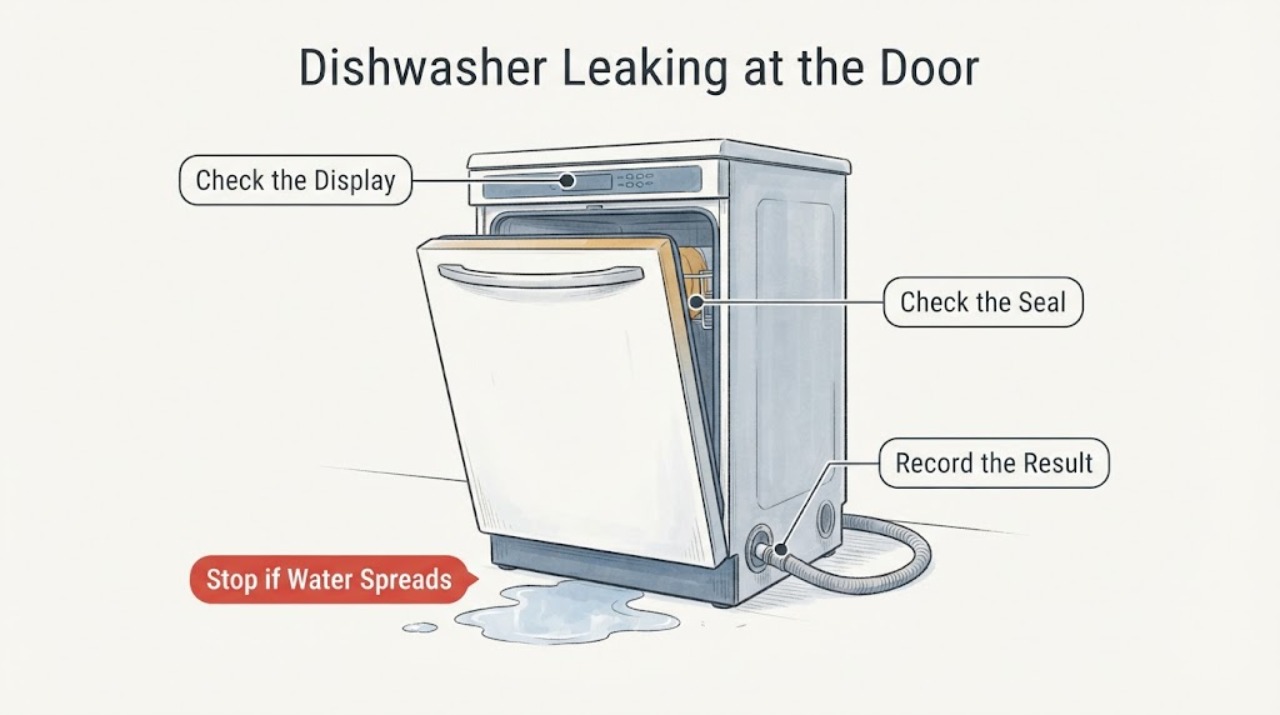
Work through in order
Diagnostic checks
Use only checks that match the exact appliance or system and its official guide.
-
Check 1
Stop the cycle if water is actively escaping, keep the floor, cord, plug and controls dry, close the accessible dishwasher water shutoff, and disconnect power only from a dry safely accessible point.
Expected result: Water stops and the electrical area remains dry, or water reaches the plug, cord, controls or another area that cannot be made safe without contact.
Next step: Keep the unit out of service and arrange qualified help for any electrical or active-water hazard. Do not reach through water, repeatedly restart the dishwasher, or pull out a built-in unit.
Why this matters
Why: A wet electrical area is a safety boundary, not a cue to continue testing. ASKO's guide specifically directs power and water off when the drain pump runs continuously, and the installation instructions require professional electrical and water connections.
-
Check 2
With the appliance safe and the door area dry, wipe the visible door edge and rubber seal with a damp cloth; if cleaner is needed, spray it onto the cloth rather than directly onto the door.
Expected result: Residue or debris is visible on the door edge or seal, or the visible seal is clean but the leak has no clear door-edge source.
Next step: Remove only the visible residue without bending or removing the seal. If the leak persists with a clean edge, continue to the closure and location checks and do not order a gasket from the symptom alone.
Why this matters
Why: Residue can interfere with the sealing surface, but cleaning alone cannot confirm that the seal, hinge or tub is sound.
-
Check 3
Check that racks and dishes are fully inside the tub and that no utensil, pan handle or rack position holds the door open or presses against the seal.
Expected result: A rack or dish interferes with closure, or the door closes evenly with no visible interference.
Next step: Reposition only the visible load or rack obstruction. Do not force the door or adjust hinge hardware without the exact model instructions; if water still appears, keep the event in the service path.
Why this matters
Why: ASKO's cleaning guide links a door that does not close with repositioning racks and checking dish interference; this result does not establish a failed hinge or seal.
-
Check 4
From a dry, stationary position, identify where moisture first appears: the door perimeter, below the front/toe-kick, or a visible water or drain connection.
Expected result: The first wet point is at the door edge, below or behind the unit, or at a visible connection; the source cannot be seen safely.
Next step: For below, behind, or inaccessible moisture, leave water and power off and schedule service. Do not remove the toe-kick, slide out the dishwasher, loosen a connection or open a panel as a user check.
Why this matters
Why: The location narrows the handoff but does not diagnose a gasket, hinge, hose, valve, pump or tub. The opened ASKO installation document's connection guidance applies specifically to its DBI675 family.
-
Check 5
Record the full model number, cycle stage, whether the door was fully closed, the first wet location, any continuously running pump, and photos taken only from a dry safe position.
Expected result: The leak returns after the visible door and load checks, the pump runs continuously, or the source is below/behind the appliance.
Next step: Keep water and power off and arrange qualified ASKO service or an appropriately qualified appliance professional. Do not substitute a generic gasket, hinge, hose or valve, and do not perform internal electrical or water-line work.
Why this matters
Why: The remaining cause is not safely identifiable from this no-model symptom. ASKO directs unresolved or hazardous conditions to Customer Care, and its installation guidance reserves connections for qualified professionals.
Use your observations
Decision map
Find the observation that best matches what you see, then follow the next safe action.
-
PATH 01Next step
What you see
Water is near the plug, cord or controls, or the leak is active and cannot be isolated without touching a wet area.
Do this next
Do not continue testing. From a dry safe location, shut off the water and power if possible, keep people away from the area, and arrange qualified service.
Why this path and its safety boundary
Why it matters: This is an electrical and water safety condition rather than a routine door-seal check.
-
PATH 02Next step
What you see
A rack, pan handle, utensil or dish prevents the door from closing evenly, or residue is visible on the door edge/rubber seal.
Do this next
Remove only the visible obstruction or residue using the opened ASKO cleaning guidance. If water returns with a clear closure path, stop treating the symptom as a user-loading problem and arrange service.
Why this path and its safety boundary
Why it matters: The visible closure path is a plausible contributor, but the result does not confirm a failed seal or hinge.
-
PATH 03Next step
What you see
Moisture first appears below or behind the dishwasher, at a visible hose/connection, or the drain pump runs continuously.
Do this next
Keep water and power off, do not pull out the built-in unit or loosen connections, and contact qualified service. Mention that the opened DBI675 instructions are family-specific if the technician needs to compare the installation.
Why this path and its safety boundary
Why it matters: The leak is outside the safe scope of a door-edge inspection; an installation or internal drainage condition remains possible, but no component is proven.
-
PATH 04Next step
What you see
The visible door edge is clean, the load does not interfere with closure, and the leak recurs at the door or its source remains unclear.
Do this next
Stop repeated cycles and schedule model-appropriate ASKO service. Do not buy a replacement part or adjust hinge hardware from this pattern alone.
Why this path and its safety boundary
Why it matters: The supplied symptom cannot distinguish a seal, alignment, tub, spray or water-management cause on an unspecified model.
Helpful context
Understand the symptom
A leak that seems to come from the door can begin at the door edge, a rack or dish that holds the door open, an installation connection below the tub, or another internal condition. The report does not identify which one is present. Use the visible checks below to locate the first point of water without turning a symptom into a parts diagnosis.
Make the leak safe before looking for its source
If water is still moving, stop the program and keep the floor, plug, cord and controls dry. Close the accessible dishwasher water shutoff. Disconnect power only at a dry, safely reachable switch or breaker; do not reach through water or pull a built-in appliance forward. ASKO's opened guide tells owners to turn power and water off and contact Customer Care when a drain pump runs continuously, while its DBI675-family installation instructions reserve water, drainage and electrical connections for qualified professionals.
Check the door edge and closure path
After the unit is safe and the door area is dry, wipe the visible door edge and rubber seal with a damp cloth. If a cleaner is needed, spray it onto the cloth rather than onto the door. Look for residue or a dish, utensil or rack position that keeps the door from closing evenly. Do not bend the seal, force the door, or remove a hinge or panel without the exact model's instructions.
Separate a door-edge leak from an installation leak
Only where the connections are already visible, note whether moisture first appears at the door perimeter, below the toe-kick, or at a supply or drain connection. Do not remove the toe-kick or slide out a built-in unit to reach a connection. ASKO's DBI675-family instructions say to use the supplied inlet hose, keep hoses free of kinks or sharp bends, make the water shutoff accessible, and check connections for watertightness after installation. Those instructions are family-specific installation guidance, not proof of the cause on an unspecified ASKO model.
Use the pattern to decide whether service is needed
A clean seal and unobstructed door path do not prove the seal is good, and a wet connection does not prove which fitting or hose is at fault. If the leak returns, appears below or behind the unit, or is accompanied by a continuously running pump, keep water and power off and provide the technician with the full model number, the cycle stage, the first wet location, and a photograph taken only from a dry safe position.
When checks do not resolve it
Need a professional?
Arrange qualified service when the leak returns after the visible door and load checks, when moisture is below or behind the dishwasher, when the pump runs continuously, or whenever the electrical area is wet. Keep the water supply and power off for those conditions.
Safety scope: Keep water and power off for active leaks, wet electrical areas, continuously running pumps, water below/behind the appliance, or any condition requiring the built-in unit to be moved. Do not open panels, adjust hinges, loosen water connections, perform live electrical tests, or select a gasket, hose, valve or pump without model-specific service guidance.
Have this ready
- Full model number, cycle stage, whether the door was fully closed, first wet location, visible residue or rack interference, continuously running pump, installation history, and safe dry-position photos.
Common questions
FAQ
Does water at the dishwasher door prove that the rubber seal is bad?
No. ASKO's guide supports cleaning the door edge and checking rack or dish interference, but the no-model symptom does not distinguish a seal, alignment, tub, spray or water-management cause. A recurring leak needs model-appropriate service.
Can I pull out the built-in ASKO dishwasher to inspect the hose?
Do not do that as a casual leak check. ASKO's opened DBI675-family instructions require qualified water, drainage and electrical connections and tell the installer to check connections for leaks. Keep the water and power off and arrange qualified help when the source is below or behind the unit.
Can I order a generic ASKO gasket or adjust the door hinge?
Not from this symptom alone. The task has no model, and the opened material does not establish a gasket or hinge failure or cross-model fit. Record the full model and have service identify the cause and compatible part.
Read the exact guide
Official sources
- Installation instructionsASKO · Opened the official ASKO PDF and kept its scope limited to the three DBI675-family models named in the document. It is used for professional connection requirements, safe installation power/water isolation, visible hose condition and watertight connection checks; it does not establish the cause of a leak on an unspecified ASKO model.
- Dishwasher CleaningASKO (askona.com) · Opened the official ASKO USA four-page PDF. The dishwasher section covers the door edge/rubber seal, closure interference and a safety/service instruction for a continuously running drain pump; later pages are washer and dryer material and were not used for dishwasher claims.
Community feedback
Share a repair observation
Share a plain-text repair observation. Accepted observations are published automatically; this page may take a moment to update.