
On this page
Start here
Quick answer
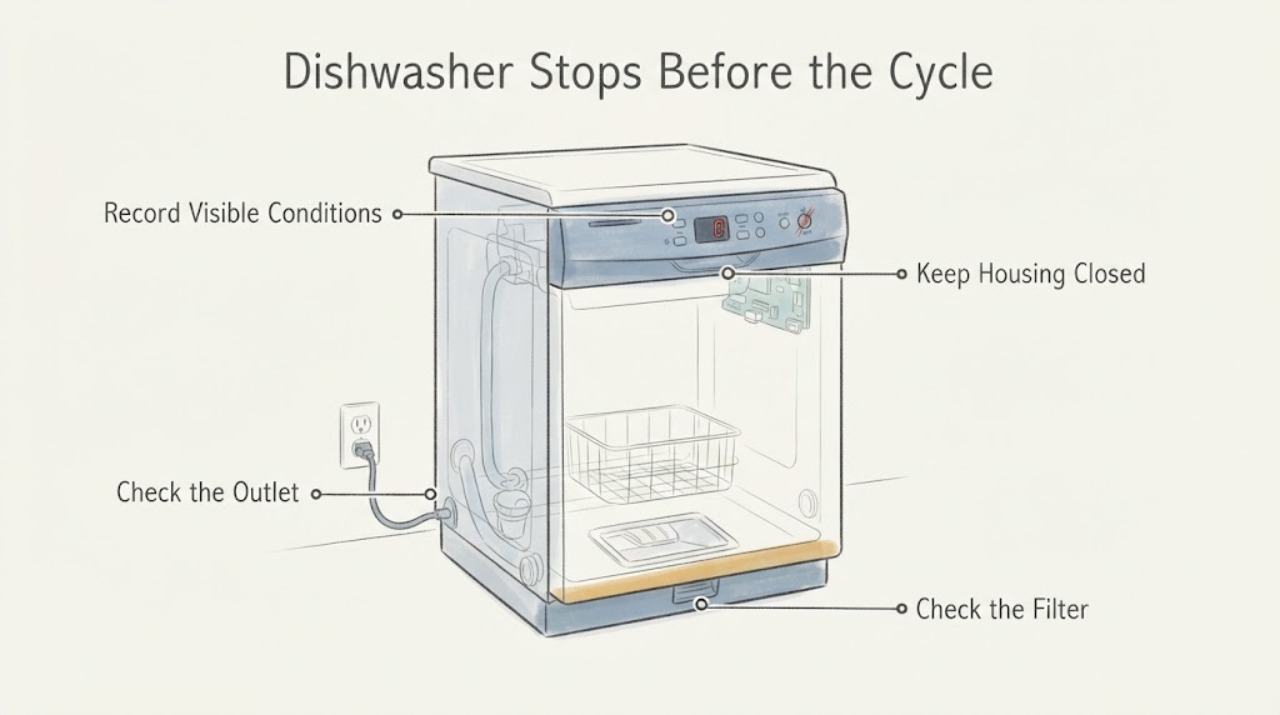
When an ASKO dishwasher stops before the cycle finishes, do not assume a failed control board, drain pump, or sensor from the remaining minutes alone. ASKO's opened Cleaning Guide specifically directs users to verify that the unit is properly plugged in and that the filters and drain are clean of debris when the unit stops during a cycle. If water remains, use the user-accessible filter and drain checks only; do not reach into a pump or dismantle the dishwasher. Record whether the display freezes, the program cancels, the unit leaves water above the filters, or the drain pump runs continuously. Turn power and water off and contact ASKO service if the pump runs continuously, there is a leak, the machine repeatedly stops after the external checks, or the exact model's use-and-care guide is needed.
Work through in order
Diagnostic checks
Use only checks that match the exact appliance or system and its official guide.
-
Check 1
When the cycle stops, record the display, the remaining time, whether the controls respond, whether the door can be opened normally, the water level above the filters, and whether any pump sound continues.
Expected result: The display is frozen, the program has returned to idle, the tub contains water, or the drain pump runs without stopping.
Next step: Do not start a component replacement from the timer reading. If the pump runs continuously or water is leaking, turn power and water off and contact service. Otherwise continue with the accessible checks.
Why this matters
Why: These are different failure states; the remaining timer alone cannot distinguish a drain issue from a control or cycle-sensing issue.
-
Check 2
Verify the dishwasher is properly plugged into its intended outlet and that the supply has not been interrupted; do not use an extension cord or open the electrical enclosure.
Expected result: The plug is loose, the outlet or breaker has an issue, or the power connection is secure and the cycle still stops at a repeatable point.
Next step: Correct only an accessible plug or supply issue. If the outlet, cord, breaker, or dishwasher connection is damaged, stop and use a qualified electrician or appliance technician; do not repeatedly reset a fault.
Why this matters
Why: A poor power connection can interrupt a cycle, but a secure connection with repeatable stopping leaves the cause unresolved and model-specific.
-
Check 3
Turn the dishwasher off, wait for hot water to cool, and clean the user-accessible filter basket and fine filter exactly as shown in the ASKO Cleaning Guide; remove visible debris from the drain area without probing the pump.
Expected result: The filters contain food or other debris, the drain area is visibly clear, or water still remains above the filters after cleaning.
Next step: Reinstall the filters correctly and run only a supervised short program if the model guide permits. If the unit stops again or retains water, stop using it and arrange model-specific service.
Why this matters
Why: Debris can restrict draining and is an official first check for a unit that stops during a cycle; clean filters do not prove that the drain pump, hose, or control is defective.
-
Check 4
If water remains, inspect the visible drain hose and sink connection for a kink, crushing, or an obvious blockage without pulling the built-in dishwasher out or disconnecting a pressurized connection.
Expected result: The visible drain path is obstructed or damaged, or it appears clear while the dishwasher still will not complete the cycle.
Next step: Correct only an accessible external obstruction. For a concealed or damaged hose, standing water that returns, or repeated cycle stops, close the water supply, disconnect power if safely accessible, and call service.
Why this matters
Why: A restricted drain path can leave water and interrupt completion, while a clear visible path does not rule out a pump, sensor, control, or model-specific drain arrangement.
-
Check 5
Record whether the stop happens on more than one program and provide the complete model and serial label to ASKO support; do not enter a diagnostic mode borrowed from another model.
Expected result: Every program stops at a similar stage, only one program stops, or a model-specific display code appears.
Next step: Keep the notes and any displayed code for ASKO service. Do not clear an error or replace a part until the exact model's guide or a qualified technician confirms the next step.
Why this matters
Why: Repeatability across programs is useful evidence for service, but it does not identify a board, pump, heater, or sensor without the correct model documentation.
Use your observations
Decision map
Find the observation that best matches what you see, then follow the next safe action.
-
PATH 01Next step
What you see
The cycle stops once, the filters contain debris, and the pump is not running continuously or leaking.
Do this next
Clean and reinstall the user-accessible filters, verify the visible drain path, and observe a supervised run using the exact model's normal program instructions.
Why this path and its safety boundary
Why it matters: The official first-line explanation is a possible filter or drain restriction, but one event does not prove a component failure.
-
PATH 02Next step
What you see
Water remains above the filters after the accessible filter and drain checks, or the unit repeatedly stops with the same remaining time.
Do this next
Stop repeated cycles, keep the water supply closed if a leak is present, and arrange ASKO service with the model, program, remaining time, water level, and observations.
Why this path and its safety boundary
Why it matters: A concealed drain restriction, pump, sensor, control, or other model-specific condition remains possible; the public guide does not establish which one applies.
-
PATH 03Next step
What you see
The drain pump runs continuously, water leaks into the base, or the machine makes an abnormal electrical smell or sound.
Do this next
Turn power and water off and contact ASKO Customer Care or a qualified appliance technician. Do not reach into the pump or keep resetting the breaker.
Why this path and its safety boundary
Why it matters: This exceeds a routine filter check and may indicate a safety or water-management fault.
-
PATH 04Next step
What you see
The display shows a model-specific error code or the controls become unresponsive.
Do this next
Photograph the display, preserve the code, locate the exact use-and-care guide, and follow ASKO service instructions rather than using another model's reset or diagnostic sequence.
Why this path and its safety boundary
Why it matters: The code and control behavior cannot be generalized across ASKO dishwasher families without the exact model guide.
Helpful context
Understand the symptom
Separate a true stop from a drain or drying phase
A timer that remains at one or a few minutes can mean the program is waiting for a drain, a safety condition, or a model-specific completion step; it does not identify a component. First note whether the controls still respond, whether the display is frozen or has returned to idle, whether the tub contains water above the filters, and whether a pump continues to run. The ASKO guide is useful for this distinction because it provides separate checks for a unit that stops during a cycle, a unit that does not drain, and a pump that runs continuously.
Use the accessible filter and drain checks
After the dishwasher is safe to open, remove and clean only the user-accessible filter parts described in the ASKO guide, and check the visible drain area for food or debris. Do not push tools into the pump, remove a circulation assembly, or infer a blocked pump from standing water alone. If the exact model uses a different filter or drain layout, stop at the model's use-and-care instructions.
Keep power, water, and model boundaries explicit
The guide's cycle-stop check starts with a properly plugged-in unit, while its continuous-pump instruction is to turn power and water off and contact Customer Care. That is a service boundary, not an invitation to reset repeatedly or replace a pump without a model diagnosis. With no model or error code in the task, do not use another ASKO model's service mode, error meaning, or part number.
Common questions
FAQ
Does stopping with a few minutes left prove the drain pump is bad?
No. It can reflect a drain restriction, filter debris, power interruption, control state, or another model-specific condition. ASKO's first checks for a unit that stops during a cycle are the plug, detergent amount, clean filters, and a drain clear of debris.
What should I do if there is water left in the dishwasher?
Turn the unit off, allow hot water to cool, and clean the user-accessible filters and drain area as described for your model. If the drain remains blocked, water returns, or a pump runs continuously, turn power and water off and contact service.
Can I use an ASKO reset or diagnostic sequence found for another model?
Do not. The task has no exact model, and control sequences and error meanings are not interchangeable. Preserve any display code and use the exact use-and-care guide or ASKO service path.
When should I stop running the dishwasher?
Stop and isolate it if the drain pump runs continuously, water leaks into the base or floor, the cord or outlet is damaged, there is an electrical smell, or the unit repeatedly stops after the accessible checks. ASKO specifically directs users to turn power and water off and contact Customer Care for a continuously running drain pump.
Read the exact guide
Official sources
- Dishwasher CleaningASKO / ASKO North America · Opened official ASKO USA PDF. It is a general Cleaning Guide rather than an exact model manual; it supports the published first-line checks and service boundaries, while cycle-specific codes, parts and diagnostics remain model-specific.
Community feedback
Share a repair observation
Share a plain-text repair observation. Accepted observations are published automatically; this page may take a moment to update.