
On this page
Start here
Quick answer
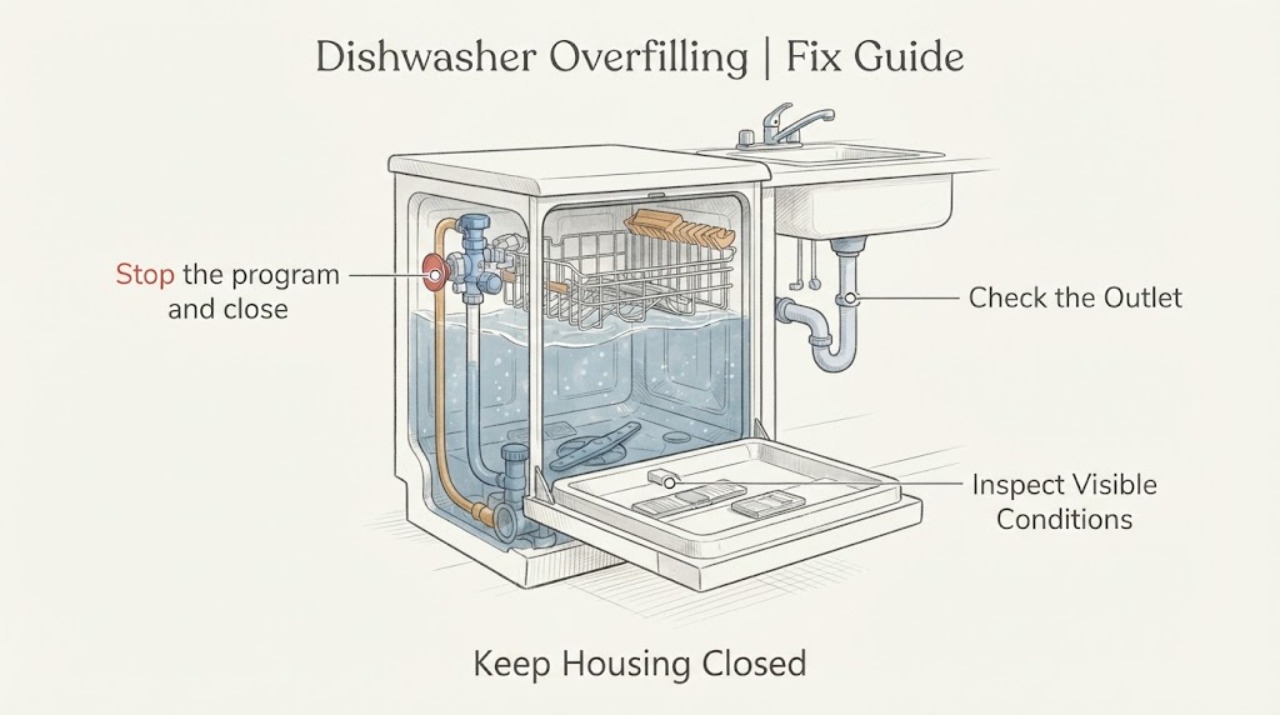
If an ASKO dishwasher is actively filling past its normal level, leaking, or leaving water above the filters, stop the cycle and do not continue testing it. Close the dishwasher's accessible water-supply valve; if water is near electrical parts or the drain pump runs continuously, turn power off only when it is safe to do so. ASKO's opened cleaning guide directs owners to clean filters for water above the filters, but directs continuous drain-pump operation to power and water shutoff plus service. Check only visible hoses and the user-accessible filter or drain path after the water supply and electrical hazard are controlled. Without an exact model, do not diagnose an inlet valve, level sensor, or control board and do not open the cabinet.
Before you begin
Safety first
- No cabinet opening, valve or sensor replacement, overflow bypass, live electrical test, or repeated trial cycle is provided.
Work through in order
Diagnostic checks
Use only checks that match the exact appliance or system and its official guide.
-
Check 1
Stop the program and close the dishwasher's accessible water-supply valve as soon as it is safe to reach.
Expected result: Water stops entering the tub, continues entering after the control is stopped, or is already leaking onto the floor or into the cabinet area.
Next step: If water continues despite the program being stopped, leave the supply valve closed and do not restart the dishwasher; arrange qualified appliance service.
Stop if: If filling stops and only a small amount remains, continue only with the isolated, model-supported visual checks below.
Why this matters
Why: Stopping the supply separates residual water from an active inlet problem and limits further flooding; it does not identify which internal component is at fault.
-
Check 2
If water is near the plug, outlet, wiring, or other electrical equipment, keep clear and turn power off at the breaker or outlet only if it can be done without touching water; never reach into standing water to unplug the machine.
Expected result: The drain pump runs continuously, water has reached an electrical area, or there is no electrical exposure and the machine is dry outside.
Next step: Keep the dishwasher isolated and call a qualified technician; do not reset or run another cycle.
Stop if: Keep the water supply closed while making only the visual and user-level checks supported by the exact manual.
Why this matters
Why: ASKO directs continuous drain-pump operation to power and water shutoff plus service; water near electrical parts adds shock risk and is not a condition for continued testing.
-
Check 3
With the water supply and electrical hazard controlled, look at the tub level without reaching into hot or contaminated water and note whether water is above the filter area or is visibly entering from the inlet.
Expected result: Water is above the filters after filling has stopped, or the water level rises while the appliance is not running.
Next step: Do not run the dishwasher. Follow the exact model guide only after the water is safe to handle, or arrange service if the level remains high or the inlet cannot be isolated.
Stop if: If the tub level is normal but water is on the floor, treat it as a leak and keep the appliance isolated for service rather than calling it overfilling.
Why this matters
Why: ASKO lists water above the filters with an interior and filter-cleaning action; water rising while the appliance is off points to an unresolved water-control issue that cannot be diagnosed from this guide.
-
Check 4
Inspect the visible inlet and drain hoses and their accessible connections for a kink, loose connection, split, or water trail; do not pull the built-in dishwasher out or loosen a hose as a test.
Expected result: A hose is kinked or visibly damaged, a connection is wet, or the hoses appear sound while the tub still overfills or leaks.
Next step: Leave the water off and have the connection or hose assessed under the model's installation instructions; do not operate the appliance to retest a leak.
Stop if: Continue to the service boundary if the tub still overfills, the pump runs continuously, or water returns with the supply closed.
Why this matters
Why: ASKO's installation instructions require accessible water shutoff, watertight connections, and hoses without kinks; a visible hose issue can explain water on the floor but does not confirm an internal valve or sensor fault.
-
Check 5
Only if the exact ASKO manual permits it and the water is safe, inspect and clean the user-accessible filters and drain path; do not remove panels or work on the inlet assembly.
Expected result: The filters or visible drain path contain food debris, or they are clear and water still remains above the filters.
Next step: Reinstall the filters exactly as the model guide requires, keep the water supply closed, and contact service rather than running a trial cycle if the level or leak returns.
Stop if: Do not improvise a drain-pump, float, sensor, or valve repair; arrange model-specific service.
Why this matters
Why: ASKO directs filter cleaning for water above the filters and lists a blocked drain line as a no-drain condition; clearing the drain path does not prove that the dishwasher was overfilling or that an internal part is good.
-
Check 6
Escalate without further testing when the dishwasher fills by itself, leaks onto the floor, cannot be isolated at the supply valve, repeatedly overfills, or has a continuously running pump.
Expected result: Any of those conditions is present, or the issue returns after the supply is restored.
Next step: Keep water and power isolated as safely possible and arrange qualified ASKO or appliance service. Provide the exact model, where the water was seen, whether filling continued when stopped, and whether the pump ran continuously.
Why this matters
Why: The appliance has an unresolved water-control, drainage, or leak condition with a flooding or shock risk; the public evidence does not support a user diagnosis of a valve, sensor, float, or control board.
Use your observations
Decision map
Find the observation that best matches what you see, then follow the next safe action.
-
PATH 01Next step
What you see
The program stops and the water level remains above the filters, with no active leak or continued filling.
Do this next
After water and electrical hazards are controlled, use only the exact model guide for the user-accessible filter or drain check; call service if the level remains high.
Why this path and its safety boundary
Why it matters: ASKO documents water above the filters with filter and interior cleaning guidance, but this does not prove a failed water-level component.
-
PATH 02Next step
What you see
Water continues entering after the cycle is stopped, or the level rises while the dishwasher is off.
Do this next
Close the accessible water valve, do not restart the dishwasher, and arrange qualified service.
Why this path and its safety boundary
Why it matters: The supply must be treated as an active water-control fault; the source evidence does not identify the internal cause for an unknown model.
-
PATH 03Next step
What you see
The pump runs continuously or water is near electrical equipment.
Do this next
Keep clear, isolate power only if safe, leave the appliance unused, and contact a qualified technician.
Why this path and its safety boundary
Why it matters: ASKO's cleaning guide directs power and water shutoff plus service for a continuously running drain pump; water near electricity creates a shock hazard.
-
PATH 04Next step
What you see
A visible hose or connection is kinked, damaged, or wet while the tub level is normal.
Do this next
Keep the water supply off and have the installation or hose corrected under the exact model instructions; do not run a leak test yourself.
Why this path and its safety boundary
Why it matters: The problem may be a hose or connection leak rather than overfilling, but the appliance still has a water-damage risk.
Helpful context
Understand the symptom
Treat active overfilling as a water-and-electricity safety problem first. Stop the program, close the accessible water-supply valve, and keep hands out of standing water near electrical connections. If the pump runs continuously, ASKO's opened dishwasher guide says to turn power and water off and contact service.
After the supply is isolated and there is no electrical hazard, distinguish water above the filters from water actively entering the tub or leaking onto the floor. ASKO documents filter and drain checks for water above the filters, but those checks do not prove that an inlet valve, level sensor, or control has failed.
Because the task has no model, use the matching ASKO use-and-care guide for any filter or drain access. Do not open the cabinet, remove an inlet valve, bypass an overflow device, or keep restarting the dishwasher to see whether it fills again.
When checks do not resolve it
Need a professional?
Call qualified ASKO or appliance service when water continues entering after the program stops, the dishwasher leaks, the pump runs continuously, the supply cannot be safely isolated, the issue returns, or any cabinet/internal component would need access. Do not continue trial cycles.
Safety scope: No cabinet opening, valve or sensor replacement, overflow bypass, live electrical test, or repeated trial cycle is provided.
Common questions
FAQ
Should I keep running the dishwasher to see whether it stops overfilling?
No. Stop the program, close the accessible water-supply valve, and isolate power only when safe. ASKO directs continuous drain-pump operation to power and water shutoff plus service, and a repeated fill can cause flooding or shock exposure.
Does water above the filters prove the inlet valve is bad?
No. ASKO's guide directs cleaning the interior and filters for water above the filters, but the symptom alone does not identify an inlet valve, level sensor, float, or control fault, especially without the exact model.
Can I clean the filter when the dishwasher is overfilled?
Only after the water supply and electrical hazard are controlled and the exact model guide permits access. Do not reach into unsafe standing water or remove panels; if the level or leak persists, use service.
What information should I give the technician?
Give the exact model, whether water continued entering after stop, the level relative to the filters, where water appeared, whether the pump ran continuously, and whether a hose or connection was visibly wet. Do not infer an internal part from the symptom.
Read the exact guide
Official sources
- Dishwasher CleaningASKO · ASKO dishwasher filter, drain, water-above-filter, continuous-pump and service guidance
- Installation instructionsASKO · ASKO dishwasher installation safety, accessible water shutoff, hose routing, leak checks and electrical isolation for the documented dishwasher family
Community feedback
Share a repair observation
Share a plain-text repair observation. Accepted observations are published automatically; this page may take a moment to update.