
On this page
Start here
Quick answer
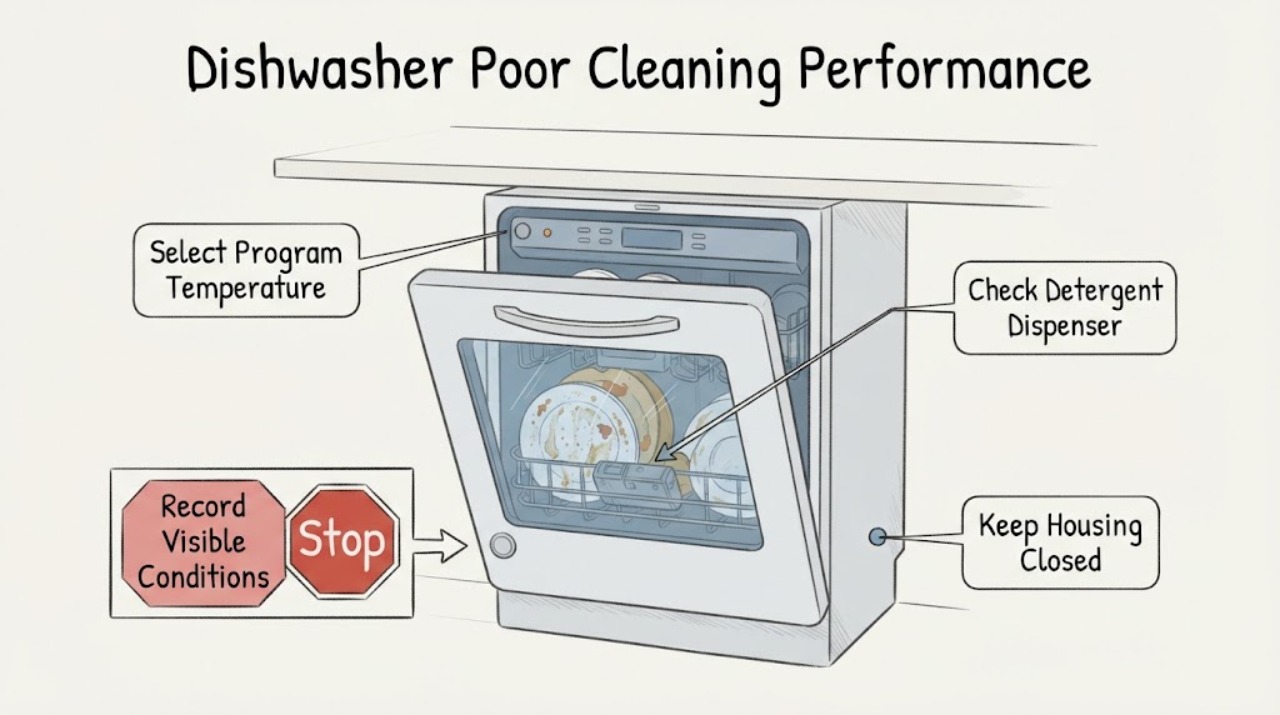
Start with the cycle and load rather than assuming a pump failure. Asko's official cleaning guide says to choose a wash cycle suited to the load, add its High Temperature option when needed, use fresh unscented granular automatic detergent, keep filters and the drain clear, and make sure the detergent dispenser is not blocked by a pot handle or utensil. Clean the filters and inspect the spray/load path only after the dishwasher is off and cool. If cleaning remains poor after the model-appropriate program, detergent, filter and water-supply checks, use the exact use-and-care guide or arrange service; the symptom alone does not identify a pump, heater or spray-arm fault.
Work through in order
Diagnostic checks
Use only checks that match the exact appliance or system and its official guide.
-
Check 1
Record the affected rack, residue type, selected program/option, whether the dispenser opened and whether the tub drained at the end of the cycle.
Expected result: All racks are dirty, only one zone is dirty, the load used a short/rinse cycle, the dispenser stayed blocked, or water remained.
Next step: Use the matching program, dispenser, filter or drain branch; do not repeat the same cycle while changing several variables at once.
Why this matters
Why: The result separates program/load/dispenser and drainage clues; it does not by itself identify a pump or heater fault.
-
Check 2
Choose the Asko cycle recommended by the exact use-and-care program chart and add High Temperature only when the model and soil require it.
Expected result: Cleaning improves on the stronger/model-appropriate program, or it remains poor.
Next step: Keep the documented program for that load. If cleaning remains poor, verify detergent, dispenser, filters and water fill.
Why this matters
Why: Asko's guide treats cycle selection and high-temperature option as first-line cleaning checks; improvement points to program/soil mismatch, while persistence needs the next checks.
-
Check 3
Use fresh, unscented, granular automatic detergent as directed for the model and check that a pot handle or utensil does not block the dispenser door before starting.
Expected result: The detergent is fresh and correctly dispensed, or the door was blocked/failed to dispense.
Next step: Correct only the documented detergent or loading issue and run the model-appropriate cycle. If the dispenser still fails to open, arrange model-specific service.
Why this matters
Why: Asko lists detergent freshness/type and dispenser blockage as cleaning-related checks; extra detergent does not prove or repair an internal fault.
-
Check 4
After the dishwasher is off and the hot interior has cooled, remove the lower rack and clean the filter basket/fine filter using the official model procedure; reinstall all parts securely.
Expected result: Filters contain food/debris and cleaning improves the result, or filters are clear and cleaning remains poor.
Next step: Maintain the model's filter schedule. If results remain poor, check the safe water-supply branch and arrange service rather than opening the pump area.
Why this matters
Why: Asko says filters should be cleaned at least yearly and more often with heavy use; a clear filter does not rule out supply or internal wash problems.
-
Check 5
If fill or spray action seems weak, confirm only the accessible dishwasher shutoff is open and note any no-water/error indication; do not move the appliance or alter plumbing.
Expected result: The shutoff is closed/uncertain, the tub appears not to fill, or fill appears normal but dishes remain dirty.
Next step: Have a plumber check supply pressure when fill is inadequate. For normal fill with persistent poor cleaning, use the exact manual/service path.
Why this matters
Why: Asko's guide lists the water shutoff and plumber-verified supply pressure for no-water conditions; normal fill does not establish an internal component fault.
-
Check 6
Give Asko service the model number, program/option, soil pattern, detergent type, dispenser result, filter condition, fill/drain observations and any error.
Expected result: Poor cleaning persists after documented external checks, or there is leakage, electrical odor, standing water, repeated stop/error or inaccessible internal access.
Next step: Keep the dishwasher off where water or electrical danger is present and arrange qualified service; do not use chemical drain cleaner or dismantle internal components.
Why this matters
Why: The remaining possibilities may involve model-specific spray, heating, circulation or control components that cannot be identified safely from the symptom.
Use your observations
Decision map
Find the observation that best matches what you see, then follow the next safe action.
-
PATH 01Next step
What you see
The load used a rinse/hold or otherwise unsuitable short cycle, and cleaning improves on the model-recommended program/high-temperature option.
Do this next
Use the documented program for the soil level and keep the model's options within its manual; do not diagnose a failed component from the original cycle.
Why this path and its safety boundary
Why it matters: Asko's guide supports program selection as a cleaning-performance variable.
-
PATH 02Next step
What you see
The dispenser door was blocked by a pot handle/utensil or detergent was stale/incorrect, and the next cycle dispenses normally.
Do this next
Load around the dispenser and follow the exact detergent instructions; arrange service if the dispenser remains blocked or fails to open.
Why this path and its safety boundary
Why it matters: Asko identifies dispenser access and fresh automatic detergent as direct cleaning checks.
-
PATH 03Next step
What you see
Filters contain debris and cleaning them improves the next result.
Do this next
Continue the model-appropriate filter schedule and monitor cleaning; do not use drain chemicals in the appliance.
Why this path and its safety boundary
Why it matters: The filter condition was a supported maintenance contributor, especially with heavy use.
-
PATH 04Next step
What you see
The dishwasher does not fill normally or shows a no-water condition.
Do this next
Leave plumbing changes to the installer/plumber and use service for appliance-side diagnosis if supply is adequate.
Why this path and its safety boundary
Why it matters: Asko directs checking the shutoff and having a plumber verify supply pressure; this does not prove an inlet valve failure.
-
PATH 05Next step
What you see
The correct program, fresh detergent, clear dispenser, clean filters and normal fill do not restore cleaning, or there is standing water, leakage or electrical odor.
Do this next
Stop using the dishwasher when water/electrical danger is present and arrange qualified Asko service; do not open panels or dismantle the wash system.
Why this path and its safety boundary
Why it matters: The safe external checks have not identified the cause and service may need to assess model-specific wash/heating/circulation systems.
Helpful context
Understand the symptom
Identify the kind of cleaning failure
Record whether residue is on every item or only one rack, whether it is soft food, baked-on soil, grease or detergent film, which cycle was used, and whether the detergent dispenser opened. Asko's cleaning guide says a dirty-load problem may need a different wash cycle and the High Temperature option. One short or rinse-only program cannot establish an appliance fault.
Choose a program that matches the soil
For dishes that remain dirty, select a different wash cycle and consult the exact use-and-care guide's program chart. Add the High Temperature option when the model offers it and the load needs more heat. Do not assume every Asko model has the same cycles, options or temperature behavior.
Use fresh detergent and keep the dispenser clear
Asko's guide recommends fresh, unscented, granular automatic detergent for dishes that are not clean. Put detergent in just before starting the program and check that a pot handle or utensil is not blocking the dispenser door. Asko's detergent guidance also distinguishes detergent systems and local-market recommendations, so use the exact product instructions for the model rather than increasing detergent blindly.
Clean filters and check the drain path
Turn the dishwasher off, let hot surfaces cool, remove the lower rack and clean the filters according to the official guide. Asko's guide says heavy use can require more frequent filter cleaning and lists a dirty filter or drain as a cause of other cycle problems. Do not remove an unfamiliar filter assembly or reach into hot water; use the model's care instructions if the layout differs.
Check water supply without opening the appliance
If the tub seems not to fill or the spray action is weak, confirm the accessible shutoff is open and note any fill error. Asko's guide directs a plumber to verify supply pressure for no-water conditions. Do not adjust plumbing, open panels or infer a failed inlet valve, circulation pump or heater from dirty dishes alone.
Escalate persistent poor cleaning
Arrange Asko or qualified appliance service when the correct program, fresh detergent, unobstructed dispenser, clean filters and safe supply checks do not restore cleaning, or when the dishwasher leaks, smells electrically burnt, stops, repeatedly shows an error or leaves standing water. Keep the unit off for a wet electrical area and do not use chemical drain cleaners or dismantle internal wash components.
When checks do not resolve it
Need a professional?
Arrange Asko or qualified appliance service when poor cleaning persists after the exact program, fresh detergent, unobstructed dispenser, clean-filter and safe water-supply checks; when the dispenser will not open, the unit stops or shows an error, water remains, or there is leakage/electrical odor. Provide the model, program, detergent, rack pattern and filter/fill observations. Do not order a pump, heater, spray arm or control from poor cleaning alone.
Common questions
FAQ
What should I check first when an Asko dishwasher leaves dishes dirty?
Record the program and residue pattern, then use the exact program chart, fresh unscented automatic detergent, an unobstructed dispenser and clean filters. Asko's official cleaning guide lists these before service.
Can too little or wrong detergent cause poor Asko cleaning?
Yes, Asko's guide recommends fresh, unscented, granular automatic detergent and says to put it in just before starting. Check the exact model/detergent instructions rather than adding more blindly.
Should I use a stronger cycle or High Temperature?
Asko's guide says to select a different wash cycle and add the High Temperature option when appropriate. Which option exists and how it behaves is model-dependent, so use the exact use-and-care program chart.
When does poor cleaning require service?
Use service when documented program, detergent, dispenser, filter and safe supply checks do not improve the result, or if the dishwasher leaks, stops, leaves standing water or has an electrical odor. The symptom alone does not identify a pump or heater.
Read the exact guide
Official sources
- Dishwasher EssentialsASKO · Official ASKO detergent page confirming ASKO-specific detergent recommendations and market-dependent product selection; it does not establish any model-specific dosage.
- ASKO Dishwasher Cleaning GuideASKO · Brand-hosted official cleaning guide covering dishwasher filters, programs, High Temperature option, detergent, dispenser obstruction, water shutoff/pressure and service boundaries; exact product manual still controls model differences.
Community feedback
Share a repair observation
Share a plain-text repair observation. Accepted observations are published automatically; this page may take a moment to update.