
On this page
Start here
Quick answer
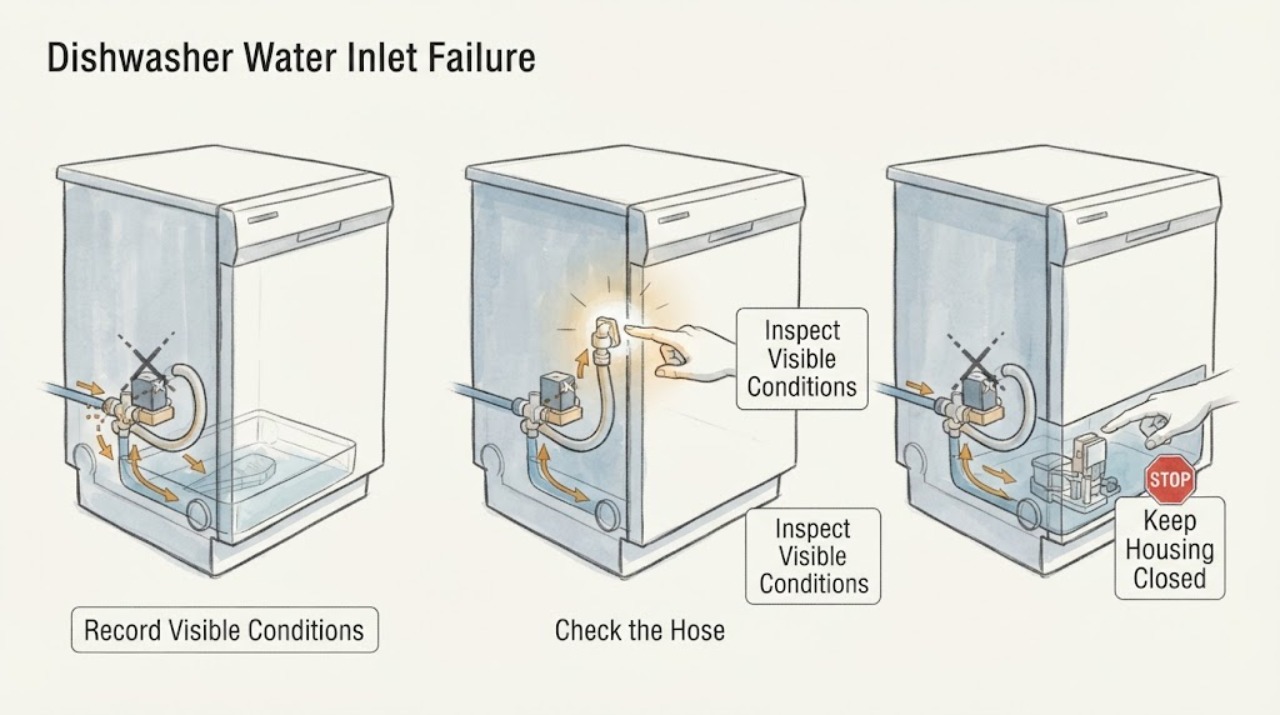
First separate three patterns: no water enters, water enters and the level fault appears, or water keeps entering/overfills. ASKO's official cleaning guide says to verify the shutoff valve and have supply pressure checked for a no-water symptom, then use the exact product guide for any displayed code. ASKO installation material says the inlet hose and supply valve must be accessible, connections must be watertight, and the hose must be the supplied one for the documented model. If water keeps entering, the tub level rises abnormally, a leak appears, or an inlet/overfill indicator returns, stop the program, close the water valve and isolate power only from a safe location; arrange service. Do not treat a status light or code from another ASKO family as proof of an inlet-valve or water-level-sensor failure.
Work through in order
Diagnostic checks
Use only checks that match the exact appliance or system and its official guide.
-
Check 1
Record the complete ASKO model and serial information, the country/market, any display code or status-light pattern, and whether the symptom is no fill, a level fault after filling, continuous filling, overfill or a visible leak.
Expected result: The appliance identity and water pattern are clear, or the report only says water inlet failure without describing what the machine does.
Next step: Use the exact model's use-and-care guide and provide the recorded pattern to service. Do not copy an F-code or button reset from another ASKO dishwasher.
Why this matters
Why: ASKO support documents are model and market dependent, and a light or code can cover more than one water-related condition. A generic label does not identify an inlet valve, level sensor or outlet problem.
-
Check 2
For a no-fill symptom, check only the accessible external water path: confirm the shutoff valve is open, the inlet hose is not kinked or visibly damaged, and there is no visible leak at the connection.
Expected result: The valve is closed, the hose is kinked/damaged, a connection leaks, or the external supply appears normal but no water enters.
Next step: Correct only an obvious valve position or loose external condition when it is safe and dry. If the supply is normal, do not open the dishwasher; document the symptom and arrange model-matched service.
Why this matters
Why: ASKO's official guide points first to the shutoff valve and water pressure, while its installation instructions require an accessible valve, supplied inlet hose and watertight connections. Normal external conditions do not prove an internal valve or sensor fault.
-
Check 3
If water enters, observe from outside whether the program stops at a water-level fault, the tub level continues rising, the machine starts draining, or water appears outside the appliance; do not reach into the tub or base while powered.
Expected result: The level fault occurs after some fill, water continues entering, the drain pump runs continuously, or a leak/water-protection indication appears.
Next step: For continued filling, rising water or leakage, stop the program, close the accessible water valve and isolate power only from a safe location. Keep the appliance out of service and contact ASKO or qualified service.
Why this matters
Why: These observations are different from a simple no-fill condition. ASKO's public material lists inlet fault, inlet-valve leakage, over-filling and water-outlet fault as separate possibilities under one flashing-red indication on a documented family, and says continuous drain-pump operation requires power and water to be turned off.
-
Check 4
Compare any displayed code or light pattern with the exact model manual rather than treating the word inlet as a diagnosis.
Expected result: The exact manual matches the code/pattern, the code is absent, or a code returns after the documented user-level step.
Next step: Record the code/pattern and stop repeating resets. If it returns or the water behavior is unsafe, provide the model and evidence to authorized service; do not infer a component from the code alone.
Why this matters
Why: ASKO's cleaning guide gives an F4 example only within that guide and says to contact service if the code reappears. The Status Light material demonstrates that a water-related indicator can represent multiple conditions on a documented family.
Use your observations
Decision map
Find the observation that best matches what you see, then follow the next safe action.
-
PATH 01Next step
What you see
The cycle starts but no water enters, there is no leak, and the accessible valve, hose and external connection appear normal.
Do this next
Keep the exact model and any code, stop repeated resets and arrange model-matched service. Do not open the base or test the inlet circuit.
Why this path and its safety boundary
Why it matters: This remains a water-inlet symptom, but the official material does not identify whether the cause is supply pressure, a hose restriction, an inlet valve, control or another internal condition.
-
PATH 02Next step
What you see
Water enters but a level-related fault appears, the program stops after filling, or the water level does not behave as expected.
Do this next
Record the exact code/light and model, then use the matching guide or service route. Do not transfer a code meaning from the same-batch Asko water-level-fault topic or another model.
Why this path and its safety boundary
Why it matters: This is a water-level decision pattern rather than proof of a failed inlet valve or level sensor. It is distinct from a dishwasher that never receives water.
-
PATH 03Next step
What you see
Water continues entering, the tub rises abnormally, water leaks, or an overfill/inlet-valve-leakage indication appears.
Do this next
Stop the program, close the water shutoff and isolate power only from a safe location. Do not bypass water protection or run another cycle; arrange qualified service.
Why this path and its safety boundary
Why it matters: This is a water-damage and electrical-safety condition, not a safe opportunity to keep testing the inlet system.
-
PATH 04Next step
What you see
Only a code or light pattern is known, with no confirmed no-fill, level, continuous-fill or leak behavior.
Do this next
Find the exact model manual, record the code or light sequence and contact service if it returns. Do not publish or follow a cross-model reset or component diagnosis.
Why this path and its safety boundary
Why it matters: A water-related indicator is not enough to choose between inlet, level, overfill or outlet causes; official meanings vary by family and market.
Helpful context
Understand the symptom
Classify the water symptom before resetting
Do not use water inlet failure as a catch-all. No water entering at the start points toward the external supply path or an inlet-control problem. Water entering but stopping at an abnormal level is a water-level symptom. Water that keeps entering, a rising tub or visible leakage is an overfill/leak safety condition. The assigned topic is distinct from the same-batch Asko water-level-fault topic, so this page keeps the decision centered on observed inlet behavior and does not merge the two identities.
Use the exact model and market manual
ASKO's manuals and product pages vary by model and market. One official ASKO cleaning guide names F4 for its documented guide, while an ASKO Status Light brochure says a flashing red light can cover water-inlet fault, inlet-valve leakage, over-filling or water-outlet fault. Those references are useful boundaries, not universal code translations for every ASKO dishwasher.
Close the water and call service for continuous filling
ASKO installation guidance requires an accessible water shutoff and watertight inlet connections. If the machine continues filling, the level rises, water leaks, or a water-protection indication returns, the safe decision is to stop the program, close the valve and obtain service. Do not remove the base, bypass the float or water protection, or energize a wet appliance.
When checks do not resolve it
Need a professional?
Contact ASKO or qualified appliance service when the external supply is normal but the dishwasher does not fill, a water-level fault returns, or the same code/light returns after the exact model's documented step., Stop the program, close the water valve and isolate power from a safe location for continuous filling, rising water, visible leakage, or water-protection indications., Do not open the base, bypass a float or water-protection system, energize a wet appliance, or infer an inlet valve, sensor or control-board failure from a generic code.
Have this ready
- complete ASKO model, serial/service number and purchase market
- whether no water enters, water enters then faults, water keeps entering, or a leak appears
- exact display code or status-light color/flash pattern
- whether the accessible shutoff valve is open and whether the inlet connection leaks
- whether the drain pump runs continuously or the appliance stops at a particular stage
Common questions
FAQ
What should I check if an ASKO dishwasher gets no water?
Check only the accessible shutoff valve, visible inlet hose condition and connection for leaks. ASKO's official guide also points to supply pressure and the exact model's error code. If the external supply is normal, stop repeated resets and arrange model-matched service.
Does a water-level fault mean the inlet valve is bad?
No. A water-level symptom does not identify one valve, sensor or control cause. It is different from no water entering, and ASKO's public indicators can cover inlet, leakage, overfill and outlet conditions depending on the documented family.
What should I do if the ASKO dishwasher keeps filling?
Stop the program, close the accessible water valve and isolate power only from a safe location. Do not continue cycling the dishwasher or bypass water protection; arrange qualified service for continuous filling, rising water or leakage.
Read the exact guide
Official sources
- ASKO Dishwasher Cleaning and Troubleshooting GuideASKO / ASKO Distribution North America · Brand-owner-hosted US guide; its F4 example and control steps are not treated as universal across all ASKO models.
- ASKO Dishwashers Collection 2024ASKO · Official ASKO brochure for the listed market/families; used to show that one flashing-red indicator can represent multiple water-related conditions, not as a universal code map.
- Integrated dishwasher DFI544H/1ASKO · Exact model page used to demonstrate that ASKO exposes model-specific instructions/support and inlet specifications; not a claim that DFI544H/1 is the task appliance.
- Installation Instructions - DOD651PHXXLS DishwasherASKO Distribution North America · Exact official manual for DOD651PHXXLS only; used for external water-safety boundaries and explicitly not generalized to every ASKO dishwasher.
Community feedback
Share a repair observation
Share a plain-text repair observation. Accepted observations are published automatically; this page may take a moment to update.