
On this page
Start here
Quick answer
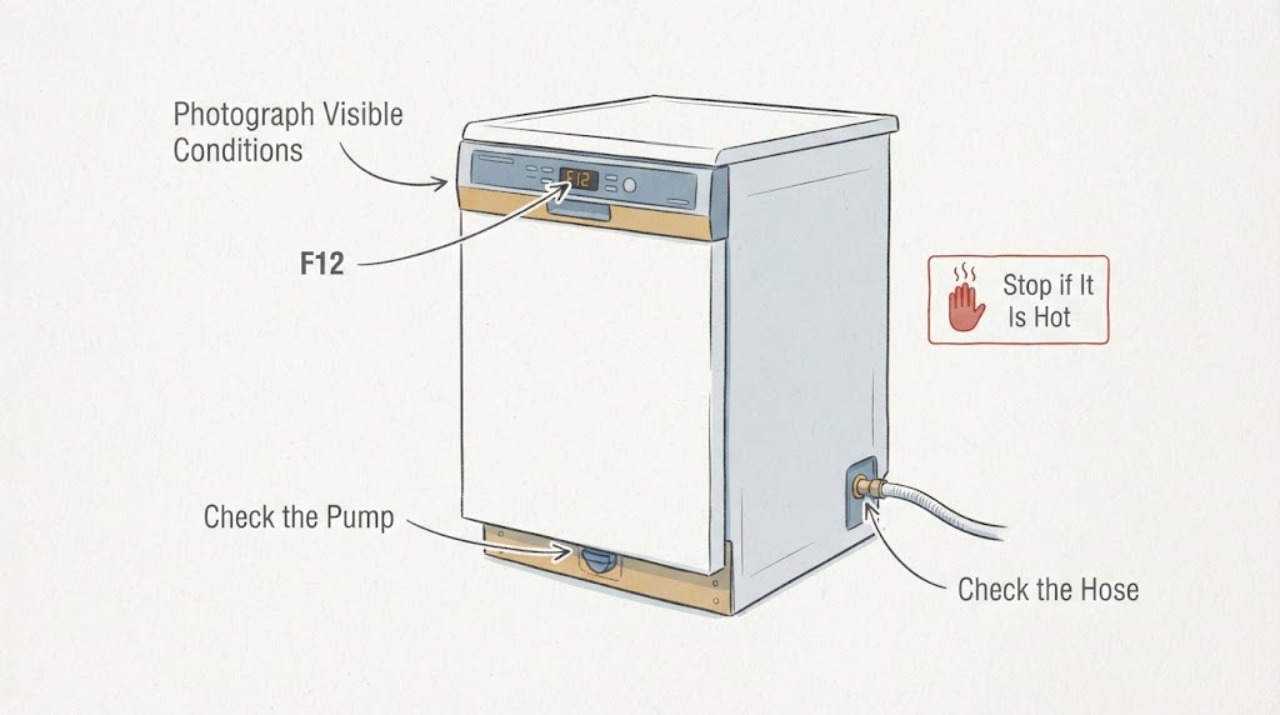
On an ASKO D5424 that admits water to a point and then stops with F12, treat the display as a water-inlet/fill-path indication, not as proof that the inlet valve, flow meter, pressure sensor, or control board is bad. The exact D5424 manual must be confirmed from the model or product label; ASKO's official manual lookup is model-number based. An exact D5424 user report describes the same fill-then-F12 timing, while an opened ASKO manual for another dishwasher platform labels F12 as a water-inlet fault and tells the owner to close the water tap and contact service. First record the code, fill timing, water level, leak status, and whether the pump is draining. With the machine stopped, check only the normally accessible shutoff valve and visible inlet hose for a kink or leak. Do not detach the hose, measure pressure yourself, enter service mode, or repeatedly run the dishwasher. If F12 returns, no water enters despite an open supply, the connection leaks, water is uncontrolled, or water remains in the tub, turn the water off as appropriate and arrange qualified ASKO service; use a plumber for an independent household supply or drain problem.
Before you begin
Safety first
- Keep the dishwasher off for an active leak, uncontrolled fill, continuous pump, water near electricity, smoke, burning odor, hot plug, damaged cord, or repeated breaker trip. No service-mode access, fill-parameter change, hose disconnection, pump dismantling, bypass, or live testing is included.
Work through in order
Diagnostic checks
Use only checks that match the exact appliance or system and its official guide.
-
Check 1
With the dishwasher stopped and safe to approach, photograph the display and the visible product or serial label. Record D5424 exactly as printed, any suffix or product number, the full F12 formatting, the selected program, and how long after starting the fill the cycle stopped.
Expected result: The label confirms D5424, shows a different suffix or product code, or the identity cannot be read without moving the appliance; the display is F12 or an uncertain look-alike.
Next step: Use the exact label information to obtain the matching manual or give it to ASKO service. Keep the code photo before any power change and do not substitute a DFI, D5434, or other ASKO table for D5424.
Stop if: Do not pull out an integrated dishwasher, remove panels, or enter a diagnostic menu to find the label or decode F12.
Why this matters
Why: ASKO's manuals portal uses the model or product code to select literature, and the D5424 family has multiple manuals and markets. An uncertain identity can make a code table or reset sequence inapplicable.
-
Check 2
Before any restart, check from a dry position for an active leak, water near the plug or electrical connection, a continuously running pump, smoke, burning odor, a hot or damaged cord, or water rising beyond the normal wash level.
Expected result: A leak, uncontrolled water, continuous pumping, smoke/odor, damaged electrical area, or another hazard is present, or the appliance is dry and stable.
Next step: For a leak or uncontrolled fill, close the water shutoff. Keep clear of wet electrics and arrange qualified appliance or electrical help; if the pump runs continuously, ASKO's guide says to turn water and power off and contact Customer Care.
Stop if: Do not repeatedly energize the dishwasher, touch wet electrical parts, open the cabinet, or try to stop a pump by disconnecting internal wiring.
Why this matters
Why: A hazard changes the decision from troubleshooting to isolation and service. A dry, stable unit only permits the limited external observations below; it does not make an internal fill repair safe.
-
Check 3
With the water connection untouched, inspect the normally accessible shutoff valve and the visible inlet hose route. Note whether the valve is closed, the hose is kinked or crushed, the connection is visibly wet or damaged, or the external path looks intact.
Expected result: The valve is closed, the hose has an obvious dry kink, the connection leaks or is damaged, or the valve and visible hose look normal.
Next step: If the connection is dry and intact, open only a normally accessible shutoff as the installation permits and watch for leakage without running a cycle. If it leaks or is damaged, close the valve and call service; do not disconnect the hose.
Stop if: Do not remove the inlet hose, clean an internal valve screen, alter a pressure-limiting valve, or perform a pressure test yourself.
Why this matters
Why: A closed valve or obvious external restriction can explain a fill interruption. A leak, damaged connection, or normal-looking external path shifts the next step to installation or internal service; F12 does not distinguish an inlet valve, flow meter, pressure sensor, or board.
-
Check 4
Use the stopped machine's state to classify the fill event without reproducing it: record whether water entered briefly and stopped, whether the tub is dry or at a stable partial level, whether water continues entering when the controls are off, and whether the drain pump is also running.
Expected result: Water entered only during the start phase, water continues with the controls off, the tub is left with water, or the pump drains continuously; the exact phase and sounds are recorded from the already observed event.
Next step: If water continues with the machine off, close the shutoff immediately and arrange service. If the tub holds water or the pump runs continuously, keep water and power off as appropriate; otherwise provide the timing record to ASKO service instead of running another cycle.
Stop if: Do not open the door into hot water, reach into the sump, force a drain, or run repeated cycles to compare the sound or water level.
Why this matters
Why: Fill timing separates a supply/fill-recognition branch from an uncontrolled-fill or drain-protection branch. It does not prove a valve, flow meter, pressure sensor, pump, or control fault, and sound alone is not a component test.
-
Check 5
Inspect only the accessible filter and drain opening after the dishwasher is off and any water is cool, looking for obvious debris or a household drain backup. Do not dismantle the pump or pull the appliance out to reach plumbing.
Expected result: Filters or the visible drain area are obstructed, the household drain backs up independently, the tub remains full, or the visible drain area is clear and dry.
Next step: Clean and reinstall only accessible filters according to the exact manual. If water remains, the drain backs up, or access requires disassembly, leave the dishwasher off and use appliance service or a plumber for an independent household drain problem.
Stop if: Do not detach drain plumbing, reach into a pump, use sharp tools, or operate the dishwasher with a missing filter or standing water near electricity.
Why this matters
Why: A drain restriction or backflow can leave water in the machine and alter the next cycle, but it is not an explanation for every F12 and does not prove a pump fault. An independent sink/standpipe backup is a plumbing branch.
-
Check 6
If the dishwasher is dry, stable, and has no leak or electrical warning, follow only the exact D5424 manual's owner-approved reset instruction, if that manual provides one; record the result and do not enter service mode or change fill measurement settings.
Expected result: The exact manual does not provide a reset, F12 clears once but the fill symptom remains, or F12 returns after the permitted reset.
Next step: Stop resetting and arrange authorized ASKO service. Provide the model/product label, code photo, fill timing, water level, visible supply condition, drain state, and the reset result.
Stop if: Do not use any button sequence copied from a forum, change pulse/time fill parameters, bypass a water sensor, or repeatedly run the machine.
Why this matters
Why: A cleared display is not proof that the fill path is healthy. A returning code or continuing fill interruption needs model-specific service diagnosis, while a missing manual means the reset cannot be safely inferred from another ASKO model.
Use your observations
Decision map
Find the observation that best matches what you see, then follow the next safe action.
-
PATH 01Next step
What you see
The label confirms D5424, F12 appears after a brief or partial fill, the supply connection is dry, and no water or electrical hazard is present.
Do this next
Document the timing and visible supply state, use only the exact manual's owner-level instruction if available, and arrange service if F12 repeats or the cycle still stops.
Why this path and its safety boundary
Why it matters: This matches the exact-model report and the water-inlet category used in ASKO documentation, but it still does not identify an inlet valve, flow meter, pressure sensor, or board.
-
PATH 02Next step
What you see
The inlet valve is closed, the visible hose is kinked without leakage, and the dishwasher is otherwise dry and stable.
Do this next
Restore only the normally accessible valve or hose position if the connection is dry and the manual permits it; stop and request service if F12 returns or the connection is damaged.
Why this path and its safety boundary
Why it matters: A simple external supply restriction is more plausible than an internal component conclusion, but the machine has not been proven repaired until the exact manual-approved operation completes normally.
-
PATH 03Next step
What you see
Water continues entering when the dishwasher is not calling for a fill, the connection leaks, or the unit's water level is uncontrolled.
Do this next
Close the water shutoff, keep clear of wet electrics, and arrange qualified appliance service. Do not attempt to replace or adjust the inlet valve yourself.
Why this path and its safety boundary
Why it matters: This is an active water-damage or inlet-control safety condition, not a reason to keep testing the cycle.
-
PATH 04Next step
What you see
The tub is left with water, the pump runs continuously, or the household drain backs up independently of the dishwasher.
Do this next
Keep the appliance stopped. Turn water and power off as appropriate for a continuously running pump or leak, use appliance service for the dishwasher, and use a plumber for an independent household drain backup.
Why this path and its safety boundary
Why it matters: A drain or backflow branch may be preventing cycle progress or triggering protection, and it must be separated from the F12 fill symptom; the pump or board is not diagnosed from this observation.
-
PATH 05Next step
What you see
F12 returns after the exact manual's one permitted reset, or no water enters despite an open, dry, visibly intact supply.
Do this next
Stop repeating resets or cycles and arrange authorized ASKO service with the complete product identity and the recorded fill sequence.
Why this path and its safety boundary
Why it matters: The external first check did not resolve the fault; the remaining possibilities require model-specific service diagnosis and cannot be narrowed to one internal part from the code.
Helpful context
Understand the symptom
D5424 is an older ASKO dishwasher designation and the market or suffix matters. ASKO's official manual portal asks for a product code or model name, so confirm the appliance label before applying any button sequence or error table. The opened exact-model Reddit post reports water entering for about a minute before F12 stops the cycle, which matches the supplied symptom, but community suggestions to change internal fill settings are not a safe owner procedure and are not reproduced here.
ASKO's opened official dishwasher manual for a different platform lists F12 as a water-inlet fault and instructs the owner to close the water tap and contact service. It also describes an external supply filter and warns that some pressure-limiting valves can restrict supply. That supports checking the external fill path and treating a returning F12 as a service condition; it does not establish that a D5424 needs an inlet valve, flow meter, pressure sensor, or board.
When checks do not resolve it
Need a professional?
Call authorized ASKO/appliance service for persistent F12, a fill-then-stop sequence on a dry open supply, no water with an intact supply, uncontrolled water, standing water, or any electrical or leak warning.
Safety scope: Keep the dishwasher off for an active leak, uncontrolled fill, continuous pump, water near electricity, smoke, burning odor, hot plug, damaged cord, or repeated breaker trip. No service-mode access, fill-parameter change, hose disconnection, pump dismantling, bypass, or live testing is included.
Have this ready
- Provide the complete model/product and serial information, market if known, F12 photo, selected program, time and stage at which filling stopped, approximate water level, whether the pump ran, visible hose/valve condition, independent drain-backup evidence, and whether any exact-manual reset was performed once.
Common questions
FAQ
What does F12 mean on an ASKO D5424?
Treat it as a water-inlet or fill-path indication, not a confirmed valve or sensor failure. An exact D5424 report describes filling for a short time and then stopping at F12. The opened official ASKO F12 table is for another platform, so confirm the D5424 manual and use service if the code returns.
Should I change the ASKO fill setting or enter the diagnostic menu?
No. Forum instructions to change pulse or timed fill are service-menu procedures and are not a safe owner fix. Do not enter service mode or bypass flow measurement; record the symptom and arrange service if the exact manual does not resolve it.
Can a pressure-limiting valve cause F12?
A supply restriction can be relevant, and ASKO documentation warns that some pressure-limiting valves can restrict dishwasher supply. Do not measure or adjust pressure yourself. Have a plumber verify the household supply when the visible valve and hose are open, dry, and intact but the code persists.
Should I keep trying cycles if the dishwasher fills partway and stops?
No. Record the fill timing and water level, and stop for any leak, uncontrolled water, continuous pump, or electrical warning. If F12 returns after the exact manual's permitted owner step, leave the unit off and contact ASKO service.
Read the exact guide
Official sources
- Dishwasher Cleaning GuideASKO · The opened ASKO guide is used only for low-risk external water/drain checks, the stated plumber pressure-verification boundary, and continuous-pump stop guidance; it is not treated as a D5424 F12 code table.
- Asko D5424 Dishwasher F12 error codeReddit r/appliancerepair · The exact post is used only to match the reported model and symptom timing. Its service-menu suggestions and user guesses are not treated as instructions or proof of a part failure.
- Search for Manuals | ASKOASKO · The opened ASKO page asks users to search by product code or model name and directs users to the local market site; it is used for identity/documentation routing, not for interpreting F12.
- ASKO Dishwasher Operating InstructionsASKO · The opened official ASKO manual lists F12 as a water-inlet fault and directs the owner to close the tap and contact service. It is explicitly used as cross-platform evidence that F12 is not a universal component diagnosis, not as proof that every D5424 detail is identical.
Community feedback
Share a repair observation
Share a plain-text repair observation. Accepted observations are published automatically; this page may take a moment to update.