
On this page
Start here
Quick answer
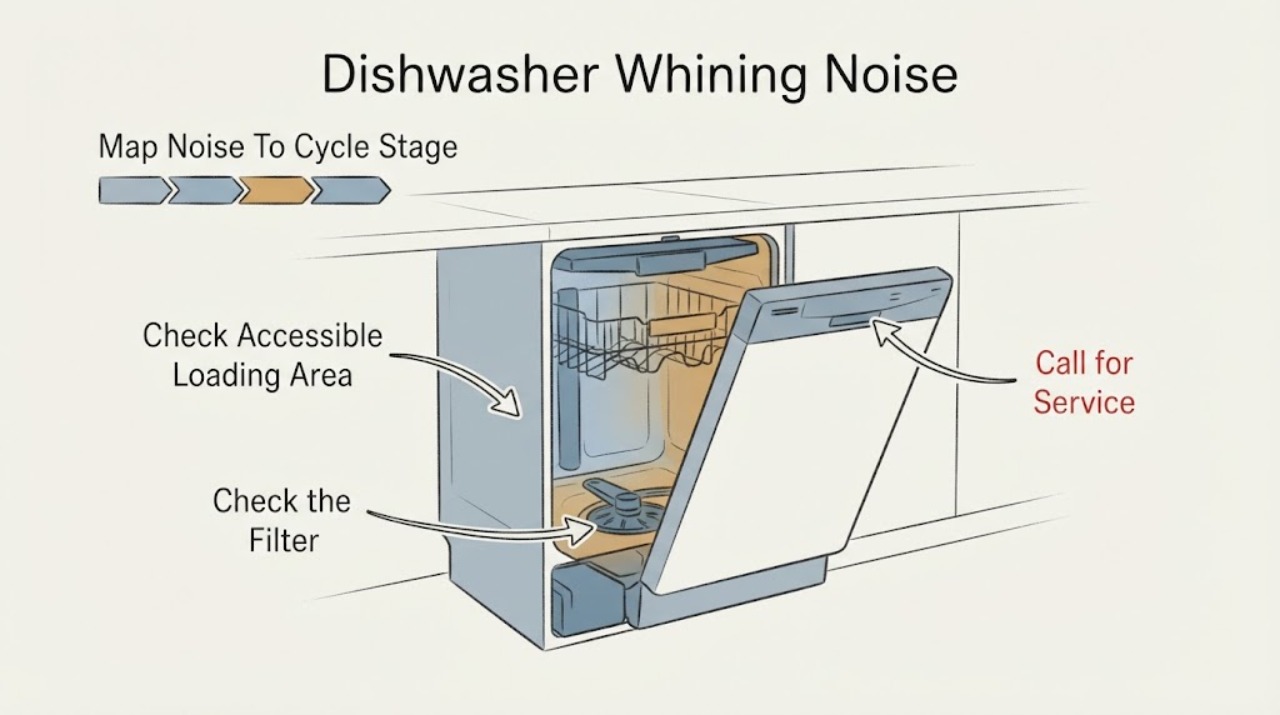
First note whether the whine occurs during filling, washing, draining or drying and whether it stops when that stage ends. ASKO's official material identifies flow and drain-pump operation as possible operation-related sounds, and some models use a drying fan; a short sound tied to one stage is different from a new sound that persists, grows louder or accompanies poor draining or a leak. With the cycle stopped, inspect only the accessible racks, spray-arm area and filter area for an item or debris, then clean the filters and check the visible drain path as ASKO directs. If the pump runs continuously, water remains above the filters, the sound returns after these checks, or there is a leak, burning smell, smoke, arcing or a breaker trip, turn off power and water as appropriate and arrange ASKO or qualified appliance service. Do not open the base, test live wiring or identify a pump or motor from the sound alone.
Work through in order
Diagnostic checks
Use only checks that match the exact appliance or system and its official guide.
-
Check 1
Note whether the whining starts during filling, washing, draining or drying, and whether it stops when that stage ends; record any change in cleaning, draining or drying.
Expected result: The sound is brief and tied to one stage, or it persists across stages or grows louder while the cycle also behaves abnormally.
Next step: Use the matching accessible check below and do not name an internal part from the sound alone.
Why this matters
Why: A stage-specific sound may be operation-related flow, drain-pump or drying activity; a persistent or worsening sound with a functional symptom needs a more cautious service path.
-
Check 2
Stop the program and, with the dishwasher no longer running, inspect the visible rack and spray-arm area for a utensil, dish or loose object touching the path of movement.
Expected result: The load is contacting the spray-arm or rack path, or nothing visible is contacting it.
Next step: Reposition only the accessible load and use the model's normal cycle controls. If the sound remains with a clear load, continue with filter/drain checks rather than reaching under the tub.
Why this matters
Why: A contact that changes with the load can explain a cycle-dependent noise; no visible contact leaves the sound source unresolved.
-
Check 3
After stopping the cycle, remove and clean the filter basket and fine filter as shown in ASKO's dishwasher cleaning guide, reinstall them, and look for water above the filters or an obvious visible drain obstruction.
Expected result: Debris or standing water is present, or the filter area is clean and the tub is not holding water.
Next step: If debris was found, restore the filter and monitor the next normal cycle. If water remains above the filters or the drain pump runs continuously, turn off power and water and contact ASKO service.
Why this matters
Why: Debris or standing water makes the drain path a relevant next check; a clean, normally draining filter area does not prove that the pump is defective.
-
Check 4
From outside the appliance, check that it is stable and that the visible inlet and drain hoses have no kink, sharp bend or cabinet contact that could strain them.
Expected result: The appliance is unstable or a hose is bent/contacting the opening, or the installation appears stable and clear.
Next step: Do not remove an integrated dishwasher or alter electrical, water or drain connections as a noise experiment. Have a qualified installer correct an installation issue or continue to service if the noise remains.
Why this matters
Why: An installation issue can add vibration or restrict the drain path; a clear installation does not identify an internal noise source.
-
Check 5
Record the exact model, cycle stage, sound timing, filter/drain result, leak or error indication and whether the sound stops; provide those observations to ASKO or qualified appliance service.
Expected result: The whine is continuous or worsening, returns after accessible checks, accompanies standing water, a leak, a cycle stop, smoke, burning smell, arcing or a breaker trip.
Next step: Stop using the dishwasher and arrange service. For smoke, arcing, a hot/damaged cord or active water near electrical parts, isolate power only from a safe location and do not restart the appliance.
Why this matters
Why: The remaining possibilities include model-specific internal systems that cannot be distinguished safely by sound alone.
Use your observations
Decision map
Find the observation that best matches what you see, then follow the next safe action.
-
PATH 01Next step
What you see
The whine occurs only during a short fill, circulation, drain or drying interval and the cycle completes without standing water or a leak.
Do this next
Record the stage and model, keep the load clear of the spray-arm path, and monitor for a change in duration, volume or performance.
Why this path and its safety boundary
Why it matters: ASKO documents flow and drain-pump operation as possible operation-related sounds, and applicable models may use a drying fan or lower-noise mode; this pattern does not confirm a failed part.
-
PATH 02Next step
What you see
The whine changes with the load and a utensil or dish is visibly touching the rack or spray-arm area while the machine is stopped.
Do this next
Reposition the accessible item and use the normal model-specific cycle. Stop and arrange service if the sound remains or the machine develops a drain, leak or error symptom.
Why this path and its safety boundary
Why it matters: The load position is a plausible external cause of a cycle-dependent sound, but it does not establish an internal defect.
-
PATH 03Next step
What you see
The whine is accompanied by water above the filters, a blocked-looking drain condition or a drain pump that keeps running.
Do this next
Stop the dishwasher, turn off its power and water supply where safe, and contact ASKO service; do not keep restarting it or probe the pump from below.
Why this path and its safety boundary
Why it matters: ASKO treats filter/drain checks as relevant to drain problems and identifies continuous drain-pump operation as a turn-off-and-contact-care condition.
-
PATH 04Next step
What you see
The sound persists or worsens after the accessible checks, or there is a leak, smoke, burning smell, arcing, a hot cord, a breaker trip or a cycle stop.
Do this next
Keep the dishwasher off and arrange ASKO or qualified service. Do not open the base, test live wiring, bypass protection or select a pump or motor solely from the sound.
Why this path and its safety boundary
Why it matters: The symptom is outside a safe generic user diagnosis, and model-specific internal or installation work may be required.
Helpful context
Understand the symptom
Map the whine to a cycle stage
A dishwasher can sound different as it fills, circulates water, drains or dries. ASKO's official warranty material specifically names flow and drain-pump operation as sounds that may result from operation, and ASKO product material documents low-noise designs and a Night mode on applicable models. Record when the sound starts, whether it stops when the stage changes, and whether the wash, drain and drying functions still complete. This avoids treating every motor-like sound as a confirmed pump failure.
Check only the accessible loading and spray area
Stop the program before opening the door. With the appliance safe to open, look for a utensil or dish touching the spray-arm area, an item trapped where the racks move, or a visible object that could make the sound change with rotation. ASKO product information identifies the spray arms, racks and strainers as dishwasher components, but the exact clearance and removal procedure varies by model. Do not reach into a moving machine or remove the tub, pump cover or base panels to chase the sound.
Clean the filters and inspect the visible drain condition
After stopping the cycle, remove the lower rack and follow ASKO's cleaning guide for the filter basket and fine filter: lift and separate the filter parts, clean debris with soap and water, and reinstall them securely. Look for water standing above the filters and for a visible drain-line blockage without pushing objects into the hose. ASKO says a continuously running drain pump is a stop-and-service condition; do not keep restarting the dishwasher to make the whine disappear.
Rule out external installation contact
If the sound is strongest when the machine runs, check from outside that the dishwasher is stable and that the visible inlet and drain hoses are not kinked, sharply bent or being damaged by the cabinet opening. ASKO's installation instructions specify leveling and hose-clearance checks and say electrical, water and drainage connections should be handled by a qualified professional. These checks can identify an installation condition; they do not identify an internal pump, motor or bearing.
Stop and arrange model-specific service when the pattern persists
Arrange ASKO or qualified appliance service when the whine is new and continuous, returns after the accessible checks, coincides with standing water or a leak, or is accompanied by an error indication or a cycle that stops. Keep the dishwasher off for smoke, a burning smell, arcing, a hot or damaged cord, a breaker trip or visible water near electrical parts. Give the service provider the model and serial information, cycle stage, sound timing and any drain or leak observations. Do not open the base, test energized wiring or order a pump or motor from the sound alone.
When checks do not resolve it
Need a professional?
Arrange ASKO or qualified appliance service when the whine is persistent or worsening, the dishwasher does not drain, the pump runs continuously, a leak or error recurs, or the sound returns after the accessible checks. Provide the exact model, cycle stage, timing, filter/drain result and any safety symptoms.
Common questions
FAQ
Is a whining sound from an ASKO dishwasher always a failed pump?
No. ASKO's official material identifies flow and drain-pump operation as possible operating sounds. The timing, persistence and any drain, leak or cycle symptom must be checked before service diagnoses an internal component.
Can I clean the filter for an ASKO dishwasher that is whining?
After stopping the cycle, you can follow ASKO's cleaning guide to remove, wash and reinstall the accessible filter parts. If water remains above the filters or the drain pump runs continuously, turn off power and water and contact service.
Should I run the dishwasher again to locate the noise?
Do not repeatedly run it as a test when the sound is continuous, worsening, accompanied by standing water or a leak, or associated with smoke, burning smell, arcing or a breaker trip. Record the stage from a safe observation and arrange service when those conditions occur.
Why is the exact ASKO model important?
ASKO dishwasher families differ in racks, spray systems, drying features, controls and installation. Use the exact manual before removing anything beyond the accessible filter or changing an installation connection; do not assume a pump or motor fits from the brand and symptom alone.
Read the exact guide
Official sources
- Dishwasher CleaningASKO · Official ASKO USA cleaning guide with dishwasher filter, drain, continuous-pump and service guidance.
- Installation instructionsASKO · Official ASKO USA installation instructions for a DBI dishwasher installation family; used only for qualified-connection, leveling and hose-clearance boundaries, not model-specific internal diagnosis.
- Dishwasher - DBI564PS - ASKOASKO · Official ASKO USA dishwasher product page used for the documented spray-arm, rack, strainer, noise-level and low-noise-mode feature scope; it does not establish a fault for every model.
- WHAT DOES THIS WARRANTY COVER?ASKO · Official ASKO Thailand warranty document; the regional warranty terms are not used for US coverage, but its operation-related noise wording identifies periodic flow and drain-pump sounds as normal-operation examples.
Community feedback
Share a repair observation
Share a plain-text repair observation. Accepted observations are published automatically; this page may take a moment to update.