
On this page
Start here
Quick answer
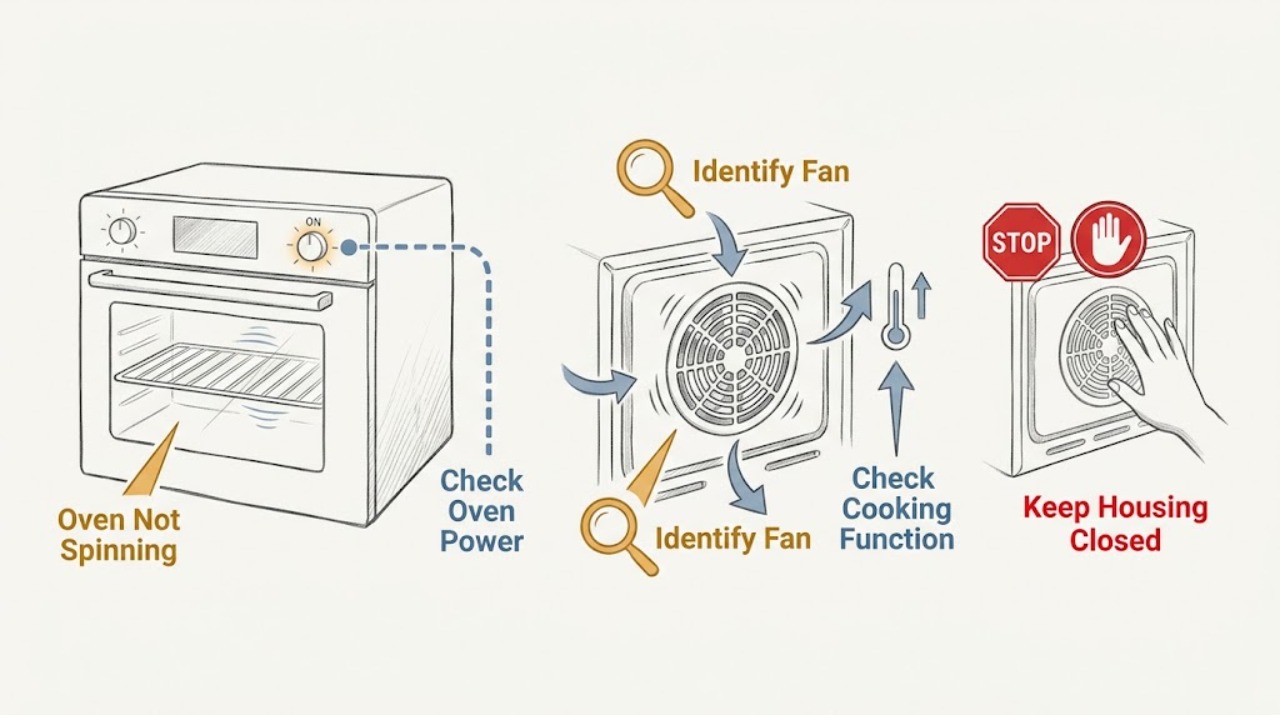
For a Beko oven, “not spinning” is meaningful only if it refers to a fan. First distinguish the cooking fan inside the cavity from the cooling fan behind the control panel. In a fan-assisted cooking setting, check from outside the appliance that the oven has power, the fuse has not tripped, the correct function and temperature are selected, and any mechanical minute minder is in manual mode. The cooling fan may run for a while after the oven is switched off and then stop as the oven cools, which is normal. If the cooking fan still does not work after the external setting and power checks, or the blade appears loose, stop trying to repair it yourself and arrange Beko or qualified service. Do not reach into a hot oven, remove panels, or test live wiring.
Before you begin
Safety first
- Do not reach into a hot oven, touch fan blades, remove panels, bypass a timer, test live wiring, or continue after smoke, burning odor, cord damage, or repeated fuse/breaker trips.
Work through in order
Diagnostic checks
Use only checks that match the exact appliance or system and its official guide.
-
Check 1
From outside the appliance, note whether the complaint concerns the fan visible or audible in the oven cavity during cooking, or the cooling fan behind the control panel after the oven is switched off.
Expected result: The complaint occurs during a fan-assisted cooking function, only after shutdown, or at an unclear time/component.
Next step: Continue with the cooking-function checks only when the symptom is a missing fan during a mode that should use it. Treat post-shutdown cooling-fan operation as normal unless the oven otherwise behaves abnormally.
Stop if: Do not put hands into the cavity, reach behind the control panel, or remove any cover to see which fan is turning.
Why this matters
Why: The two fans have different jobs and timing. Beko says the cooling fan can run after shutdown until the oven cools, while the not-working guidance concerns the oven fan used during operation.
-
Check 2
With the oven cool and the controls dry, check from outside that the appliance is plugged into its grounded socket and that the household supply is present; inspect the fuse box for a tripped oven circuit without opening the oven.
Expected result: The plug is not seated, the oven circuit or mains fuse is tripped, power is absent elsewhere, or the oven has power but the fan remains inactive.
Next step: Restore only an obvious external power connection or reset a tripped household breaker in the ordinary safe manner. If the breaker trips again or the oven has power but the fan does not run, stop and arrange service.
Stop if: Do not remove the oven back, change wiring, repeatedly reset a tripping breaker, or use a wet plug or damaged cord.
Why this matters
Why: Beko lists a defective or tripped mains fuse, an unplugged product, and a household power cut among reasons an oven fan may not work. Restored power does not prove the fan motor or blade is healthy.
-
Check 3
Select the exact Beko cooking function that is intended to use the oven fan and set a temperature according to the model instructions; do not judge the fan in a function that does not call for it.
Expected result: The wrong function or no temperature is selected, the oven uses a mechanical Minute Minder that is not in manual mode, or the correct fan-assisted function is selected and the fan still does not run.
Next step: Correct the external setting using the model's controls. If the fan remains inactive in the correct mode, stop at user-level checks and contact Beko or qualified service.
Stop if: Do not remove knobs or panels, bypass the timer, or test the fan circuit with instruments.
Why this matters
Why: Beko lists an incorrect cooking function/temperature and a mechanical timer left outside manual mode as possible reasons for a fan not working. A correct selection with no fan narrows the issue toward a service-level fault without identifying a specific part.
-
Check 4
After switching the oven off and allowing it to cool, record whether the cooling fan runs for a while, whether the cooking fan was silent only during operation, and whether there was unusual noise or a visibly loose blade without touching it.
Expected result: The cooling fan runs and then stops, the cooking fan never runs in the correct function, the blade appears loose, or there is abnormal noise, burning smell, smoke, or repeated power loss.
Next step: Keep the oven off and arrange service for a persistent cooking-fan failure, loose blade, abnormal noise, burning odor, smoke, or repeated power trip. Do not attempt to confirm an internal cause.
Stop if: Do not touch the blade, open the control panel, run the oven with smoke or burning odor, or continue after an electrical protection device trips.
Why this matters
Why: Post-shutdown cooling-fan operation can be normal. Beko says a loose fan blade or faulty thermostat may remain when the basic checks do not resolve the cooking-fan problem; smoke, burning odor, or repeated power loss is an immediate stop condition.
-
Check 5
Prepare a service handoff with the exact Beko model, the fan identified, selected function and temperature, power/fuse observations, timer mode, when the fan is silent, and any noise, odor, smoke, or loose-blade observation.
Expected result: The correct mode and power are confirmed but the cooking fan remains inactive, or the issue includes a loose blade, abnormal noise, or electrical warning.
Next step: Give the record and model information to Beko or a qualified appliance technician, and keep the oven out of use until an unsafe or unresolved fault is assessed.
Stop if: Do not attempt self-repair, live testing, or part replacement from the symptom label alone.
Why this matters
Why: A control or power setting issue is different from a persistent fan or thermostat fault. The evidence does not justify naming or replacing a motor, blade, thermostat, or control board without model-specific service diagnosis.
Use your observations
Decision map
Find the observation that best matches what you see, then follow the next safe action.
-
PATH 01Next step
What you see
The fan is heard only after the oven is switched off and then stops as the oven cools, with no abnormal operation.
Do this next
Treat this as normal cooling-fan behavior. Do not open the panel; investigate further only if the cooking fan fails during the correct fan-assisted function or another symptom appears.
-
PATH 02Next step
What you see
The oven fan is silent during cooking, and the plug, household power, fuse, cooking function, temperature, or mechanical timer mode is incorrect.
Do this next
Correct the obvious external setting or power issue safely. If power is restored and the correct function is selected but the fan still does not run, escalate to service.
-
PATH 03Next step
What you see
The correct fan-assisted function and temperature are selected, power is present, and the cooking fan remains inactive or has unusual noise/loose-blade symptoms.
Do this next
Stop user-level troubleshooting and arrange Beko or qualified appliance service. Do not infer a specific motor, blade, thermostat, or control-board failure.
-
PATH 04Next step
What you see
The oven produces smoke or a burning odor, the cord or socket is damaged or wet, or a fuse/breaker repeatedly trips.
Do this next
Stop using the oven, keep clear of hot or energized parts, and seek qualified appliance or electrical service. Do not repeatedly reset the protection device or open the appliance.
Helpful context
Understand the symptom
“Not spinning” must identify the fan
A Beko oven does not have a washer-style rotating drum. The assigned symptom is actionable when it means the oven's cooking fan is not turning, or when a user is confusing that fan with the cooling fan behind the control panel. Note when the fan is expected to run and which part is silent before changing settings or calling for a part.
Check the controls before assuming a motor fault
Beko's oven-fan guidance starts with the household power supply, plug, selected cooking function and temperature, and—in models with a mechanical Minute Minder—the manual setting. A fan that does not run in a mode that does not call for it is not evidence of a failed fan.
Cooling-fan timing is different
The cooling fan is located behind the control panel and may continue after the oven is turned off, then stop automatically when the oven has cooled. Do not open the control panel or touch a fan to test it. Persistent failure of the cooking fan, a loose blade, or abnormal operation belongs with qualified service.
When checks do not resolve it
Need a professional?
Arrange Beko or qualified appliance service when the correct cooking function and power are confirmed but the oven fan remains inactive, a blade appears loose, abnormal noise persists, or any electrical or overheating symptom occurs.
Safety scope: Do not reach into a hot oven, touch fan blades, remove panels, bypass a timer, test live wiring, or continue after smoke, burning odor, cord damage, or repeated fuse/breaker trips.
Have this ready
- Exact Beko model information
- Whether the symptom concerns the cooking fan or cooling fan
- Selected cooking function, temperature, and mechanical timer mode
- Power/fuse observations and any noise, odor, smoke, or loose-blade observation
Common questions
FAQ
What does “not spinning” mean on a Beko oven?
It should refer to a fan, usually the cooking fan during a fan-assisted function. A Beko oven does not have a rotating drum. Identify which fan and when it should run before troubleshooting.
Is it normal for my Beko oven fan to keep running after I turn it off?
Yes. Beko says the cooling fan behind the control panel can continue running until the oven has cooled, then stop automatically. That is different from a cooking fan failing during operation.
What should I check when the Beko oven cooking fan will not run?
Check the external power and fuse, plug connection, selected cooking function and temperature, and—if fitted—a mechanical Minute Minder set to manual mode. If the correct settings and power are present but the fan remains inactive, arrange service.
Can I repair a Beko oven fan myself?
Beko does not recommend self-repair for this issue. Do not remove panels or test the fan circuit; arrange qualified service if the external checks do not resolve it or if the blade appears loose.
Read the exact guide
Official sources
- Oven fan keeps running after I have turned it off?Beko UK · Beko oven cooling-fan location and normal post-shutdown operation
- Why is my oven fan not working?Beko UK · Beko oven cooking-fan power, function, timer, fault, and service guidance
Community feedback
Share a repair observation
Share a plain-text repair observation. Accepted observations are published automatically; this page may take a moment to update.