
On this page
Start here
Quick answer
A bad smell from a Beko washing machine usually needs a moisture and residue check rather than more fragrance. Stop immediately for a burning smell, smoke, unusual heat, a damaged cord, standing water near electrical parts, or a chemical or sewage hazard; keep the machine unused and arrange qualified service. For a musty or damp smell, remove laundry promptly, leave the door and drawer ajar when safe, inspect the door gasket and drawer for residue, and run only the empty drum-cleaning or hottest approved maintenance cycle allowed by the exact manual. Check the pump filter only with the machine off and the water cool, using the model instructions because trapped water may be present. If the smell returns after cleaning, the machine will not drain, leaks, or the source is behind the cabinet or in the drain plumbing, stop and request professional diagnosis.
Before you begin
Safety first
- This article covers safe observation and model-approved cleaning only. Qualified service determines whether the source is a seal, pump, filter, drain hose or plumbing, heater, wiring, or hidden contamination and performs any internal repair.
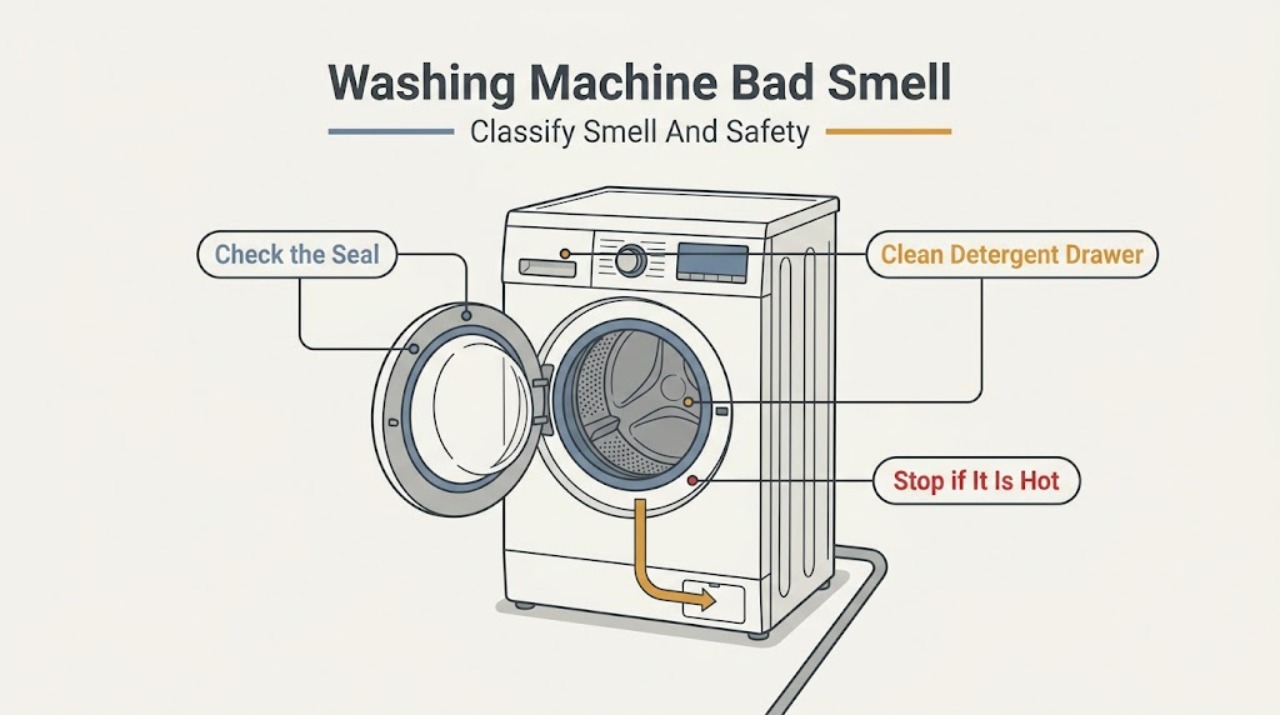
Work through in order
Diagnostic checks
Use only checks that match the exact appliance or system and its official guide.
-
Check 1
Stop the current cycle and from a dry, stable position record where the Beko smell is strongest: inside the drum, around the door gasket, at the detergent drawer, near the lower filter area, behind the machine, or in the room drain; do not lean into a hot or wet appliance.
Expected result: The smell is musty or damp, sour or sewage-like, detergent or mildew-like, or hot/electrical/solvent-like; note smoke, unusual heat, a leak, standing water, or a damaged cord.
Next step: For any safety smell, smoke, heat, leak near electrical parts, or damaged cord, keep the machine unused and arrange qualified service; if the normal isolator or plug is safely reachable without touching water, switch it off. Otherwise do not approach it further.
Stop if: Do not run another cycle to mask a burning or chemical smell, touch wet electrical equipment, or move the machine to inspect behind it.
Why this matters
Why: Musty or detergent odour supports a moisture and residue path. Sewage-like odour with retained water can involve the drain path. A burning, electrical, solvent, or chemical smell, smoke, abnormal heat, or water near electrical parts is not a routine cleaning issue.
-
Check 2
With the machine stopped and the door area safe, inspect the visible folds of the door gasket and the drum opening for trapped lint, hair, detergent film, sludge, foreign items, standing water, or visible mould; remove only loose residue that the manual permits you to handle without lifting or damaging the seal.
Expected result: Residue or water is concentrated in the gasket folds, the drum looks clean but the smell is strong, the gasket is torn or distorted, or the source cannot be judged without disassembly.
Next step: For intact, accessible residue, clean and dry the gasket only by the model's care guidance, then keep the door open for ventilation. Arrange service for a torn seal, repeated retained water, hidden contamination, or any need to remove the seal or cabinet.
Stop if: Do not pull the gasket away from the metal, scrape it with a sharp tool, use an abrasive, or open the cabinet.
Why this matters
Why: Beko states that dirt, lint, detergent residue, and other debris can collect in seal folds and cause unpleasant odours or mould growth. A torn seal, persistent water, or inaccessible contamination can allow the smell to return and needs more than surface wiping.
-
Check 3
When the programme is complete and the drawer is safe to handle, remove the detergent drawer only as the Beko instructions show; wash detachable pieces and the visible drawer housing with warm soapy water, then allow them to dry before refitting.
Expected result: The drawer or its housing contains softener gel, detergent deposits, mould-like residue, standing water, or no visible residue while the smell remains.
Next step: Rinse and dry the drawer and housing completely, refit every detachable piece in its original position, and make one normal empty maintenance check later. Request service if the drawer will not seat, water remains in it, or the smell persists.
Stop if: Do not open the drawer while the machine is running, mix cleaning products, spray into the control panel, or force a stuck drawer.
Why this matters
Why: Deposits in the drawer can retain moisture and produce odour or restrict the movement of detergent into the drum. A clean drawer with a continuing smell shifts attention to the gasket, drum, filter, drain path, or a hidden leak rather than repeated drawer washing.
-
Check 4
If the exact Beko manual permits user filter care, switch the machine off, wait until wash water is cool, protect the floor from expected water, and inspect the lower pump-filter area for lint, hair, coins, or stagnant water without reaching under the machine.
Expected result: The filter is blocked, water is trapped, the filter area is dry and clear, the machine has failed to drain, or the filter cannot be reached without moving the appliance or opening an unfamiliar panel.
Next step: Clean or refit the filter only by the exact model procedure and only after the water is cool. If water remains, draining is poor, the filter will not seal, the smell returns, or access requires moving the machine, stop and arrange qualified appliance or plumbing service.
Stop if: Do not open the filter while a programme is running or water is hot, place hands under the machine, force the cap, or disconnect hoses as a smell test.
Why this matters
Why: Beko notes that a clogged filter can affect draining and that stagnant water can contribute to odour. A clear filter does not rule out a restricted drain hose, pump fault, or plumbing issue; inability to access it safely is a service boundary.
-
Check 5
After the visible checks are complete and the machine is free of laundry, select the installed Beko model's Drum Cleaning programme or the hottest approved empty maintenance cycle, using only the cleaning agent and amount allowed by its manual.
Expected result: The odour decreases after the empty cycle, residue appears in the drum, the machine cannot complete the cycle, the smell becomes stronger, or the odour is unchanged.
Next step: Wipe accessible moisture when the cycle is complete, leave the door and drawer ajar, and monitor the next normal load. If the smell returns or the cycle fails, stop cleaning experiments and arrange qualified diagnosis.
Stop if: Do not use laundry in the cleaning cycle, combine descaler with bleach or another product, exceed the manual's product guidance, or keep running cycles after smoke, heat, or a leak appears.
Why this matters
Why: Improvement supports accumulated residue or biofilm as a contributor, but it does not prove the drain and seal are clear. An incomplete cycle, stronger smell, or no change points toward retained water, a blocked drain, a seal problem, or a service issue.
-
Check 6
For the next few normal washes, remove laundry promptly, wipe accessible moisture from the door and gasket, leave the door and drawer ajar when safe, and use the recommended detergent and load size; track whether the smell returns immediately or only after several days.
Expected result: The smell stays away, returns after the machine sits closed, returns with retained water or poor draining, or remains after the gasket, drawer, filter, and approved empty cycle were addressed.
Next step: Continue the safe ventilation routine only when the machine operates normally. For any recurring smell, leak, poor draining, failed programme, or inaccessible source, leave the appliance unused as needed and arrange qualified appliance or plumbing service.
Stop if: Do not mask the odour with fragrance, dismantle the cabinet, move the appliance over wet flooring, or continue use when a burning smell or electrical warning returns.
Why this matters
Why: A smell that follows closed dampness supports a ventilation and maintenance pattern. Recurrence with retained water or poor draining suggests a drain or pump path. Persistence despite accessible cleaning means the source may be behind the seal, in the drain plumbing, or inside the machine.
Use your observations
Decision map
Find the observation that best matches what you see, then follow the next safe action.
-
PATH 01Safety boundary
What you see
There is a burning, electrical, solvent, or chemical smell; smoke; unusual heat; a damaged cord; water near electrical parts; or a leak that makes the area unsafe.
Do this next
Stop the cycle, keep people away, and switch off the normal isolator or plug only if it is safely reachable without touching water or damaged equipment; arrange qualified appliance or electrical service.
Why this path and its safety boundary
Safety stop: Do not run another cycle, spray the cabinet, touch wet electrical equipment, or open the machine.
-
PATH 02Safety boundary
What you see
Musty or damp smell is strongest at accessible gasket folds, the drum, or detergent drawer, and there is no safety warning.
Do this next
Clean and dry only the accessible area using the Beko model guidance, then run one approved empty maintenance cycle and leave the door and drawer ajar when safe.
Why this path and its safety boundary
Safety stop: Do not lift the gasket, scrape residue, mix products, or use sharp or abrasive tools.
-
PATH 03Safety boundary
What you see
The smell is sewage-like or accompanied by retained water, poor draining, a blocked filter, or water that returns after a cycle.
Do this next
Stop repeated cycles, check the pump filter only by the cool-water model procedure, and arrange appliance or plumbing service when water remains or the drain path is not safely accessible.
Why this path and its safety boundary
Safety stop: Do not open a hot filter, disconnect hoses as a test, enter pooled water, or move the machine across a wet area.
-
PATH 04Safety boundary
What you see
The odour returns after accessible gasket, drawer, filter, ventilation, and one approved empty cleaning cycle, or the machine leaks, fails a programme, or smells from behind the cabinet.
Do this next
Leave the machine unused as needed and arrange qualified appliance service; provide the smell type, location, timing, draining behavior, cleaning steps, and photos of visible residue or leaks.
Why this path and its safety boundary
Safety stop: Do not dismantle the cabinet, replace a pump or seal from the smell alone, or continue masking the odour with chemicals.
Helpful context
Understand the symptom
Match the smell to the part of the wash system
A musty or damp smell often follows moisture trapped in the drum, folds of the door gasket, the detergent drawer, or clothing left after a cycle. A sewage-like smell can also follow stagnant water or a restricted drain path. A smell that is hot, electrical, solvent-like, or accompanied by smoke is a stop condition, not a cleaning problem. Beko also notes that repeated low-temperature or short cycles can allow odour and bacteria layers to develop.
Clean one source at a time and observe what changes
The useful sequence is to document the smell, inspect the gasket and drawer, check the filter only under the model's safe procedure, and then run an approved empty maintenance cycle. This separates surface residue from retained water or a drain problem. Do not pour cleaners into unknown compartments, mix products, spray the cabinet, or use sharp tools; the exact manual controls which products and programmes are suitable for the installed Beko model.
Prevent the damp environment from returning
After a cycle, remove laundry promptly, wipe accessible moisture from the gasket and door, and leave the door and detergent drawer ajar when the room and machine can remain safely open. Use the recommended detergent amount and load size, and follow the model's drum-cleaning schedule. If the odour returns quickly or cleaning does not change it, service must check the drain path, pump area, seals, and hidden contamination rather than masking the smell.
Only after diagnosis
Potential parts
- door gasket or bellows seal
Consider this part class only if inspection finds a torn, distorted, leaking, or persistently contaminated seal and qualified diagnosis links it to the odour or water retention.
Confirm the full Beko model and approved fit information before ordering; a generic smell does not identify the correct seal. - drain pump or pump filter assembly
Consider this part class only if safe filter and drain observations show poor draining or a qualified diagnosis identifies a pump or filter fault.
Verify the full model and component position with the manufacturer's fit information; do not replace a pump based on odour alone. - detergent drawer siphon or drawer assembly
Consider this part class only if the drawer cannot drain, will not seat, or remains damaged after cleaning and qualified diagnosis links it to residue or water retention.
Confirm model-specific drawer layout and fit before ordering; detachable inserts vary by appliance.
When checks do not resolve it
Need a professional?
Arrange qualified appliance or plumbing service when the smell is burning, electrical, chemical, or sewage-like; there is smoke, unusual heat, a damaged cord, a leak, retained water, poor draining, a failed programme, a torn seal, or an odour that returns after safe accessible cleaning and one approved empty maintenance cycle.
Safety scope: This article covers safe observation and model-approved cleaning only. Qualified service determines whether the source is a seal, pump, filter, drain hose or plumbing, heater, wiring, or hidden contamination and performs any internal repair.
Have this ready
- Full Beko model and whether the machine is a washer or washer-dryer
- Smell description, strongest location, and when it appears in the cycle
- Photos of the gasket, drawer, filter area, visible residue, standing water, or leak
- Whether draining, spinning, and the empty maintenance cycle complete normally
- Cleaning products and model-approved steps already used, without mixing products
Common questions
FAQ
Why does my Beko washing machine smell musty?
Moisture, detergent or dirt residue, and mould-like buildup in the drum, door-gasket folds, or detergent drawer can create a musty smell. Clean only by the model guidance, dry accessible areas, and leave the door and drawer ajar when safe.
Can a blocked filter cause a bad smell in a Beko washing machine?
It can contribute when water or debris remains in the drain path. Switch the machine off and wait for the water to cool before checking the filter by the exact manual procedure. Poor draining, retained water, leaks, or an inaccessible filter require service.
What cycle should I use to clean a smelly Beko washing machine?
Use the installed model's Drum Cleaning programme or the hottest approved empty maintenance cycle, with only the cleaning agent and amount permitted by the manual. Do not mix products or use laundry in the cycle. If the odour persists, seek diagnosis instead of repeating cleaning experiments.
When is a Beko washing-machine smell a safety problem?
Treat burning, electrical, solvent, or chemical odour, smoke, unusual heat, a damaged cord, water near electrical parts, or a serious leak as a stop condition. Keep the machine unused and arrange qualified appliance or electrical service; a sewage smell with retained water also needs prompt attention.
Read the exact guide
Official sources
- Beko Washing Machine Owner's Manual BM3WT4841IABeko · Supports stopping for high-temperature water, avoiding hands under the machine, not using sharp or abrasive tools or sprayed water, and ventilation and gasket drying for odour prevention.
- How To Clean A Washing MachineBeko UK · Supports drawer and filter observations, seal residue, approved empty cleaning cycles, and recurring-odour prevention.
- How To Stop A Washing Machine From SmellingBeko UK · Supports moisture, residue, clog, overloading, prompt laundry removal, door ventilation, filter reference, approved cleaning, and professional escalation for persistent or burning smells.
- Help Center ResultBeko · Supports the pump-filter location and periodic cleaning context while deferring the detailed procedure to the appliance guide.
- How do I clean the washing machine seal?Beko UK · Supports inspection of seal folds, moisture and mould odour, drum-first cleaning, safe wiping without lifting the seal, and ventilation after cleaning.
- How to clean the detergent drawer of your washing machineBeko UK · Supports removing detachable drawer pieces as designed, warm soapy cleaning, drying, and careful refitting.
Community feedback
Share a repair observation
Share a plain-text repair observation. Accepted observations are published automatically; this page may take a moment to update.