
On this page
Start here
Quick answer
First classify the smell and protect yourself: a burning or electrical smell, smoke, hot water escaping, or a strong chemical or sewage odor is a stop condition. For a musty or sour AEG washing-machine smell, the usual low-risk path is to remove wet laundry promptly, leave the door and detergent drawer ajar so the machine can dry, inspect and gently clean the accessible door seal and drawer, use the detergent dose specified for the product and detergent, and run the model-approved empty maintenance or high-temperature cleaning cycle. With the machine switched off and unplugged, and the water cool, clean the accessible drain or fluff filter only if the model manual permits it. If the smell persists after these steps, returns quickly, comes from the drain connection, or is accompanied by a leak, heating problem, error, or abnormal noise, stop and arrange qualified AEG or appliance service.
Before you begin
Safety first
- User checks are limited to drying, normal controls, accessible seal/drawer cleaning, correct dosing, a model-approved empty maintenance cycle, and a cool unplugged user-accessible filter check; electrical, heating, pump, hose, mould-remediation, and internal work requires qualified service.
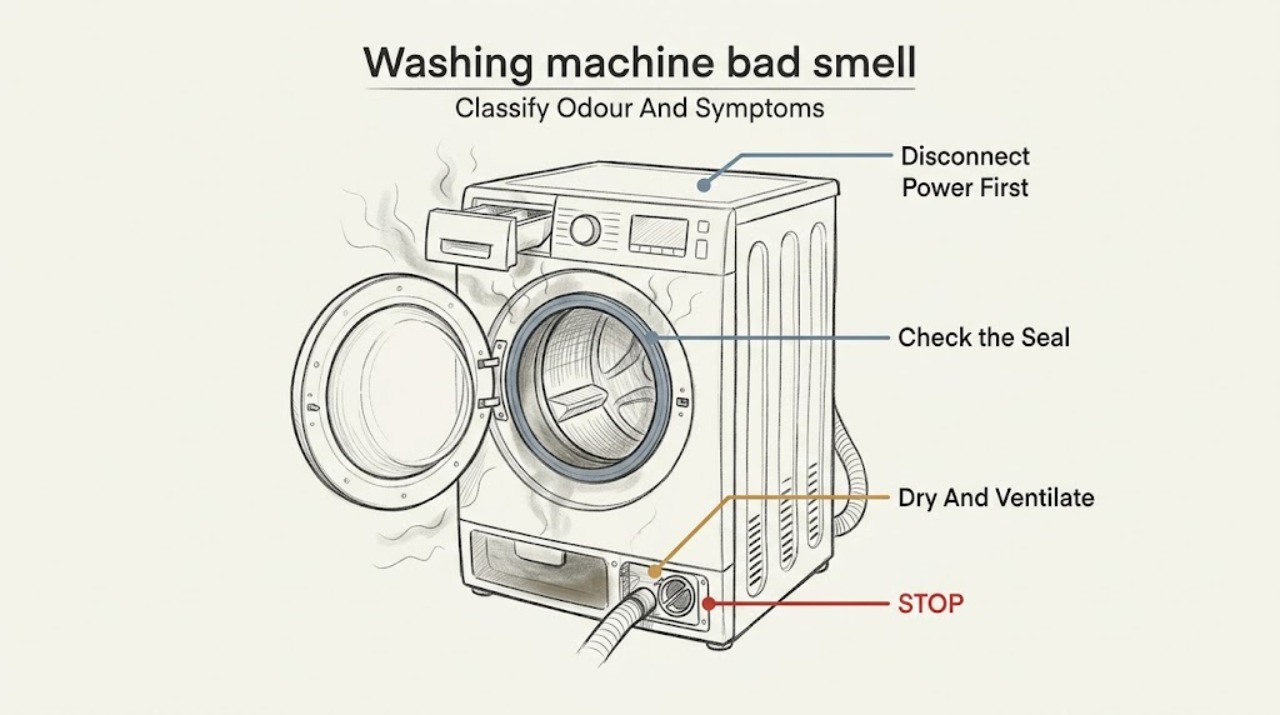
Work through in order
Diagnostic checks
Use only checks that match the exact appliance or system and its official guide.
-
Check 1
With the machine idle, note where the smell is strongest—door seal, detergent drawer, drum, drain area, or outside the cabinet—and whether it appears after a cycle, only when draining, or even when the machine is off. Record any smoke, sparking, leak, error, unusual noise, hot-water issue, or visible residue without opening covers.
Expected result: The smell is musty or sour and strongest at the seal/drum; detergent-like and strongest at the drawer; sewage-like near the drain; or burning, electrical, chemical, or accompanied by smoke, heat, or a leak.
Next step: Continue only with the matching low-risk maintenance checks for a musty, sour, or detergent odor. For a hazardous or strong drain-related odor, keep the machine off and use the service or plumbing assessment branch.
Stop if: Stop immediately for smoke, sparks, burning or electrical smell, hot water, visible leak near electrics, strong chemical fumes, or an odor that makes the room unsafe.
Why this matters
Why: Musty or sour odor fits moisture and residue pathways addressed by cleaning and ventilation. A drain-area odor makes the hose or waste installation more relevant. Burning, electrical, chemical, smoke, heat, and leak symptoms are not ordinary odor maintenance and can be hazardous.
-
Check 2
After the cycle has ended and the machine is safe to approach, remove wet laundry promptly and leave the door ajar. Leave the detergent drawer slightly open if the design allows it, and keep the room reasonably ventilated; do not block the door open where children or pets could access the drum.
Expected result: The smell decreases when the door and drawer are left open; the seal and drawer remain damp between cycles; or the odor is unchanged despite several properly ventilated intervals.
Next step: Continue by checking the accessible seal and drawer. Keep the door and drawer ajar between uses as the model permits, but do not treat ventilation as a fix for a leak, drain odor, or electrical smell.
Stop if: Do not leave the appliance open if the door, hinge, lock, or cabinet is damaged or cannot remain safely supported.
Why this matters
Why: A damp interior supports retained moisture as a contributor. No improvement after drying suggests residue, drain installation, hidden moisture, or a service-level cause rather than ventilation alone.
-
Check 3
When the machine is off, inspect the accessible folds of the rubber door or lid seal and the detergent drawer for lint, coins, dark spots, gelled detergent, or standing residue. Wipe the seal with a clean damp cloth and clean the removable drawer only according to the model manual; do not scratch the rubber or reach behind fixed panels.
Expected result: Residue or dark spots are present and the smell improves after cleaning; the seal is torn or permanently deformed; the drawer will not release normally; or both areas are clean but the odor persists.
Next step: If cleaning is permitted and the seal remains intact, continue to an empty maintenance wash. If the seal is damaged, the drawer is jammed, or odor persists, document the finding and arrange service instead of forcing or replacing parts without the exact model.
Stop if: Stop if the seal is torn, the door cannot close, the drawer is jammed, or cleaning would require dismantling the machine.
Why this matters
Why: AEG notes that moisture, mould/mildew, and excess detergent can collect around the seal, while drawer residue can contribute to odor. A damaged seal or inaccessible residue can allow moisture to return and needs model-specific assessment.
-
Check 4
Check the detergent and fabric-softener amounts against the AEG model instructions and the product label, then remove all laundry and run the model's maintenance or drum-cleaning program. If the manual has no maintenance program, use only the empty high-temperature cycle and approved washing-machine cleaner specified for that model; never combine cleaners or add unapproved chemicals.
Expected result: The cycle produces excess foam or residue; the drum and seal smell cleaner afterward; the odor remains unchanged; or the machine cannot heat or complete the approved cleaning cycle.
Next step: Use the correct dose and schedule periodic maintenance washes as the manual recommends. If the cycle cannot heat, stops with an error, produces abnormal foam, or the odor returns quickly, stop the cleaning experiments and arrange qualified service.
Stop if: Stop for smoke, burning odor, a chemical reaction, hot water escaping, an error with unsafe behavior, or any need to open the appliance during the cycle.
Why this matters
Why: Overdosing detergent and repeated low-temperature washing can leave residues that support sour smells. Improvement after an approved empty cleaning cycle supports a residue-maintenance cause. A failed or cold cleaning cycle is a separate heating, control, water, or service clue—not a reason to keep increasing temperature or cleaner quantity.
-
Check 5
If the model manual identifies a user-accessible drain or fluff filter, switch off and unplug the machine, wait until any water is cool, place a shallow container under the access point, and inspect only as far as the manual directs. Check the visible drain-hose connection for an obvious kink, loose connection, or wastewater odor; do not detach a pressurized hose or force a filter that will not turn.
Expected result: The filter contains lint or objects and the odor improves after approved cleaning; the filter is jammed; water is hot or unexpectedly forceful; the hose connection leaks or smells strongly of waste; or the filter and hose appear normal.
Next step: Refit an accessible filter only as the manual specifies and check for leaks with the machine still off before normal use. For a jammed filter, leak, drain-installation concern, or persistent odor, arrange qualified appliance or plumbing help.
Stop if: Do not remove a filter while operating, handle hot water, force the filter, disconnect a hose, or continue if water reaches electrical parts.
Why this matters
Why: A dirty filter or incorrect waste connection can retain residue or return drain odor, but the filter design varies by model. A jammed filter, hot water, leak, or strong wastewater odor can cause injury or contamination and requires a more controlled assessment.
-
Check 6
After one complete, model-approved maintenance attempt, record whether the odor is gone, reduced, or unchanged; whether it returns after the next wash; and whether laundry, heating, draining, the door seal, or the display behaves abnormally. Photograph accessible residue or damage and record the exact model information without removing panels.
Expected result: The smell stays gone; returns after a short interval; persists despite a clean seal, drawer, filter, correct dosing, and maintenance wash; or is accompanied by an error, leak, abnormal noise, or failure to heat or drain.
Next step: Keep the machine dry between uses and arrange qualified AEG or appliance service for recurrence or combined faults. Provide the odor type, location, timing, cleaning steps, model, and any codes or visible findings.
Stop if: Stop using the machine if the smell is burning, electrical, chemical, or accompanied by smoke, leaking, overheating, repeated errors, or unsafe door/lock behavior.
Why this matters
Why: A lasting improvement supports a moisture or residue source that the maintenance steps addressed. A quick recurrence or combined mechanical, electrical, heating, or draining symptom suggests a hidden or service-level cause that odor alone cannot identify.
Use your observations
Decision map
Find the observation that best matches what you see, then follow the next safe action.
-
PATH 01Next step
What you see
The smell is burning, electrical, chemical, or sewage-like with smoke, sparks, hot water, a leak near electrics, or an unsafe room condition.
Do this next
Stop the cycle if it can be done without approaching the hazard, isolate power only from a safe location if appropriate, keep people away, ventilate only when safe, and arrange qualified electrical, plumbing, or appliance help. Do not add cleaner or run another cycle.
Why this path and its safety boundary
Why it matters: This is outside routine odor maintenance and may involve fire, shock, chemical, hot-water, or wastewater exposure risk.
-
PATH 02Next step
What you see
The smell is musty or sour, is strongest at the seal or drawer, and there is visible moisture, mould-like spotting, or detergent residue.
Do this next
Clean only accessible areas as the manual permits, dry the door and drawer between cycles, correct dosing, and run one approved empty maintenance wash. Escalate if the odor returns or the seal is damaged.
Why this path and its safety boundary
Why it matters: Moisture and residue are plausible contributors, especially after repeated low-temperature or short washes, but this does not prove that hidden parts are clean.
-
PATH 03Next step
What you see
The smell is strongest at the drain area or appears when the machine pumps out, while the seal and drawer are clean.
Do this next
Check the visible hose connection and user-accessible filter only while the machine is off, unplugged, and cool. Arrange appliance or plumbing assessment for wastewater odor, leaks, a jammed filter, or a smell that persists.
Why this path and its safety boundary
Why it matters: The visible drain hose connection, waste installation, or accessible filter becomes more relevant than a drum-cleaning cycle alone.
-
PATH 04Next step
What you see
The smell fades after an approved empty maintenance wash, correct detergent dosing, and leaving the door and drawer ajar.
Do this next
Remove wet laundry promptly, wipe the seal as needed, keep the machine ventilated, and follow the model's recommended maintenance interval. Monitor for rapid recurrence.
Why this path and its safety boundary
Why it matters: The result supports a moisture or detergent-residue maintenance cause rather than confirming a failed part.
-
PATH 05Next step
What you see
The machine cannot complete the approved maintenance cycle, the wash remains unexpectedly cold, an error appears, or the smell returns with abnormal draining or noise.
Do this next
Stop using repeated cleaning cycles and arrange qualified AEG or appliance service with the model, cycle, temperature behavior, error, odor timing, and prior cleaning steps.
Why this path and its safety boundary
Why it matters: A heating, control, pump, drain, or other appliance fault may be contributing; odor and external observation cannot identify the failed component.
-
PATH 06Next step
What you see
The gasket is torn/deformed, the door cannot close, the detergent drawer or drain filter is jammed, or cleaning requires disassembly.
Do this next
Keep the machine off if it leaks or cannot close safely, photograph the condition, and arrange model-specific service. Do not order a seal, filter, pump, or other part without exact model confirmation.
Why this path and its safety boundary
Why it matters: The appliance may not dry, seal, or drain correctly, and forcing a user-accessible part can create a leak or damage a safety interlock.
Helpful context
Understand the symptom
Identify the smell before cleaning
A musty or sour smell after repeated cool or short cycles often points to retained moisture, detergent residue, or growth on an accessible seal or inside the machine. A drain or sewage-like smell changes the first check to the drain hose and waste connection. A burning, solvent-like, or electrical smell is not a cleaning problem: stop using the machine and arrange assessment. Smell alone cannot prove which hidden component is responsible.
Keep cleaning limited to the model-approved user areas
Use the exact AEG manual for the model because front loaders, top loaders, and washer-dryers can differ. Switch off and unplug before cleaning or touching a drain filter, and wait for water to cool. Do not reach into a running machine, force a jammed filter, mix cleaning chemicals, use abrasive pads or wire wool, open electrical covers, or remove hoses from a pressurized connection.
What a successful result means
If the smell fades after drying the machine, correcting detergent dosing, cleaning the accessible seal and drawer, and completing an approved maintenance cycle, the likely source was a maintenance or residue condition. If the smell returns despite those changes, or the drain, heating, pump, or electrical behavior is abnormal, stop repeating cycles and give a technician the smell description, timing, recent cleaning, and model information.
Safety boundary
Stop conditions
- Stop immediately for smoke, sparks, burning or electrical odor, hot water escaping, a chemical reaction, strong sewage odor with contamination, or visible leakage near electrical parts.
- Switch off and unplug before cleaning a drain or fluff filter; never remove a filter while the machine is operating, handle hot water, or force a jammed filter.
- Do not mix cleaning products, use abrasive pads or wire wool, open electrical covers, dismantle the pump or heating system, or disconnect a pressurized hose.
- Arrange qualified service when the odor returns quickly, persists after an approved maintenance wash and accessible cleaning, accompanies an error/heating/draining fault, or requires replacing a part without exact model confirmation.
When checks do not resolve it
Need a professional?
Call promptly for burning or electrical odor, smoke, chemical fumes, strong sewage odor, hot water, leakage near electrics, a damaged seal or door, a jammed filter, repeated errors, failure to heat or drain, or an odor that remains after the model-approved maintenance steps.
Safety scope: User checks are limited to drying, normal controls, accessible seal/drawer cleaning, correct dosing, a model-approved empty maintenance cycle, and a cool unplugged user-accessible filter check; electrical, heating, pump, hose, mould-remediation, and internal work requires qualified service.
Have this ready
- Provide the exact AEG model, odor description and location, when it appears, recent detergent and cycle patterns, seal/drawer/filter observations, maintenance steps attempted, and any error, temperature, leak, drainage, or noise symptoms.
Common questions
FAQ
Why does my AEG washing machine smell musty or sour?
AEG identifies retained moisture, detergent residue, seal mould or mildew, and repeated low-temperature or short cycles as common contributors. Dry the seal, leave the door and drawer ajar, correct detergent dosing, and run one model-approved empty maintenance wash; persistent or rapid recurrence needs service.
Should I leave the AEG washing-machine door open after washing?
Yes, leave the door slightly open after the cycle if the model and household setup allow it, and leave the detergent drawer slightly open as well. This helps the drum and drawer dry. Remove wet laundry promptly and do not leave the appliance open if its door or lock is damaged.
Can too much detergent cause a bad smell in an AEG washer?
Yes. AEG says overdosing can leave residue and foam, especially when combined with repeated low-temperature washing. Follow the model and detergent instructions, do not keep adding cleaner, and use an approved empty maintenance cycle.
Can I clean the drain filter to fix an AEG washing-machine smell?
Only if the exact model has a user-accessible filter and its manual permits the check. Switch off and unplug first, wait for water to cool, use a shallow container, and never force a jammed filter or remove it while the machine runs. A leak, hot water, or strong drain odor needs qualified help.
When is a bad smell from an AEG washing machine not a cleaning issue?
Treat burning or electrical odor, smoke, chemical fumes, hot water, wastewater contamination, leakage near electrics, repeated errors, failure to heat or drain, or rapid odor recurrence as a stop or service condition. Do not run more cleaning cycles to cover those symptoms.
Read the exact guide
Official sources
- How to clean the rubber seal on my AEG washing machineAEG · AEG washing machines and washer-dryers; seal moisture, mould/mildew, detergent overdosing, maintenance wash, and ventilation.
- How to fix / resolve a smelly or bad smelling washing machineAEG · AEG washing-machine odor prevention through maintenance washes and the exact-model manual.
- Foam and detergent powder residue in washing machineAEG · AEG washing machines and washer-dryers; overdosing, residue, excessive foam, empty cleaning cycles, and maintenance washing.
- Washing machine emits unpleasant smellAEG · AEG front-loader, top-loader, and washer-dryer odor causes, ventilation, maintenance washing, detergent drawer, pump filter, seal, drain hose, and service escalation.
Community feedback
Share a repair observation
Share a plain-text repair observation. Accepted observations are published automatically; this page may take a moment to update.