
On this page
Start here
Quick answer
A musty Bosch washing-machine smell usually needs a targeted clean of the rubber seal, detergent drawer, drum, and any accessible drain area, followed by the model's documented cleaning cycle. Bosch says frequent low-temperature washing with too little detergent can allow unpleasant odors to develop, recommends the Bosch Washing Machine Cleaner every few months, and advises against vinegar or citric acid descaling because they may degrade rubber parts. Leave the door and detergent drawer open so they can dry after use. If the odor is burning, electrical, chemical, or accompanied by smoke, heat, sparking, a leak, or a repeated error, stop the machine, isolate power only when safe, close the water tap if needed, and arrange qualified service instead of running another cleaning cycle.
Before you begin
Safety first
- This article covers dry, ordinary-access inspection and Bosch-documented cleaning only. Isolate the washer for hazardous symptoms and leave electrical, heating, motor, bearing, pump, concealed drain, and cabinet work to qualified service.
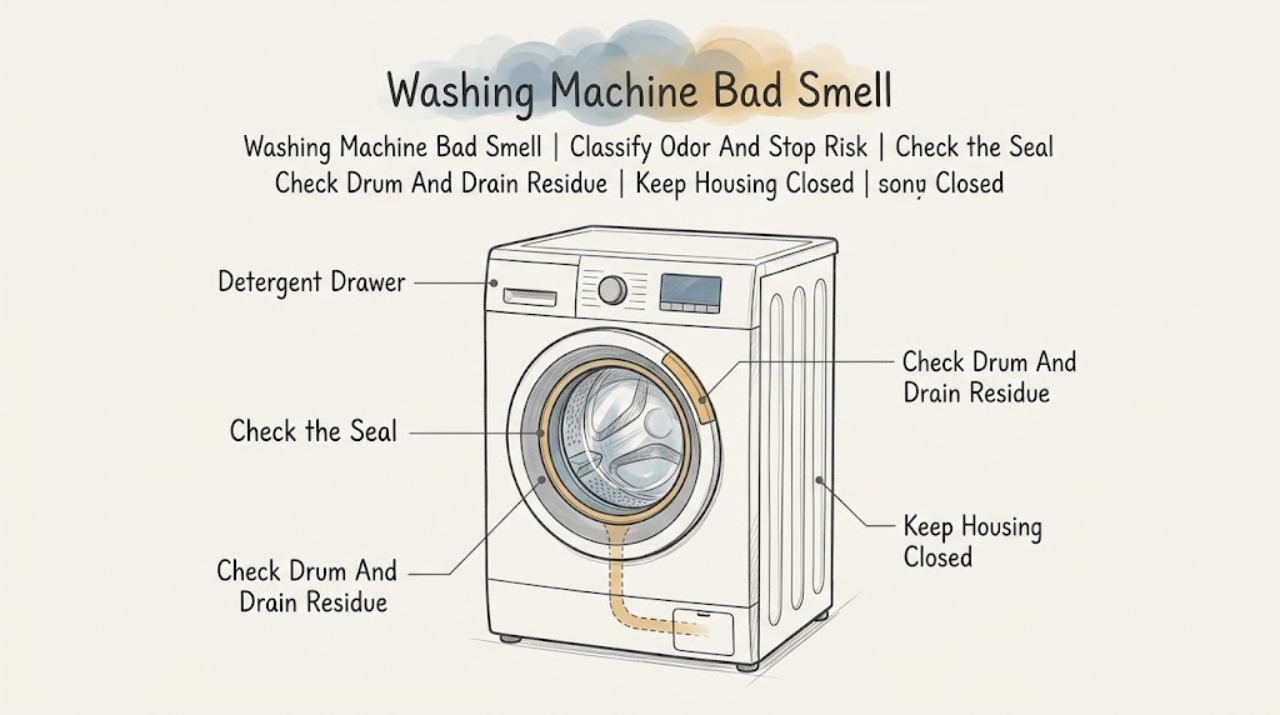
Work through in order
Diagnostic checks
Use only checks that match the exact appliance or system and its official guide.
-
Check 1
Stop the current cycle, ventilate the room, and identify the odor from a safe distance without leaning into the drum or touching hot parts. Check only visible areas around the door, drawer, lower service area, and power connection.
Expected result: Classify the smell as musty or sour, detergent or chemical, sewage-like, stagnant-water, burning or melting-plastic, or accompanied by smoke, heat, sparking, a leak, or an electrical trip.
Next step: For an ordinary musty odor, unplug only when the plug and outlet are dry and safely reachable, then continue with external cleaning checks. For a hazardous odor or visible damage, leave the washer isolated and arrange qualified service.
Stop if: Do not run another cycle, spray cleaner, or open panels after smoke, burning smell, sparking, shock, hot wiring, a leaking connection, or a repeated electrical trip.
Why this matters
Why: Musty or residue odors can follow the cleaning branch. Burning, smoke, abnormal heat, sparking, a strong chemical odor, or a water or electrical hazard is not a routine-cleaning symptom and requires immediate stop and service.
-
Check 2
With the washer off and cool, open the door and detergent drawer. Inspect the folds of the rubber seal, the drawer compartments, and the visible housing for trapped lint, hair, detergent or softener residue, standing water, mildew-like film, foreign objects, or a damaged seal.
Expected result: Record whether residue or trapped items are localized at the seal, drawer, or both, whether water remains, and whether the rubber is intact or torn, swollen, loose, or leaking.
Next step: Wipe the seal with a soft, damp cloth and clean the removable drawer with mild, model-approved care instructions. Leave the door and drawer open to dry when safe; request service for a torn seal, leak, or inaccessible buildup.
Stop if: Do not use abrasive, aggressive, or chlorine-containing cleaners on the rubber seal, force the drawer, or reach behind the seal into moving or electrical parts.
Why this matters
Why: Localized residue and retained moisture support a clean-and-dry branch. A damaged seal, persistent standing water, or a leak can make odor recur and may indicate a seal, drain, or installation fault rather than a surface-cleaning issue.
-
Check 3
Inspect the visible drum, door glass, detergent path, and accessible drain or pump-filter area using only the exact model manual's procedure. Place a shallow container and towels before opening an approved drain access because residual water may escape.
Expected result: Record greasy film, lint, stagnant water, blocked filter material, a sewage-like odor, or a clean and dry accessible path. Note whether the drain hose connection leaks or the filter cannot be reached without removing panels.
Next step: Clean only the accessible filter or drain area as the model manual directs, restore its cap or cover correctly, and clean any spill. If odor returns immediately, water remains, or the drain path is concealed, arrange service.
Stop if: Do not open a filter with the machine running, force a seized cap, reach into moving parts, use a water jet, or continue when water can reach electrical components.
Why this matters
Why: Greasy residue or retained water can support a musty smell. A blocked or foul drain path can reintroduce odor after cleaning, while an inaccessible or leaking path requires service rather than forceful disassembly.
-
Check 4
After the ordinary-access areas are clean and dry, run the exact model's documented drum-clean or suitable hot maintenance cycle with the Bosch-tested washer cleaner if the product instructions and model manual permit it; use the correct detergent amount for later laundry cycles.
Expected result: Observe whether the odor improves, remains at the door or drain area, becomes chemical or unusually strong, or is accompanied by foam, a leak, error, smoke, or abnormal heat.
Next step: Repeat only the maintenance interval documented by Bosch or the model manual, not an improvised series of chemical cycles. If odor remains after an approved cleaning, stop and arrange service.
Stop if: Do not use vinegar, citric acid, mixed cleaners, chlorine on the rubber seal, solvents, or a cleaning product not approved for the appliance; stop for smoke, burning smell, leak, or electrical abnormality.
Why this matters
Why: Improvement supports residue and moisture as the cause. No improvement or immediate recurrence suggests a hidden drain, seal, detergent, installation, or mechanical issue. A dangerous symptom ends the cleaning branch.
-
Check 5
After the cleaning cycle, wipe away visible moisture, leave the loading door and detergent drawer open in a child-safe condition, and monitor the next normal load without overusing detergent or repeatedly opening the door.
Expected result: Record whether the washer and laundry remain odor-free, the smell returns only after a drain or low-temperature cycle, the seal stays wet, or a new leak, noise, error, heat, or electrical symptom appears.
Next step: Maintain the model's cleaning and detergent guidance. If the odor returns after approved cleaning, if water remains, or if any hazardous symptom appears, stop using the washer and provide the technician with the odor location and cleaning history.
Stop if: Stop immediately for burning smell, smoke, sparking, shock, a hot cord or cabinet, water under the appliance, uncontrolled filling, or repeated error.
Why this matters
Why: An odor-free result supports residue and moisture retention as the original cause. A return tied to drainage or standing water suggests a drain or installation branch; a new burning or electrical symptom is a fault, not a maintenance result.
Use your observations
Decision map
Find the observation that best matches what you see, then follow the next safe action.
-
PATH 01Safety boundary
What you see
The smell is burning, electrical, melting plastic, hot rubber, chemical, or accompanied by smoke, sparking, heat, a leak, or a protective-device trip.
Do this next
Stop the washer, isolate power only from a dry and safe point, close the water tap if a leak is present, and arrange qualified appliance service.
Why this path and its safety boundary
Why it matters: This is not a routine washer-cleaning symptom and may involve electrical, mechanical, heating, or chemical hazards.
Safety stop: Do not restart the machine, spray deodorizer, open panels, or attempt a component replacement.
-
PATH 02Safety boundary
What you see
The odor is musty and residue or retained moisture is visible in the door seal, detergent drawer, or drawer housing.
Do this next
Clean the accessible parts with Bosch-approved care methods, dry them, and leave the door and drawer open when safe.
Why this path and its safety boundary
Why it matters: Residue and moisture retention are plausible contributors to the odor.
Safety stop: Do not use abrasive or chlorine cleaners on the seal, force parts, or continue if the seal is damaged or leaking.
-
PATH 03Safety boundary
What you see
The smell is strongest at the lower drain area, stagnant water remains, or odor returns after draining.
Do this next
Follow the exact model manual for an accessible filter or drain check, contain residual water, and request service for concealed, leaking, or blocked plumbing.
Why this path and its safety boundary
Why it matters: A drain filter, pump, hose, or installation issue may be retaining foul water and reintroducing the odor.
Safety stop: Do not force the pump cap, reach into moving parts, or open an access point while the washer is powered.
-
PATH 04Safety boundary
What you see
The machine has a musty odor, no hazard is present, and the seal, drawer, and accessible drain areas are clean.
Do this next
Run the documented drum-clean or maintenance cycle with the Bosch-tested washer cleaner when allowed by the manual, then dry the machine between uses.
Why this path and its safety boundary
Why it matters: Residue in the drum or tubes and repeated low-temperature or low-detergent washing remain plausible.
Safety stop: Do not use vinegar, citric acid, mixed products, or unapproved chemicals; stop for a new leak, error, smoke, or abnormal heat.
-
PATH 05Safety boundary
What you see
The smell returns after approved cleaning, water remains, the seal leaks, or the odor has no accessible source.
Do this next
Stop repeated cleaning experiments and arrange qualified Bosch appliance service with the odor location, cycle history, cleaning products, and visible findings.
Why this path and its safety boundary
Why it matters: A concealed drain, seal, bearing, pump, detergent-path, installation, or other appliance fault remains unresolved.
Safety stop: Do not dismantle the cabinet, replace a pump or seal from the smell alone, or continue operating when a leak or electrical symptom exists.
Helpful context
Understand the symptom
Musty odor and burning odor are different faults
A damp, sour, or stale smell that is strongest at the door seal, drawer, or drum often points to residue and moisture retention. A sharp electrical, melting-plastic, hot-rubber, or smoke smell is not a cleaning problem. Do not keep cycling the machine to see whether a dangerous odor disappears; stop and use the service branch.
Dry the places that retain residue
After a cycle, moisture can remain in the door seal, detergent drawer, and drum. Bosch recommends wiping the rubber seal with a soft, damp cloth and avoiding abrasive, aggressive, or chlorine cleaners. Leave the door and drawer open only when children and pets cannot access the machine, so the interior can dry between cycles.
Use Bosch-approved cleaning guidance
Bosch recommends its tested washer cleaner every few months for greasy residues and odor reduction. Follow the package and exact model manual. For limescale, Bosch specifically advises using its approved descaler instead of vinegar or citric acid; do not mix cleaning products or improvise a chemical combination.
Safety boundary
Stop conditions
- Stop immediately for a burning, electrical, melting-plastic, or chemical smell, smoke, sparking, shock, hot wiring, repeated electrical trip, or visible heat damage.
- Stop for water under the appliance, a leaking hose or seal, uncontrolled filling, or standing water that can reach electrical parts; close the water tap when appropriate.
- Do not open cabinet panels, probe wiring, reach into moving parts, or force a pump filter, drain connection, seal, or detergent drawer.
- Do not use vinegar, citric acid, mixed cleaners, solvents, abrasive products, or chlorine-containing products on the rubber seal unless the exact model documentation expressly permits them.
- Do not keep running cleaning cycles when the odor persists after an approved procedure or when the machine displays a repeated error.
Only after diagnosis
Potential parts
- washing-machine door seal
Consider this category only if inspection or qualified diagnosis confirms that the rubber seal is torn, distorted, loose, or leaking after ordinary cleaning.
Confirm the exact Bosch model and seal design with the manufacturer or technician before ordering; do not force the seal into place or continue using a leaking washer. - washing-machine drain pump or filter assembly
Consider this category only after qualified diagnosis confirms a pump or filter fault once accessible blockage, hose routing, and residual water causes have been checked.
Confirm the exact model, pump or filter configuration, electrical specification, and safe replacement procedure; do not replace an internal part from odor alone.
When checks do not resolve it
Need a professional?
Arrange qualified Bosch appliance service when a musty odor returns after approved cleaning, water remains or leaks, the door seal or drain path is damaged, the source is inaccessible, a repeated error appears, or the odor is burning, electrical, chemical, or accompanied by smoke, heat, sparking, or an electrical trip.
Safety scope: This article covers dry, ordinary-access inspection and Bosch-documented cleaning only. Isolate the washer for hazardous symptoms and leave electrical, heating, motor, bearing, pump, concealed drain, and cabinet work to qualified service.
Common questions
FAQ
Why does my Bosch washing machine smell musty?
Bosch says frequent low-temperature washing with too little detergent can allow odors to develop. Residue and moisture may remain in the door seal, detergent drawer, drum, or drain path. Clean accessible areas under the model manual and let the door and drawer dry open when safe.
Can I use vinegar to remove odor from a Bosch washer?
Bosch does not recommend vinegar or citric acid for descaling because they may degrade rubber parts. Use only the cleaner and procedure approved for the exact machine, and never mix cleaning products.
How do I clean the rubber seal on a Bosch washing machine?
With the machine off and cool, wipe the seal thoroughly with a soft, damp cloth. Bosch warns against abrasive, aggressive, or chlorine-containing cleaners, and a torn or leaking seal needs service rather than stronger chemicals.
Should I leave the Bosch washer door open after a cycle?
Yes, when the area is safe from children and pets. Leaving the loading door and detergent drawer open helps retained moisture dry. Follow the exact manual if your installation or model has a different instruction.
What if my Bosch washer smells like burning or melting plastic?
Stop the machine immediately. Isolate power only from a dry, safe point and do not restart, open panels, or run a cleaning cycle. Smoke, sparking, shock, heat damage, or a repeated electrical trip requires qualified appliance service.
Read the exact guide
Official sources
- How to Clean the Washing Machine DrumBosch Home Appliances · Bosch US owner support guidance for drum cleaning; use the exact model manual for program selection and access.
- Washing machineBosch Home Appliances · Bosch washing-machine manual for a model family; use the appliance's exact manual for access steps and controls.
- Descale the washing machine with household productsBosch Home Appliances · Bosch US owner support guidance for descaling; use the exact model manual and approved product instructions.
- Washing machine smellsBosch Home Appliances · Bosch support guidance for unpleasant washing-machine odors; exact cycle controls and care intervals remain model-specific.
- Cleaning Washing Machine Seal | Washing Machine TipsBosch Home Appliances · Bosch US owner support guidance for cleaning the washer rubber seal; exact seal access and replacement remain model-specific.
Community feedback
Share a repair observation
Share a plain-text repair observation. Accepted observations are published automatically; this page may take a moment to update.