
On this page
Start here
Quick answer
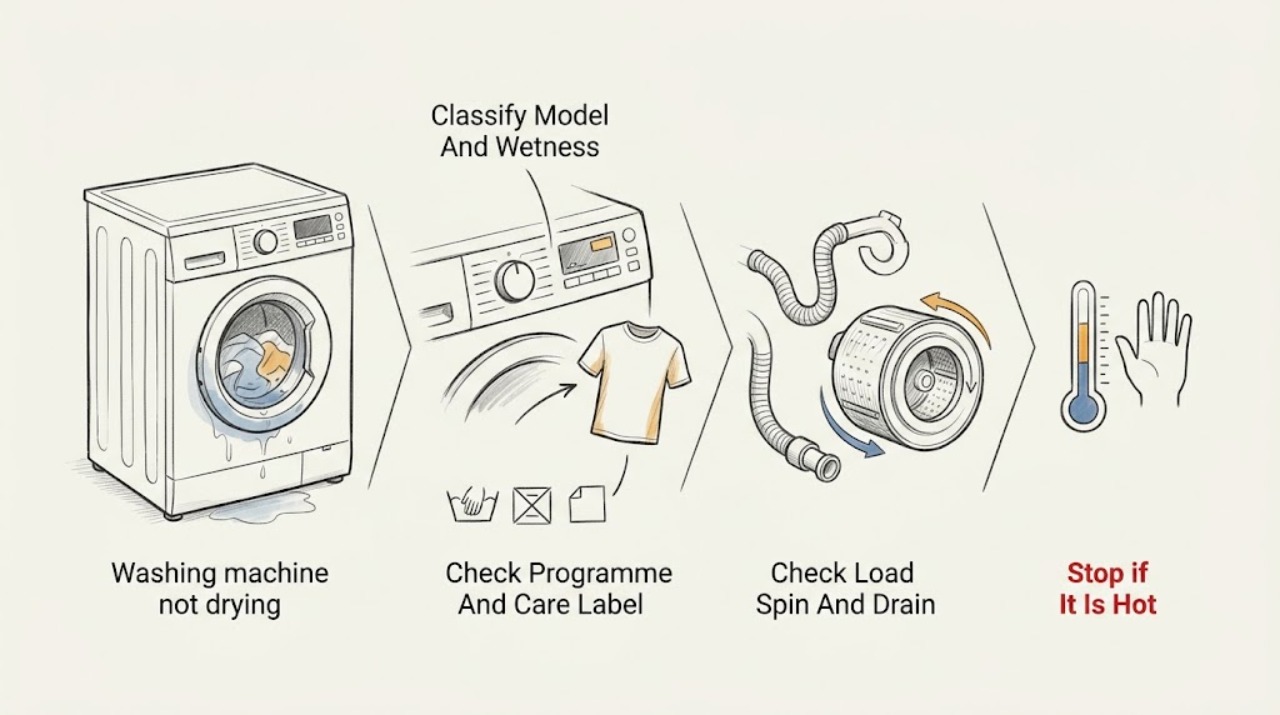
First determine whether this Beko is a washer only or a washer-dryer, and whether the clothes are merely wet after spin or still wet after a completed drying programme. For wet clothes after washing, check that the machine drained, the load was balanced, the selected spin speed was allowed, and excess foam or an overloaded drum did not prevent effective extraction. For a washer-dryer, confirm that drying was actually selected, the tap is open if the model uses water during drying, the load and programme match the manual, and the clothes are suitable for drying. Do not force a locked door, reach into a moving drum, open panels, or assume a dryer filter or programme applies to every Beko model. If the machine leaves water, will not spin, shows an error, smells hot, leaks, or remains unable to dry after model-approved checks, stop and contact an authorised service agent.
Work through in order
Diagnostic checks
Use only checks that match the exact appliance or system and its official guide.
-
Check 1
After the programme has ended and the drum is safe to access, record the Beko model from its label or paperwork and classify the result as a washer-only load wet after spin, a washer-dryer load wet after drying, or a drying programme that never started.
Expected result: Note whether water remains in the drum, the spin completed, the drying option was shown, the door-lock indicator remains active, and the clothes are dripping wet or only slightly damp after cooling.
Next step: Use the exact model manual to choose the matching branch; do not force the door or add a drying programme that the model does not support.
Stop if: Stop for a locked door that will not release after the manual's cooling and safety behavior, standing water that cannot be drained safely, smoke, burning odor, or a damaged cord.
Why this matters
Why: Dripping clothes with incomplete draining or no spin point first to extraction. Clothes that remain wet after a completed drying step point toward programme, load, tap, spin, or drying-system checks. A washer-only machine has no drying function to troubleshoot.
-
Check 2
For a washer-dryer, verify from the control display and exact manual that the drying function was selected after washing, the selected programme supports drying, and the garments' care labels permit the selected drying treatment.
Expected result: Record drying not selected, drying unavailable for the programme, an unsuitable garment-care symbol, a timed or sensor option that differs from the intended result, or a valid drying selection.
Next step: Run only the model-approved drying option with a compatible load; keep incompatible garments out of the machine rather than overriding the care label.
Stop if: Do not select a heat programme for garments marked unsuitable, override a lock or error, or use a programme whose load limits are unknown.
Why this matters
Why: Beko identifies an unselected drying step and an unsuitable programme or garment type as explanations for laundry coming out wet. If the selection is valid, the next decision shifts toward load size, spin extraction, water supply, filters, or a technical fault.
-
Check 3
For clothes wet after washing or drying, inspect the load distribution and drum state without reaching into a moving machine; note whether the load is a single bulky item, overloaded, foamy, or accompanied by water left in the drum.
Expected result: Record an uneven load, excess suds, incomplete drain, a low or unavailable spin speed, or a balanced load that drained and spun normally.
Next step: After the machine is stopped and safe, follow the model manual to rearrange a suitable load, use the permitted spin option, or address excess detergent; if water remains, check only the manual-approved drain-hose and pump-filter access.
Stop if: Do not spin an unstable or overloaded load, force the door, reach into the drum, or open a pump filter while water can escape onto an unsafe floor.
Why this matters
Why: Beko says unbalanced loads can stop the spin step, excess foam can interrupt spinning, and incomplete draining prevents spinning. Insufficient spin leaves more water for any later drying step; a normal spin shifts attention away from extraction.
-
Check 4
On a washer-dryer only, verify from a safe external position that the water tap is open as required by the exact drying programme, the inlet hose is not visibly kinked, and any user-accessible drying or lint filter is clean according to the manual.
Expected result: Record a closed tap, kinked inlet, filter warning, clean accessible filter, or a model whose drying programme does not use the checked feature.
Next step: Restore only an obviously closed tap or displaced external hose when safe and permitted, clean only the filter named in the manual, and run one compatible light load; service a persistent failure.
Stop if: Do not dismantle inlet valves, heater ducts, fans, sensors, or panels, and do not assume a tumble-dryer filter procedure applies to this washer-dryer model.
Why this matters
Why: Beko's drying-programme documentation says some washer-dryers use water during drying, so a closed tap can prevent that programme from operating. A clean filter and open water supply make load, programme, spin, sensor, heater, or control faults more likely.
-
Check 5
After the manual-approved programme, load, spin, tap, and filter checks, run one compatible test and compare the result only after the clothing has cooled; document the programme, load type, final moisture, water state, noise, and any code.
Expected result: Record dry or acceptably damp clothing, dripping clothes after a completed spin, wet clothes after a completed drying step, a cycle that stops, a returning error, a leak, or unusual heat or smell.
Next step: Stop testing and contact an authorised service agent with the model, programme, load, result, code, and checks already completed; do not order a heater or pump from the symptom alone.
Stop if: Stop immediately for smoke, burning smell, electrical arcing, water near electrical parts, a damaged cord, repeated error, or an unsafe locked-door condition.
Why this matters
Why: A successful light-load result supports a selection, balance, overload, foam, spin, or tap issue. Persistent wetness after valid settings and supply checks points to a drain, pump, heater, fan, sensor, control, or other model-specific technical fault.
Use your observations
Decision map
Find the observation that best matches what you see, then follow the next safe action.
-
PATH 01Safety boundary
What you see
The model is a washer only and the clothes are wet after the wash programme's spin.
Do this next
Follow the extraction branch and use a separate dryer or air-dry the load as appropriate; do not search for a drying heater in a washer-only model.
Why this path and its safety boundary
Why it matters: There is no drying function to repair; the result depends on draining, load balance, foam, spin speed, and the selected wash programme.
Safety stop: Stop if the machine leaves water, will not spin, leaks, or shows a recurring error.
-
PATH 02Safety boundary
What you see
The machine leaves a bulky or uneven load wet, shows excess foam, or uses a low or unavailable spin setting.
Do this next
Use the exact manual to rebalance a suitable load, use the permitted spin option, and follow detergent dosing guidance; service persistent problems.
Why this path and its safety boundary
Why it matters: Beko's guidance makes load balance, detergent foam, and insufficient spin plausible causes of high residual moisture.
Safety stop: Do not force a high-speed spin on an unsuitable load or operate with a door or drum problem.
-
PATH 03Safety boundary
What you see
Water remains in the drum or the machine stops before spin, even though the drying function was not the main symptom.
Do this next
Turn the machine off and use only the model-approved drain-hose and pump-filter checks; request service if water remains or the path is inaccessible.
Why this path and its safety boundary
Why it matters: Beko says spinning will not start if water has not drained completely; a bent or clogged drain hose, pump filter, or drain fault is more likely than a drying heater issue.
Safety stop: Do not open the pump filter with uncontrolled water, reach into the drum, or pull the appliance through a wet floor.
-
PATH 04Safety boundary
What you see
A washer-dryer finishes washing but does not dry because drying was not enabled, the programme is unsuitable, the tap is closed, or the load exceeds the model's permitted conditions.
Do this next
Select a model-supported drying option, confirm the care label, use a compatible load, and keep the tap open when the exact programme requires water.
Why this path and its safety boundary
Why it matters: This is a programme, water-supply, garment-care, or load issue rather than proof of a failed heater or sensor.
Safety stop: Do not override the care label, exceed the manual's load guidance, or change a programme while the door is locked.
-
PATH 05Safety boundary
What you see
The washer-dryer has a valid programme and load, the spin and tap checks are normal, but clothes remain wet after the drying step and cooling.
Do this next
Stop repeating hot cycles and contact an authorised service agent with the model, programme, load, final moisture, and any code; do not replace a component by guesswork.
Why this path and its safety boundary
Why it matters: A technical issue involving airflow, filter path, heating, sensors, controls, or another model-specific drying component becomes more likely.
Safety stop: Stop for unusual heat, smoke, burning smell, a leak, repeated error, or a door that remains locked beyond the manual's cool-down behavior.
-
PATH 06Safety boundary
What you see
The model cannot be identified, the documented steps conflict with the controls, the door will not safely unlock, or the machine leaks, overheats, smells burnt, or shows a recurring error.
Do this next
Leave the appliance off and contact an authorised service agent with the model identity and observed symptoms.
Why this path and its safety boundary
Why it matters: The available generic guidance is no longer enough; forcing a door or applying another Beko model's procedure could create injury or equipment damage.
Safety stop: Do not open panels, defeat a door lock, handle wiring or heaters, or continue a hot or leaking cycle.
Helpful context
Understand the symptom
Not every Beko washing machine can dry
The phrase washing machine not drying can describe two different outcomes. A washer-only model removes water during spin but does not heat-dry clothing. A washer-dryer has a separate drying option and may use water during that programme. Check the controls, model label, and manual before following drying instructions; do not infer a feature from the presence of a spin cycle.
Clothes wet after spin point to extraction first
If the drum completed washing but the load is dripping wet, check whether water remains, whether the load was uneven, whether too much foam was produced, and which spin speed the selected programme permits. Beko says an uneven load can cause the machine to stop spinning to prevent damage, and incomplete draining also prevents the spin step. These are different from a failed heating or drying function.
Washer-dryer drying depends on programme, load, spin, and water
On Beko washer-dryer models, the drying option must be selected for the programme, the load must suit the care label and model capacity, and a stronger permitted spin can reduce the moisture entering the drying step. Beko documentation also warns that some drying programmes use water, so the tap may need to remain open. Exact options and capacities vary by model.
Heat, door-lock, and electrical boundaries matter
A door can remain locked after drying while the machine cools, and Beko warns not to repair a nonfunctional product yourself when the documented checks do not resolve it. Stop for a burning smell, smoke, a hot or damaged cord, a leak, repeated error, or a door that stays locked; leave internal electrical, heater, fan, sensor, and control diagnosis to an authorised service agent.
Safety boundary
Stop conditions
- Stop immediately for smoke, burning smell, electrical arcing, a damaged or hot cord, water near electrical parts, or a recurring error; isolate the appliance only from a safe accessible control and arrange service.
- Do not force a locked door, reach into a moving or hot drum, open panels, handle heaters or wiring, or bypass a door or safety interlock.
- Do not assume a washer-only machine has a drying function, or apply a tumble-dryer procedure to a washer-dryer without checking the exact model manual.
- Keep the machine off for a leak, uncontrolled water, drum or door damage, or a cycle that repeatedly stops with water remaining.
- Stop routine checks when the programme, load, spin, tap, and user-accessible filter checks do not restore drying; contact an authorised service agent.
Only after diagnosis
Potential parts
- Beko washer-dryer lint or filter component
Consider only when the exact manual identifies a user-serviceable filter and it is damaged or cannot be restored after cleaning.
Match the exact Beko model and manual; do not substitute a tumble-dryer filter for a washer-dryer part. - Beko drain hose or pump component
Consider only when incomplete draining is confirmed and an authorised diagnosis identifies a damaged hose or pump.
Confirm exact model and safe access before replacement; residual water and door-lock behavior can make this service-sensitive. - Beko washer-dryer heater, fan, sensor, or control component
Consider only after an authorised service diagnosis confirms the specific component in a valid programme and load.
Drying components and electrical compatibility are model-specific; do not order or fit a part from the symptom alone.
When checks do not resolve it
Need a professional?
Contact an authorised Beko service agent when clothes remain wet after a valid washer-dryer programme and model-approved checks, the machine will not drain or spin, water remains, a drying cycle stops, an error returns, the door remains locked, there is a leak or unusual heat, or internal heater, fan, sensor, control, pump, or electrical diagnosis is needed. Provide the exact model, programme, load, spin setting, tap state, final moisture, and any code.
Common questions
FAQ
Does a Beko washing machine have a drying function?
Only a washer-dryer model has a drying step; a washer-only model removes water through spin but does not heat-dry clothes. Confirm the model and controls in the exact manual before troubleshooting drying.
Why are clothes still wet after a Beko wash cycle?
Check whether water remained, the load was uneven, excess foam interrupted spin, or the programme used an insufficient permitted spin speed. Beko says incomplete draining and unbalanced loads can prevent or reduce extraction, leaving clothes wetter for any later drying step.
Why does a Beko washer-dryer finish with wet clothes?
Verify that drying was selected, the programme and load suit the care label and model, the wash spin extracted enough water, and the tap is open when that drying programme uses water. If a valid programme still leaves clothes wet after cooling, contact an authorised service agent.
Read the exact guide
Official sources
- How to fix a tumble dryer that’s not dryingBeko · Beko separate tumble-dryer programme, lint-filter, load, and model-manual distinction
- How to fix a washing machine that won’t spin?Beko · Beko washing-machine spin extraction, load balance, foam, drain, hose, pump, and service troubleshooting
- Drying ProgrammesBeko · Beko washer-dryer drying programme selection, water use, and spin behavior
- TroubleshootingBeko · Beko washer-dryer wet laundry, drying selection, load, spin, tap, door-lock, and service guidance
Community feedback
Share a repair observation
Share a plain-text repair observation. Accepted observations are published automatically; this page may take a moment to update.