
On this page
Start here
Quick answer
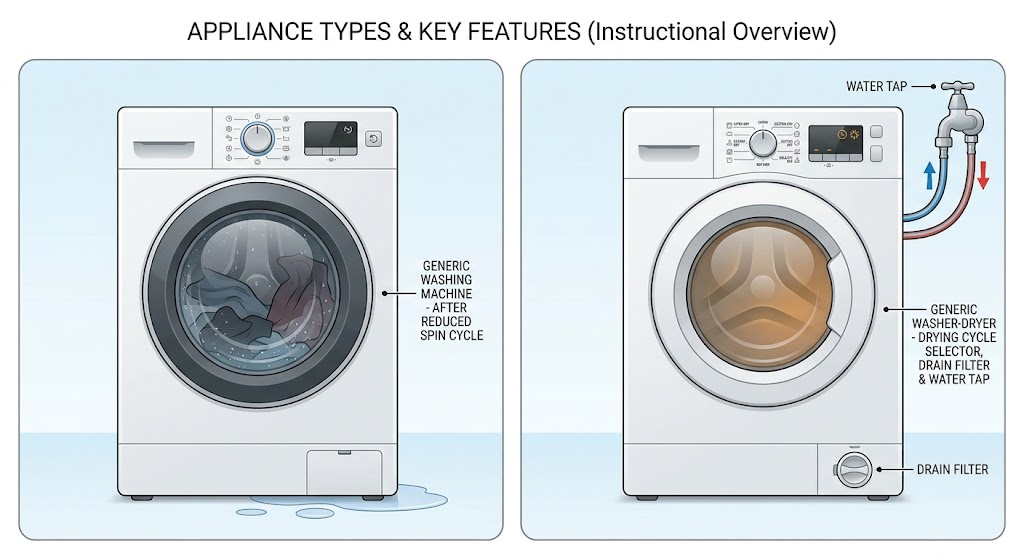
An AEG washing machine normally washes and spins; if clothes are wet at the end, the first question is whether the machine skipped or reduced its final spin, not whether a dryer heater failed. AEG lists load imbalance, Rinse Hold, levelling, a blocked drain filter, and installation issues as causes of wet laundry after washing. Check the selected programme and spin setting, redistribute an uneven load, inspect the visible drain path, and run one supervised empty Spin/Drain or spin-only test. If the appliance is actually an AEG washer-dryer and the dampness remains after a drying programme, use the washer-dryer branch: confirm the water tap is on, the drying load is within the smaller drying limit, the applicable air and drain filters are clear, and the selected drying cycle matches the fabric. Do not assume the recent symptom identifies a component, and do not open panels or test heaters, motors, or live wiring. Stop for a leak, hot or burning smell, damaged cord, repeated electrical trip, trapped water that cannot be drained safely, or a recurring error, and arrange authorized appliance service.
Before you begin
Safety first
- Keep the machine disconnected for filter or drain work, let hot water cool, do not open panels or test live components, do not bypass the door lock or interlocks, and do not run the appliance after a leak, electrical hazard, or uncontrolled water event until it has been evaluated.
Work through in order
Diagnostic checks
Use only checks that match the exact appliance or system and its official guide.
-
Check 1
Identify the AEG model from the rating plate or manual and record whether the completed programme was wash-only, Spin/Drain, or a documented wash-and-dry programme. Check the programme table for whether the model has a drying function; do not infer it from the word 'dry' in a cycle name.
Expected result: The model is a washing machine with no drying programme, it is a washer-dryer, or the model and programme are uncertain.
Next step: Use the washing-machine branch unless the manual confirms a drying cycle. Keep the model number for any service request and do not substitute washer-dryer procedures for a washing-machine spin problem.
Why this matters
Why: A wash-only machine leaving clothes wet is primarily a spin or drain question. A washer-dryer that remains damp after drying has additional water, load, filter, cycle, and drying-system checks. Uncertain model identity prevents safe part or cycle assumptions.
-
Check 2
For a wash-only result, select the documented Spin or Spin/Drain programme with a small, evenly distributed load—or an empty drum if the manual permits—and observe whether the drum accelerates, drains fully, and completes without an error. Do not force the door or reach into a moving drum.
Expected result: The empty or small-load spin completes, the drum rotates slowly and stops, water remains, or an error such as EF5 repeats.
Next step: Use one supervised test only. If the appliance fails with an empty or normally loaded drum, stop repeated cycles and arrange AEG service; do not open the cabinet or attempt motor or control testing.
Why this matters
Why: A successful empty or balanced spin makes a load-distribution or programme-option issue more likely. Failure with an empty drum, remaining water, repeated imbalance alert, or unusual mechanical noise makes a drain, motor, suspension, sensor, or control fault more likely.
-
Check 3
Redistribute laundry, remove a single bulky item, and reduce an overloaded drum before one spin attempt. Check that the appliance stands on a firm, level floor and that any recent installation followed the AEG instructions, including removal of transit bolts where applicable.
Expected result: The load is tightly packed, one heavy item is gathered on one side, the machine rocks, the floor flexes, or transit hardware may remain; alternatively the load and installation appear normal.
Next step: Make only the accessible load or level correction described by the manual, then run one spin test. Stop if the machine walks, bangs, leaks, or continues to refuse spin with a balanced load.
Why this matters
Why: AEG says imbalance, overloading, very small or single-item loads, unstable flooring, and installation issues can prevent the machine from reaching spin speed. A normal load and stable installation shift attention to drainage or an internal fault.
-
Check 4
Check the display for Rinse Hold or another option that intentionally leaves the final rinse and spin incomplete. Confirm the selected spin speed and programme against the fabric and manual, then run the documented Drain or Spin programme once.
Expected result: Rinse Hold is selected, the final rinse water remains, spin speed is reduced or disabled, or no such option is active.
Next step: Choose the documented drain or spin completion option only if no leak or hazard exists. Do not repeatedly restart a programme that leaves standing water or displays an error.
Why this matters
Why: Rinse Hold can intentionally skip the final spin and leave water in the drum, so wet laundry may be normal for that option. With no hold or reduced-spin selection, drainage, imbalance, installation, or a fault remains more likely.
-
Check 5
If water remains in the drum or Spin/Drain does not complete, disconnect mains power, allow hot water to cool, and inspect only the model-accessible drain filter and visible drain hose according to the AEG manual. Use a shallow container for water and reinstall the filter correctly.
Expected result: The filter is blocked with lint or objects, the drain hose is kinked, the pump makes an unusual sound, the filter is clear, or water still cannot drain.
Next step: Stop if the filter is hot, seized, damaged, or releases uncontrolled water. Do not reach into a pump, remove internal hoses, or run the appliance with a loose filter; arrange authorized service for persistent no-drain symptoms.
Why this matters
Why: AEG links blocked filters, kinked hoses, and pump issues to poor drainage and spin failure. A clear visible path with continued no-drain or pump symptoms makes a concealed pump, hose, sensor, or control issue more likely.
-
Check 6
Only if the model has a documented drying function and the clothes remained damp after a drying programme, turn on the water tap, check applicable air and drain filters, reduce the drying load below the wash capacity, and select the correct drying cycle and fabric-care setting. Follow the manual for any model-specific filter access.
Expected result: The water tap is off, the drying load exceeds the smaller drying capacity, an applicable filter is clogged, the cycle does not match the fabric, or all visible settings are correct.
Next step: Run one supervised documented drying test only if there is no leak, overheating, or burning smell. Stop and arrange service if the cycle will not heat or dry, an error returns, or the model is not confirmed as a washer-dryer.
Why this matters
Why: AEG says washer-dryers may need water during drying, have a smaller drying load than washing, and require clear filters and a suitable cycle. If those conditions are correct but the drying programme remains damp, an internal drying or control fault is possible.
Use your observations
Decision map
Find the observation that best matches what you see, then follow the next safe action.
-
PATH 01Next step
What you see
Do this next
Check the selected spin option, redistribute the load, verify stable installation, and inspect the accessible drain path before one supervised Spin/Drain test.
-
PATH 02Next step
What you see
Do this next
Use smaller, evenly distributed loads and the documented spin option. If normal loads later fail, record the programme and arrange service rather than repeatedly increasing spin settings.
-
PATH 03Next step
What you see
Do this next
Stop repeated programmes and arrange AEG authorized service with the exact code and test result. Do not open the cabinet or test live components.
-
PATH 04Next step
What you see
Do this next
Disconnect power and let water cool before the manual's accessible filter procedure. Stop for a seized filter, uncontrolled water, or persistent no-drain and arrange service.
-
PATH 05Next step
What you see
Do this next
Check those model-documented conditions once. If the drying programme still fails or an error returns, arrange AEG service without opening the dryer or heater compartment.
-
PATH 06Next step
What you see
Do this next
Read the model manual or rating plate and use the washing-machine spin/drain path until a drying function is documented. Arrange service if the model information is inaccessible or the appliance is malfunctioning.
-
PATH 07Next step
What you see
Do this next
Stop the programme, disconnect power only if it can be done without contacting water or damage, close the water tap when safe, keep clear of the appliance, and obtain authorized appliance or electrical service. Do not restart it to collect more evidence.
Helpful context
Understand the symptom
First decide whether this is a washing machine or a washer-dryer
The assigned problem says not drying, but a washing machine without a drying programme can only leave clothes wetter or drier after its spin. AEG treats wet laundry after washing as a spin and drain issue. Only use drying-cycle checks if the model has a documented drying function and the clothes were still damp after that drying programme. Do not rename the appliance or infer a dryer fault from wet laundry after a wash-only cycle.
Wet after spin is not the same as wet after drying
A skipped final spin may leave water in the drum and clothes saturated. A washer-dryer can also have a separate drying load, water, filter, cycle, or fabric-setting issue. Record which programme ran, whether water remained in the drum, whether the drum accelerated to spin speed, and whether the model actually has a drying cycle before choosing the next check.
Keep drain and electrical work within the safe boundary
Disconnect the appliance before accessing a drain filter and let hot water cool. Keep a tray and towels ready for expected water, follow the model manual, and stop if the filter is seized, the machine is full of hot water, a hose or cord is damaged, or water reaches an electrical connection. Internal pump, motor, heater, suspension, and control diagnosis belongs to an authorized service professional.
Safety boundary
Stop conditions
- Stop and disconnect mains power only from a dry, safe position if there is a burning smell, hot or damaged cord, smoke, sparks, repeated electrical trip, visible water near an electrical connection, or abnormal heat. Arrange authorized appliance or electrical service.
- Stop before opening a drain filter if the water may be hot, the filter is seized, water is uncontrolled, the appliance is moving, or the manual's access procedure is unavailable. Do not reach into a pump or moving drum.
- Do not open cabinet panels, test live voltage, bypass the door lock, defeat a safety interlock, open a heater or motor compartment, or alter internal wiring as a homeowner check.
- Do not continue running a machine that leaks, retains water after the documented drain procedure, repeatedly shows an error, bangs or walks, or fails an empty spin test. Do not treat one successful cycle as proof of a durable repair.
- If the model is not confirmed as a washer-dryer, do not apply drying-heater or air-filter procedures; identify the appliance from its manual or arrange authorized service.
Only after diagnosis
Potential parts
- AEG drain pump or drain-path component
Consider only after a clear filter and hose still leave water in the drum or a qualified diagnosis confirms a pump or drain-path failure.
Confirm the complete AEG model and pump configuration; a wet load after a skipped spin does not identify a drain-pump part. - AEG suspension or drive component
Consider only when the machine repeatedly fails an empty or balanced spin test, has confirmed mechanical symptoms, and qualified diagnosis identifies suspension or drive failure.
Confirm model, revision, and service diagnosis before selecting a part; do not infer motor or suspension replacement from wet laundry alone. - AEG washer-dryer drying-system component
Consider only for a confirmed washer-dryer that passes spin and drain checks but remains damp after the documented water, load, filter, and cycle checks and receives a qualified drying-system diagnosis.
Do not use this category for a washing-machine-only model; confirm the exact AEG model and drying-system configuration before any part decision.
When checks do not resolve it
Need a professional?
Arrange AEG authorized appliance service when the machine fails Spin/Drain with a balanced or empty drum, a drain path is clear but water remains, EF5 or another error repeats, unusual mechanical noise occurs, or the appliance has a confirmed drying programme that still leaves laundry damp after its water, load, filter, and cycle checks. Use urgent service for leaks, uncontrolled water, burning smell, damaged cord, smoke, sparks, repeated electrical trips, or a locked/seized filter or door.
Safety scope: Keep the machine disconnected for filter or drain work, let hot water cool, do not open panels or test live components, do not bypass the door lock or interlocks, and do not run the appliance after a leak, electrical hazard, or uncontrolled water event until it has been evaluated.
Common questions
FAQ
Does an AEG washing machine actually dry clothes?
A standard washing machine washes, drains, and spins; it does not have a separate drying programme. If clothes are wet after washing, troubleshoot the final spin and drain. Use drying-cycle checks only after the AEG manual confirms the appliance is a washer-dryer.
Why are my AEG clothes still wet after the wash?
AEG lists imbalance, Rinse Hold, levelling or unstable flooring, a blocked drain filter, and installation issues as common reasons for reduced or cancelled spin. Check the selected option, redistribute the load, and verify drainage before arranging service if the problem repeats.
What if water is still in the AEG drum?
A blocked filter, kinked drain hose, or pump issue can prevent drainage and spin. Disconnect mains power, let hot water cool, and follow the model manual for the accessible drain procedure. Stop for uncontrolled water, a seized filter, or persistent no-drain and arrange service.
Why does my AEG washer-dryer wash but not dry?
For a confirmed washer-dryer, AEG directs you to check that the water tap is on, the applicable filters are clear, the drying load is smaller than the wash load, and the cycle matches the fabric. If those checks are correct and clothes remain damp, arrange service.
Should I run an empty spin test?
AEG describes an empty spin-only test as a way to help separate a laundry-load problem from an appliance problem. Run only one supervised documented test; stop if the drum fails to accelerate, an error returns, the machine bangs or walks, or water cannot drain.
When should I stop troubleshooting an AEG machine with wet laundry?
Stop for a leak, uncontrolled or hot water, burning smell, smoke, sparks, a damaged cord, repeated electrical trips, a seized filter or door, recurring errors, or failure of a balanced or empty test. Arrange authorized appliance service rather than opening panels or replacing parts by symptom.
Read the exact guide
Official sources
- Drying cycle of washer dryer takes too long, too short or not drying at allAEG · Applies only to AEG washer-dryers with a documented drying function; exact filter and programme details vary by model.
- Washing Machine Not Draining? How to Drain It Quickly & Fix IssuesAEG · AEG support guidance for models with an accessible filter or drain procedure; follow the exact model manual.
- User ManualAEG · Opened AEG manual for a specific model family; use the installed model's manual for exact access, loads, and programmes.
- AEG Washing Machine Does Not Spin – Causes and SolutionsAEG · AEG support guidance for front-load, top-load, and washer-dryer models; exact programmes and codes vary by model.
Community feedback
Share a repair observation
Share a plain-text repair observation. Accepted observations are published automatically; this page may take a moment to update.