
On this page
Start here
Quick answer
First confirm that the Hoover appliance is a washer-dryer and that a drying programme is selected; a washing-only model cannot dry clothes. On a Hoover washer-dryer, the drying load is smaller than the wash load, so remove part of a full drum, use a fabric-appropriate programme, and make sure the wash has spun the water out. Check for standing water or a drain indication and follow the exact model manual before cleaning an accessible pump filter. Hoover washer-dryers do not use a separate tumble-dryer fluff filter; fluff is carried away with drain water. Disconnect power before examining the appliance, and arrange qualified appliance repair if a reduced load still will not dry, the appliance does not heat, a code or leak appears, or there is overheating, burning odor, smoke, or electrical damage.
Work through in order
Diagnostic checks
Use only checks that match the exact appliance or system and its official guide.
-
Check 1
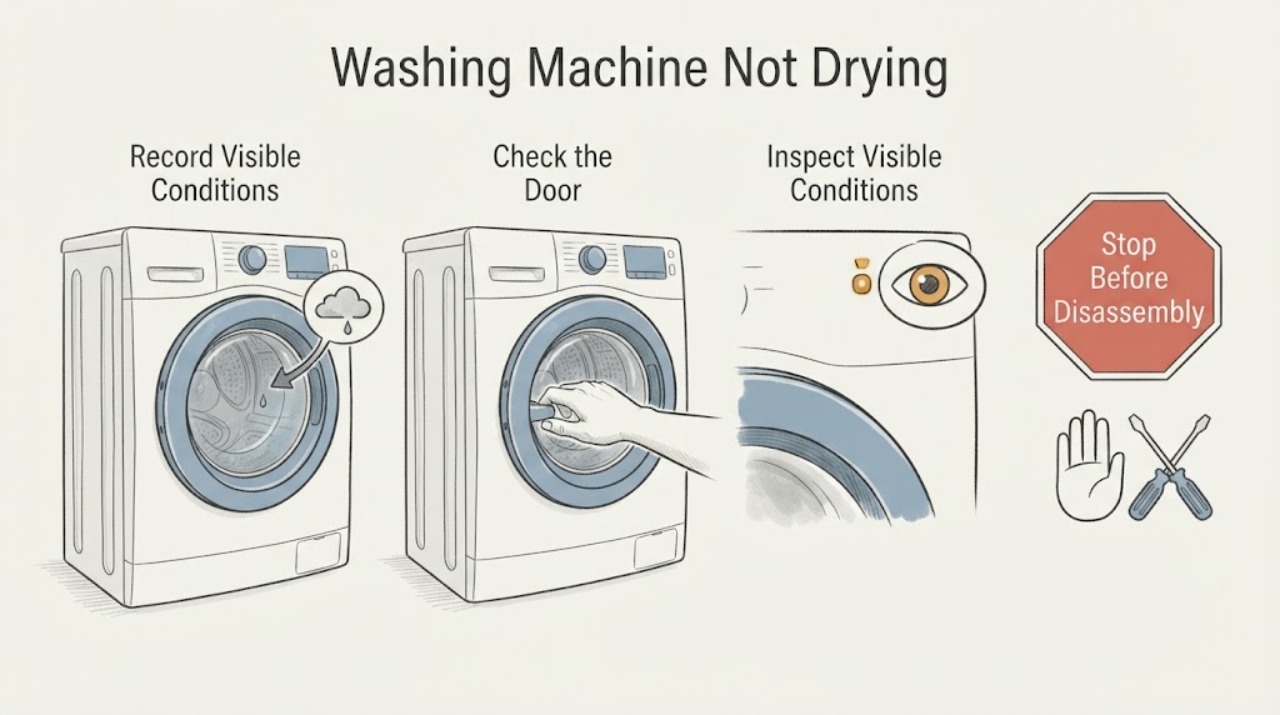
Record the full Hoover model number from the rating label and confirm whether the appliance has a drying programme. From outside the machine, note the selected programme, drying time or dryness setting, whether the cycle completes, whether clothes are damp or dripping, and any code, flashing light, or leak.
Expected result: The controls show no drying programme, a drying programme is available, the cycle ends early, the clothes are saturated, or a code or leak is present.
Next step: If no drying function exists, use an external drying method. If drying exists, continue with the load and extraction checks using the exact Hoover manual. Stop for a leak or unsafe electrical symptom.
Why this matters
Why: A wash-and-spin-only model has no drying function. On a washer-dryer, the pattern separates a capacity or spin problem from a programme, drain, heating, sensor, or safety problem; the model number is needed for exact controls and access.
-
Check 2
With the cycle stopped, compare the amount of laundry with the Hoover manual's drying capacity, not just its wash capacity. Remove part of a full drum and separate bulky, absorbent, or heat-sensitive items; do not force the door or run a visibly packed drum.
Expected result: The load is at or below the drying limit, the load is larger than the drying limit, or a single small item is being tested on a sensor-dry setting.
Next step: Test one reduced, mixed load on the manual-approved drying programme. If the reduced load dries normally, the prior symptom was a load-size or load-composition issue; if it remains wet, continue to the spin and drain checks.
Why this matters
Why: A washer-dryer may wash more than it can dry. An overloaded drum limits tumbling and moisture removal, while a single item can be a poor sensor-dry test and may finish with an inaccurate dryness result.
-
Check 3
Check the wash result before drying: after the spin phase, look at whether water is dripping from the clothes and whether the drum completed a normal spin. If the exact model offers a spin-only programme, run it only with a balanced, fabric-suitable load and the door closed; do not reach into a moving drum.
Expected result: Clothes are only damp, clothes are dripping wet, the spin never starts or stops with an unbalanced indication, or spin completes normally.
Next step: Redistribute a visibly uneven load and use the model-approved spin setting once. If the drum cannot spin, repeatedly reports imbalance, or leaves the clothes saturated, inspect only the model-approved drain path and arrange service if it persists.
Why this matters
Why: Dripping clothes point first toward incomplete extraction, an unbalanced load, or a drain problem rather than insufficient drying heat. Normal spinning makes the drying programme, load, drain, heating, or sensing path more likely.
-
Check 4
Look for standing water in the drum, a drain warning, slow draining, or a pump sound without water leaving. With the appliance stopped, cool, and disconnected from power through its normal accessible plug, inspect the visible drain hose for a kink and clean the pump filter only if the exact Hoover manual identifies it as user-accessible; use towels or a shallow container for residual water.
Expected result: Water remains in the drum, the hose is kinked, the filter is blocked, the drain path is clear, or the filter location and procedure are not identified for this model.
Next step: Correct only an obvious external hose position and follow the exact model's filter procedure. Refit the filter securely, check for leaks, and run one monitored drain or spin. If water remains, the pump is silent or only hums, a code returns, or access is unclear, keep the machine off and request appliance service.
Why this matters
Why: Water left after the wash can prevent proper spinning and make the drying phase ineffective. A blocked filter or restricted hose is possible, but a clear path does not prove the pump, control, or internal hose is sound.
-
Check 5
Check the selected drying programme and fabric suitability against the exact Hoover manual. Confirm that the door closes and the programme is allowed to run for its specified time; clean and dry the accessible door seal and remove only lint or objects visible at the opening. Do not search for or remove a separate tumble-dryer fluff filter on a Hoover washer-dryer.
Expected result: The programme is a dry-only or suitable combined cycle, the setting is unsuitable or too short, the door will not latch, the seal is obstructed, or no separate fluff filter exists.
Next step: Choose a manual-approved drying programme and a reduced load, then monitor one cycle. If the door will not latch or the correct programme will not run, do not bypass the lock; arrange qualified service.
Why this matters
Why: A wrong programme, unsuitable fabric setting, short selected time, or door-closure problem can stop or limit drying. Hoover says washer-dryers do not have a separate tumble-dryer fluff filter; the absence of one is normal.
-
Check 6
Run one controlled test with a reduced, balanced, fabric-suitable load after the safe external checks. Observe whether the drum tumbles, whether the cycle completes, whether clothes become warm and progressively drier, and whether a code, unusual noise, leak, or excessive heat appears. Stay nearby and stop if the appliance behaves abnormally.
Expected result: The reduced load dries, remains cold and wet, dries only partly, the programme ends early, or the appliance shows a fault or hazard.
Next step: Do not repeat cycles to force a result. Record the model, programme, load size, spin and drain observations, and any code or temperature symptom, then arrange qualified appliance repair for persistent failure or any hazard.
Why this matters
Why: Normal drying on the reduced test points to the original load or programme. Persistent cold or wet results after normal spin and drain checks make a heater, temperature or moisture sensor, fan or airflow, pump, control, or wiring fault more likely; a hazard is not a diagnostic invitation.
-
Check 7
Prepare the service information without opening the cabinet: full model number, whether it is washer-only or washer-dryer, programme and load, whether the wash spun and drained, filter or hose observations, code, door status, and what changed after a reduced-load test. Keep the water supply closed if a leak is present and leave the appliance disconnected when that can be done safely.
Expected result: The problem persists after a model-approved external check, the appliance cannot heat or complete drying, an internal part is suspected, or a leak, electrical warning, smoke, burning odor, or overheating is present.
Next step: Arrange qualified appliance repair. Tell the technician whether the issue is no heat, incomplete drying, saturated clothes, no drain, a code, or a safety symptom so the correct diagnosis can begin without guessing a part.
Why this matters
Why: The remaining fault may be inside the heating, sensing, pump, fan, control, door-lock, or wiring system. Those parts and live electrical tests are model-specific and outside safe owner troubleshooting.
Use your observations
Decision map
Find the observation that best matches what you see, then follow the next safe action.
-
PATH 01Next step
What you see
The Hoover controls and exact manual show wash and spin programmes but no drying function.
Do this next
The appliance is a washing machine rather than a washer-dryer; wet clothes are not evidence of a failed drying system.
-
PATH 02Next step
What you see
The washer-dryer dries a reduced mixed load but failed with a full wash load, a bulky load, or a single item on sensor drying.
Do this next
Load size, load composition, or the sensor programme is more likely than a failed heater.
-
PATH 03Next step
What you see
Clothes are dripping wet, the spin stopped with an imbalance indication, standing water remains, draining is slow, or a drain code appears.
Do this next
Incomplete extraction or a drain restriction is more likely than a drying-only fault.
-
PATH 04Next step
What you see
The appliance has a drying function but the selected cycle is not suitable, ends before the set time, or the door will not close or latch.
Do this next
A programme, fabric-setting, time, or door-closure condition can prevent the intended drying sequence.
-
PATH 05Next step
What you see
A reduced suitable load has spun and drained normally, the correct drying programme completes, but clothes remain cold or wet.
Do this next
A heater, temperature or moisture sensor, fan or airflow, control, pump, or wiring fault is more likely than capacity or supply settings.
-
PATH 06Next step
What you see
There is a leak, smoke, burning odor, sparking, damaged cord, abnormal heat, repeated fault code, uncontrolled water, or persistent failure after the safe external checks.
Do this next
The appliance has reached the professional safety boundary; continued cycles could increase water, fire, or electrical risk.
Helpful context
Understand the symptom
Identify what the Hoover appliance can do
People often call a washer-dryer a washing machine. Check the rating label and the exact Hoover manual for a drying programme, drying-capacity figure, and model-specific controls. If the appliance has wash and spin programmes only, wet clothes after a wash are not evidence of a failed dryer; use a suitable external drying method. If it does have drying, note whether the drum is full, whether the clothes are dripping wet, whether the cycle ends early, and whether a code or leak is present.
A washer-dryer needs both extraction and drying capacity
A Hoover washer-dryer can wash a larger load than it can dry. Clothes that leave the wash phase saturated, an overloaded drum, or an unsuitable fabric setting can make a drying result look like a heat failure. Reduce the load and select only a programme the manual says is suitable for those fabrics; do not add an unverified temperature or time setting.
Do not look for the wrong filter
Hoover's washer-dryer advice says there is no separate tumble-dryer fluff filter to remove. Lint is carried away with drain water, while some models provide an accessible pump filter at the lower front. Filter access and the drain procedure vary by model, so use the exact manual and never open a cabinet or guess a filter location.
When the owner checks end
If the appliance has the correct drying programme, a small suitable load, a completed spin, and a clear model-approved drain path but still produces cold or wet results, the remaining possibilities include a heater, temperature or moisture sensor, fan or airflow path, pump, control, or wiring. Those parts require model-specific diagnosis. Keep the washer-dryer off for a leak, overheating, burning odor, smoke, damaged cord, or repeated fault indication.
Safety boundary
Stop conditions
- Stop immediately for a water leak, water near electrical parts, damaged cord or plug, smoke, sparking, burning odor, abnormal heat, or uncontrolled water.
- Disconnect power through the normal accessible plug before examining the appliance or an approved pump filter. Do not remove cabinet panels, test live wiring, or reach into a moving drum.
- Do not bypass the door lock, defeat a sensor, improvise a drying setting, or operate the washer-dryer with a missing filter, damaged hose, or loose drain component.
- Stop owner troubleshooting when a reduced suitable load has normal spin and drain but still will not dry, when a code repeats, or when the exact Hoover manual does not describe a safe user-accessible check.
Only after diagnosis
Potential parts
- pump or drain-path component
Consider only when the exact model's visible hose and approved filter path are clear but the washer-dryer leaves water, cannot spin out, or a drain fault persists after diagnosis.
Confirm the full appliance model and the manufacturer's fit information; Hoover washer-dryer platforms and pump assemblies vary by model. - drying heater or thermal sensor
Consider only when a reduced suitable load has completed a normal spin and drain, the correct drying programme runs, and a qualified diagnosis confirms no heat or an out-of-range temperature-sensing fault.
Do not infer fit from the Hoover brand alone; verify the exact model and service documentation before any replacement. - moisture sensor or drying control component
Consider only when load, programme, spin, drain, and door conditions are correct but sensor drying ends incorrectly or a qualified technician identifies a sensor or control fault.
Model-specific component access and compatibility must be confirmed by the exact Hoover documentation or technician.
When checks do not resolve it
Need a professional?
Arrange qualified appliance repair when the correct drying programme, reduced load, normal spin, and model-approved drain checks do not restore drying; when the appliance remains cold, ends early, returns a fault code, or will not latch; or when a pump, heater, thermal or moisture sensor, fan, control, or wiring fault is suspected. Treat leaks, smoke, burning odor, sparking, damaged electrical parts, uncontrolled water, and abnormal heat as stop-using conditions.
Common questions
FAQ
Can a Hoover washing machine dry clothes?
Only a Hoover washer-dryer has a drying function. Check the model label and exact manual for a drying programme. A washing-only Hoover can wash and spin but cannot produce a drying cycle.
Why does my Hoover washer-dryer wash normally but leave clothes wet?
The drying load may exceed the washer-dryer's smaller drying capacity, the load may leave the spin phase dripping wet, or the selected programme may not suit the fabrics. Test a reduced, balanced load after confirming that it drains and spins normally. Persistent cold or wet results then need appliance diagnosis.
Where is the fluff filter on a Hoover washer-dryer?
Hoover says its washer-dryers do not have a separate tumble-dryer fluff filter. Fluff is carried away with drain water. Some models have an accessible pump filter, but its location and procedure must come from the exact model manual.
Should I run a dry-only cycle when my Hoover washer-dryer leaves clothes damp?
A dry-only programme can complete drying when the wash cycle stopped before the intended dry phase, but first reduce the load and confirm the clothes are not saturated from a spin or drain problem. Use only a dry-only cycle listed for your model and fabrics.
When should I stop using a Hoover washer-dryer that is not drying?
Stop for a leak, water near electrical parts, damaged cord, smoke, sparks, burning odor, abnormal heat, uncontrolled water, or a repeating fault code. Also stop when the correct programme, reduced load, normal spin, and model-approved drain check do not restore drying; do not open panels or test live wiring, and arrange qualified appliance repair.
Read the exact guide
Official sources
- Hoover Washer Dryer Dynamic 8+5 WDYN 855D Instruction ManualHoover · The named WDYN 855D model manual is an example; exact model instructions take precedence
- Washer Dryer Appliance Advice CentreHoover · General Hoover washer-dryer guidance; use the exact model manual for access and settings
- Hoover Washer dryer takes a long time to dryHoover · Hoover washer-dryer drying cycles; capacity remains model-specific
- Where is the fluff filter? - Hoover Advice CentreHoover · Hoover washer-dryer models; pump-filter location and access are model-specific
- Won't dry - Hoover Advice CentreHoover · Hoover washer-dryer models; exact programme and model manual still control the procedure
Community feedback
Share a repair observation
Share a plain-text repair observation. Accepted observations are published automatically; this page may take a moment to update.