
On this page
Start here
Quick answer
First decide whether this is a standard LG washer leaving clothes wet after the final spin or an LG washer-dryer combo failing during its drying function. A standard washer does not dry clothes with heat: wet laundry usually means the load did not drain or spin effectively, often because of an unbalanced load, drain restriction, excess suds, low spin selection, or leveling/floor movement. A combo can also have a true drying issue; LG says to respect the lower drying capacity, include a spin before drying, keep the water supply open, and prevent water from pooling in the drain hose. Run only the checks that match your appliance, record any displayed code and cycle stage, and stop for leaks, burning smell, electrical symptoms, or any repair that requires opening panels.
Before you begin
Safety first
- This article covers ordinary external observation and model-directed user maintenance only. Disconnect power before any model-directed drain-filter access, keep water away from electrical parts, and leave internal electrical, heating, pump, drive, sensor, control, and cabinet work to a qualified technician.
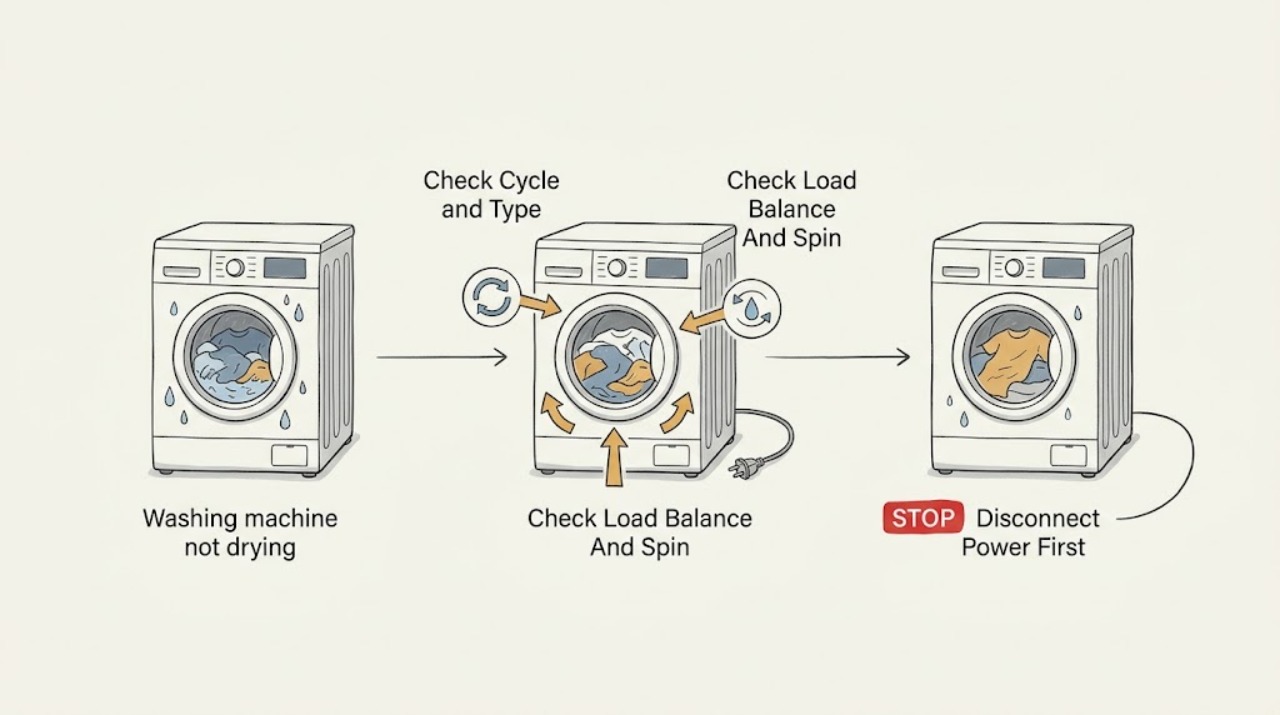
Work through in order
Diagnostic checks
Use only checks that match the exact appliance or system and its official guide.
-
Check 1
Read the control panel and the model label without removing covers. Record whether the appliance has only Wash/Spin or also has a Dry programme, which cycle was selected, the displayed time or code, and whether the clothing is dripping wet after spin or merely damp after a dry cycle.
Expected result: Classify the symptom as wet after a normal washer spin, damp after a combo Dry cycle, a cycle that never reaches spin or dry, or an error-code stop; record the exact code and stage rather than translating it from another LG model.
Next step: Follow only the branch that matches the appliance and symptom. If the appliance has no Dry programme, skip all heater and combo-drying checks.
Stop if: Stop if there is a burning smell, smoke, a hot or damaged cord, water reaching electrical parts, repeated breaker trips, or an error that calls for service in the exact owner manual.
Why this matters
Why: Wet after spin is primarily a drain, balance, suds, spin, or stability path. Damp after a genuine Dry cycle adds capacity, water-supply, drain-hose, fabric, sensor, and drying-system possibilities. A code or stage-specific stop must remain model-specific.
-
Check 2
For a standard washer or the wash portion of a combo, inspect the finished load and rerun a small, evenly distributed load using a spin setting allowed by the garment care labels; do not overload, and do not force a door or lid open.
Expected result: Note whether the original load was a single item, blanket, sheet, rug, pillow, or other bulky/small load; whether the tub shook or the spin repeatedly slowed; and whether a balanced smaller load leaves clothes substantially drier.
Next step: Use the load-size and spin guidance for the exact model. If the result is unchanged, continue to the drain-path observation rather than repeatedly rerunning heavy loads.
Stop if: Stop if the appliance walks, strikes the cabinet, leaks, smells hot, or cannot safely complete spin; do not compensate by disabling safety controls or opening the cabinet.
Why this matters
Why: Improvement with a balanced load makes load distribution or selected spin speed more likely. Repeated vibration, failure to reach spin, or equally wet clothes with a suitable load points toward drainage, leveling, floor support, or a mechanical/control fault.
-
Check 3
From ordinary external access, observe the drain hose, standpipe or laundry tub, and any visible drain outlet for kinks, crushing, an incorrectly positioned loop, slow household drainage, or water left in the tub. If the model provides a user-accessible pump-filter procedure, power off and disconnect the appliance first and follow that exact manual procedure for containing residual water.
Expected result: Record whether the hose is restricted or routed outside the model's instructions, whether the household drain backs up, whether the pump hums, and whether the filter contains debris; do not reach into a moving pump or improvise a filter access method.
Next step: Correct only an obvious external hose-routing issue allowed by the manual, clean a user-serviceable filter only as directed, then run the model's permitted rinse-and-spin test. Use a plumber for a household drain issue and an appliance technician for an internal pump or wiring fault.
Stop if: Do not work with the appliance energized, standing water near electrical connections, a blocked hose that would require cabinet access, or a filter cap that will not release without force.
Why this matters
Why: A restricted hose, slow standpipe, clogged user-serviceable filter, or residual water supports a drain problem that can prevent effective spin. A pump that hums without moving water, no pump sound, or a clear path with persistent failure requires model-specific service diagnosis.
-
Check 4
Review the detergent label and recent cycle history, then check from outside whether the washer rocks or sits unevenly; use only the leveling procedure for the exact model and do not move a loaded appliance by force.
Expected result: Note regular versus HE detergent, excess foam or residue, use of more detergent than the model permits, visible rocking, and whether wetness occurs mainly after cycles with heavy suds or severe vibration.
Next step: Use the exact detergent type and amount stated for the model and correct only safe, user-directed leveling. Test one suitable load; if wetness persists, preserve the observations for service.
Stop if: Stop if leveling would require lifting the appliance, removing shipping or cabinet parts, exposing wiring, or working around a leak or damaged floor.
Why this matters
Why: Excess suds can interfere with draining and spin, while an unlevel washer or flexible floor can cause the control to reduce spin for stability. If detergent and stability are normal, these causes become less likely and the drain or internal drive path needs assessment.
-
Check 5
Only for an LG washer-dryer combo, compare the wet load with the model's drying-capacity label, confirm the clothing is dryer-suitable, ensure the preceding spin completed, verify the water supply valve is open, and inspect the visible drain hose for a U-shaped section that can hold water.
Expected result: Record whether the dry load exceeded the stated drying capacity, contains thick or incompatible fabrics, entered drying without a strong spin, has low or absent water supply, or has water pooling in the hose; note whether a smaller fully spun load improves.
Next step: Run the exact model's permitted Dry-only or additional-dry option with a correctly sized load and no added detergent or softener. If the cycle stops at an unusual stage, shows a code, or remains ineffective, arrange service with the recorded model and results.
Stop if: Do not open the rear panel, test heater or wiring live, bypass sensors, add chemicals, or continue a cycle with burning odor, smoke, overheating, water leakage, or electrical symptoms.
Why this matters
Why: Capacity, fabric, spin, water supply, or hose routing can explain poor combo drying without an internal part failure. If a correctly sized, suitable, fully spun load still remains damp and the supply and hose are normal, a model-specific drying-system diagnosis becomes more likely.
Use your observations
Decision map
Find the observation that best matches what you see, then follow the next safe action.
-
PATH 01Safety boundary
What you see
The appliance has no Dry programme and clothes are wet after the final spin.
Do this next
Compare a suitable balanced load, observe drain behavior, and check detergent and stability in that order; use the model's rinse-and-spin test if the manual permits.
Why this path and its safety boundary
Why it matters: This is not a heater fault. Drainage, load balance, spin selection, excess suds, leveling, and floor movement are the relevant first distinctions.
Safety stop: Stop for a leak, severe shaking, electrical symptom, or any need to open the cabinet.
-
PATH 02Safety boundary
What you see
A combo completes drying but the load is too large, contains thick or unsuitable fabrics, or was not fully spun first.
Do this next
Use a smaller, dryer-suitable, fully spun load and the model's permitted additional-dry option; compare the result before considering parts.
Why this path and its safety boundary
Why it matters: The result is consistent with the combo's load and fabric limits rather than proof of a failed heater or sensor.
Safety stop: Do not dry fabrics against their care labels or exceed the appliance's drying-capacity label.
-
PATH 03Safety boundary
What you see
A combo's load is correctly sized and spun, but the water supply is closed or weak, or the visible drain hose has a low/U-shaped section where water pools.
Do this next
Restore only an obvious external valve or hose-routing condition allowed by the installation instructions, then retest. Escalate a supply or household drain problem to the appropriate professional.
Why this path and its safety boundary
Why it matters: LG identifies water use and drainage during combo drying; poor supply or trapped water can reduce drying performance.
Safety stop: Stop if the hose or valve leaks, the connection is damaged, or correction requires moving a loaded appliance or opening a panel.
-
PATH 04Safety boundary
What you see
The tub retains water, the drain is slow, the hose is restricted, or a user-accessible pump filter contains debris; spin is weak or does not complete.
Do this next
Follow the exact model's safe drain-filter procedure, correct external routing if permitted, and repeat the approved test. Use appliance service for persistent failure and plumbing service for a household drain restriction.
Why this path and its safety boundary
Why it matters: A drain restriction can leave clothes too wet and prevent effective spin, but an internal pump or wiring fault cannot be identified from a symptom alone.
Safety stop: Do not energize the unit with covers open, reach into a pump, or force a filter cap or hose.
-
PATH 05Safety boundary
What you see
The drain path is clear, but the problem follows bulky/single loads, heavy suds, rocking, or repeated vibration; a suitable smaller load spins better.
Do this next
Use model-approved load and detergent limits and correct only user-accessible leveling. If the machine still cannot reach spin with a balanced load, request diagnosis.
Why this path and its safety boundary
Why it matters: Load distribution, detergent behavior, or stability is more likely than a drying-system failure.
Safety stop: Stop when movement is severe, the floor or pedestal is damaged, or correction requires lifting or cabinet access.
-
PATH 06Safety boundary
What you see
A correctly sized and balanced load has a clear drain path and proper supply, yet the washer cannot spin or the combo still cannot dry; a code, unusual noise, burning odor, or repeated stop is present.
Do this next
Stop testing and provide the technician with the exact model, code, cycle stage, load type, drain/supply observations, and any photos taken without opening the cabinet.
Why this path and its safety boundary
Why it matters: The remaining possibilities include model-specific pump, drive, control, sensor, fan, heater, or wiring faults that cannot be safely confirmed by external checks.
Safety stop: Do not live-test, bypass a lock or sensor, or replace an internal electrical or heating part based only on a generic symptom.
Helpful context
Understand the symptom
A washer and a washer-dryer combo have different meanings of not drying
If your LG appliance has wash and spin only, the useful symptom is how wet the load is after spin: dripping-wet clothing directs attention to draining, balance, suds, spin selection, and machine stability. Do not look for a heater or hot-air fault in a washer that has no drying cycle. If the control panel has a Dry or drying programme, treat it as a washer-dryer combo and record whether the load is already spun, whether the combo reaches the target dryness, and whether the cycle stops with a code or unusual behavior.
For wet-after-spin loads, find the point where water remains
An unbalanced single or bulky load can cause the washer to reduce or interrupt spin; drain restrictions and excessive suds can also leave water in the tub or clothes. LG's support flow checks error codes, drain-hose routing, detergent and suds, level, load type, drain-filter condition, and a controlled rinse-and-spin test. These checks are observations, not permission to remove panels, bypass a door lock, or replace a pump without model-specific evidence.
For combo drying, check capacity, water, spin, and hose routing before parts
On an LG washer-dryer combo, a load can finish damp because the drying load is too large, the fabric is not suitable, the preceding spin left too much water, the water supply is closed or weak, or water pools in a U-shaped drain hose. LG also notes that sensor-controlled drying can take longer than the initial estimate and that thick or bulky items may not dry completely. A clean, correctly routed hose and a correctly sized, fully spun load are prerequisites before suspecting an internal heater, sensor, fan, or control fault.
Safety boundary
Stop conditions
- Stop and disconnect power as the model instructions direct for smoke, burning odor, overheating, a damaged cord, repeated breaker trips, or water reaching electrical parts.
- Do not open the cabinet, rear panel, heater area, pump wiring, or control area; do not bypass a door/lid lock or sensor.
- Do not test internal electrical or heating components live, force a filter cap or hose, or reach into a moving pump.
- Stop for a leak, severe walking or cabinet impact, damaged floor or pedestal, or a household drain restriction that needs plumbing access.
- Do not treat a standard washer's wet-after-spin symptom as proof of a failed dryer heater; use combo-drying checks only when the model actually has a Dry function.
Only after diagnosis
Potential parts
- drain-pump filter or filter seal
Consider only if the exact LG model uses a user-serviceable filter or the technician confirms a damaged seal or filter after a drain inspection.
Verify the complete model number and the exact service-manual or manufacturer part identification; do not substitute a generic filter or continue operation with a leaking seal. - drain pump assembly
Consider only when testing by a qualified technician confirms an internal pump fault after hose, filter, household drain, and load causes are excluded.
Confirm exact model, revision, electrical characteristics, seals, and installation procedure before ordering or fitting. - combo drying-system component
Consider only for a model with a Dry function and only after capacity, fabric, spin, water supply, hose routing, and model-specific diagnostics point to an internal fault.
A heater, sensor, fan, duct, or control is not interchangeable by symptom; identify the exact model and have a qualified technician confirm the failed component.
When checks do not resolve it
Need a professional?
Arrange appliance service when a suitable balanced load still will not drain or spin, a clear drain path still leaves standing water, a combo remains damp after a correctly sized and fully spun load with proper water supply and hose routing, an error code or unusual stop recurs, or the next check requires cabinet access. Use a plumber for a household standpipe or drain restriction. Escalate immediately for burning smell, smoke, overheating, electrical symptoms, severe vibration, or water near electrical components.
Safety scope: This article covers ordinary external observation and model-directed user maintenance only. Disconnect power before any model-directed drain-filter access, keep water away from electrical parts, and leave internal electrical, heating, pump, drive, sensor, control, and cabinet work to a qualified technician.
Common questions
FAQ
Does an LG washing machine dry clothes?
A standard washer removes water by draining and spinning; only models with a Dry programme provide a true drying function. Check the control panel and model manual before using combo-drying guidance.
Why are clothes still wet after my LG washer finishes?
Start with load balance, spin selection, drain hose and filter condition, excess suds, leveling, and floor movement. LG identifies drain restrictions and unbalanced loads as common paths for clothes that are too wet.
Why is my LG washer-dryer combo still damp after drying?
Check that the load is within the drying capacity, fabrics are dryer-suitable, the preceding spin completed, the water supply is open, and the drain hose cannot hold pooled water. Sensor drying time can vary by load and fabric.
Can I use a dryer-heater troubleshooting guide on an LG washer?
Only if the exact LG model has a Dry function. A washer that only washes and spins does not have a dryer heater path; treat wet laundry as a drain, spin, balance, suds, or stability issue instead.
When should I stop troubleshooting and call for service?
Arrange service for persistent no-drain or no-spin behavior, a combo that remains damp after setup checks, recurring codes, cabinet-access work, or internal pump, drive, sensor, heater, fan, control, or wiring symptoms. Stop immediately for smoke, burning odor, overheating, electrical symptoms, severe vibration, or water near electrical parts.
Read the exact guide
Official sources
- [LG Washer][Drying Function] Dry Time Stops at 6minutesLG USA Support · LG USA Help Library guidance for washer-dryer combos and washers with a drying function; exact model controls available cycles.
- [LG Washer] Dryer Performance TroubleshootingLG USA Support · LG USA Help Library guidance listed for Washer Dryer Combos and Washers; images and content may differ by model.
- LG Washer - Troubleshooting Washer Does Not Drain or Spin (Clothes Too Wet)LG USA Support · LG USA Help Library troubleshooting article for listed washer and washer-dryer categories; exact model instructions control access and cycle behavior.
- LG Dryer – Why is My Dryer Not Heating, Not Drying or Taking a Long Time Drying?LG USA Support · LG USA Help Library guidance for standalone LG dryers; used here only to keep internal heater and airflow work outside a washing-machine user's scope.
Community feedback
Share a repair observation
Share a plain-text repair observation. Accepted observations are published automatically; this page may take a moment to update.