
On this page
Start here
Quick answer
A Candy washing machine normally removes water by spinning; it does not dry clothes with heat unless the exact model is a washer-dryer. First confirm whether the appliance has a drying program in the model manual. If clothes are wet after a wash, check whether water remains in the drum, whether the final spin was skipped or weak, whether the load was unbalanced or too large, and whether the model-authorized filter or drain path is restricted. If it is a washer-dryer, also check that a drying program was selected, the drying load is within that model's drying capacity, and no error or water-drain problem stopped the cycle. Do not assume a Candy washing-only model has a heater or drying circuit, and do not open panels, test live wiring, or replace a motor or heating part from a wet-clothes symptom. A persistent no-spin, no-drain, error-code, burning smell, water leak, or electrical problem needs qualified appliance service.
Before you begin
Safety first
- Keep the appliance off for wet electrical areas, flooding, burning odor, smoke, shock, damaged cord, repeated breaker operation, severe mechanical noise, or abnormal heat. Do not bypass the interlock, open panels, or test energized wiring.
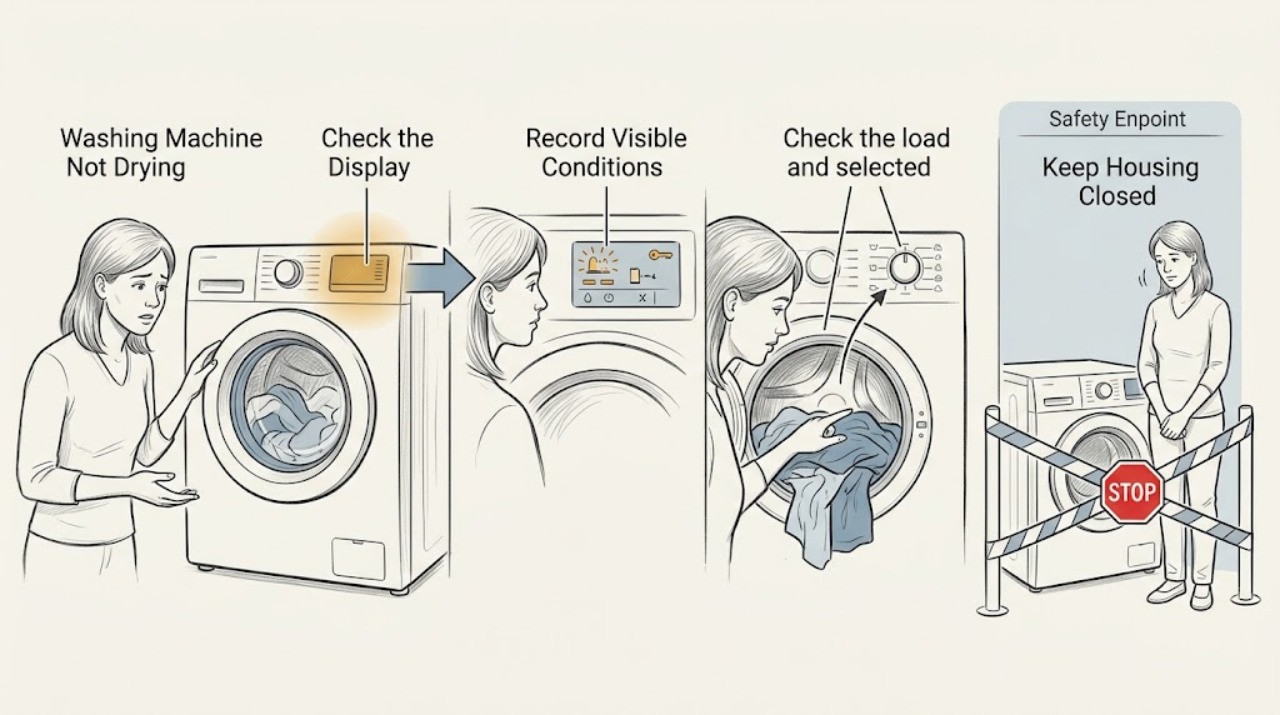
Work through in order
Diagnostic checks
Use only checks that match the exact appliance or system and its official guide.
-
Check 1
Use the full Candy model or product code to open the matching manual and identify the product line: washing machine or washer-dryer. Confirm whether the control panel and manual contain a drying program; do not copy a drying sequence from another model.
Expected result: The manual identifies a washing-only appliance, a washer-dryer with drying programs, or the model cannot be confirmed.
Next step: Follow only the matching manual. If the model remains unknown, describe the appliance as spin extraction only and arrange service rather than guessing at a drying component.
Why this matters
Why: A washing-only machine can only remove water through drain and spin; a washer-dryer has an additional model-specific drying system. An unknown model makes program, capacity, filter access, and part assumptions unreliable.
-
Check 2
After the drum has stopped, note the water level and clothing condition. Look through the door or lid without reaching into a moving drum, and record whether water remains, the drum is empty but clothes are saturated, or clothes are only slightly damp.
Expected result: Water remains in the drum, the drum is empty but clothes are very wet, or the drum is empty and clothes are only slightly damp.
Next step: Keep the appliance off if water is near electrical parts. Use the exact manual to choose the next drain or spin check; do not force the door, remove panels, or run a drying procedure on a washing-only model.
Why this matters
Why: Remaining water points first toward drain or pump-path trouble. An empty drum with very wet clothes points toward weak/skipped spin, balance, load, or selected-spin issues. Slight dampness may be normal for spin-only extraction and is not proof of a failed dryer.
-
Check 3
Check the load and selected spin setting against the fabric label and exact Candy manual. Note a single bulky item, an overloaded drum, a mixed load gathered to one side, a delicate low-spin setting, or a normal balanced load; do not exceed the manual's loading guidance.
Expected result: The load is overloaded or badly unbalanced, a low-spin or delicate option was selected, or the load is suitable and the machine still leaves clothes very wet.
Next step: If the manual permits it, redistribute or reduce the load and run one model-authorized spin-only cycle. Stop if the washer will not spin, bangs severely, shows an error, or leaves water behind.
Why this matters
Why: Candy identifies imbalance and excessive load as common reasons for ineffective spinning, while fabric programs may intentionally use lower spin. A suitable load with persistent wet clothes shifts suspicion toward drain, motor, interlock, control, or mechanical service.
-
Check 4
If the exact Candy manual identifies a user-accessible pump filter or drain check, first make the appliance safe from a dry position and prepare for residual water. Inspect only as the manual directs; do not loosen a cap by force, reach into the pump, or disconnect a wet appliance.
Expected result: The model has no user filter, the filter contains lint or a foreign object, residual water is excessive or hot, the cap is damaged or stuck, or the filter is clear.
Next step: Reassemble only as the exact manual directs and make one supervised spin/drain observation if safe. Arrange appliance service for a stuck or damaged filter, leak, clear filter with no drain, or any water near electrics.
Why this matters
Why: A restricted filter or drain path can prevent the pump from removing water and can suppress the final spin. Filter location, access, and residual-water handling vary by Candy model; a clear filter does not prove the pump or control is good.
-
Check 5
For a confirmed Candy washer-dryer only, compare the selected drying program and load with the exact manual. Note whether the wash load exceeds the drying capacity, the drying phase was skipped, the load remains cold and wet, or the program ends with an error; do not add a drying assumption to a washing-only model.
Expected result: The appliance is washing-only, the washer-dryer load is above its drying limit, the drying program was not selected, drying stops with an error, or drying runs but clothes remain wet.
Next step: Use the exact manual's load and program instructions for one safe retry only when no stop condition exists. For a confirmed washer-dryer with persistent no-dry, heat, or error symptoms, arrange qualified appliance service.
Why this matters
Why: A washing-only model cannot perform heated drying. On a washer-dryer, excess load, program selection, unresolved drain moisture, airflow/condensation, heater, sensor, or control faults are separate possibilities.
-
Check 6
Record any displayed error, unusual pump or motor sound, repeated stopping, burning smell, leak, damaged cord, or breaker operation. Match an error only to the exact Candy manual and do not open the cabinet or test wiring.
Expected result: An error returns, the drum will not spin, the pump is silent or noisy, the appliance leaks, or electrical/heat symptoms appear.
Next step: Stop use for leaks near electrics, burning odor, damaged cord, repeated breaker operation, smoke, or shock. Otherwise provide the model, program, load, water level, spin result, and code to qualified Candy appliance service.
Why this matters
Why: A returning code or abnormal mechanical/electrical symptom can involve the pump, motor, belt, door interlock, heater, sensor, control, or wiring; the visible symptom does not identify the failed part.
Use your observations
Decision map
Find the observation that best matches what you see, then follow the next safe action.
-
PATH 01Next step
What you see
The appliance is a Candy washing-only model, the drum is empty, and clothes are wet after the final cycle.
Do this next
Check the load and manual-authorized drain/filter path, then make one model-authorized spin observation. Arrange service if a suitable load still will not spin or remains saturated.
Why this path and its safety boundary
Why it matters: The complaint is a spin-extraction problem, not a failed heated dryer. Load balance, selected spin, drain restriction, pump, motor, interlock, or control behavior should be separated.
-
PATH 02Next step
What you see
Water remains in the drum or the washer stops before a proper final spin.
Do this next
Use only the exact manual's safe filter/drain check. Stop for hot or excessive residual water, a stuck cap, leaks, or wet electrical parts and arrange appliance service.
Why this path and its safety boundary
Why it matters: Drain or pump-path restriction is more likely than a heater issue; the machine may inhibit high-speed spinning when water has not cleared.
-
PATH 03Next step
What you see
The load is overloaded, gathered to one side, or paired with a low-spin fabric program, and a suitable smaller balanced load spins normally.
Do this next
Use the manual and garment-care labels to select a suitable load and spin. If the same problem returns with a suitable load, arrange service rather than increasing settings beyond the model guidance.
Why this path and its safety boundary
Why it matters: Load balance, capacity, or fabric-selected spin is more likely than a confirmed machine failure.
-
PATH 04Next step
What you see
The appliance is a confirmed Candy washer-dryer, the wash phase completes, but drying was not selected, the load exceeds drying capacity, or drying ends with an error.
Do this next
Follow the exact washer-dryer manual for program and load limits. If a correctly loaded drying cycle still fails or an error returns, arrange qualified appliance service.
Why this path and its safety boundary
Why it matters: The result may reflect product capability, load/program selection, or a washer-dryer fault; it should not be diagnosed as a washing-only spin problem.
-
PATH 05Next step
What you see
A leak reaches electrical parts, the cord or plug is damaged, there is a burning smell, smoke, shock, repeated breaker operation, or a washer-dryer becomes abnormally hot.
Do this next
Stop use and keep clear. Isolate power only from a dry, safe location if it can be done normally without touching the wet appliance; arrange qualified appliance service or emergency help as appropriate.
Why this path and its safety boundary
Why it matters: The immediate risk is shock, fire, water damage, or overheating; further wash or dry tests are unsafe.
Helpful context
Understand the symptom
First ask what the Candy appliance can do
The phrase not drying covers two different results. A washing-only Candy model leaves clothes damp when spin extraction is weak or skipped; a Candy washer-dryer can also fail during its separate drying phase. Look for a drying program in the exact model manual or on the control panel. Do not infer a drying heater, condenser, or capacity from the Candy name alone.
Wet after washing is usually a spin or drain question
If water remains in the drum, a drain restriction can prevent a proper final spin. If the drum is empty but clothing is very wet, the load may have been unbalanced, the selected spin may be low for the fabric, or the washer may have stopped the spin. Candy's own spin guidance points to load balance and filter condition as initial checks.
Washer-dryer drying is load- and program-specific
A washer-dryer can wash a larger load than it can dry, and its drying levels or time controls vary by model. A full wash load may need to be reduced before drying. Use only the exact manual's program, load limit, fabric guidance, and filter or condenser instructions; do not treat a washing-only Candy model as a washer-dryer.
Know the service boundary
A clear drain and balanced load do not prove that the motor, pump, heater, thermal sensor, door interlock, control, or wiring is healthy. Those parts require model-specific internal testing. Stop if there is a leak near electrical parts, a burning smell, a damaged cord, repeated breaker operation, or an error that returns.
Safety boundary
Stop conditions
- Stop immediately for water near the cord, plug, outlet, controls, or other electrical parts; do not touch a wet appliance that remains connected.
- Stop for burning smell, smoke, sparking, shock, damaged cord, repeated breaker operation, severe banging, or abnormal heat. Do not restart to test.
- Do not open the cabinet, reach into a moving drum, bypass a door interlock, or perform live electrical tests. Do not force a filter or drain cap.
- Do not run a drying procedure on a washing-only Candy model, and do not exceed the exact washer-dryer manual's drying load or fabric guidance.
- Stop and arrange service when a pump/filter is inaccessible or damaged, water remains after the model-authorized check, a suitable load will not spin, or an error returns.
Only after diagnosis
Potential parts
- drain pump or pump filter
Consider this category only when the exact manual and qualified diagnosis identify a restricted or failed drain path after load and external drain checks.
Pump and filter arrangements vary by Candy model and product line. Confirm the exact model and diagnosis before selecting a part. - drive belt or spin motor
Consider this category only when a suitable balanced load and clear drain path are confirmed but qualified testing finds a drive problem.
Belt, motor type, mounting, and control compatibility are model-specific. Do not infer fit from a similar Candy appliance. - door interlock
Consider this category only when the door closes correctly but the exact model prevents spin or returns an interlock indication after safe external checks.
Interlocks differ by Candy platform and model. Confirm exact documentation and qualified diagnosis before selection. - washer-dryer heating or drying sensor assembly
Consider this category only for a confirmed washer-dryer whose correctly loaded drying program fails after drain, program, and error checks and qualified diagnosis identifies a heating or sensing fault.
A washing-only machine has no corresponding drying assembly; heater, sensor, and wiring fit are exact-model concerns requiring qualified service.
When checks do not resolve it
Need a professional?
Arrange qualified Candy appliance service when a washing-only machine leaves a suitable load saturated after one model-authorized drain and spin check, the pump is noisy or silent, the drum will not spin, a filter or door interlock is damaged, a washer-dryer still will not dry with its exact load and program, or any error returns. Stop immediately for leaks near electrical parts, burning smell, smoke, shock, damaged cord, repeated breaker operation, or abnormal heat.
Safety scope: Keep the appliance off for wet electrical areas, flooding, burning odor, smoke, shock, damaged cord, repeated breaker operation, severe mechanical noise, or abnormal heat. Do not bypass the interlock, open panels, or test energized wiring.
Common questions
FAQ
Does a Candy washing machine dry clothes with heat?
Not necessarily. A washing-only model removes water through drain and spin. Confirm a drying program in the exact manual before diagnosing a heater or drying circuit; Candy washer-dryers are a separate product line.
Why are clothes wet when the drum is empty?
An ineffective or skipped final spin can result from an imbalanced or heavy load, a low-spin fabric setting, a restricted filter or drain path, or a machine fault. Candy's spin guidance recommends separating these observations rather than assuming a dryer failure.
What if water remains in the drum?
Treat it first as a drain or pump-path question. Use only the exact Candy manual's safe filter or drain check, and stop for excessive or hot residual water, leaks, a stuck cap, or water near electrical parts.
What if my Candy washer-dryer still will not dry?
Confirm the product is a washer-dryer, use the exact drying program and load limit, and verify that the wash phase drained properly. A persistent failure or returning code needs qualified appliance service for the drying system and controls.
Read the exact guide
Official sources
- CS 149TW4-80 | Washing Machine Smart | CandyCandy · Official Candy washing-machine product page used to show a washing-only model with spin-drying specifications and no general washer-dryer assumption.
- Spin cycle: all you need to knowCandy · Official Candy article explaining spin removes excess water and identifying imbalance, heavy load, and clogged filter as possible ineffective-spin causes.
- CBWD 8514D-19 | Washer dryers BUILT IN | CandyCandy · Official Candy washer-dryer product page showing that a washer-dryer is a distinct product line with separate washing and drying capacities and its own manual.
- Product user manuals | CandyCandy · Official Candy manual finder; exact model controls programs, capacities, filter access, error meanings, and safe procedures.
Community feedback
Share a repair observation
Share a plain-text repair observation. Accepted observations are published automatically; this page may take a moment to update.