
On this page
Start here
Quick answer
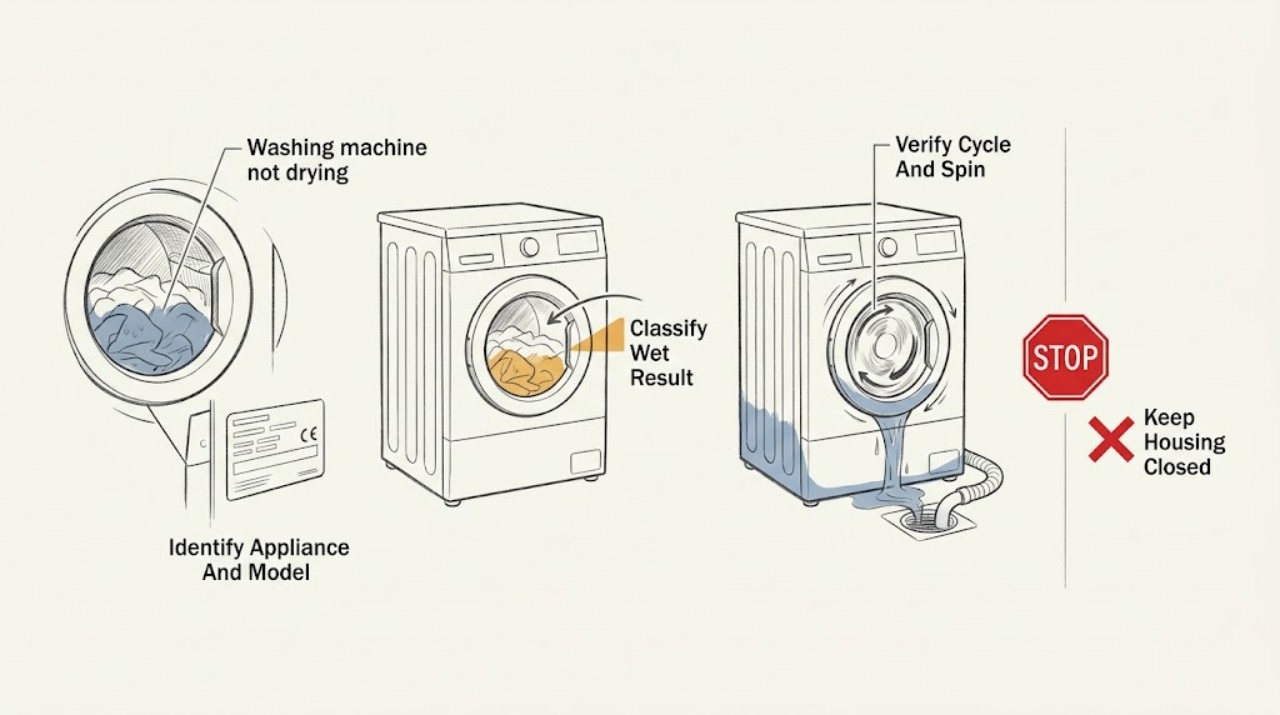
A Kenmore washer normally removes water by spinning; it does not heat-dry clothing unless the appliance is a Kenmore laundry center or washer-dryer with a documented dry cycle. First identify the exact model and decide whether clothes are merely left wet after wash and spin or whether a separate dry cycle is failing. If water remains in the tub, the load did not reach its intended spin, or the machine stopped before draining, check only the visible hose, selected cycle, load balance, and model-approved user access. If the unit really has a dryer section, use that model's dry-cycle, lint-filter, and vent instructions instead of assuming a washer fault. Kenmore says its manuals are found by entering the appliance model number, and its product pages distinguish washers, dryers, and laundry centers. Stop for leaking water near electricity, smoke, a burning smell, a damaged cord, a door or lid that will not safely latch, or any need to open panels or bypass an interlock; recurring failure after the model-specific checks needs qualified appliance service.
Work through in order
Diagnostic checks
Use only checks that match the exact appliance or system and its official guide.
-
Check 1
From a dry, stable position, photograph the Kenmore model label and control panel, and determine whether the appliance is a stand-alone washer, a separate washer and dryer, a laundry center, or a washer-dryer with a documented dry cycle.
Expected result: Record the full model number, whether a Dry, Air Dry, or similar control is present, and whether the complaint happens after wash and spin or after an attempted dry cycle.
Next step: Open the matching Kenmore manual and follow its wording for cycles, drain access, filters, and resets before choosing a diagnosis or part.
Stop if: Stop if the label is missing, unreadable, or the appliance identity cannot be established without removing a panel.
Why this matters
Why: A washer with no dry function can only leave clothes too wet after spin; a laundry center or washer-dryer has a distinct dry-side path. The exact model controls which checks and user-accessible filters are applicable.
-
Check 2
Run no new cycle yet; inspect the completed load and the visible tub or drum area, and note whether the load is damp, dripping, or sitting in standing water.
Expected result: Record whether water remains in the tub, the drain phase completed, the basket or drum spun, and whether the load is evenly distributed or bunched on one side.
Next step: Use the corresponding wet-load, drain, or spin section of the exact manual; do not jump to dryer parts unless the model has a dry cycle.
Stop if: Stop and keep the appliance out of service for a leak reaching the outlet or wiring, exposed water with a damaged cord, smoke, sparking, or a burning smell.
Why this matters
Why: Standing water or an incomplete drain makes a drain-path or cycle-completion problem more likely. A drained tub with a poor or interrupted spin makes selection, balance, lid or door status, or a model-specific spin fault more likely; damp laundry after a completed spin is not evidence of a failed heater.
-
Check 3
With the tub or drum safe and empty of loose items, compare the selected cycle and spin option with the exact manual, then redistribute an obviously bunched load without overfilling or forcing the lid or door.
Expected result: On a model-approved repeat with a small, balanced load, note whether the washer completes drain and spin, reaches its documented spin behavior, or stops, rocks, or leaves water again.
Next step: Save the cycle name, load type, and result; proceed to the visible hose check only if the manual permits it and the machine is not leaking.
Stop if: Do not hold a lid or door open, defeat an interlock, reach into a moving basket or drum, or repeat a cycle that produces abnormal noise, smoke, or a burning odor.
Why this matters
Why: A corrected cycle or load that now spins and drains supports a selection or balance issue. Repeated stopping with a balanced load points away from simple loading and toward a drain, latch, sensing, drive, or control diagnosis that should remain model-specific.
-
Check 4
Only from the outside and only as the exact manual allows, inspect the drain hose and its visible connection for kinks, crushing, displacement, or a hose end that is not positioned as specified; do not pull the machine out over a wet floor or open the pump housing.
Expected result: Record whether the hose is visibly kinked or displaced, whether the tub still holds water, and whether the floor or connection is wet before any movement.
Next step: Correct only a plainly displaced external hose in the manner described by the manual, then perform one model-approved drain or rinse-and-spin check; otherwise arrange service with the observation recorded.
Stop if: Stop for active leakage, water near electrical parts, a hose or fitting that is cracked, a heavy appliance that must be moved, or any need to access an internal pump or wiring.
Why this matters
Why: A visible hose restriction or displaced connection can explain an incomplete drain and consequently a wet load. A clear visible route with standing water does not clear an internal pump, filter, sensor, or control, and is not a reason to dismantle the machine.
-
Check 5
If and only if the model is a laundry center or washer-dryer with a dry cycle, confirm the selected dry program, load size, door or lint-filter status, and any visible vent or airflow instruction in that model's manual without removing panels or disconnecting the vent.
Expected result: Record whether the dry cycle starts and tumbles, whether it produces the expected result for the documented cycle, whether a filter alert or code appears, and whether airflow or heat is absent, weak, or excessive.
Next step: Follow the exact model's user-level filter and airflow instructions once; if the dry fault remains, stop using that function and request qualified appliance service.
Stop if: Do not operate a dry cycle with a missing or damaged lint filter, blocked visible airflow, smoke, scorching, a burning smell, a hot or damaged cord, or a door that will not latch safely.
Why this matters
Why: A dry-capable unit that washes and spins normally but fails only during drying has a separate dry-side branch. A plain washer has no heater or dryer vent to test; a missing heat result can involve controls, airflow, a sensor, or a heater and cannot be assigned to a part from this observation alone.
-
Check 6
After the appliance is dry, stopped, and free of immediate hazards, perform at most the single reset or power-cycle procedure explicitly listed for the exact model; do not invent a breaker interval or repeat resets as a substitute for diagnosis.
Expected result: Record whether the display, cycle selection, drain, and spin or dry function return normally once, or whether the same interruption, code, or wet result returns.
Next step: If the symptom returns, leave the affected function unused and give the technician the model, code, cycle, load, water level, and reset result.
Stop if: Do not open the control console, measure live voltage, bypass a door or lid lock, or keep resetting a machine with a leak, smoke, sparking, or burning odor.
Why this matters
Why: One documented reset can clear a temporary control state, but a recurring result after the reset supports a persistent mechanical, water-path, latch, sensor, or control fault rather than a resolved issue.
-
Check 7
Before requesting appliance service, assemble the model photo, cycle and option names, load description, whether water remained, whether spin completed, any dry-cycle result, visible hose observations, displayed codes, and the date the symptom began.
Expected result: The record identifies a repeatable wet-spin or dry-cycle symptom and distinguishes a single unusual load from a failure that persists with a balanced test load.
Next step: Use Kenmore Customer Care or a qualified appliance service channel for repair guidance; keep the appliance out of service when a stop condition is present.
Stop if: Do not resume normal use while the machine leaks, overheats, smells burnt, damages clothing, or cannot safely latch or stop.
Why this matters
Why: A precise handoff prevents a stand-alone washer from being treated as a dryer and helps the technician select the correct model documentation and safe access procedure.
Use your observations
Decision map
Find the observation that best matches what you see, then follow the next safe action.
-
PATH 01Next step
What you see
The model is a stand-alone washer with no dry cycle, the tub drains, and clothing is damp or dripping after a completed or apparently incomplete spin.
Do this next
Follow the exact manual's cycle and spin guidance, perform one small balanced-load check if safe, and request service if the result repeats.
Why this path and its safety boundary
Why it matters: This is a wet-spin complaint, not a failed heater. Cycle selection, load balance, lid or door status, drainage, and model-specific spin behavior are more relevant than dryer components.
-
PATH 02Next step
What you see
Water remains in the tub or the machine repeatedly stops before drain and spin, even after a visible hose check finds no obvious kink.
Do this next
Keep the appliance stopped if water is leaking or near electricity and arrange qualified appliance diagnosis rather than opening the pump area.
Why this path and its safety boundary
Why it matters: An internal drain path, pump, filter, sensor, latch, or control issue is possible, but the symptom does not identify which part.
-
PATH 03Next step
What you see
A documented cycle or spin option and a redistributed, smaller load complete normally, with no standing water or hazard.
Do this next
Use the model's load and cycle limits, monitor the next few loads, and request service if the same symptom returns with ordinary balanced loads.
Why this path and its safety boundary
Why it matters: The earlier result is more consistent with load distribution or a cycle choice than a proven failed component; it does not establish that every future load will behave the same way.
-
PATH 04Next step
What you see
The appliance is a Kenmore laundry center or washer-dryer, wash and spin finish normally, but the documented dry cycle does not start, tumble, heat, or finish as expected.
Do this next
Perform only the model-approved user-level filter or airflow check once, then stop the dry function and call qualified service if the result remains.
Why this path and its safety boundary
Why it matters: The fault is on the dry side and may involve the selected cycle, filter or airflow path, sensing, controls, or heating components; a washer-only diagnosis does not apply.
-
PATH 05Next step
What you see
The model number is unavailable, a code or symptom repeats after one documented check, or the controls, latch, motor, or drainage behavior cannot be interpreted from the exact manual.
Do this next
Stop experimenting, preserve the model and symptom record, and obtain model-specific guidance from Kenmore Customer Care or qualified appliance service.
Why this path and its safety boundary
Why it matters: Generic part swapping and cross-model instructions are unsafe because Kenmore laundry products differ in configuration and user access.
-
PATH 06Next step
What you see
Water reaches electrical parts, the cord or outlet is damaged, smoke or a burning odor appears, a hot surface or scorching occurs, or the door or lid will not safely latch or stop the machine.
Do this next
Stop using the appliance and seek qualified appliance or appropriate emergency help from a safe location; do not remove panels or bypass a safety device.
Why this path and its safety boundary
Why it matters: This is a stop-use and safety issue, not a troubleshooting opportunity; repeated cycling can increase shock, fire, flood, or moving-part risk.
Helpful context
Understand the symptom
“Not drying” can describe two different Kenmore appliances
A stand-alone washing machine washes, rinses, and spins; the spin removes water so clothes can dry elsewhere. Kenmore also sells laundry centers and separate dryers with dry cycles. If the load is dripping at the end of spin, start with drainage, spin selection, and load balance. If the appliance has a dry-cycle control and heat or tumbling is missing, treat it as a dry-side problem. Do not use a dryer's vent or heat instructions on a washer that has no dryer section.
Use the exact Kenmore model before choosing a part or procedure
Kenmore's manual page asks for the appliance model number and says the number is at least 11 characters long. Record the full model exactly as shown on the appliance, then use that manual for the permitted drain, spin, dry-cycle, filter, and reset procedures. Kenmore's laundry pages show that controls and capacities vary between washers, dryers, and combination products, so a generic pump, filter, vent, or heater diagnosis is not a fitment decision.
A wet load is a result to interpret, not proof of a failed heater
A clean tub with a balanced load and a completed high-speed spin points in a different direction from standing water, a repeated drain interruption, or a load that never accelerates. A true dry-capable unit adds a separate branch for the selected dry cycle and its airflow or filter instructions. Keep the observation narrow: the visible water level, cycle stage, control response, and exact model are more useful than guessing at an internal part.
Keep internal electrical and moving-part work out of ordinary checks
A washer or laundry center can combine water, mains electricity, a motor, a door or lid interlock, and—on some products—a heated dryer section. Unplug only as directed by the model's safety instructions and do not remove panels, reach into a moving basket or drum, probe energized wiring, bypass an interlock, or repeatedly run a cycle after a burning odor or leak. Give the technician the model, cycle, water level, error code if any, and the point at which the load stayed wet.
Safety boundary
Stop conditions
- Water near an outlet, cord, control, or other electrical part; active leakage or a damaged hose or fitting.
- Smoke, sparking, burning odor, scorching, abnormal heat, or a damaged cord or outlet.
- A door or lid that will not latch, unlock, stop, or otherwise operate as the model specifies.
- Any need to remove panels, reach a moving basket or drum, probe live wiring, open an internal pump, or bypass an interlock.
- A dry-capable unit with a missing or damaged lint filter, blocked airflow, or recurring dry fault after one model-approved check.
Only after diagnosis
Potential parts
- drain hose or drain-path component
Consider only if the exact model diagnosis confirms a damaged hose or an internal drain-path fault after the visible hose check; a wet load alone does not identify this part.
Confirm the full appliance model and the manufacturer's fit information before ordering or installing any component. - lid or door-latch assembly
Consider only when the exact model's documented behavior and service diagnosis show that latch or interlock feedback is preventing a safe drain, spin, or dry cycle.
Do not bypass the latch or assume a visually similar assembly fits; model-specific service information is required. - dryer airflow, sensor, or heating component
This category applies only to a confirmed laundry center or washer-dryer whose wash and spin work but whose documented dry cycle still fails after user-level filter or airflow checks.
Do not order or access a heater, sensor, or internal airflow component without the exact model's qualified service diagnosis.
When checks do not resolve it
Need a professional?
Call a qualified appliance technician when a Kenmore washer repeatedly leaves water in the tub, fails to complete spin with a balanced load, or returns the wet result after the exact model's user checks. On a laundry center or washer-dryer, stop the dry function when the documented filter or airflow check does not restore it, or when heat, tumbling, sensing, or a code remains abnormal. Stop immediately for a leak near electricity, smoke, a burning smell, sparking, scorching, a damaged cord or outlet, a door or lid that will not latch or stop safely, or any need to open panels, reach moving parts, test live wiring, or bypass an interlock.
Common questions
FAQ
Does a Kenmore washing machine dry clothes by itself?
A stand-alone washer normally removes water through its spin; it does not heat-dry clothes. A Kenmore laundry center or washer-dryer may have a separate dry cycle, so identify the model before troubleshooting.
Why are clothes dripping wet after a Kenmore washer finishes?
Start by distinguishing standing water from a completed but weak spin. Check the exact model's cycle and load-balance guidance and the visible drain hose. If water remains or the result repeats with a balanced load, arrange model-specific service rather than guessing at a dryer part.
Can I use dryer vent or heater checks on a Kenmore washer?
No. Use vent, lint-filter, sensor, or heater guidance only when the exact appliance is a laundry center or washer-dryer with a dry cycle and its manual permits the check. A plain washer has a different wet-spin problem path.
What should I give Kenmore service when the load will not dry?
Give the exact model number, appliance type, selected cycle and options, load size, whether water remained, whether spin completed, whether a dry cycle exists, any displayed code, visible hose or filter observations, and the result after one model-approved check.
Read the exact guide
Official sources
- 24" 1.6 cu. ft. 240V Electric Laundry Center | KenmoreKenmore · Kenmore laundry-center example showing distinct washer and dryer sections and dry cycles
- Find Your Manual | Kenmore Appliance Manuals & GuidesKenmore · Kenmore appliance model-number manual lookup for washers, dryers, and related laundry products
- Customer Care & Support | Kenmore AppliancesKenmore · Kenmore customer care, warranty, safety and compliance, manuals, and repairs support
- Laundry Appliances | Washers & Dryers | KenmoreKenmore · Kenmore laundry product categories and washer/dryer function distinctions
Community feedback
Share a repair observation
Share a plain-text repair observation. Accepted observations are published automatically; this page may take a moment to update.