
On this page
Start here
Quick answer
For a Blomberg DV17542 dryer that vibrates or makes a repeating noise, start with safe external causes: stop the cycle, unplug before moving the appliance, check that the floor is firm and level, confirm every foot is firmly seated, and reduce or redistribute the load. Check the drum for a loose object and, with power disconnected, turn it gently by hand to see whether the sound repeats at one point. These observations can separate installation or load movement from a persistent mechanical symptom, but they do not identify a belt, pulley, motor, bearing, or blower part. Stop using the dryer for scraping, burning odor, cord damage, or severe walking and arrange qualified Blomberg service.
Work through in order
Diagnostic checks
Use only checks that match the exact appliance or system and its official guide.
-
Check 1
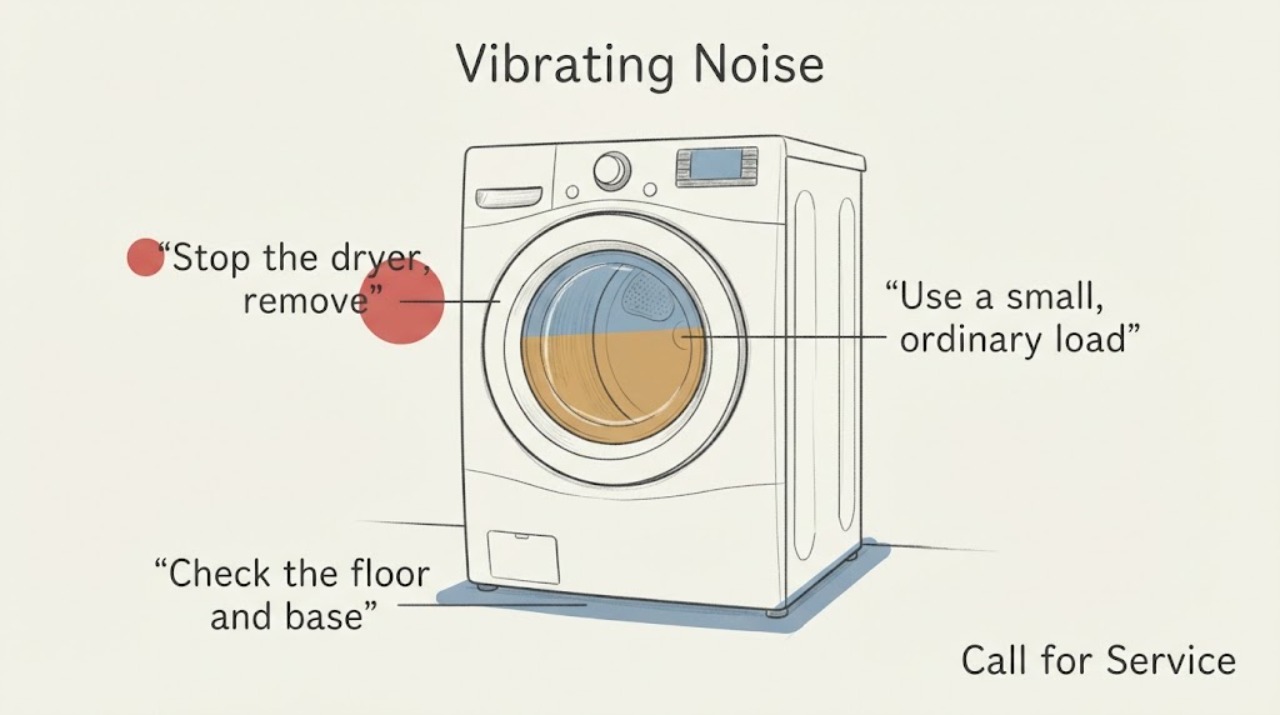
Stop the dryer, remove the load, and unplug it before moving or inspecting the DV17542. Note whether the vibration happened only during a loaded cycle or whether the empty drum also produces the noise when turned gently by hand.
Expected result: The noise disappears with no load, or it remains with the drum empty and power disconnected.
Next step: If empty, power-free rotation is quiet, continue with load and installation checks. If the empty drum still makes the same noise, stop using the dryer and arrange service.
Stop if: Do not keep running the dryer to reproduce a harsh or worsening noise; record when it occurs and provide that pattern to service.
Why this matters
Why: A load-dependent symptom points first to load movement or balance; a repeatable empty-drum symptom needs a mechanical assessment without assuming which component is at fault.
-
Check 2
Check the floor and base from outside: use a level if available, make sure the floor is solid, and confirm every adjustable foot is firmly in contact. Follow the DV17542 manual's adjustment instructions and do not use tools to force or remove a foot.
Expected result: The dryer rocks when gently pressed, a foot is not seated, or the floor is uneven or flexible.
Next step: Correct only the accessible installation condition using the model manual, then recheck stability with the dryer empty. Do not tilt a heavy dryer alone.
Stop if: If the base is stable and the noise persists, continue to the load and visible-drum checks rather than tightening internal parts.
Why this matters
Why: An unstable base can amplify normal drum movement into vibration and walking.
-
Check 3
Use a small, ordinary load within the DV17542 manual's capacity, distribute items rather than packing the drum, close zips and buttons, and remove coins or other loose objects from pockets.
Expected result: The vibration is strongest with a large or single bulky load, or a loose object is visible in the drum or door area.
Next step: Remove the loose object or reduce and redistribute the load, then reassess only with the door closed and the dryer operating normally.
Stop if: If the same vibration occurs with an appropriate load, treat it as a persistent symptom and arrange service.
Why this matters
Why: Overloading, uneven contents, or a loose object can create impact and imbalance without proving an internal failure.
-
Check 4
With the dryer unplugged, turn the drum slowly by hand and observe whether the sound occurs at one repeatable point, whether the drum feels unusually easy or difficult to turn, or whether there is visible rubbing or a foreign object.
Expected result: The sound repeats at one point, the drum resistance is abnormal, or visible rubbing or damage is present.
Next step: Leave the dryer unplugged and give service the model, sound timing, load condition, and manual-rotation observation. Do not open the cabinet or order a part from the symptom alone.
Stop if: If manual rotation is smooth and quiet but operating vibration continues, service should observe the appliance under controlled conditions rather than having the user run repeated tests.
Why this matters
Why: This is evidence for a service-level mechanical inspection, but it does not distinguish a belt, pulley, bearing, blower, seal, or drum fault from outside the cabinet.
Use your observations
Decision map
Find the observation that best matches what you see, then follow the next safe action.
-
PATH 01Next step
What you see
The dryer is stable and quiet empty, but vibration appears only with a large, single, or uneven load.
Do this next
Use a smaller, evenly distributed load within the DV17542 manual's capacity and stop if the appliance still walks or strikes the cabinet.
-
PATH 02Next step
What you see
The appliance rocks, a foot is not firmly seated, or the floor is not level.
Do this next
Unplug and correct the accessible base condition using the exact DV17542 manual; do not tilt a heavy dryer alone or remove a foot.
-
PATH 03Next step
What you see
The same noise repeats with an empty drum or at one point during slow, power-free manual rotation.
Do this next
Keep the dryer unplugged and request qualified Blomberg service; do not run it repeatedly or open the cabinet.
Helpful context
Understand the symptom
First decide whether the vibration follows the installation or the drum
A dryer can shake when its base is unstable, its load is excessive or uneven, or a loose object moves in the drum. The exact DV17542 manual should control any adjustment specific to this model. A noise that repeats with the same point of manual drum rotation, or that remains after the base and load are corrected, needs service diagnosis rather than a guessed part.
Keep the inspection external and power-free
Do not remove the cabinet, reach around a running drum, or test the motor, belt, pulley, heater, or wiring. Blomberg's support guidance routes persistent drum and drive symptoms to customer care; use the model number when requesting service so the DV17542 documentation and parts can be matched.
When checks do not resolve it
Need a professional?
Use Blomberg customer care or a qualified appliance technician for persistent vibration/noise after external installation and load checks, abnormal manual rotation, or any internal mechanical or electrical diagnosis. Provide DV17542 and the exact observation pattern.
Common questions
FAQ
Can an uneven floor cause a Blomberg DV17542 to vibrate?
Yes, an unstable or uneven base can amplify movement. Unplug the dryer, check that the floor is firm and level and that every foot is seated, then follow the DV17542 manual for any adjustment.
What does it mean if the noise repeats when I turn the drum by hand?
A repeatable sound with power disconnected is a reason for service inspection, not proof of a particular belt, pulley, bearing, blower, or motor fault. Leave the dryer unplugged and do not open the cabinet.
Should I run the dryer again to identify the vibrating part?
No. First remove the load and unplug it. Use only the safe external observations in this guide; persistent or worsening vibration should be documented for qualified service rather than reproduced repeatedly.
Read the exact guide
Official sources
- My new washing machine/washer dryer is shaking, what should I do?Blomberg · Opened Blomberg's laundry stability FAQ. It is explicitly for washing machines/washer dryers, so this article uses only its general external stability principles and directs DV17542 owners to the exact dryer manual for model-specific adjustment.
- User ManualBlomberg · Opened Blomberg's official manual portal. It requires a model-number lookup and identifies tumble-dryer model-number placement; it is used here to keep DV17542-specific capacity and foot-adjustment instructions tied to the assigned model rather than inferred.
- Why is my tumbler dryer not spinning?Blomberg · Opened Blomberg tumble-dryer FAQ. It supports checking an overloaded drum, manual drum rotation only as an external clue, visible door/power conditions, and professional diagnosis for persistent drive faults; it does not identify a DV17542 part.
- Why are my clothes not drying in my tumble dryer?Blomberg · Opened Blomberg tumble-dryer FAQ. It supports load-space, lint/vent, power-free manual drum, and service boundaries; it does not provide an internal repair procedure or cross-model part fit.
Community feedback
Share a repair observation
Share a plain-text repair observation. Accepted observations are published automatically; this page may take a moment to update.