
On this page
Start here
Quick answer
On the Bosch NIT8669UC/01, automatic hood start is not a property of every hood. Bosch documents cooktop-hood control only with a matching, Home Connect-compatible hood (or a documented direct connection), and the cooktop's hood-control settings include automatic fan switch-on, manual switch-on, and off. First record the full hood model and confirm that Bosch lists the pair as compatible. If the pair is compatible, check that the cooktop and hood are connected and that automatic fan switch-on is enabled; if the cooktop zone works but the hood will not respond even though manual hood controls work, stop at the connection/settings/hood service branch rather than replacing a cooktop part.
Before you begin
Safety first
- Do not open the cooktop or hood, alter wiring, probe a live circuit, bypass a control, or repeatedly reset a breaker.
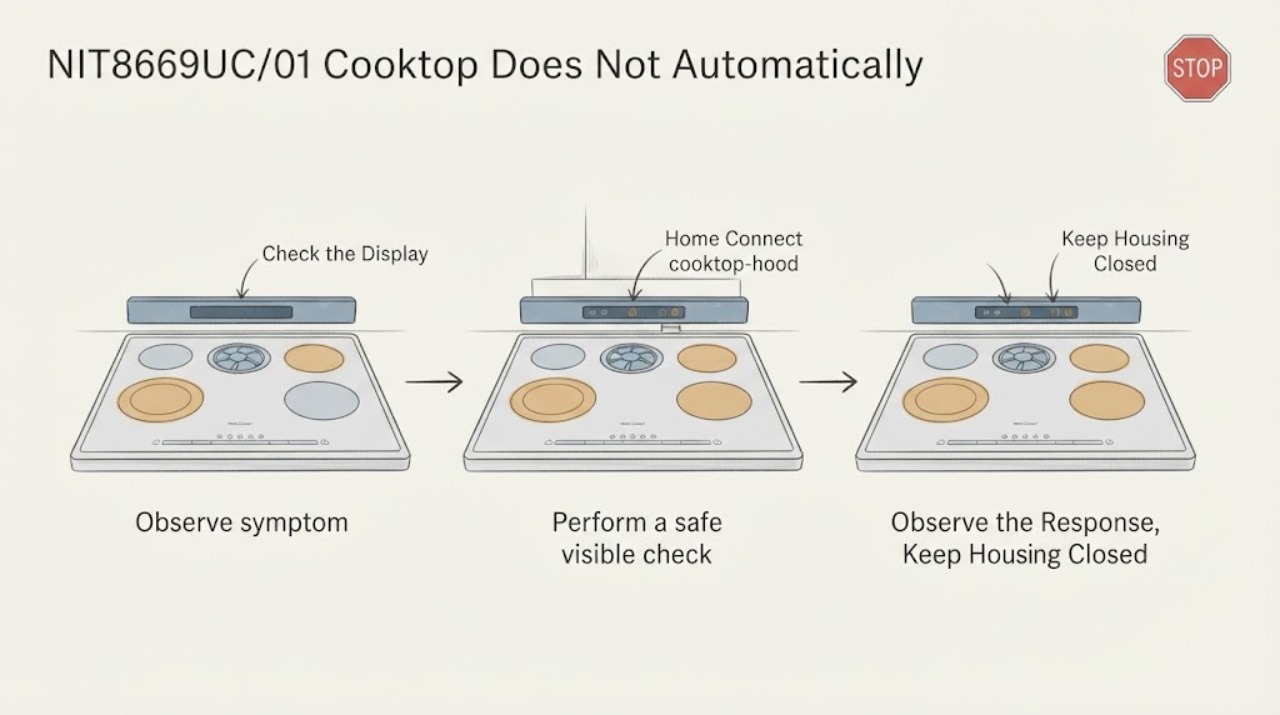
Work through in order
Diagnostic checks
Use only checks that match the exact appliance or system and its official guide.
-
Check 1
With the cooktop and hood controls off, make a normal visual safety check and separate the symptoms: is the NIT8669UC/01 cooktop display and one zone control responsive, is only the hood fan missing, and can the hood still be operated from its own controls? Do not remove a panel or touch wiring.
Expected result: The cooktop may operate normally while the hood is silent; the hood may run from its own controls; or the cooktop itself may be blank or unresponsive. Any smoke, scorching, odor, liquid in the control area, damaged wiring, crack, or repeat breaker trip is a hazard observation.
Next step: If there is a hazard, leave both appliances off and arrange qualified help. If the cooktop is responsive and the hood is the only symptom, continue by recording both appliance identities and compatibility.
Why this matters
Why: A working cooktop with a hood that runs manually points first to compatibility, pairing, or the hood-control setting. A hood that cannot run from its own controls is not proven to be a cooktop-link fault. A blank cooktop or electrical hazard belongs to the separate cooktop or electrical service path.
-
Check 2
Read the cooktop label or Bosch support record to confirm NIT8669UC/01, then record the hood's complete model and suffix from its rating label or support record. Compare the pair in Bosch's ventilation compatibility information; do not treat a generic Bosch, 800 Series, or Home Connect label as proof that the two models can be paired.
Expected result: You either have an exact hood model that Bosch identifies as pairable with the cooktop, or the hood model is missing, non-compatible, or not listed for this pairing.
Next step: For an unlisted or uncertain hood, use the hood's own controls and obtain the exact hood model before attempting setup. Do not copy a connection sequence from another Bosch hood or another cooktop.
Why this matters
Why: Bosch's feature description is for connected or matching equipment, and Bosch directs users to a pairing chart or model search. If the hood is not compatible, selecting a cooktop zone is not expected to start it automatically, so the symptom is a feature-availability mismatch rather than evidence of a failed cooktop control.
-
Check 3
For a documented compatible pair, check the cooktop's hood-control status without opening either appliance. The NIT8669UC-family manual describes a direct connection or a home-network connection; in either case, the cooktop and hood must complete the matching connection process. If using Home Connect, confirm that both appliances are present in the configured app/network and that the cooktop shows a connected hood rather than an unconnected state.
Expected result: The hood controls or connection indicator are present on the cooktop, both appliances are visible as connected, and the connection completes; or the hood-control symbols are absent, the hood is not visible, or the connection process times out.
Next step: If the pair is compatible but not connected, follow only the NIT8669UC-family manual and the hood's own documentation for one connection attempt. If the process will not complete, stop and preserve the exact model, connection state, and any displayed indicator for service; do not factory-reset or rewire by guesswork.
Why this matters
Why: The manual says hood-control settings are shown only when the appliance is connected to a hood and that Home Connect requires both appliances to be compatible. Missing symbols or an incomplete connection explain why selecting a zone cannot command the fan, without proving a failed electronic part.
-
Check 4
When a hood connection is present, open the cooktop's documented basic settings and inspect Automatic fan switch-on. The exact manual lists the choices as switched off, switched on in automatic mode, or switched on in manual mode; select the documented automatic mode only if that is the intended behavior, then exit the settings normally.
Expected result: The setting is off, in manual mode, in automatic mode, or the hood-control setting is not displayed at all.
Next step: Use one normal settings change with the hood connected, then test once. If the desired setting cannot be selected or immediately reverts, stop changing settings and arrange Bosch appliance service with the exact cooktop and hood models.
Why this matters
Why: Off means the hood must be started manually. Manual mode starts the hood with a default setting when a cooking zone is switched on, while automatic mode is the mode the manual associates with a zone-triggered start. If the setting is absent, the manual says that these options appear only when the cooktop is connected to a hood, so compatibility or connection remains unresolved.
-
Check 5
With the cooktop and hood otherwise safe, select one cooking zone using the normal cooktop controls and observe both appliances. Do not heat an unattended pan just to test the link. If needed, separately use the hood's own control once to see whether its fan can run, then return the hood to a safe setting.
Expected result: The cooktop zone responds and the hood starts automatically; the zone responds but the hood does not; or the cooktop zone itself does not respond. The hood may also fail to run from its own controls.
Next step: Record the zone tested, the hood's manual result, the connection state, and the automatic setting. Stop testing if the hood, cooktop, or circuit behaves abnormally and use the matching service branch below.
Why this matters
Why: A zone that works with a hood that runs manually but does not start from the cooktop leaves pairing, compatibility, or the automatic setting as the leading user-level branch. A hood that fails manually as well is a hood or power/control fault, while a nonresponsive cooktop zone is a separate cooktop operating fault.
-
Check 6
Prepare a service handoff instead of opening the appliances when the compatible pair is connected, automatic mode is selected, and one normal zone test still does not start the hood. Provide the exact cooktop suffix, full hood model, connection method, setting shown, whether the hood runs manually, and any safety symptom or indicator.
Expected result: The failure is repeatable only in cooktop-triggered operation, or the hood also fails independently, or the cooktop has its own blank/unresponsive or electrical symptom.
Next step: Leave the affected function off and arrange qualified Bosch appliance service, or qualified electrical assessment if the circuit is involved. Do not bypass the link, add wiring, probe live terminals, or keep resetting a tripping breaker.
Why this matters
Why: A repeatable link-only failure points to the documented cooktop-hood control path or hood controls; a hood that also fails manually requires hood/power diagnosis; a cooktop power or control failure must be handled as a cooktop service case. The observations are more useful to a technician than a guessed fan, board, or wiring part.
Use your observations
Decision map
Find the observation that best matches what you see, then follow the next safe action.
-
PATH 01Next step
What you see
The hood model is not listed as compatible, or the cooktop has no hood-control connection and the hood works normally from its own controls.
Do this next
Use the hood's own controls and confirm the model pairing before seeking a cooktop repair.
Why this path and its safety boundary
Why it matters: Bosch limits cooktop-hood control to a matching or compatible hood. Automatic start is therefore not an expected feature for this pair, and the cooktop has not been shown to be defective.
-
PATH 02Next step
What you see
The hood is compatible but the cooktop shows no connected hood, the app/network pairing is incomplete, or the connection attempt times out.
Do this next
Follow the exact cooktop and hood connection documentation once; if it will not complete, stop and arrange service with both model identities and the connection state.
Why this path and its safety boundary
Why it matters: The control path is not established. The exact manual requires the appliances to complete their documented direct or network connection process before hood controls appear on the cooktop.
-
PATH 03Next step
What you see
The hood is connected and manual controls work, but Automatic fan switch-on is off or set to manual mode.
Do this next
Select the documented automatic mode if desired, perform one normal zone test, and stop if the setting will not stay selected.
Why this path and its safety boundary
Why it matters: The setting itself explains the expected behavior: off requires manual hood activation, while manual mode is different from the documented automatic mode.
-
PATH 04Next step
What you see
The pair is compatible and connected, automatic mode is selected, the cooktop zone responds, but the hood still does not start from the cooktop; the hood does run manually.
Do this next
Leave the automatic function unused and request qualified Bosch appliance service with the recorded connection and setting details; do not guess at a fan or control-board replacement.
Why this path and its safety boundary
Why it matters: The remaining symptom is isolated to cooktop-triggered hood control or the hood's connected control path, not to the selected induction zone itself.
-
PATH 05Next step
What you see
The hood will not run manually, the cooktop display or zone is also unresponsive, or there is smoke, scorching, odor, exposed wiring, a crack, liquid in the control area, or a repeat breaker trip.
Do this next
Turn the affected appliance off, avoid electrical switching when an odor or smoke hazard is present, and arrange qualified appliance or electrical service as appropriate.
Why this path and its safety boundary
Why it matters: This is no longer a simple cooktop-hood automation check. It may involve the hood, the cooktop, or the household circuit, and the visible hazard takes priority over testing.
Helpful context
Understand the symptom
This is a cooktop-to-hood control problem, not necessarily a failed cooktop. The NIT8669UC/01 is a Bosch 800 Series induction cooktop, and its exact manual describes hood synchronization as a feature for a matching hood. A hood that lacks the required compatibility, a connection that was never completed, or an automatic setting that is off can all look like a dead fan when a zone is selected.
Keep all checks on the normal user side. Do not open the cooktop or hood, alter wiring, probe a live circuit, bypass a control, or repeatedly reset a breaker. Stop immediately for smoke, scorching, a burning or electrical odor, exposed wiring, liquid entering the control area, a cracked cooktop, or a breaker that trips again.
When checks do not resolve it
Need a professional?
Provide the exact NIT8669UC/01 identity, the hood's full model and suffix, whether the pair is listed as compatible, the connection method and status, the Automatic fan switch-on setting, whether the hood runs manually, and the result of one normal zone selection.
Safety scope: Do not open the cooktop or hood, alter wiring, probe a live circuit, bypass a control, or repeatedly reset a breaker.
Common questions
FAQ
Does selecting a cooking zone always start the hood on the NIT8669UC/01?
No. Bosch documents this behavior through cooktop-hood control with a matching compatible hood and an automatic fan switch-on setting. An incompatible or unconnected hood should be controlled separately.
Why is the hood-control setting missing from the cooktop?
The exact manual says hood-control settings are displayed only when the cooktop is connected to a hood. Confirm the hood model and connection before treating the missing setting as a cooktop failure.
Can I test the link by opening the cooktop or adding a wire?
No. Keep the check to normal controls and model documentation. Wiring, live electrical testing, and component diagnosis belong to qualified service.
Read the exact guide
Official sources
- Use and Care Manual - Cooktop - NIT8669SUC NIT8669UCBosch Home Appliances · Exact NIT8669UC family manual; US English PDF
- Kitchen Ventilation Buying Guide | BoschBosch Home Appliances · Bosch US ventilation buying and pairing guidance
- Connected Appliances for a Smart Home | Home Connect® | BOSCHBosch Home Appliances · Bosch US Home Connect information for compatible connected appliances
- 36" Induction Cooktop with Home Connect™, NIT8669UC, Black FramelessBosch Home Appliances · US product specification sheet for NIT8669UC
- Appliance Information - Induction Cooktop | NIT8669UC/01Bosch Home Appliances · Exact US product-support page for NIT8669UC/01
Community feedback
Share a repair observation
Share a plain-text repair observation. Accepted observations are published automatically; this page may take a moment to update.