
On this page
Start here
Quick answer
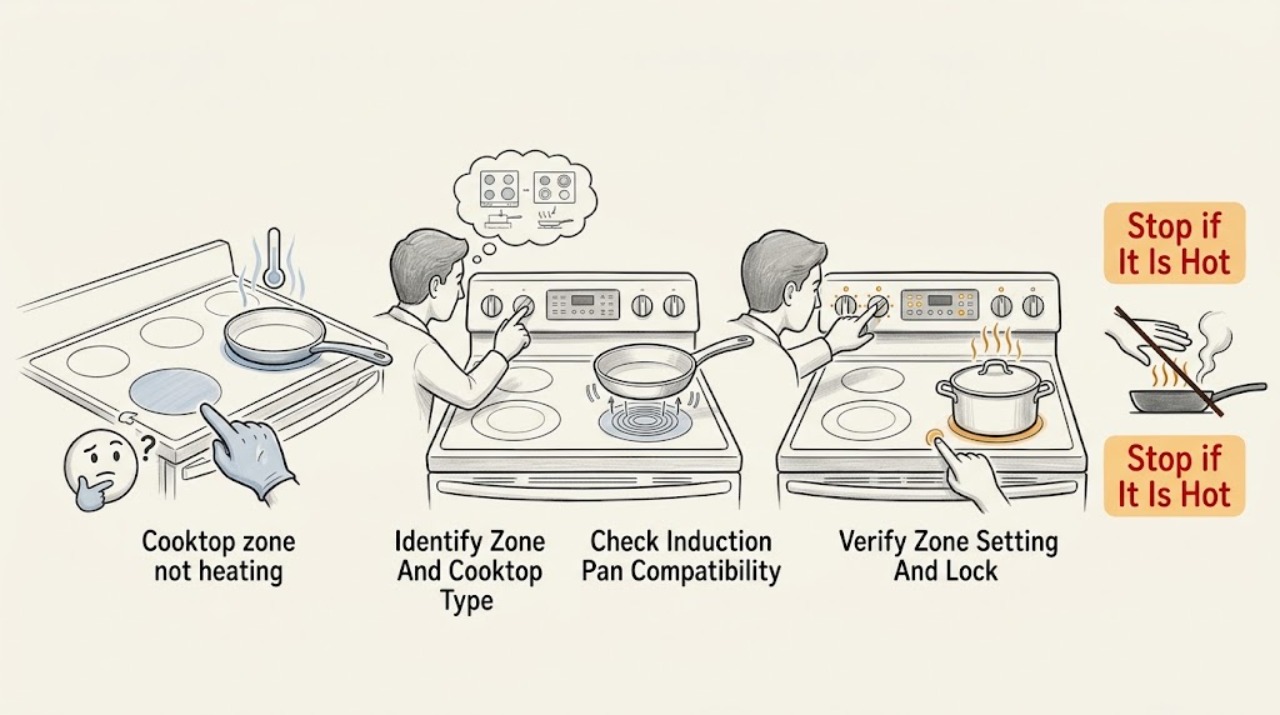
First identify whether the Bosch cooktop is induction or electric, and whether one zone is cold, a zone cycles on and off normally, or the entire cooktop is unresponsive. On an induction model, a zone may not heat when the pan is not magnetic, is too small, or is not centered; check the pan and zone placement using Bosch's cookware guidance. On an electric glass model, an element may cycle on and off and may not glow at low settings, but a zone that never heats while other zones work is not explained by normal cycling. Confirm the intended zone, power level, and child or panel-lock status, and make only a safe visual check of the appliance circuit. Let an identified overheat condition cool and follow the exact model manual for one permitted reset. Do not open the cooktop, test live wiring, defeat a lock, touch a hot surface, or keep using it if glass is cracked, heat is uncontrolled, there is smoke, burning odor, sparks, shock, or a gas odor. If the zone remains cold after the model-specific checks, leave the cooktop off and arrange qualified appliance service.
Work through in order
Diagnostic checks
Use only checks that match the exact appliance or system and its official guide.
-
Check 1
With all controls in a safe state, identify whether the Bosch appliance is induction or electric, which cooking zone is affected, whether the display responds, and whether any other zone heats normally; record any symbol or code exactly.
Expected result: Distinguish one cold zone from all zones being cold, a zone that cycles, an induction pan-not-detected indication, a lock symbol, a blank display, or an error message.
Next step: Use the matching induction, electric-cycling, power, or service branch below; do not guess a component from the display alone.
Stop if: Stop for cracked glass, uncontrolled heat, smoke, burning odor, sparks, shock, exposed wiring, abnormal flame on a gas model, or a zone that cannot be turned off.
Why this matters
Why: One affected zone with normal controls points toward cookware detection, a zone component, sensing, or local control. All zones cold or a blank panel points toward power, lock, or shared control. A visible cycle on an electric element may be normal regulation rather than a failed heater.
-
Check 2
For an induction Bosch model only, use a cool pan and check the manufacturer's cookware guidance: confirm the base is magnetic, suitable for induction, and centered on the affected zone at the intended size; skip this action for an electric radiant model.
Expected result: Note whether the pan is detected and heats, whether the zone shows no-pan or equivalent behavior, whether a different known-suitable pan works, or whether no pan works on that zone.
Next step: Use the exact zone and cookware requirements in the Bosch manual. If a suitable pan still does not heat, stop repeated tests and continue to controls and service diagnosis.
Stop if: Do not use a hot, damaged, or empty pan for testing, place metal objects on an active zone, or touch the cooking surface while its residual-heat indicator is on.
Why this matters
Why: A nonmagnetic, undersized, warped, or off-center pan can make an induction zone appear not to heat. If a suitable centered pan is detected but the zone remains cold while others work, cookware is less likely and a local appliance fault is more likely.
-
Check 3
With the cooktop surface safe to approach, select the affected zone in the normal way, verify that a power level is shown, and check for a child, panel-lock, pause, or wet/covered-control indication without bypassing any safety feature.
Expected result: Record whether the control accepts a zone and level, the lock or pause indicator clears using the model's ordinary procedure, all indicators flash, or the control remains unresponsive.
Next step: Follow only the exact Bosch model's normal unlock or control procedure. If the control is unresponsive or the lock will not clear normally, leave the cooktop off and arrange service.
Stop if: Do not pry, hold keys outside the manual's instructions, pour liquid on the panel, or remove the touch-control surface.
Why this matters
Why: A missing level, active lock, or covered touch panel can prevent a zone from heating without a failed element. A correct setting with a responsive control and one cold zone makes a local zone, sensor, wiring, or control fault more likely.
-
Check 4
For an electric radiant Bosch model, observe the selected zone only from a safe distance and without touching the glass, noting whether its indicator or glow cycles on and off while heat is maintained; do not use an empty pan or high heat to force a test.
Expected result: Separate a zone that warms and cycles from one that remains cold, has no indicator at any permitted setting, heats uncontrollably, or differs sharply from the other zones.
Next step: If the zone never heats while settings and power are normal, stop using that zone and arrange qualified service; if it cycles and maintains heat normally, follow the manual rather than replacing a part.
Stop if: Do not touch the surface to check temperature, operate with cracked glass, or continue if the zone will not turn off or the surface overheats abnormally.
Why this matters
Why: Cycling is part of temperature regulation on applicable electric cooktops, so a momentarily dark element can be normal. A persistently cold zone or an uncontrolled zone is not explained by normal cycling and needs model-specific diagnosis.
-
Check 5
For a blank panel, all-zone failure, overheat indication, or recurring error, make only a safe visual check for an obvious tripped appliance circuit and note whether the surface or electronics have cooled; do not open a panel or reset a breaker that trips again.
Expected result: Record a normal display with one cold zone, a tripped breaker, a breaker that will not hold, an overheat message, or a code that identifies supply or electronics trouble.
Next step: If and only if the exact manual permits it and no hazard exists, follow one model-specific cooling or reset step. Otherwise leave the cooktop off and arrange service.
Stop if: Do not remove a breaker-panel cover, test live conductors, repeatedly reset a tripping circuit, or work around a wet or heat-damaged appliance.
Why this matters
Why: A supply interruption can disable all zones, while an overheat indication can be a protective shutdown. A recurring trip, voltage-related code, or persistent blank display requires qualified electrical or appliance diagnosis.
-
Check 6
If the affected zone remains cold after the correct cookware, normal setting, lock, power, and cooling checks, record the model, zone location, code or symbol, pan behavior, and whether other zones operate; do not remove the glass or attempt internal tests.
Expected result: A useful service note distinguishes a suitable pan not detected, an electric element that never glows or heats, a code that returns, a local zone failure with other zones working, and an all-zone or breaker fault.
Next step: Keep the cooktop off and arrange qualified Bosch appliance service, or qualified electrical help for a supply concern. Do not continue cooking on another zone as a workaround when the cooktop has a fault or damaged surface.
Stop if: Stop immediately for gas odor, smoke, sparks, shock, exposed wiring, uncontrolled heat, severe overheat, or any crack or loose glass.
Why this matters
Why: These patterns help service inspect the heating zone or coil, sensor, control, wiring, or supply in the right order. They do not prove that a particular part is defective or compatible.
Use your observations
Decision map
Find the observation that best matches what you see, then follow the next safe action.
-
PATH 01Next step
What you see
The Bosch cooktop is induction, the selected zone responds, and a cool pan is not detected or does not heat, while another known-suitable magnetic pan works when centered on that zone.
Do this next
Use the cookware and zone-size guidance in the exact Bosch manual. Arrange service if a suitable centered pan still is not detected or heats only intermittently.
-
PATH 02Next step
What you see
The Bosch cooktop is electric radiant, the selected zone warms, cycles off and on, or its glow disappears at a lower setting, and it maintains heat without uncontrolled behavior.
Do this next
Follow the model's normal use guidance and monitor from a safe distance. Arrange service if the zone stays cold, no longer cycles into heat, or begins overheating or failing to turn off.
-
PATH 03Next step
What you see
One zone remains cold with suitable induction cookware or a permitted electric setting, the control and lock respond normally, other zones operate, and no external power issue is evident.
Do this next
Stop using the affected cooktop and arrange qualified appliance service. Do not remove the glass, swap internal connectors, or order a zone part from the symptom alone.
-
PATH 04Next step
What you see
All zones are cold or the panel is blank, a breaker is tripped or will not hold, a supply-related code appears, or a correct visual power check does not restore operation.
Do this next
Leave the cooktop off and arrange qualified electrical or appliance diagnosis. Do not open the breaker panel, cooktop, or junction box or repeatedly restore power.
-
PATH 05Next step
What you see
An overheat or recurring error accompanies the cold zone, the zone will not turn off, the glass is cracked, liquid has reached controls, or there is smoke, burning odor, sparks, shock, exposed wiring, or gas odor on a gas model.
Do this next
Turn controls off if safe, leave the area for gas odor or active fire, keep people away, and arrange qualified or emergency help appropriate to the hazard. Do not touch the cooktop until it is safe and cleared.
Helpful context
Understand the symptom
Separate normal cycling from a cold zone
An electric radiant element may glow, switch off, and glow again while regulating temperature; a missing glow at a low setting does not automatically mean no heat. Induction zones work differently: the pan itself must be detected and become the heat source. Start by recording the cooktop type, the selected zone and level, whether another zone heats, and whether any indicator or code appears. The exact Bosch manual controls the model-specific behavior.
Induction cookware can look like a dead zone
For an induction Bosch cooktop, a pan made from a nonmagnetic material, a base that is too small for the zone, or a pan that is off-center may not be recognized. Use a cool pan and the Bosch cookware guidance; a magnet test is a compatibility check, not a test of a cracked or energized appliance. If a known suitable pan is centered and the zone still does not heat, stop treating cookware as the explanation.
Use controls, lock, and power as decision points
A selected zone with no power level, an active child or panel lock, a wet or covered touch panel, or a tripped circuit can prevent heating. Check these conditions without touching hot glass or opening the unit. A circuit that trips again, a blank display with normal household power, or an error that returns after the listed reset is a service or electrical diagnosis—not an invitation to remove the cooktop or probe wiring.
A single cold zone needs a component diagnosis
If the cookware, setting, lock, power, and cooling checks are appropriate but one zone remains cold while the rest operate, the affected heating element or induction coil, temperature sensing, electronic control, or wiring may need inspection. The symptom does not identify which component is defective. Keep the cooktop off when the failure is persistent, accompanied by an abnormal code, or associated with heat, glass, or electrical damage.
Safety boundary
Stop conditions
- Stop using the cooktop for cracked glass, liquid entering controls, a zone that will not turn off, smoke, burning odor, sparks, shock, exposed wiring, a recurring breaker trip, severe overheating, abnormal flame, gas odor, or active fire.
- Do not open the cooktop, remove the glass, test live wiring, open a junction box, bypass a child or panel lock, touch a hot surface to test it, or repeatedly reset an unexplained fault.
- A safe user check is limited to identifying the cooktop type and zone, verifying normal settings and lock state, checking induction cookware and placement when applicable, observing permitted electric-element cycling from a safe distance, and following one exact model-approved cooling or reset step. Persistent no-heat faults belong to qualified service.
Only after diagnosis
Potential parts
- Bosch electric surface heating element or induction coil
Relevant only when qualified diagnosis confirms that the affected zone's element or induction coil is open, damaged, or otherwise failed after cookware and control causes are excluded.
Confirm the exact Bosch model, zone position, and approved component; a cold zone does not establish element or coil failure. - Bosch cooktop temperature sensor or limiter
Relevant only when testing links a recurring overheat, no-heat, or protection behavior to the sensor or limiter circuit.
Use model-specific diagnostic evidence and approved fitment; do not replace a sensor solely because a zone is cold. - Bosch cooktop electronic control or power module
Relevant only after qualified diagnosis finds a control or power-module fault affecting one or more zones with correct supply and settings.
Confirm the exact model and electrical configuration before replacement; a recurring code or breaker event needs diagnosis first. - Bosch cooktop touch-control panel or interface
Relevant only when the lock, wet-panel, setting, and supply checks are normal but qualified diagnosis confirms that the touch interface is not selecting or controlling the zone.
Match the exact model's approved interface and do not bypass its lock or substitute a visually similar panel.
When checks do not resolve it
Need a professional?
Arrange qualified Bosch appliance service when one zone remains cold with suitable induction cookware or a correctly selected electric setting, a zone never cycles into heat, an error returns after the exact model's permitted reset or cooling step, or a local zone fails while other zones work. Arrange qualified electrical help for a blank panel, supply-voltage concern, or breaker that trips again. Stop immediately for cracked glass, uncontrolled heating, smoke, sparks, shock, exposed wiring, gas odor, or active fire and use emergency help for immediate danger. Provide the model marking, cooktop type, zone, code, pan behavior, lock state, and power observations.
Common questions
FAQ
Why is one Bosch cooktop zone not heating?
On induction, cookware may not be magnetic, correctly sized, or centered. On electric glass, the element may cycle off and on normally, but a zone that stays cold can involve its element, sensor, control, wiring, or supply. Check the cooktop type, setting, lock, cookware, and model guidance before service.
How can I tell if my Bosch induction pan is compatible?
Use a cool pan and the Bosch induction cookware guidance. Suitable cookware is magnetic; a magnet sticking to the pan bottom is a simple compatibility check. Center the pan on the correct zone and use the model's size guidance. If a known-suitable pan still is not detected on one zone, arrange service.
Is it normal for a Bosch electric element to stop glowing?
Often, yes. Bosch documentation says radiant elements regulate temperature by cycling on and off, so the glow may disappear during operation, especially at lower settings. A zone that never warms, overheats, or will not turn off is not explained by normal cycling and needs service.
Can a Bosch cooktop lock prevent one zone from heating?
A child or panel lock can prevent normal control operation on applicable models. Check the lock indicator and use only the model's ordinary unlock procedure. Never bypass a lock or open the control panel; persistent failure after a normal unlock check belongs to service.
Should I reset a Bosch cooktop that is not heating?
Only follow a reset when the exact Bosch manual lists it for the displayed condition and there is no heat, glass, gas, or electrical hazard. Record the code first and do not repeatedly reset the unit. If the zone remains cold or the code returns, keep the cooktop off and arrange service.
What if all Bosch cooktop zones are not heating?
Check only for an obvious visual power or lock indication and save any code. All-zone failure or a blank display points more toward shared power, connection, or control than one heating element. Do not open the breaker panel or cooktop; arrange qualified electrical or appliance diagnosis if power does not return normally.
When should I stop using a Bosch cooktop with a cold zone?
Stop for cracked glass, liquid in controls, uncontrolled heating, a zone that will not turn off, smoke, burning odor, sparks, shock, exposed wiring, severe overheating, gas odor, or a recurring breaker trip. Keep the cooktop off and use qualified or emergency help appropriate to the hazard.
Read the exact guide
Official sources
- Bosch Cooktop & Rangetop Error CodesBSH Home Appliances Corporation · Bosch electric, induction, and gas cooktop error, overheat, lock, voltage, and service categories
- Use and Care Manual HII8057U, HII8057C, HII8047UBSH Home Appliances Corporation · Bosch induction cooktop cookware suitability and fault-code guidance
- Bosch Induction Cooktop TroubleshootingBSH Home Appliances Corporation · Bosch induction cooktop no-heat, cookware, control, lock, power, and overheating checks
- Use and Care Manual NET5469SCBSH Home Appliances Corporation · Bosch electric cooktop model-family operating behavior and heating-zone cycling
- What is Induction Safe Cookware?BSH Home Appliances Corporation · Bosch induction cookware material and magnetic compatibility guidance
- Bosch Electric Cooktop TroubleshootingBSH Home Appliances Corporation · Bosch electric cooktop power, lock, overheating, error, cracked-surface, and service guidance
Community feedback
Share a repair observation
Share a plain-text repair observation. Accepted observations are published automatically; this page may take a moment to update.