
On this page
Start here
Quick answer
When a cooktop control responds but one zone does not heat, first identify whether the surface is radiant, plug-in coil, or induction and test the correct cookware and setting. A radiant zone may cycle on and off by design, and some areas may not glow red continuously; an induction zone needs a correctly sized, flat, compatible pan centered on the cooking area. If only one zone remains cold while other zones work, a heating element, receptacle, limiter, sensor, switch, or control fault is more likely. If several zones are cold, check the appliance power supply and breaker without opening the cooktop. Turn the cooktop off and let it cool before any permitted visual or element check. Do not open the appliance, test live voltage, handle wiring, or force an element. Arrange qualified appliance service if the correct pan and setting do not restore heat, the breaker trips, a surface is cracked, or there is sparking, smoke, burning odor, or visible damage.
Before you begin
Safety first
- Heating-element, receptacle, limiter, sensor, infinite-switch, electronic-control, wiring, breaker, and glass-surface repairs should be performed by a qualified appliance or electrical technician using the exact model documentation and power-isolation procedures.
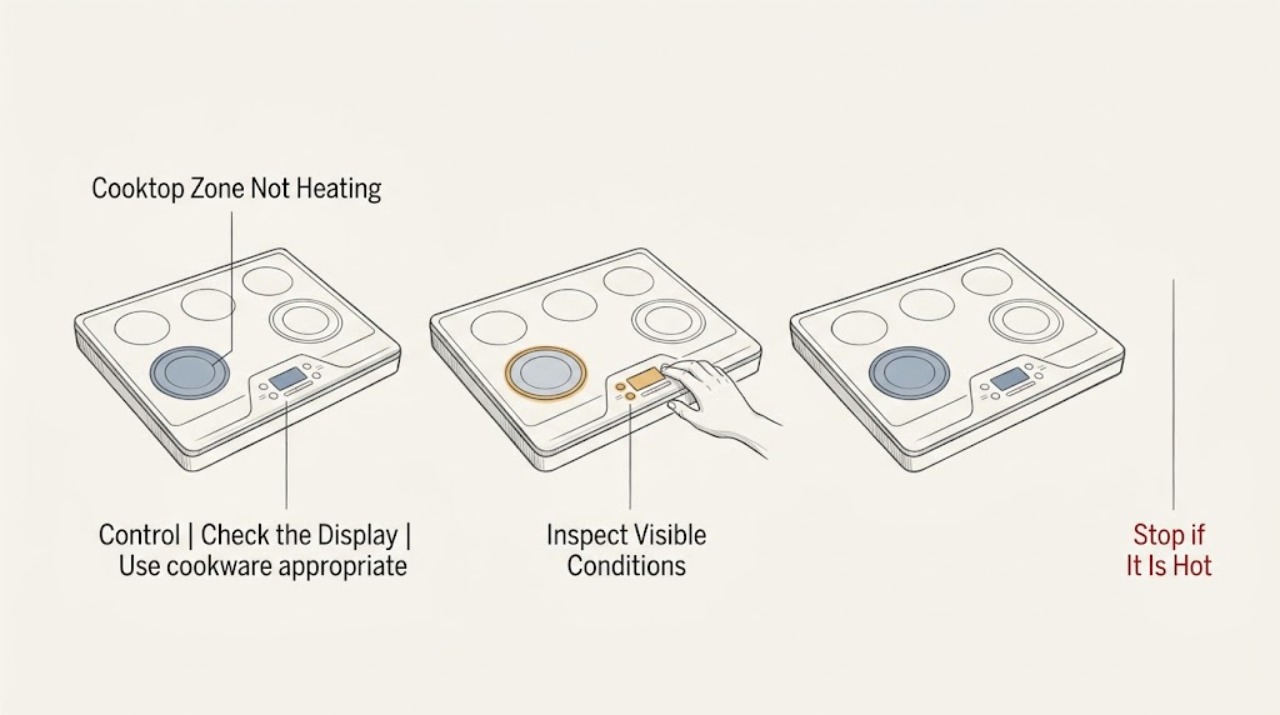
Work through in order
Diagnostic checks
Use only checks that match the exact appliance or system and its official guide.
-
Check 1
Identify the cooktop type and select the affected zone using the model's normal control sequence. Note whether the control light or display responds, whether the zone indicator changes, whether other zones heat, and whether the surface is radiant, plug-in coil, or induction.
Expected result: The control responds but one zone stays cold, several zones stay cold, the zone cycles on and off, or the zone is induction and shows a pan or power indication.
Next step: Continue with the cookware and setting check for the identified zone. If several zones are affected or the control behavior is abnormal, inspect only the external power indication and arrange service if it persists.
Stop if: Turn the cooktop off for smoke, sparks, a burning smell, cracked glass, visible damage, or a hot control area that behaves abnormally.
Why this matters
Why: One cold zone with working neighbors points toward that zone's element, receptacle, limiter, sensor, switch, or control path. Several cold zones make an appliance power or control-supply issue more likely. Cycling may be normal for radiant elements, while an induction pan indication points to cookware detection.
-
Check 2
Use cookware appropriate to the zone. For induction, use a flat magnetic pan that covers the marked zone and is centered; for radiant or coil zones, use a flat pan suited to the zone size. Select a normal heating setting rather than warming or simmer, following the owner's manual.
Expected result: The zone heats with the correct pan, the induction display stops indicating a pan problem, the pan is too small or off-center, or the zone remains cold with suitable cookware.
Next step: Use the model's recommended cookware and setting if heat is restored. If the zone remains cold, continue to the element and power checks without opening the appliance or repeatedly cycling it.
Stop if: Do not use a pan that rocks, overlaps dangerously, contacts a cracked surface, or becomes abnormally hot in one spot; stop for smoke, sparks, or an electrical smell.
Why this matters
Why: Heat restored by the correct pan supports cookware detection or heat transfer as the cause, not a failed element. A cold induction zone with a centered compatible pan, or a cold radiant or coil zone with suitable cookware, points toward the appliance heating path.
-
Check 3
For a radiant surface, observe one complete heating cycle from a safe position rather than judging only by the glow. For a plug-in coil model, turn the cooktop off, disconnect power as the manual directs, and check only whether the removable element is seated correctly; do not remove a hardwired or glass-surface element.
Expected result: The radiant area cycles while the pan warms, the coil is loose and reseats correctly, the zone never warms, or a glass surface shows a damaged or dark area.
Next step: Stop using the zone if it remains cold, is damaged, or behaves unevenly, and arrange qualified appliance service. Do not swap elements unless the exact model manual explicitly permits that check and the appliance is fully cool and disconnected.
Stop if: Do not reach into a hot surface, remove a hardwired element, open the cooktop, or continue with a cracked ceramic surface or loose electrical connection.
Why this matters
Why: A radiant element cycling or not glowing uniformly can be normal when the pan warms. A coil that heats after proper seating points to a contact issue. A cold zone after a permitted seating check, or a damaged glass area, keeps an element, receptacle, limiter, sensor, or control fault in consideration.
-
Check 4
With the cooktop off, inspect the household electrical indication without removing panels. Check whether the appliance breaker or fuse has tripped, whether a cord or plug is visibly loose where the manual permits access, and whether other zones or oven functions have power. Do not slide a heavy appliance or touch wiring to reach a connection.
Expected result: The breaker or fuse is tripped, several zones are cold, the clock or other functions work while the surface does not, or the external power indication is normal.
Next step: Reset a tripped breaker only once if it can be done safely and no burning, smoke, or damage is present. If it trips again, power remains abnormal, or the appliance may be miswired, keep the cooktop off and arrange qualified electrical or appliance service.
Stop if: Do not reset repeatedly, replace a fuse with an incorrect type, slide the appliance to expose wiring, or touch a hot, damaged, or wet electrical connection.
Why this matters
Why: A tripped supply or multiple cold zones can indicate a power or connection issue rather than one heating element. A responsive display with one cold zone makes a local element or control path more likely, while a recurring trip indicates an electrical fault.
-
Check 5
After the cookware, setting, element-seating, and power observations, make one brief test with the correct pan only when the surface is cool and the owner's manual permits it. Stay nearby and stop if the zone stays cold, cycles abnormally, the display shows a fault, or any smell, sound, smoke, spark, or damage appears.
Expected result: The zone heats normally, heats weakly or intermittently, remains cold while the control responds, or affects other zones when selected.
Next step: Stop using the affected zone and arrange qualified appliance service for persistent or intermittent failure. Provide the model, zone location, cooktop type, pan result, indicator behavior, and breaker observations; do not perform live electrical tests.
Stop if: Stop immediately for sparks, smoke, burning odor, a breaker trip, cracked glass, visible arcing, or heat in the controls or wiring area.
Why this matters
Why: Normal heating after the external checks points toward cookware, setting, seating, or a temporary power condition. Persistent cold or weak heat with correct conditions makes an element, limiter, sensor, switch, receptacle, or electronic control fault more likely.
Use your observations
Decision map
Find the observation that best matches what you see, then follow the next safe action.
-
PATH 01Next step
What you see
Do this next
Use the correct pan and setting described by the owner's manual. Stop only if the pan does not heat, the cycle becomes abnormal, or damage or odor appears.
Why this path and its safety boundary
Why it matters: The zone is likely operating normally; a radiant element need not glow continuously or uniformly at every setting.
-
PATH 02Next step
What you see
Do this next
Continue using compatible cookware centered within the marked zone. Arrange service if a suitable pan is still not detected or the zone repeatedly stops heating.
Why this path and its safety boundary
Why it matters: Cookware detection or pan position was the limiting condition rather than a failed heating element.
-
PATH 03Next step
What you see
Do this next
Keep that zone off and arrange qualified appliance service. Do not open the cooktop or test live wiring to identify the part.
Why this path and its safety boundary
Why it matters: A local element, receptacle, limiter, sensor, switch, or control path is more likely than a whole-appliance power failure.
-
PATH 04Next step
What you see
Do this next
Keep the appliance off after one safe external breaker observation and arrange qualified electrical or appliance service. Do not repeatedly reset the breaker or expose wiring.
Why this path and its safety boundary
Why it matters: A supply, connection, control-supply, or installation problem is more likely than one failed surface element.
-
PATH 05Next step
What you see
Do this next
Stop using the cooktop, disconnect power only if safe without touching damaged or wet equipment, keep clear, and obtain qualified appliance or electrical service.
Why this path and its safety boundary
Why it matters: This is an electrical, burn, fire, or glass-injury hazard rather than a routine zone-heating check.
Helpful context
Understand the symptom
A responsive control does not prove the zone is heating
A light, display, or touch control can respond even when the element is cycling normally, the pan is incompatible with induction, or the power path to one zone has failed. Radiant elements use limiters and may cycle at high settings; induction zones can refuse to heat when the pan is absent, too small, not magnetic, or not centered. Compare the actual pan and surface behavior before assuming the control is defective.
Keep the diagnosis external and cool
Use the owner's manual for the exact zone type, cookware requirements, reset procedure, and any removable coil-element instructions. Turn the cooktop off before touching cookware or an element and allow hot surfaces to cool. Internal element, switch, limiter, sensor, wiring, and control work belongs to qualified appliance service.
Safety boundary
Stop conditions
- Stop immediately for sparks, smoke, burning odor, visible arcing, cracked glass, a hot control area, a recurring breaker trip, or a damaged cord or connection.
- Turn the cooktop off and allow it to cool before touching cookware or a removable coil; do not reach across a hot surface or use a damaged pan or zone.
- Do not open the cooktop, remove a hardwired element, test live voltage, handle wiring, force a receptacle, or continue with a wet or damaged appliance.
- Do not reset a breaker repeatedly, replace a fuse with an incorrect type, or slide a heavy appliance to expose electrical connections.
- Arrange qualified appliance service for a zone that remains cold with correct cookware and setting, an intermittent or weak element, an abnormal limiter or sensor, a failed switch or control, or an unsafe access condition.
Only after diagnosis
Potential parts
- cooktop surface heating element
Consider this only when a qualified diagnosis confirms the affected radiant, coil, or induction element is open, damaged, or otherwise failed after cookware and power causes are ruled out.
Element shape, wattage, connector, sensor, and mounting vary by cooktop model and surface type; identify the exact model before ordering. - cooktop element receptacle or terminal
Consider this only when a technician confirms a plug-in coil receptacle or terminal is loose, burned, or damaged and is causing one zone to remain cold.
Terminal layout, heat rating, wiring, and fit are model-specific and require safe power isolation; do not select a connector from the symptom alone. - cooktop limiter, switch, sensor, or control component
Consider this only after professional testing identifies the limiter, infinite switch, pan sensor, touch control, or related component as the cause of persistent no-heat behavior.
Component type, ratings, software or sensor compatibility, and mounting vary by model; use the exact service documentation and qualified installation.
When checks do not resolve it
Need a professional?
Contact qualified appliance service when one cooktop zone stays cold after the correct cookware, setting, permitted element-seating, and external power checks, when several zones are affected, or when the surface cycles abnormally. Escalate immediately for sparks, smoke, burning odor, cracked glass, visible arcing, a recurring breaker trip, or damaged wiring.
Safety scope: Heating-element, receptacle, limiter, sensor, infinite-switch, electronic-control, wiring, breaker, and glass-surface repairs should be performed by a qualified appliance or electrical technician using the exact model documentation and power-isolation procedures.
Have this ready
- Provide the cooktop make and model, radiant, coil, or induction type, affected zone, pan type and position, control and indicator behavior, whether other zones heat, element-seating result if applicable, breaker or fuse behavior, and any sound, smell, spark, or visible damage.
Common questions
FAQ
Why does my cooktop control respond but the zone stays cold?
The control can respond while the wrong cookware or setting is selected, a radiant element is cycling normally, or the zone's element, limiter, sensor, receptacle, switch, or control path has failed. Identify the surface type and compare other zones before choosing a repair.
Should a radiant cooktop element glow red continuously?
Not necessarily. Radiant elements can cycle on and off through a limiter, and some portions may not glow visibly even while heat is present. Judge the result by whether the correct pan warms; persistent cold or abnormal cycling needs service.
Why does my induction cooktop zone respond but not heat?
Induction needs a flat, magnetic, correctly sized pan centered over the marked zone. A missing, small, off-center, or incompatible pan can make the control respond without producing heat; if a suitable pan is still not detected, arrange service.
Can a cooktop breaker cause one zone not to heat?
A supply or connection issue is more likely when several zones are cold, the appliance behaves inconsistently, or the breaker trips. Check only the external breaker or fuse indication safely and do not repeatedly reset it or expose wiring.
When should I call for cooktop service?
Call when the affected zone stays cold with the correct pan, setting, and permitted element-seating check, when multiple zones are affected, or when the limiter, switch, sensor, receptacle, or control may be faulty. Stop immediately for sparks, smoke, burning odor, cracked glass, visible arcing, or a recurring breaker trip.
Read the exact guide
Official sources
- Cooktop Not Working - Electric CooktopWhirlpool · Official Whirlpool electric-cooktop product help used for radiant cycling, pan-size, setting, and power distinctions; the exact model manual controls the procedure.
- Electric Range - Surface Burners Not Heating or WorkingGE Appliances · Official GE electric-range support used for distinguishing one cold element from broader power or connection problems; exact appliance construction controls the safe check.
- Electric Range & Cooktop - Surface Burners Not Heating WellGE Appliances · Official GE support guidance used for generic electric cooktop checks; element design and safe access remain model-specific.
- Electric Range & Cooktop - Induction Burners Not Working or Flashing Power LevelGE Appliances · Official GE induction support used only for the induction branch; radiant and plug-in coil cooktops use different checks.
- Not Powering On - Electric CooktopWhirlpool · Official Whirlpool electric-cooktop help used for external power and removable-coil seating checks; exact model instructions determine whether a check applies.
Community feedback
Share a repair observation
Share a plain-text repair observation. Accepted observations are published automatically; this page may take a moment to update.