
On this page
Start here
Quick answer
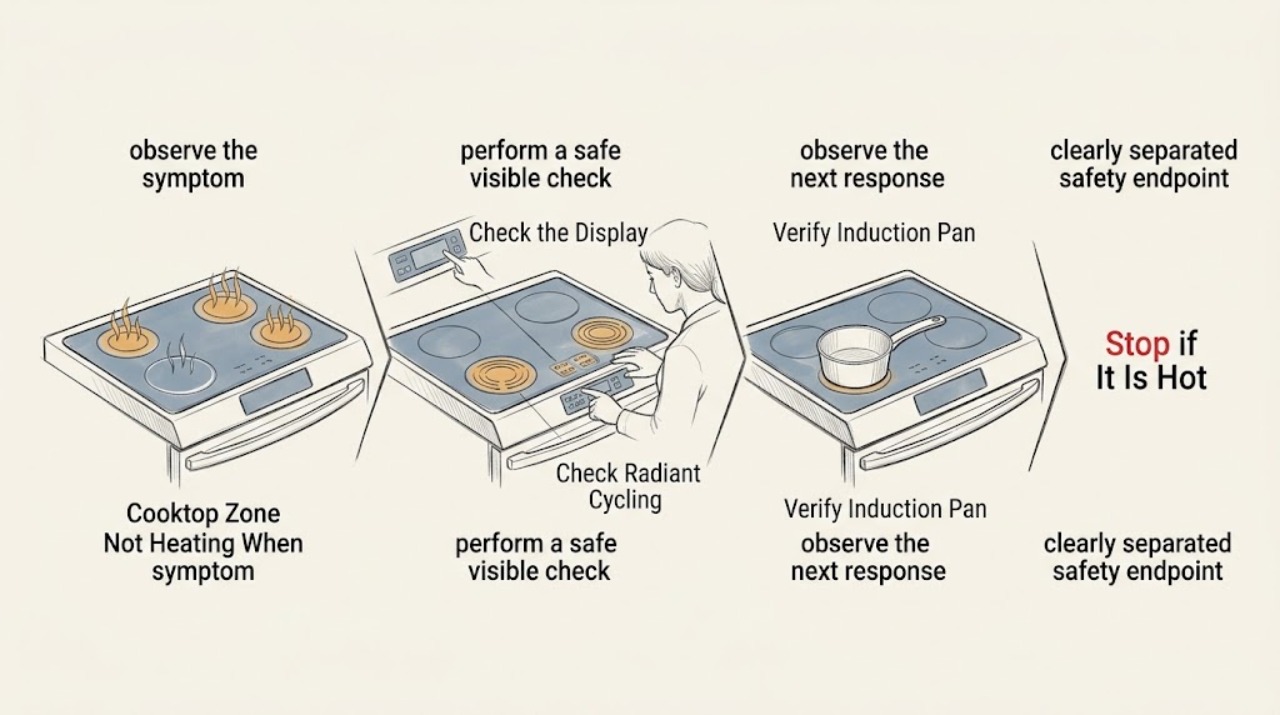
When one cooktop zone stays cool while the other zones work, first identify whether it is a radiant electric, removable-coil, or induction zone and confirm that the correct control is selected. Radiant elements can cycle on and off, and an induction zone may refuse to heat an empty, nonmagnetic, or incorrectly sized pan. With the controls off and the surface cool, check only accessible seating, cookware, lock, and display conditions; a removable coil may be compared in another same-size receptacle only when the manufacturer's instructions allow it and power is disconnected. If the zone remains cold with the correct control and cookware, or the problem follows the receptacle or electronic control, stop using that zone and arrange qualified appliance service rather than opening the cooktop or testing live voltage.
Work through in order
Diagnostic checks
Use only checks that match the exact appliance or system and its official guide.
-
Check 1
Turn the affected zone control off, let the surface cool, and identify whether the cooktop uses radiant glass, a removable electric coil, induction, or gas. Check the control marking, display, timer or control lock, and that the selected control corresponds to the cold zone; do not touch the surface to test it.
Expected result: The wrong zone, lock, timer, error indication, or control selection was present, or the correct zone is selected with no lock or error and still does not heat.
Next step: Correct only the setting described by the owner's manual and make one supervised retest with suitable cookware. If the correct control is already selected or the display is abnormal, stop repeated testing and record the indication for service.
Stop if: Stop for smoke, sparking, a burning odor, cracked or shattered glass, an uncontrolled flame, or controls that activate a different zone than the one selected.
Why this matters
Why: A selection or lock condition can prevent a zone from being energized without a failed element. If the correct zone remains cold while others respond, the issue is more localized and needs the technology-specific checks below.
-
Check 2
For a radiant electric zone, use the correct control at a high setting only as the owner's manual permits and observe from a safe position for the normal heating cycle; keep hands, towels, and combustibles away from the glass.
Expected result: The zone cycles on and off or glows less continuously than expected, or it remains completely cold while the other zones operate normally.
Next step: Allow a normal cycle only when the surface and controls are safe. If the affected zone never warms, do not remove the glass or open the control area; leave that zone off and arrange appliance service.
Stop if: Do not continue a test when the glass is cracked, the zone overheats, a warning or error appears, or there is smoke, sparking, or a burning smell.
Why this matters
Why: Radiant elements can cycle on and off, including at high settings, so a momentary dark period is not proof of failure. A zone that never heats while the others work is outside that normal cycling pattern and is more consistent with a local element, sensor, or control fault.
-
Check 3
For an induction zone, place a pan that the manufacturer's instructions identify as compatible and magnetic, center it on the affected zone, and use water rather than an empty pan for a brief supervised heating check; use the cookware size specified for that zone.
Expected result: The zone heats with the compatible centered pan, or it stays cool and displays a pan-detection, cookware, or other warning while the same pan works on another zone.
Next step: Use the compatible pan and follow the model manual if the test succeeds. If the zone still will not heat water or repeatedly reports a cookware fault with a known suitable pan, leave it off and request qualified service.
Stop if: Do not operate an induction zone empty, bypass pan detection, place metal objects on the surface, or open the cooktop to test the coil or inverter.
Why this matters
Why: Induction can shut off for nonmagnetic or incorrectly sized cookware, poor positioning, or an empty pan. If a suitable pan is recognized yet the affected zone stays cold while others heat it, a local induction coil, sensor, or control problem becomes more likely.
-
Check 4
For a removable electric coil model only, turn the appliance off, disconnect power as directed by the owner's manual, and inspect that the affected coil is fully seated and shows no visible damage. If the manual explicitly permits it, compare that coil in another receptacle of the same size; do not access wiring or perform this check while energized.
Expected result: The coil was not seated, the coil itself is damaged, the coil heats in the other same-size receptacle, or it remains cold in both locations.
Next step: Restore only the seating or connection described in the manual and keep power disconnected during access. Use model-specific parts or arrange service for a damaged coil, failed receptacle, or any uncertainty about the comparison.
Stop if: Do not slide the appliance to reach wiring, remove panels, bend terminals, bypass a safety switch, or test voltage yourself.
Why this matters
Why: A mis-seated or damaged coil can stop one zone. If the fault follows the coil, the coil is more suspect; if a known-good same-size coil fails only in the original receptacle, that receptacle or control circuit is more suspect. A coil that fails in multiple locations needs service or replacement based on the exact model.
-
Check 5
If the owner's manual supports a power reset, turn every control off and switch off the cooktop's identified breaker or disconnect for the documented interval; restore power once, then observe the affected zone without opening the appliance or repeating resets.
Expected result: The zone returns to normal operation, remains cold while other zones work, or the breaker trips or the fault returns immediately.
Next step: Leave the affected zone off and give the technician the zone location, cooktop technology, control or error behavior, cookware result, and any coil comparison. Arrange qualified appliance service when the zone remains cold or the breaker trips.
Stop if: Do not remove the cooktop, defeat a breaker, repeat a tripping reset, or measure energized wiring or terminals.
Why this matters
Why: A single documented reset can clear a control state, but it does not repair a local heating element, receptacle, sensor, or electronic fault. A returning fault or tripping breaker is evidence to stop using the cooktop rather than reset it again.
Use your observations
Decision map
Find the observation that best matches what you see, then follow the next safe action.
-
PATH 01Next step
What you see
The wrong zone was selected, control lock or timer behavior was active, or a manual-described setting prevented heating and the zone works after the setting is corrected.
Do this next
Use the normal control sequence from the manual and monitor the zone; obtain service if the same setting problem returns or another zone activates unexpectedly.
Why this path and its safety boundary
Why it matters: The initial symptom was a control-state issue rather than proof of a failed heater.
-
PATH 02Next step
What you see
A radiant zone briefly cycles or appears less red while maintaining heat, and no damage, odor, or error is present.
Do this next
Judge performance by whether suitable cookware warms, not by a continuous glow; follow the manual if cooking performance is still poor.
Why this path and its safety boundary
Why it matters: The element may be regulating temperature normally rather than failing to heat continuously.
-
PATH 03Next step
What you see
Only the induction zone rejects an empty, nonmagnetic, off-center, or incorrectly sized pan, but it heats water in a compatible centered pan.
Do this next
Use cookware and placement that the exact model supports; never bypass the detection system or operate the zone empty.
Why this path and its safety boundary
Why it matters: Pan recognition or placement explains the no-heat symptom more than a failed zone.
-
PATH 04Next step
What you see
A removable coil remains cold in another same-size receptacle, or a known-good coil heats elsewhere but not in the original receptacle.
Do this next
Keep power disconnected during any permitted access and arrange model-specific appliance service for the failed coil, receptacle, or control circuit.
Why this path and its safety boundary
Why it matters: The result separates a coil-level fault from a receptacle or control-circuit fault, but it does not authorize internal electrical repair.
-
PATH 05Next step
What you see
The selected zone stays cold with the correct control, safe radiant observation, compatible induction pan, or permitted coil check, while other zones still heat.
Do this next
Stop using the affected zone and arrange qualified appliance service. Supply the exact model and test observations; do not open panels or test live voltage.
Why this path and its safety boundary
Why it matters: A localized element, sensor, receptacle, or electronic control fault is more likely than a whole-cooktop power problem.
Helpful context
Understand the symptom
A cold zone is not always a failed element
The first distinction is cooktop technology. A radiant surface can cycle to control temperature and may not glow continuously, while induction needs suitable cookware and may turn off when the pan is empty. A removable coil also has a seating and receptacle check that does not apply to a glass surface. Do not touch a zone to judge its temperature; use the control behavior and a safe observation instead.
What the other working zones tell you
Because the other zones heat, a whole-appliance power failure is less likely, but it does not identify the failed part. The fault can remain local to the element, receptacle, sensor, control, or induction cookware interface. A swap or control test is useful only when the design and manual make it safe; an internal panel or live electrical test belongs to a qualified technician.
Only after diagnosis
Potential parts
- removable electric coil element
Only consider this category when the exact model uses a removable coil and the fault follows the coil or the coil shows visible damage.
Confirm the model, coil size, terminal arrangement, and manufacturer's fit information before ordering. - radiant surface heating element
Only consider this category after a radiant zone remains cold while other zones heat and the controls and normal cycling behavior have been ruled out.
Glass-top element replacement requires exact model compatibility and professional service if access involves panels or wiring. - induction zone coil or sensor assembly
Only consider this category when suitable cookware is recognized yet one induction zone remains cold and the manufacturer directs service for the localized fault.
Induction assemblies are model-specific and involve internal electrical components; qualified service should confirm the failed part. - surface-element receptacle or control component
Only consider this category when a known-good removable coil fails in the original receptacle or the zone remains cold after element and cookware checks.
Do not infer fit from appearance; verify the exact model and have a qualified technician diagnose internal wiring or controls.
When checks do not resolve it
Need a professional?
Arrange qualified appliance service when the single zone remains cold after the safe, technology-specific checks; a removable-coil fault stays with the receptacle; a breaker trips or the fault returns after one documented reset; the display or control behaves abnormally; or repair requires opening panels, accessing wiring, testing live voltage, replacing an induction assembly, or removing the glass. Stop using the cooktop for smoke, sparking, burning odor, cracked glass, uncontrolled flame, or any electrical condition that is not safe to observe.
Common questions
FAQ
Why is one cooktop zone cold when the other zones work?
A single cold zone points toward a local element, receptacle, sensor, control, or induction cookware issue, but first rule out a wrong control, lock, normal radiant cycling, or incompatible induction pan. If the correct zone remains cold after those checks, arrange qualified service.
Should a radiant glass cooktop element stay red the whole time?
No. Manufacturer guidance says radiant elements can cycle on and off, including at high settings, to regulate temperature. A zone that never warms at all while the others heat is different from a normal dark interval and needs service if the safe control check does not change it.
How can I tell whether an induction zone is failing or the pan is wrong?
Use a pan the exact cooktop manual identifies as compatible and magnetic, center it on the zone, and test with water rather than an empty pan. If the suitable pan is recognized but the zone still will not heat while other zones work, leave that zone off and request service.
Read the exact guide
Official sources
- Electric Range - Surface Burners Not Heating or WorkingGE Appliances · GE electric coil surface burner and receptacle troubleshooting
- Ranges - Why does my surface element appear to go on and off on my ceramic glass cooktop?Frigidaire · Frigidaire ceramic glass radiant surface-element cycling
- Not Powering On - Electric CooktopWhirlpool Product Help · Whirlpool electric coil cooktop element seating, cycling, reset, and service guidance
- One burner on the Samsung cooktop does not workSamsung · Samsung electric radiant and induction cooktop single-burner troubleshooting
- Ranges - No HeatingFrigidaire · Frigidaire electric coil and glass cooktop no-heating checks
Community feedback
Share a repair observation
Share a plain-text repair observation. Accepted observations are published automatically; this page may take a moment to update.