
On this page
Start here
Quick answer
When a cooktop zone will not heat but the glass is intact, first determine whether the zone is cycling normally, whether the selected control and cookware match the cooktop type, and whether the fault affects one zone or the whole appliance. Radiant and coil elements can cycle rather than glow continuously, while an induction zone may stay cool when it cannot detect suitable, centered cookware. Check the control lock or displayed code, keep the control area clean and dry, and perform no more than the model's documented power reset after the unit is cool. If one zone stays cold with the correct setting and cookware, the breaker trips, an error returns, or there is smoke, sparking, a burning odor, a cracked surface, or gas odor, stop using the cooktop and arrange qualified appliance service.
Before you begin
Safety first
- This article covers external observation, manual-directed controls, compatible cookware placement, cooling, and one documented external reset only. Do not open the appliance, test live wiring, bypass safety devices, or replace a part without qualified diagnosis.
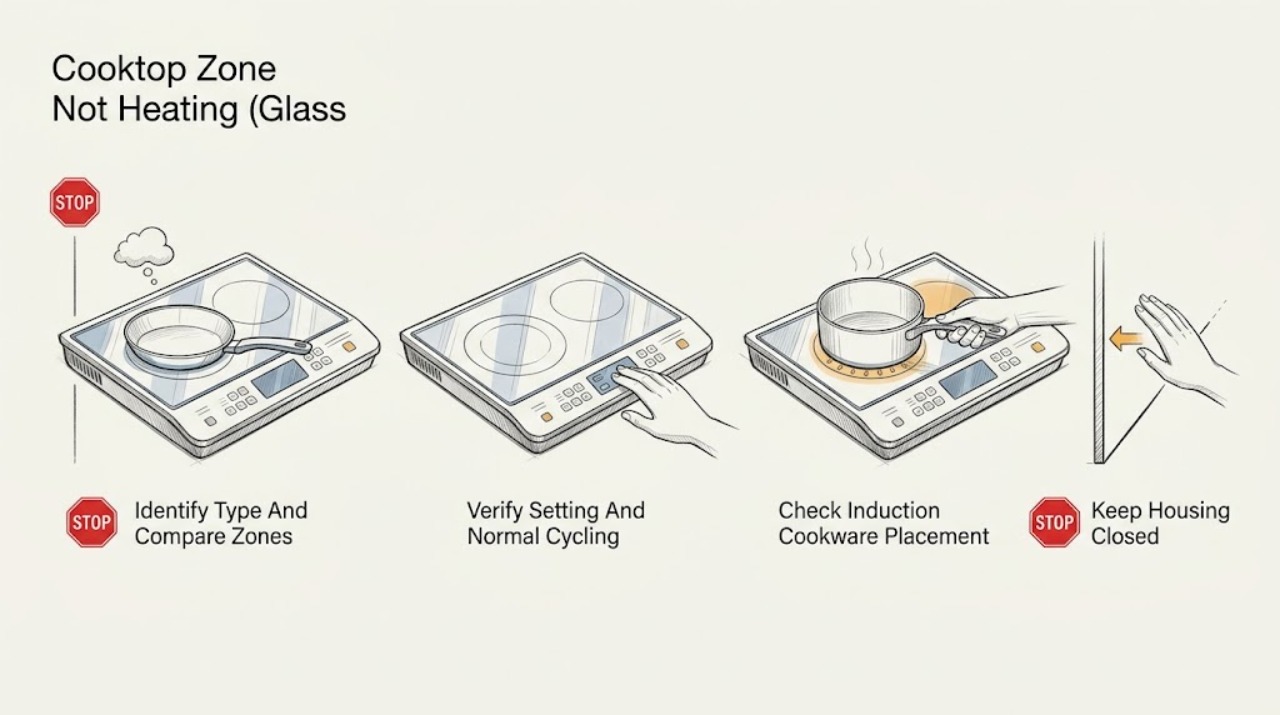
Work through in order
Diagnostic checks
Use only checks that match the exact appliance or system and its official guide.
-
Check 1
With the cooktop cool enough to inspect and the glass visibly intact, identify whether it uses plug-in coils, radiant glass elements, or induction controls. Compare the affected zone with a neighboring zone using the same ordinary control sequence and a suitable test setup allowed by the owner's manual.
Expected result: Record whether the display has power, whether only one zone is affected, whether another zone heats, whether an indicator or code appears, and whether the affected area warms intermittently or stays completely cold.
Next step: Use the one-zone or whole-appliance branch after the remaining checks; do not remove the cooktop to compare internal parts.
Stop if: Stop immediately for smoke, sparking, a burning odor, gas odor, a crack or shattered glass, an uncontrolled flame, or a breaker that trips again.
Why this matters
Why: One cold zone with otherwise normal operation narrows the issue to that zone's control, sensor, element, or induction power path. All zones cold or a blank display makes a supply, lock, or whole-appliance condition more likely. Intermittent heat can be normal temperature regulation when the zone still warms.
-
Check 2
For a coil or radiant model, verify that the control is set to the affected zone rather than a neighboring control and that the setting is above Off. Watch from a safe position through one ordinary heating cycle; do not touch the element or use a red glow as the only test.
Expected result: The zone warms and cycles off and on, warms only at a low level, or remains cold while the matching control is on and another zone behaves normally.
Next step: If the zone warms, use it only as the manual permits and reassess the cooking result. If it remains cold, continue with the power, lock, and cookware checks and then arrange service if the pattern persists.
Stop if: Do not pull out a hot coil, touch a radiant element, bypass a temperature limiter, or open the cooktop to test continuity.
Why this matters
Why: A zone that warms and cycles may be regulating temperature normally; Whirlpool notes that radiant elements may cycle and may not glow on every setting. A zone that remains cold with a correct control setting makes an element, sensor, limiter, or control fault more likely.
-
Check 3
If the cooktop is induction, after the zone is Off and cool use a flat-bottom pan that the model manual identifies as compatible; center it on the matching zone and keep its base close to the zone size. Do not run the zone with an empty pan.
Expected result: The pan is detected and the zone heats, the display reports no pan or an error, or the zone remains cold with compatible cookware centered on it.
Next step: Keep the cookware arrangement that the exact manual approves. If suitable cookware is not detected or a code returns, record the code and model number for service rather than trying another internal adjustment.
Stop if: Do not use an empty pan as a prolonged test, place metal objects on the surface, or remove panels to inspect the induction assembly.
Why this matters
Why: Detection and heating after changing the pan points to cookware material, size, or placement rather than a failed zone. Continued failure with suitable centered cookware makes the zone sensor, coil, inverter, or control path more likely.
-
Check 4
Inspect the control display for a lock, pause, timer, demo indication, or error code. With the cooktop Off, remove any object from the touch controls and wipe away moisture with a suitable dry cloth; use only the exact model's documented unlock or code-clearing sequence.
Expected result: The zone begins responding after the documented lock or pause is cleared, the display remains locked or wet-control behavior returns, or a code reappears immediately.
Next step: Record the exact display text and model number. If the controls remain unresponsive or the code returns, leave the cooktop unused and arrange qualified service.
Stop if: Do not guess at a code, bridge a control, spray liquid into the panel, or continue operating a cooktop with an abnormal display or hot zone that ignores its control.
Why this matters
Why: A lock, covered or wet touch panel, demo state, or model-specific fault can prevent a heating request without a broken glass surface. A code that returns after the documented procedure requires model-specific diagnosis.
-
Check 5
From outside the appliance, check whether the cooktop's breaker or fuse has operated and whether the display or other zones have lost power. If the unit is cool, there is no odor or visible damage, and the manual allows it, switch the cooktop circuit off for the documented reset interval, restore it once, and observe without repeatedly starting the zone.
Expected result: Power returns normally, the same single zone remains cold, the breaker trips again, or the cooktop remains blank or reports a fault.
Next step: If the fault persists or the breaker operates again, stop resetting and arrange a qualified appliance technician or electrician as appropriate; provide the zone comparison and any code.
Stop if: Do not remove the breaker panel, expose wiring, test live voltage, replace a fuse with an unverified type, or keep resetting a breaker that trips.
Why this matters
Why: A one-time documented reset can clear a transient control state, but a recurring trip, blank display, or persistent single-zone failure indicates an electrical or appliance fault rather than a setting problem.
-
Check 6
After any over-temperature indication or interrupted cycle, turn all controls Off, remove cookware only when safe to handle, allow the cooktop to cool, and then perform one brief retest using the exact control and cookware setup specified by the manual.
Expected result: The zone heats normally after cooling, the zone still stays cold, an overheat or other code returns, or the control requests heat while the zone remains abnormally hot.
Next step: Use the cooktop only if the manual's normal operation is restored. Otherwise leave it out of service and give the technician the timing, zone, settings, cookware, and code history.
Stop if: Do not repeat tests through smoke, sparking, odor, a returning breaker trip, a cracked surface, or heat that does not follow the controls.
Why this matters
Why: Recovery after cooling supports a protection or normal-cycle event, but a persistent cold zone or returning code makes an element, sensor, power module, or control fault more likely. Heat that remains with the control Off is abnormal.
Use your observations
Decision map
Find the observation that best matches what you see, then follow the next safe action.
-
PATH 01Next step
What you see
The affected coil or radiant zone warms at the selected setting, then cycles off and on, or the surface is warm but does not glow continuously.
Do this next
Follow the exact manual's normal-use guidance and compare the cooking result with a suitable pan. Seek service if the zone never warms, the control cannot turn it off, or heating becomes erratic or unsafe.
Why this path and its safety boundary
Why it matters: Temperature regulation or a low/warming setting is more likely than a completely failed element; a continuous glow is not required on every model or setting.
-
PATH 02Next step
What you see
Only the induction zone fails to heat with an empty, unsuitable, too-small, or off-center pan, but it heats with compatible cookware centered as the manual specifies.
Do this next
Keep using only cookware approved for the exact cooktop. If compatible cookware is not detected or the error returns, stop experimenting and arrange model-specific service.
Why this path and its safety boundary
Why it matters: Cookware detection, size, or placement is more likely than a failed heating zone.
-
PATH 03Next step
What you see
The display and neighboring zones work, the correct control is selected, and a compatible setup is used, but one zone remains completely cold after cooling and one documented reset.
Do this next
Leave that zone unused and arrange qualified appliance service. Provide the model number, zone location, cooktop type, settings, cookware, indicators, and reset result; do not order a part until fit and diagnosis are confirmed.
Why this path and its safety boundary
Why it matters: A localized element, temperature sensor or limiter, zone switch, induction coil, power module, or control path is more likely than a house-wide power loss.
-
PATH 04Next step
What you see
All zones are cold, the display is blank or locked, or the breaker trips instead of restoring normal operation.
Do this next
Perform only the external, model-documented check once. If power is absent, the breaker trips again, or the display remains abnormal, stop and contact a qualified appliance technician or electrician as appropriate.
Why this path and its safety boundary
Why it matters: An external supply, lock, control, wiring, or whole-appliance fault is more likely than a single heating element.
-
PATH 05Next step
What you see
Smoke, sparking, burning odor, gas odor, visible damage, heat with the control Off, a returning overheat or error code, or an abnormal hot surface appears.
Do this next
Stop using the cooktop, keep people away, and seek qualified appliance or electrical service; for gas odor, smoke, fire, or immediate danger, leave the area and contact the appropriate emergency or gas service from a safe location.
Why this path and its safety boundary
Why it matters: This is no longer a routine no-heat check. Continued operation could worsen an electrical, thermal, gas, or surface-safety fault.
Helpful context
Understand the symptom
A cold-looking zone is not always a failed element
The symptom has different meanings on different cooktops. A coil or radiant zone may cycle to regulate temperature, especially at a low or warming setting, so a continuous red glow is not a reliable test. An induction zone transfers heat through compatible cookware and may not heat when the pan is unsuitable, too small, off-center, or absent. Identify the technology from the controls and model documentation before deciding that the heating zone has failed.
Use the intact glass as a scope boundary
An intact surface makes ordinary external checks reasonable, but it does not make the heating assembly or wiring user-serviceable. Keep all checks outside the appliance: controls, visible indicators, cookware, accessible airflow, and the external breaker. Do not remove the glass, lift the cooktop, probe terminals, bypass a limiter, or substitute a heating part without exact model service information and qualified help.
Compare a single zone with the rest of the cooktop
A single cold zone with normal neighboring zones points toward that zone's element, sensor, power module, or control path. If every zone is cold or the display is blank, treat the symptom as a supply, lock, control, or whole-appliance issue first. A breaker that trips again is a stop condition, not an invitation to keep resetting it.
Safety boundary
Stop conditions
- Do not remove the glass, lift the cooktop, open electrical compartments, probe live terminals, or attempt continuity or voltage testing as an ordinary-user check.
- Do not bypass a temperature limiter, sensor, lock, control, or safety device, and do not keep resetting a breaker that trips.
- Do not run an induction zone with an empty pan as a prolonged test or place unapproved metal objects on the surface.
- Stop immediately for smoke, sparking, burning odor, gas odor, a crack or shattered glass, an uncontrolled flame, or heat that remains with the control Off.
- Leave a persistent single-zone failure, returning code, or whole-cooktop power fault out of service until qualified diagnosis confirms a safe repair.
Only after diagnosis
Potential parts
- cooktop heating element or radiant coil
Consider this category only if qualified diagnosis confirms that one coil or radiant zone is not heating while its control and supply path are otherwise correct.
Confirm the exact cooktop model, element shape, wattage, connector, limiter arrangement, and manufacturer fit information before ordering. - induction zone coil or power module
Consider this category only when suitable centered cookware is not detected or heated and a qualified technician isolates the zone's induction assembly or power electronics.
Induction assemblies are model-specific and may require configuration or safety checks; do not substitute a generic coil or module. - cooktop temperature sensor or limiter
Consider this category only when cycling, overheat protection, or a zone that remains cold is traced to the sensor or limiter rather than the element or control.
Confirm the exact model, sensor or limiter specification, mounting, and safety calibration with the manufacturer or qualified technician. - cooktop zone control or control board
Consider this category only when the correct control does not command one zone or an error persists after cookware, lock, cooling, and external power checks.
Confirm exact model fit, software or configuration requirements, and the technician's diagnosis before ordering.
When checks do not resolve it
Need a professional?
Arrange qualified appliance service when one zone remains cold with the correct control and compatible cookware, an error or overheat indication returns, the controls ignore the zone, or a documented reset does not restore normal operation. Contact an electrician when the external supply or breaker behavior points beyond the appliance. For smoke, fire risk, gas odor, sparking, a cracked surface, or uncontrolled heating, stop use immediately and seek appropriate emergency or qualified help.
Safety scope: This article covers external observation, manual-directed controls, compatible cookware placement, cooling, and one documented external reset only. Do not open the appliance, test live wiring, bypass safety devices, or replace a part without qualified diagnosis.
Common questions
FAQ
Why is one cooktop zone not heating when the glass is intact?
A single cold zone can result from a wrong control selection, normal cycling, unsuitable or misplaced induction cookware, a lock or error state, overheating protection, or a failed element, sensor, limiter, zone control, or power module. Compare the zone with a neighboring one and use only the checks that match the cooktop type.
Should an electric cooktop element always glow red?
No. Whirlpool explains that radiant elements can cycle on and off and that warming or simmer settings may not produce a visible red glow. Use whether the zone warms and cooks normally, not a continuous glow alone, as the observation.
Why does an induction cooktop zone stay cold with a pan on it?
The pan may be unsuitable, too small, off-center, or not close to the zone size the manual specifies. After the zone is Off and cool, try only compatible cookware in the approved position; if it is still not detected or heated, record the indication and arrange service.
Can I reset the cooktop breaker when one zone stops heating?
Only use a reset if the exact model instructions allow it, the cooktop is cool, and there is no odor, smoke, sparking, or visible damage. Perform the documented reset once. A breaker that trips again or a zone that stays cold needs qualified diagnosis, not repeated resets.
Is a broken heating element the only possible part failure?
No. Depending on the cooktop type and the test results, the fault may involve a temperature sensor or limiter, zone switch, induction coil, power module, control board, or external supply. A technician should confirm the exact model-compatible part before replacement.
When should I stop using a cooktop that is not heating?
Stop immediately for smoke, sparking, a burning or gas odor, visible damage, heat with the control Off, a returning error or overheat code, or a breaker that trips again. Keep people away and obtain qualified appliance or electrical help; for gas odor or immediate danger, leave the area and contact the appropriate emergency or gas service from a safe location.
Read the exact guide
Official sources
- Cooktop Not Working - Electric CooktopWhirlpool Product Help · Manufacturer guidance for Whirlpool electric smooth-top cooktops; cycling and indicators vary by model and cooktop type.
- Bosch Gas Cooktop Troubleshooting & RepairBosch Home Appliances · Manufacturer troubleshooting reference with cooktop-type-specific sections; follow the exact model manual and do not transfer an induction check to a gas or radiant model.
- Bosch Cooktop & Rangetop Error CodesBosch Home Appliances · Use only to show why an exact displayed code should be recorded and matched to the model; code meanings are not universal across cooktops.
- Not Powering On - Electric CooktopWhirlpool Product Help · Manufacturer guidance for Whirlpool electric coil cooktops; use the exact appliance manual when the cooktop is another type or brand.
Community feedback
Share a repair observation
Share a plain-text repair observation. Accepted observations are published automatically; this page may take a moment to update.