
On this page
Start here
Quick answer
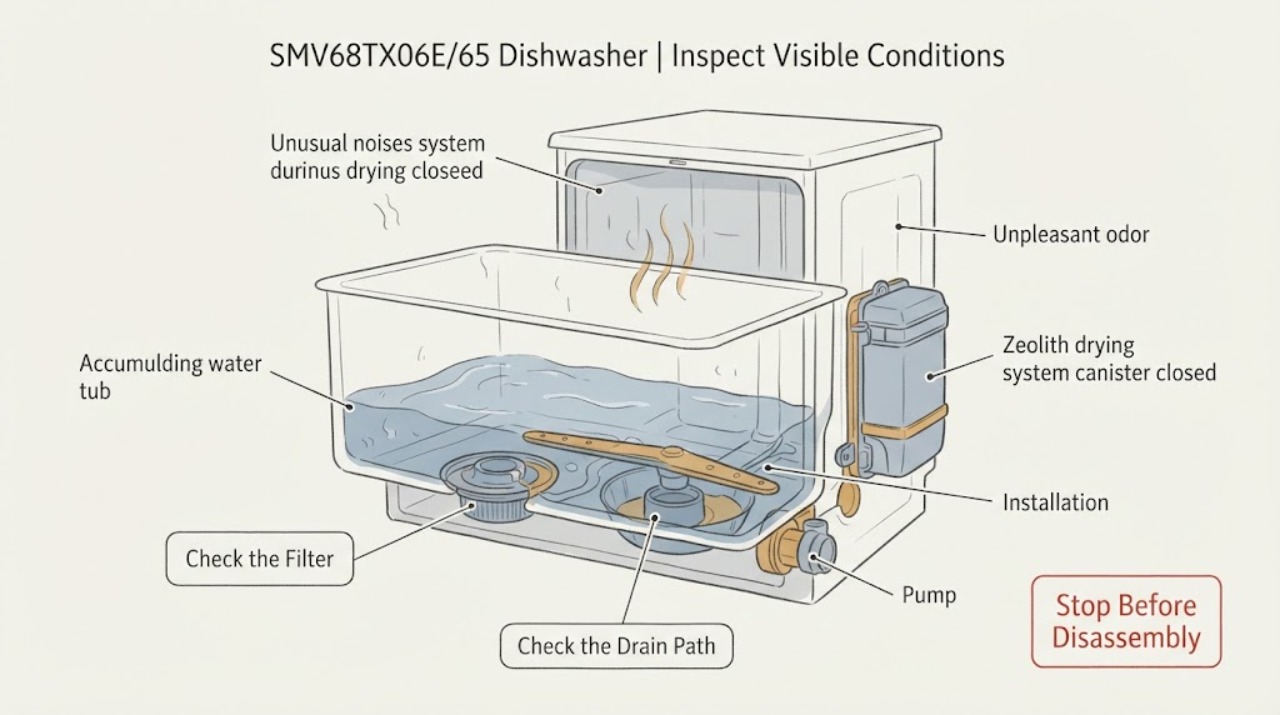
The Bosch SMV68TX06E/65 is a fully integrated dishwasher with Zeolith drying, but water, odor, and a noise heard near drying do not by themselves prove a Zeolith failure. If water is leaking outside the tub, the machine smells strongly, or the sound is loud or newly persistent, stop the cycle and use Bosch's reset procedure only if the door and controls are safe. Then, with power isolated, check the filter and visible sump for food or glass, confirm that the previous cycle finished and the drain path is not blocked, and note when the sound occurs. Persistent standing water, repeated odor, a blocked pump path, or abnormal noise after these external checks needs Bosch service; do not open the Zeolith housing or make an internal repair diagnosis from the symptom alone.
Work through in order
Diagnostic checks
Use only checks that match the exact appliance or system and its official guide.
-
Check 1
If water is leaking outside the dishwasher, the door or controls are unsafe, or the sound is violent or accompanied by smoke or a burning odor, stop the cycle, switch the appliance off, and isolate power only if the plug or breaker can be reached safely. Do not pull out the fully integrated appliance or open its base.
Expected result: The problem is contained inside the tub and the controls are safe, or there is an external leak, smoke, burning odor, electrical damage, or unsafe access.
Next step: For an unsafe condition, keep the dishwasher disconnected, close the water supply if safe, and arrange Bosch service. Do not repeatedly run a cycle to reproduce the sound.
Why this matters
Why: An internal drying or drain symptom can be investigated later, but an external leak or electrical warning takes priority over troubleshooting the Zeolith system.
-
Check 2
If the cycle was interrupted or the dishwasher is still showing an active programme, use Bosch's model-compatible reset/cancel procedure: press and hold the documented Reset or Start control for approximately four seconds only when the controls and door are safe, then wait for the residual water to be pumped out.
Expected result: The reset completes and water drains, or water remains after the cycle has been cancelled.
Next step: If water remains, switch off and disconnect power before checking only the user-accessible filter and visible sump. If the reset cannot complete or the water returns, arrange service.
Why this matters
Why: Bosch says the reset procedure cancels the cycle and pumps residual water out. Water that remains afterward points to a drain, filter, pump, or hose problem rather than proving a Zeolith failure.
-
Check 3
With the dishwasher off and power isolated, remove and inspect the accessible filter unit and visible sump area according to the SMV68TX06E/65 manual. Wear cut-resistant or protective gloves if handling the filter area, and look for food debris, glass, or other objects without reaching into a concealed pump or Zeolith housing.
Expected result: The filter is blocked or dirty, objects are visible, or the filter and visible sump are clear.
Next step: Clean and refit the accessible filter exactly as the manual specifies. Do not pry into the pump, remove the Zeolith container, or continue testing if glass, damaged parts, or standing water remain.
Why this matters
Why: Bosch says food particles and debris in the filter can prevent waste water from being pumped effectively and cause odor; foreign objects can also contribute to pump noise.
-
Check 4
Record whether the noise occurs during drain, circulation, or the drying phase, and check that the spray arms can rotate freely with no loaded utensil touching them. Do not place hands near moving parts; make this observation only with the appliance stopped and unloaded as needed.
Expected result: The sound is a brief drain buzz/grind, a knocking or rattling tied to the load, or a new loud sound that persists during or after drying.
Next step: Correct only an obvious loading obstruction and keep the sound record. If the sound remains loud or is linked to water or odor, stop using the dishwasher and book Bosch service rather than opening the drying system.
Why this matters
Why: Bosch associates drain grinding or buzzing with forcing water down the drain and knocking or rattling with a spray arm striking dishes. A persistent loud sound after those external conditions are clear is not identified by the public guidance as a specific Zeolith part.
-
Check 5
After the filter and drain observations, note the odor source, whether the prior cycle completed, rinse-aid or detergent use, and whether standing water returns. Use only the SMV68TX06E/65 manual's approved maintenance programme and cleaner instructions for any maintenance wash.
Expected result: The odor improves after the filter and approved maintenance checks, or it persists with standing water, incomplete drainage, or an abnormal drying sound.
Next step: If the odor or water persists, keep a record of the E-Nr, cycle, sound, and visible findings and contact Bosch service. Do not add unapproved chemicals or dismantle the Zeolith system.
Why this matters
Why: Bosch links odor to food debris, soiled filters, residual water, and maintenance needs, but persistent odor with water or noise can indicate a drain or internal fault requiring diagnosis.
Use your observations
Decision map
Find the observation that best matches what you see, then follow the next safe action.
-
PATH 01Next step
What you see
A reset/cancel completes and the residual water drains, while the filter is clear and the noise is brief and tied to draining.
Do this next
Run the next cycle only if there is no leak or electrical warning, and monitor whether water, odor, or abnormal noise returns. Escalate if it recurs.
Why this path and its safety boundary
Why it matters: The water may have been from an interrupted cycle, and Bosch documents drain buzzing or grinding as a possible operating sound; this pattern does not establish a Zeolith failure.
-
PATH 02Next step
What you see
Food, glass, or other debris is present in the accessible filter/sump area and the odor or water improves after the approved cleaning and refit.
Do this next
Keep the filter maintained under the SMV68TX06E/65 manual. If standing water, odor, or noise returns, stop treating it as routine cleaning and arrange service.
Why this path and its safety boundary
Why it matters: A blocked or soiled filter and retained waste water were plausible contributors to the odor or drainage symptom.
-
PATH 03Next step
What you see
The filter is clear, water remains after reset, the cycle repeatedly stops incomplete, or standing water and odor return.
Do this next
Keep the dishwasher out of service and request Bosch diagnosis using E-Nr SMV68TX06E/65, cycle status, water location, and filter observations. Do not open the pump or Zeolith housing.
Why this path and its safety boundary
Why it matters: A persistent drain, pump, hose, or internal control problem remains possible; Bosch's public guidance does not let the symptom isolate the Zeolith system.
-
PATH 04Next step
What you see
The sound is a new, very loud, or persistent noise during or after drying, especially when the load and spray arms are clear.
Do this next
Stop repeated testing and book Bosch service. Provide the exact E-Nr, the phase when the noise starts, and whether water or odor is also present.
Why this path and its safety boundary
Why it matters: Bosch describes some drain and spray-arm sounds, but does not identify this pattern as a confirmed Zeolith fault in the opened public guidance.
Helpful context
Understand the symptom
Confirm what the SMV68TX06E/65 is designed to do
Bosch's service page identifies the assigned E-Nr as SMV68TX06E/65. Bosch product information for the SMV68TX06E family lists Zeolith drying, a heat exchanger, AquaStop, a self-cleaning filter system, and a low published noise level. Those specifications establish the appliance family and drying technology, not a diagnosis of the reported water, odor, or sound.
Separate residual water and odor from a confirmed drying fault
A completed or cancelled cycle can leave water that should be pumped out by the reset procedure, while a blocked filter can retain food and waste water and produce an odor. Check the filter and visible sump only after disconnecting power and following the SMV68TX06E/65 manual. Do not treat standing water or smell alone as proof that the Zeolith container or heater has failed.
Use the timing and character of the noise
Bosch notes that grinding or buzzing can occur while water is forced down the drain and that knocking or rattling can come from a spray arm contacting dishes. A new, very loud, or persistent sound during or after drying needs service once the accessible filter, load, and drain observations are recorded. The sound does not identify a Zeolith component or justify opening the base.
When checks do not resolve it
Need a professional?
Arrange Bosch service if water remains after a completed reset, water leaks outside the tub, odor persists after the accessible filter and approved maintenance checks, the pump or drain path remains blocked, or a new loud noise continues during or after drying. Do not open the Zeolith container, heater, pump, or built-in base; do not select a replacement part from the combined symptoms alone.
Common questions
FAQ
Does water in the Bosch SMV68TX06E/65 prove the Zeolith system has failed?
No. Bosch's reset and cleaning guidance points first to an incomplete cycle, filter or drain obstruction, pump path, and retained waste water. The model has Zeolith drying, but the opened official sources do not support diagnosing its container or heater from standing water alone.
Is a buzzing or grinding sound always a drying-system failure?
No. Bosch says grinding or buzzing can occur when the dishwasher forces water down the drain, and knocking or rattling can occur when a spray arm contacts loaded dishes. A new or persistent loud sound after those checks needs service.
What should I give Bosch service for this problem?
Provide E-Nr SMV68TX06E/65, whether the cycle completed or was reset, where water remains, filter and visible-sump findings, the odor description, and the exact phase when the noise starts. Do not dismantle the Zeolith system to collect more evidence.
Read the exact guide
Official sources
- How to Clean a Smelly Dishwasher | What Causes The Bad Smell?Bosch · Official Bosch dishwasher odor guidance used for filter, food-debris, spray-arm, cleaning, and service checks. It does not attribute odor to the Zeolith system or prove a part failure for SMV68TX06E/65.
- How to Reset the Dishwasher | TroubleshootingBosch · Official Bosch reset guidance used only for the safe, control-level cancellation context: holding Reset 4 Sec. or Start for approximately four seconds pumps residual water out and ends the cycle. Exact button labeling must be confirmed for the assigned E-Nr manual.
- SMV68TX06E Vollintegrierter GeschirrspülerBosch · Official Bosch product page for the SMV68TX06E family. It confirms Zeolith drying, heat exchanger, AquaStop, and product-family features relevant to the assigned /65 E-Nr; it does not diagnose the reported water, odor, or noise.
- What to do when dishwasher is making noiseBosch · Official Bosch dishwasher noise guidance used to distinguish drain grinding/buzzing and spray-arm knocking/rattling from persistent abnormal noise. It does not define a Zeolith drying fault from noise alone.
- Service Assistance - SMV68TX06E/65 | BOSCH USBosch · Official Bosch service page that identifies the exact assigned E-Nr SMV68TX06E/65 and provides access to its manuals, documents, parts, and owner support. It is used to lock model identity and service scope, not to infer a Zeolith fault.
Community feedback
Share a repair observation
Share a plain-text repair observation. Accepted observations are published automatically; this page may take a moment to update.