
On this page
Start here
Quick answer
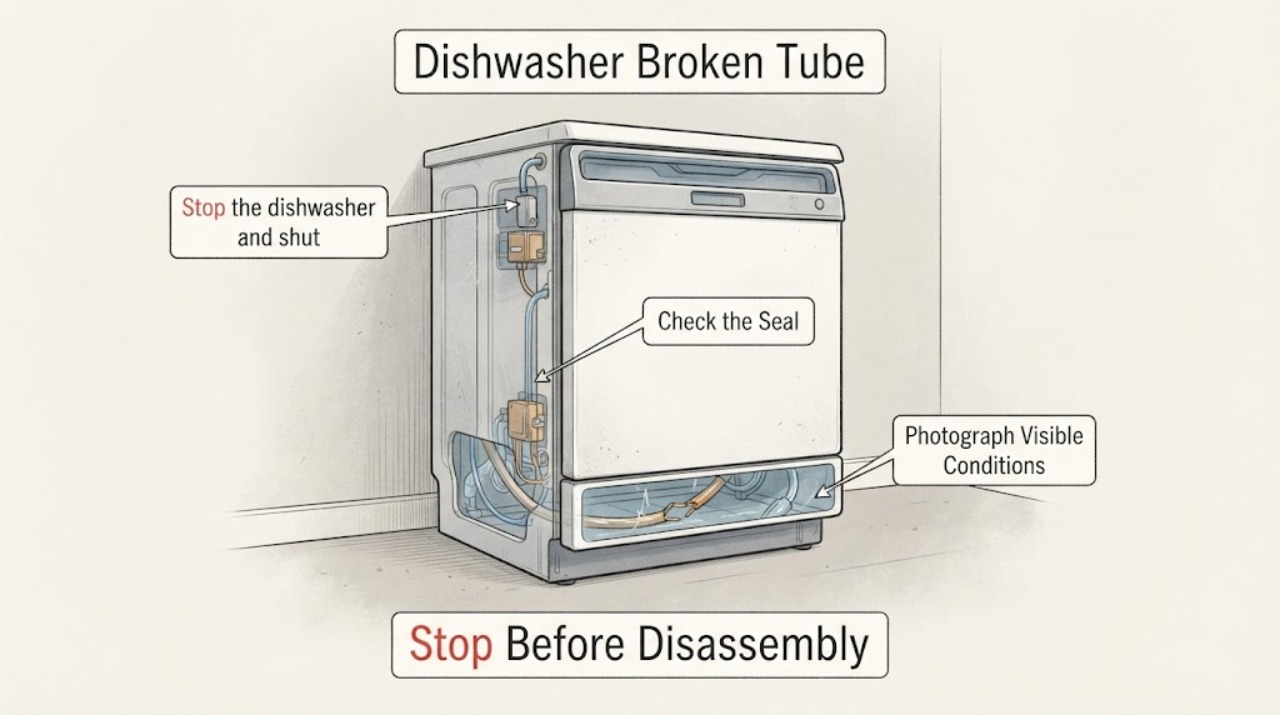
Do not run a Bosch dishwasher with a known broken tube and do not seal it with silicone, Flex Seal, tape, epoxy, or another improvised patch. A tube may be part of the inlet, drain, or an internal water path, and the wrong repair can leak, contaminate the pump path, or leave water in the base. Stop the cycle, turn off the dishwasher water supply, and keep the appliance out of service. Look only for visible water and record the exact E-Nr/model and which tube is damaged; do not remove panels or disconnect a pressurized hose. Bosch says damaged or modified water hoses can cause material damage and that the correct supplied or genuine hose and model compatibility matter. If there is water under the unit, an E15/E3100-type water-in-base indication, a wet electrical area, or an unknown internal tube, leave it off and arrange Bosch or qualified appliance service.
Work through in order
Diagnostic checks
Use only checks that match the exact appliance or system and its official guide.
-
Check 1
Stop the dishwasher and shut off its water supply before inspecting the area.
Expected result: Note whether water is actively pooling, whether the base area is wet, and whether the dishwasher has displayed an E15/E3100-type water-in-base indication.
Next step: Leave the dishwasher off and arrange Bosch or qualified appliance service. If water is near electrical parts, do not reach into it; isolate power only from a safe, dry location. Do not restart a cycle to confirm the leak.
Why this matters
Why: Active water or a leak-protection indication means the water path is not safe to keep testing; it does not identify which tube or component failed.
-
Check 2
Record the complete Bosch E-Nr/model and photograph only the visible damaged tube or connection.
Expected result: Classify the visible item as the household inlet hose, the drain hose, or an unknown tube inside the cabinet/base; record where each end appears to connect without disconnecting it.
Next step: Use the exact E-Nr and the identified location with Bosch support or the model documentation. If the tube is internal or its identity is uncertain, stop at observation and use a technician; do not remove panels.
Why this matters
Why: The words “broken tube” alone do not establish a part identity, connection type, or replacement fit.
-
Check 3
Reject improvised sealants and temporary wraps as a running repair.
Expected result: If silicone, Flex Seal, tape, epoxy, glue, or another patch has already been applied, do not assume it is food-safe, pressure-safe, heat-safe, or secure in the dishwasher water path.
Next step: Keep the dishwasher out of service and tell the technician what material was applied. Do not run several cycles while waiting for a replacement.
Why this matters
Why: A patch can detach or obstruct the water path and does not prove the underlying tube or connection is sound; the exact Reddit case also contains community concern about sealant reaching the pump.
-
Check 4
Obtain a model-matched replacement or service assessment before reconnecting the dishwasher.
Expected result: Compare the proposed hose/tube and connection with the complete E-Nr documentation; if a seller cannot show compatibility, treat the fit as unverified.
Next step: Use Bosch support or a qualified appliance technician for the replacement, especially for an internal tube or any water found in the base. Follow the exact model's post-repair leak check; do not improvise a pressure or run test.
Why this matters
Why: Bosch's official parts listing requires compatibility to be checked, and a model-free listing cannot establish that the part fits this dishwasher.
Use your observations
Decision map
Find the observation that best matches what you see, then follow the next safe action.
-
PATH 01Next step
What you see
Water is pooling under the dishwasher, the base is wet, or an E15/E3100-type water-in-base indication is present.
Do this next
Turn off the water inflow, keep the appliance off, and contact Bosch or qualified service. Do not run another cycle or open the base.
Why this path and its safety boundary
Why it matters: The appliance has a leak-protection or water-in-base concern; the symptom does not identify the broken tube.
-
PATH 02Next step
What you see
The visible damaged item is the external inlet or drain hose and the exact Bosch E-Nr is available.
Do this next
Keep water off and use Bosch support or a model-matched genuine replacement/service; do not patch, cut, or reconnect a pressurized hose by guesswork.
Why this path and its safety boundary
Why it matters: The tube identity is narrower, but compatibility and the connection still need the exact model documentation.
-
PATH 03Next step
What you see
The tube is inside the cabinet/base, the damaged end cannot be identified, or a panel would need to be removed.
Do this next
Leave the dishwasher out of service and provide the E-Nr, photos, leak history, and any displayed code to qualified appliance service. Do not use an adhesive or attempt internal disassembly.
Why this path and its safety boundary
Why it matters: The assigned phrase does not safely identify the internal part or its repair procedure.
-
PATH 04Next step
What you see
There is no visible leak, but a crack or split is suspected and the only proposed solution is to run a few temporary cycles.
Do this next
Do not run the temporary cycles. Confirm the exact tube and model through Bosch documentation or service before use.
Why this path and its safety boundary
Why it matters: Absence of visible water does not prove that a water path is intact; a small leak can reach the base or appear only during filling/draining.
Helpful context
Understand the symptom
The phrase “broken tube” does not identify a single Bosch part. It could describe an external inlet or drain hose, or a tube inside the tub or base. That distinction controls whether the immediate concern is a supply leak, a drain leak, water reaching the base, or a component that must be accessed by a technician. Keep the assigned identity as a Bosch dishwasher, but do not infer a part number or a model-specific repair from the phrase alone.
Stop water and the cycle before looking for the leak
Cancel the cycle if it is safe to do so, keep the dishwasher off, and close its water shutoff. If water is pooling near electrical connections, do not reach into the area; isolate power only from a dry, safe location or have a professional do it. Do not keep starting short cycles to see whether a patch holds. Bosch's public dishwasher code guidance identifies water in the base as a leak-protection condition and directs the user to turn off the water inflow and contact support.
Identify the tube without opening the appliance
Read the rating label for the complete E-Nr/model and note whether the visible damage is on the household inlet hose, the drain hose, or a tube inside the dishwasher. Photograph the label and the visible damage without removing a panel. A tube that is only suspected to be inside the base should remain an internal-service question. Bosch's opened manual warns that modified or damaged water hoses can cause material damage and says not to kink, crush, modify, or cut them; the exact hose or tube still has to be confirmed against the appliance documentation.
Do not turn a temporary fix into a new failure
Do not apply silicone, Flex Seal, tape, epoxy, glue, or a clamp as a general answer to a broken dishwasher tube. Sealant can detach, obstruct a water path, or make the eventual repair harder; the exact Reddit discussion includes the same temporary-use question and replies that caution against material reaching a pump. Those replies are community experience, not a Bosch approval, so the safe conclusion is to avoid the proposed patch and stop use.
Use exact-model compatibility for any replacement
Once the E-Nr and the tube location are known, use the Bosch manual or Bosch service channel to identify the documented replacement. Bosch's official hose-kit listing says to check compatibility with the appliance before buying; that page is a compatibility gate, not proof that its pictured kit is the right part here. Do not substitute a generic tube by diameter or rely on a product title that omits the full model. An internal tube, a tube in the base, or a connection that requires panels to be removed belongs with qualified appliance service.
When checks do not resolve it
Need a professional?
Call Bosch or qualified appliance service for any internal tube, water in the base, recurring leak, unknown tube identity, or a replacement that cannot be verified against the full E-Nr., Keep the dishwasher off and seek urgent electrical or emergency help if there is smoke, sparking, a burning smell, or water in an electrical area. Do not handle wet electrical connections.
Common questions
FAQ
Can I use silicone or Flex Seal for a few days?
No safe temporary patch can be selected without the exact tube and model. Keep the dishwasher off rather than applying silicone, Flex Seal, tape, epoxy, or glue and running cycles; tell service if a material was already applied.
Does a broken tube always mean the dishwasher must be replaced?
No. The topic does not identify the tube or model, so replacement of the appliance cannot be concluded. Bosch service can identify whether the documented hose or tube is replaceable and whether water reached the base; keep the unit off until that assessment.
Can I keep using it if there is no water on the floor?
No. A missing puddle does not prove the water path is sound. A suspected crack can leak during filling or draining and may trigger water-in-base protection. Do not run temporary cycles while the tube identity is unresolved.
Read the exact guide
Official sources
- Bosch Dishwasher Error Codes: Troubleshooting GuideBosch Home Appliances USA · Opened Bosch support guide. Used as a corroborating stop-use/service source for E15/E3100 water-in-base guidance, not as evidence that this topic has a particular code.
- 11051476 Water Supply Hose KitBosch Home Appliances USA · Opened Bosch product page. Used only to show that compatibility must be checked before purchase; it does not establish that this kit fits the model-free topic.
- Information for Use SMI2ITS33EBSH Home Appliances / Bosch · Opened official Bosch manual for model SMI2ITS33E. Its hose-safety instructions are used as a clearly scoped Bosch-manual safety reference, not as proof of the assigned dishwasher's exact hose layout or parts.
- Dishwasher Error Codes | SupportBosch Home Appliances USA · Opened Bosch dishwasher support page. Used for the water-in-base/leak-protection stop boundary and related water-flow/service guidance; it does not identify the assigned broken tube or a part number.
- Temp fix for broken tube inside Bosch dishwasher?Reddit r/appliancerepair · Opened exact post. It verifies the user-intent context and community discussion, not Bosch approval, exact model, tube identity, sealant safety, or a repair outcome.
Community feedback
Share a repair observation
Share a plain-text repair observation. Accepted observations are published automatically; this page may take a moment to update.