
On this page
Start here
Quick answer
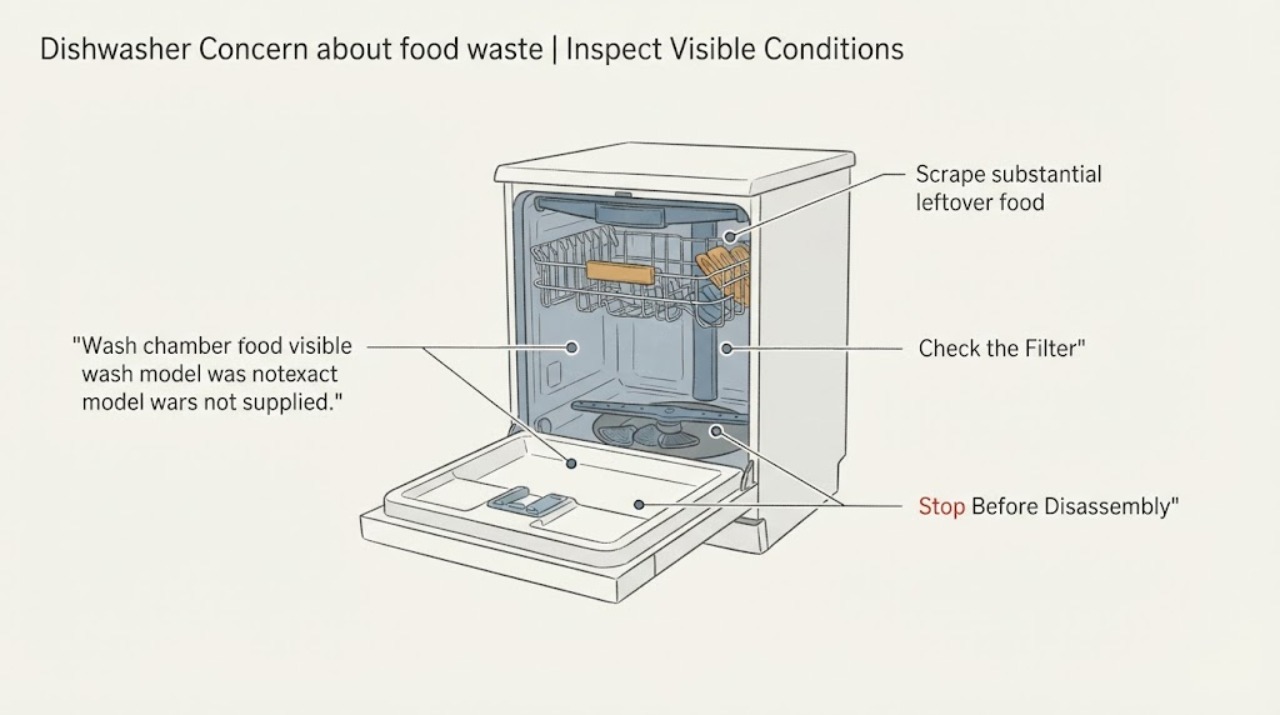
A Bosch dishwasher filter is designed to catch food particles, so seeing residue on the filter is not by itself a failure. Scrape leftover food from dishes, load them so the spray arms can turn, and clean the filter regularly under running water with mild soap and a soft brush according to the exact owner's manual. If food remains on dishes, check the filter and spray-arm holes; if there is standing water, persistent odor, gritty film, poor cleaning after these checks, or a repeat error, use Bosch model-specific support rather than guessing at a pump or filter part.
Work through in order
Diagnostic checks
Use only checks that match the exact appliance or system and its official guide.
-
Check 1
Identify where the food waste is observed after a cycle: on the removable filter, on otherwise clean dishes, in spray-arm holes, as an odor or gritty film, or as debris with standing water.
Expected result: Residue is limited to the filter; food is on dishes; spray holes are blocked; or odor, gritty film, standing water, or an error is also present.
Next step: Follow the matching check below and keep the exact Bosch E-Nr. for any support request. Do not infer a failed pump from residue alone.
Why this matters
Why: Food on the filter can be normal filtration. Food on dishes or in blocked spray arms points to cleaning/load maintenance, while odor, standing water, or an error may indicate a drain or model-specific service issue.
-
Check 2
Scrape substantial leftover food from dishes before loading, leave space between items, and ensure tall cookware does not block either spray arm. Do not rely on a generic loading layout if the exact manual shows a different rack arrangement.
Expected result: A smaller, correctly spaced load cleans better; or food remains despite clear spray-arm movement and appropriate loading.
Next step: Continue with filter and spray-arm cleaning. If food remains after those checks, use the model manual or Bosch support instead of changing an unverified part.
Why this matters
Why: Bosch says scraping is sufficient and that blocked spray arms or poor spacing can prevent wash water from reaching dishes. Persistent residue after a correct load is not proof of a particular internal part.
-
Check 3
Using the exact Bosch owner's manual for removal, take out the filter at the bottom of the dishwasher and wash it under running water with mild soap and a soft brush; reinstall it fully according to that manual.
Expected result: The filter contains food debris or grease and becomes clear after cleaning; or it is damaged, cannot be removed as described, or quickly blocks again.
Next step: Run the next appropriate cycle only with the filter correctly installed. If debris rapidly returns or the dishwasher still performs poorly, preserve the filter observation and arrange Bosch support.
Why this matters
Why: Bosch says food particles are caught in the filter and regular cleaning protects the pump and improves wash performance. A damaged or model-mismatched filter needs exact-E-Nr. support, not an appearance-based replacement.
-
Check 4
With the dishwasher stopped and the exact manual consulted, inspect the spray arms for blocked holes and rinse them under water. Where Bosch's general guidance permits, loosen a hole obstruction gently with a toothpick; do not force a tool into an unknown assembly.
Expected result: A spray-arm hole is blocked and clears; the spray arms cannot turn because of loading; or the holes are clear but food remains.
Next step: Reinstall the spray arms exactly as the manual shows and keep them free to rotate. If cleaning remains poor with clear arms and filter, use model-specific service rather than opening the pump or control area.
Why this matters
Why: Bosch identifies blocked spray arms and loading interference as causes of poor cleaning. Clear holes do not establish a pump or water-pressure diagnosis when the model is unknown.
-
Check 5
After filter, loading, and spray-arm checks, note whether the dishwasher leaves standing water, develops a persistent odor or gritty film, or displays a repeat error. Record the exact E-Nr. and the full display or light pattern.
Expected result: The residue and cleaning problem resolves; or standing water, odor, gritty film, repeated poor cleaning, or an error remains.
Next step: Contact Bosch support or an authorized servicer with the model and observations. Do not remove a pump cover, bypass a sensor, or buy a filter/pump based on a generic Bosch image or code.
Why this matters
Why: Bosch links odor and poor cleaning with food debris in filters or spray arms and links standing water with a drain problem; a repeat condition needs the exact model support path.
Use your observations
Decision map
Find the observation that best matches what you see, then follow the next safe action.
-
PATH 01Next step
What you see
Food residue is on the filter, while dishes are clean, spray arms are unobstructed, and there is no odor, standing water, or repeat error.
Do this next
Clean the filter at the model-appropriate interval and after unusually food-heavy or starchy loads; continue normal loading and scraping practice.
Why this path and its safety boundary
Why it matters: This is consistent with the filter doing its intended job of catching food particles.
-
PATH 02Next step
What you see
Food remains on dishes, the load was crowded, or a tall item prevented a spray arm from turning.
Do this next
Scrape leftovers, space items, keep both arms clear, and rerun an appropriate cycle. If residue persists, clean the filter and arms according to the exact manual.
Why this path and its safety boundary
Why it matters: Loading or spray coverage is a supported first explanation for poor cleaning, and it does not establish an internal pump fault.
-
PATH 03Next step
What you see
The filter is blocked with food or grease, or spray-arm holes contain debris.
Do this next
Clean the filter and arms with the exact manual's removal/reinstallation instructions. If they cannot be safely removed, are damaged, or quickly block again, arrange Bosch support.
Why this path and its safety boundary
Why it matters: The filtration or spray path needs accessible maintenance; Bosch says these parts collect food debris and can affect cleaning performance.
-
PATH 04Next step
What you see
Standing water, persistent odor, gritty film, repeated poor cleaning, or a repeat display/light error remains after the accessible checks.
Do this next
Stop adding unverified parts or chemicals, record the exact E-Nr. and observations, and contact Bosch support or an authorized servicer. Do not open the pump or control area from this generic guidance.
Why this path and its safety boundary
Why it matters: The issue exceeds a general food-residue explanation and may involve a model-specific drain or wash-system condition.
Helpful context
Understand the symptom
Food particles belong in the filter, not back on clean dishes
Bosch describes the dishwasher filter as the place where food particles are caught. Its jobs include protecting the pump, clearing wash water, and preventing food from landing or resticking on dishes. The first question is therefore where the residue is: on the filter, on dishes after the cycle, in spray-arm holes, or in the tub with an odor or standing water.
Use scraping, loading, filter, and spray-arm checks before diagnosing a part
Bosch says dishes do not need pre-rinsing; scrape leftover food, leave space between items, and keep tall items from blocking the spray arms. Clean the filter with soap and a soft brush under running water and clean blocked spray-arm holes as the model instructions allow. These observations can improve cleaning without proving a pump, motor, filter assembly, or control failure.
Escalate persistent residue or standing water by model
If food remains after the accessible maintenance checks, or if odor, gritty film, standing water, or an error returns, record the exact E-Nr. and use Bosch support or the model manual. Bosch's maintenance guidance describes pump cleaning only through its model-specific instructions; do not remove a pump cover or order a filter by appearance when the model is unknown.
When checks do not resolve it
Need a professional?
Use Bosch model-specific support when food remains after correct loading, filter, and spray-arm checks; when the filter or arm is damaged or cannot be safely reinstalled; or when odor, gritty film, standing water, or a repeat error remains. Do not select a filter, pump, or other part by appearance when the E-Nr. is unknown, and do not open the pump or control area from this general article.
Common questions
FAQ
Is food waste on a Bosch dishwasher filter normal?
The filter is designed to catch food particles, so residue on the filter alone is expected. Clean it regularly with the exact manual's removal instructions. Concern is warranted when food returns to dishes, the filter blocks quickly, cleaning performance drops, or odor or standing water appears.
Do I need to pre-rinse all food from dishes?
Bosch says to scrape leftover food rather than pre-rinse everything. Load items with space between them and keep tall items from blocking the spray arms; then clean the filter and spray arms as needed.
Should I replace the Bosch pump or filter if food remains?
Not from this symptom alone. First check loading, filter, and spray-arm debris using the exact E-Nr. manual. If residue, odor, standing water, or an error remains, contact Bosch support or an authorized servicer instead of guessing at part compatibility.
Read the exact guide
Official sources
- How to Clean & Descale Bosch Dishwashers: A Complete Guide | Bosch – Maintenance TipsBosch · Opened Bosch's official US maintenance page. It supports general cleaning branches while routing pump and exact procedures to the matching instructions.
- How to clean your dishwasher filter | BoschBosch · Opened Bosch's official US support page. It supports general filter maintenance; exact filter removal and fitment remain model-specific.
- Bosch Dishwasher Troubleshooting & Repair Guide | Bosch – Fix Common Dishwasher ProblemsBosch · Opened Bosch's official US dishwasher owner-support page. It connects food debris in filters/spray arms with odor and standing water with drain trouble, then routes unresolved issues to support.
- Dishwasher Not Cleaning Dishes | Dishwasher Troubleshooting | BoschBosch · Opened Bosch's official US support page. It supports general food-residue troubleshooting without assigning a universal component diagnosis.
Community feedback
Share a repair observation
Share a plain-text repair observation. Accepted observations are published automatically; this page may take a moment to update.