
On this page
Start here
Quick answer
Start by separating undissolved detergent from a white mineral or soapy film. Bosch says the dispenser and tablet tray must be clean, the tablet must lie flat, and dishes or pan handles must not block the dispenser or spray arms. Keep the dispenser dry, use fresh dishwasher detergent in the designated compartment, and check the filter and spray arms using the model manual. If residue remains after those external checks, or the dispenser does not open, do not guess at a pump, heater, or control fault; record the exact model and arrange Bosch or qualified dishwasher service.
Before you begin
Safety first
- Do not probe wiring, bypass a latch, open the door or control assembly, or order an internal component from residue alone. Stop and arrange service for leaks, electrical damage, burning odor, damaged spray arms, a dispenser that will not open, or persistent residue after the model-approved external checks.
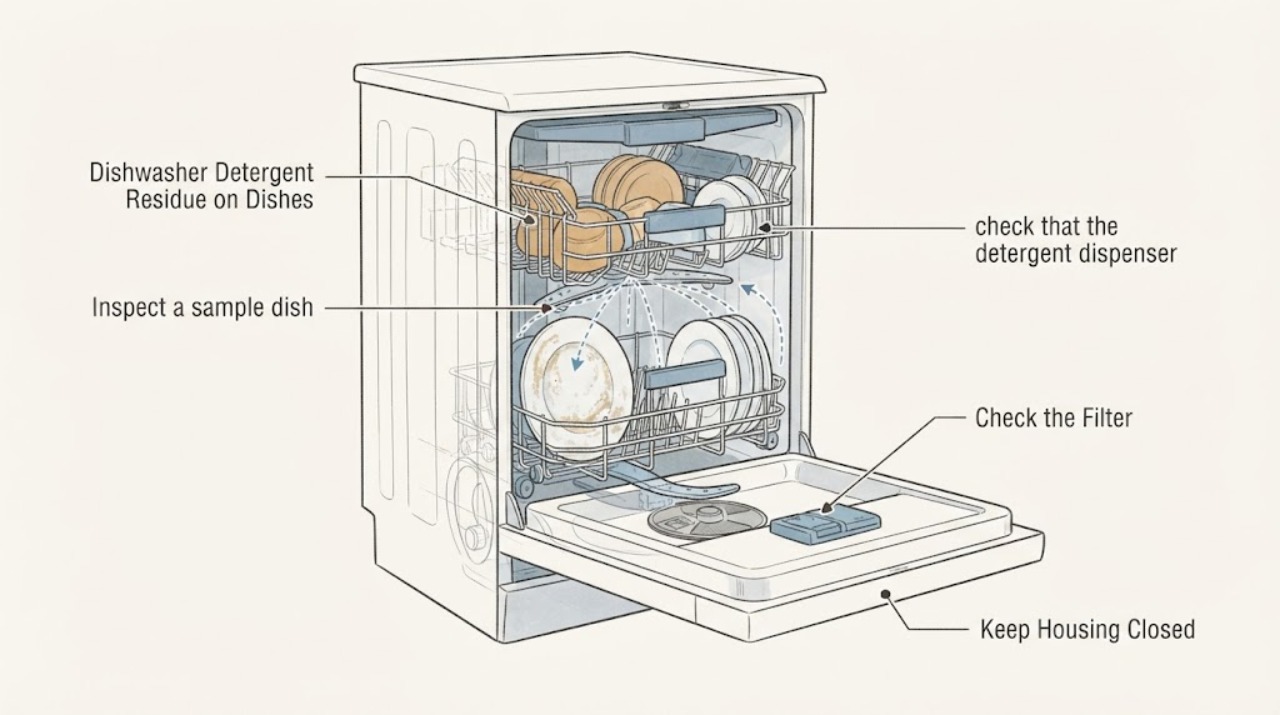
Work through in order
Diagnostic checks
Use only checks that match the exact appliance or system and its official guide.
-
Check 1
Inspect a sample dish and the dispenser after the cycle, without opening a panel. Classify the residue as an intact or partly intact tablet, loose powder, white/cloudy film, or greasy/food film.
Expected result: The residue has the shape or texture of detergent, or it is a thin film without recognizable detergent.
Next step: Use the matching branch below; do not increase detergent until the residue type is clear.
Why this matters
Why: Recognizable detergent points first to dispensing, wetting, or cycle-time conditions. A thin film may be mineral, soapy, food, or cookware-related and is not proof that detergent failed to dissolve.
-
Check 2
With the dishwasher unloaded and cool, check that the detergent dispenser and tablet collecting tray are clean and dry; place a tablet flat in the designated compartment and keep dishes or handles away from the cover and tray.
Expected result: The cover opens freely, the tray is clear, the tablet lies flat, and no dish blocks the dispenser, or one of those conditions is not true.
Next step: Correct only the visible loading condition and run the model-approved cycle. If the cover does not open or remains blocked, use the service path rather than forcing it.
Why this matters
Why: A blocked cover/tray, upright tablet, damp dispenser, or overfilled compartment can leave detergent behind. A clear, dry, correctly loaded dispenser removes those user-level causes but does not prove the dispenser mechanism is sound.
-
Check 3
Rearrange the load so tall items do not block either spray arm, then check by hand that the arms rotate freely when the appliance is empty; clean visible spray-arm openings and the filter only as the owner manual permits.
Expected result: The arms rotate freely and are clear, or a dish blocks them, a nozzle is clogged, an arm is cracked, or the filter is heavily soiled.
Next step: Correct the accessible load or cleaning condition, then retest. If an arm is damaged, cannot rotate, or residue remains with a clear spray path, arrange service.
Why this matters
Why: Blocked or damaged spray arms can prevent water from reaching the detergent and dishes. A clean, freely rotating spray path makes a circulation restriction less likely but cannot identify a hidden pump fault.
-
Check 4
Check the detergent container and cycle selection: use fresh dishwasher detergent stored dry, never hand dish soap, and note whether the residue appeared after a quick or short cycle.
Expected result: The detergent is damp/old, the wrong product was used, or an intact tab was used on a short cycle; otherwise the product is fresh and the cycle is suitable.
Next step: Replace only the questionable detergent, use the designated compartment, and select a model-approved cycle. If the product and cycle were already correct, continue to water-condition and service checks.
Why this matters
Why: Bosch says damp or old detergent can perform poorly, hand dish soap is too foamy, and a short cycle may not provide enough dissolving time for a tab. These findings do not establish a failed heater.
-
Check 5
If the residue is a film rather than undissolved detergent, review the exact model manual for water hardness, softener salt, rinse aid, and cleaning guidance; do not add salt or change a softener setting unless the model supports it.
Expected result: The film is consistent with mineral/soapy buildup, the model has a water softener, or the exact model configuration is unknown.
Next step: Follow the exact manual for the model and region. If residue persists or the water-softener configuration is unclear, provide the model and observations to Bosch or qualified service.
Why this matters
Why: Bosch distinguishes hard-water deposits and soapy film from detergent left in the dispenser. Softener and salt behavior varies by model and water hardness, so a generic setting is unsafe as a diagnosis.
-
Check 6
Prepare the full model number, detergent form and age, selected cycle, residue description, dispenser/tray condition, spray-arm and filter observations, and whether standing water is present for Bosch or qualified service.
Expected result: Residue persists after the external checks, the dispenser will not open, spray arms are damaged, or standing water accompanies the residue.
Next step: Stop guessing at pumps, heaters, valves, or control boards and arrange Bosch support or qualified dishwasher service. Keep the appliance out of use if there is leaking, electrical damage, burning odor, or another safety concern.
Why this matters
Why: The remaining cause may be inside the dispensing or circulation system, and the no-model task does not support naming a compatible part or safe internal repair.
Use your observations
Decision map
Find the observation that best matches what you see, then follow the next safe action.
-
PATH 01Next step
What you see
A recognizable tablet or powder remains in the dispenser/tray, and the cover or tray was blocked, damp, or loaded incorrectly.
Do this next
Clean and dry the dispenser, place the detergent flat in its designated compartment, clear the load, and retest on a model-approved cycle.
Why this path and its safety boundary
Why it matters: The result is consistent with a user-level dispensing condition described by Bosch.
-
PATH 02Next step
What you see
The dispenser and tray are clear and dry, the tablet is flat, the spray arms rotate freely, and detergent residue remains after a normal cycle.
Do this next
Record the model and cycle and arrange Bosch or qualified dishwasher service. Do not open the dispenser, door, or control assembly based on residue alone.
Why this path and its safety boundary
Why it matters: The documented external causes have not resolved the symptom; this does not identify a particular internal part.
-
PATH 03Next step
What you see
The residue is a white/cloudy or easily removable film rather than a recognizable tablet or powder.
Do this next
Follow the exact model’s water-softener, salt, rinse-aid, and cleaning instructions; do not assume more detergent will solve it.
Why this path and its safety boundary
Why it matters: Mineral deposits or a soapy film are possible, and Bosch treats water hardness, softener settings, and cleaning as separate checks.
-
PATH 04Next step
What you see
Residue is accompanied by standing water, a leak, a damaged spray arm, a dispenser that will not open, burning odor, or electrical damage.
Do this next
Stop using the appliance as appropriate, keep hands away from damaged or energized parts, and arrange Bosch or qualified service.
Why this path and its safety boundary
Why it matters: The symptom now includes a drainage, leak, damage, or safety boundary that cannot be resolved by detergent selection.
Helpful context
Understand the symptom
Residue on dishes is a result, not a component diagnosis. First look at what remains: a recognizable tablet or granules point toward dispensing, wetting, or cycle-time conditions; a thin white or cloudy film may instead be mineral or soapy buildup. Bosch guidance supports checking the dispenser, tray, loading, spray arms, filter, detergent freshness, and water-softener setup before escalating.
Identify the residue before changing detergent
After the cycle ends, inspect one affected item and the dispenser area without opening any panel. Note whether the residue is a partly intact tab, loose powder, a white film, or a greasy/food film. Bosch describes hard-water deposits and soapy film separately from detergent that remains in the dispenser or tab tray, so one generic “use more detergent” fix can make the wrong problem worse.
Clear the dispenser and tablet tray
With the appliance unloaded and cool, check that the detergent dispenser and tablet collecting tray are clean and dry. Place a tablet flat in the designated dispenser, do not overfill powder or liquid, and keep dishes, utensils, or a pan handle from blocking the cover or tray. The exact dispenser layout can vary, so use the owner manual for the model on the rating label.
Restore water reach without disassembling the machine
Rearrange tall items so the spray arms can rotate freely. If the model manual permits user removal, rinse the spray arms and clear visible nozzle deposits; Bosch also recommends regular filter cleaning with water, soap, and a soft brush. These checks address whether wash water can reach and rinse the detergent, but they do not prove a pump or heater failure.
Check detergent storage, cycle choice, and water conditions
Use detergent intended for dishwashers and keep it dry; Bosch warns against hand dish soap because it is too foamy and can damage the appliance. A tab may not finish dissolving in a short cycle, and old or damp detergent may lose effectiveness. If the film is mineral or soapy rather than undissolved detergent, review the exact model’s water-hardness and softener-salt instructions instead of adding salt or changing a setting by guesswork.
Escalate when the external path is clear
If the dispenser stays closed, the tab tray remains blocked, spray arms cannot rotate or are damaged, residue persists after a correctly loaded normal cycle, or standing water is also present, stop treating the symptom as a detergent choice alone. Record the exact model, detergent form, cycle, residue appearance, and filter/spray-arm observations, then use Bosch support or a qualified dishwasher servicer. Do not open the door or control assembly, probe wiring, or order an internal part from this symptom alone.
When checks do not resolve it
Need a professional?
Arrange Bosch or qualified dishwasher service when residue persists after the dispenser, load, spray-arm, filter, detergent, cycle, and model-specific water-condition checks, or when the dispenser will not open, a spray arm is damaged, standing water or a leak is present, or there is burning odor or electrical damage. Do not infer a specific failed part from residue alone.
Safety scope: Do not probe wiring, bypass a latch, open the door or control assembly, or order an internal component from residue alone. Stop and arrange service for leaks, electrical damage, burning odor, damaged spray arms, a dispenser that will not open, or persistent residue after the model-approved external checks.
Have this ready
- Full model number and region, detergent type and condition, cycle selected, residue appearance, dispenser/tray state, spray-arm and filter observations, and any standing water, leak, damage, or odor.
Common questions
FAQ
Why is a Bosch dishwasher tablet still on the dishes or in the tray?
Bosch points first to a blocked dispenser cover or tablet tray, a tablet placed upright instead of flat, blocked spray arms, a damp dispenser, an old detergent, or a short cycle that does not provide enough dissolving time. Check those visible conditions before assuming an internal failure.
Should I use more detergent when residue remains?
Not automatically. If the residue is a film, Bosch distinguishes mineral or soapy buildup from detergent left in the dispenser. Confirm the residue type, use fresh dishwasher detergent in the designated compartment, and follow the exact model’s dosing and water-hardness instructions.
Can I use hand dish soap in a Bosch dishwasher?
No. Bosch says hand dish soap is too foamy and can damage the appliance. Use detergent intended for dishwashers and keep it dry.
When does detergent residue need service?
Use Bosch or qualified service if the dispenser will not open, the spray path is damaged or cannot rotate freely, residue continues after the documented external checks, or the symptom includes standing water, a leak, burning odor, or electrical damage. The residue alone does not identify a safe replacement part.
Read the exact guide
Official sources
- My dishwasher tablet is not dissolvingBosch Home Appliances · Opened official Bosch QA support page. Used for family-level dispenser/tray, flat-tablet, blocked-load, spray-arm, and service guidance; exact model manual controls any model-specific removal or cycle difference.
- Dishwasher Troubleshooting: Dishwasher Not Cleaning DishesBosch Home Appliances · Opened Bosch US owner-support guidance. Used for family-level filter, loading, spray-arm, scrape-only, rinse-aid, and service-boundary checks; no model-specific control or part claim is made.
- Choosing the best detergent for your Bosch dishwasherBosch Home Appliances · Opened Bosch US detergent guidance. Used for designated compartment, detergent form/storage, hand-dish-soap warning, and water-hardness context; it is not used to claim a universal brand or dose requirement.
- How to Clean & Descale Bosch Dishwashers: A Complete GuideBosch Home Appliances · Opened Bosch US maintenance guidance. Used for residue, filter, spray-arm, cleaner/descaler, water-softener, standing-water, and service boundaries; exact model instructions govern any optional feature or removal step.
- Bosch dishwasher owner manual, troubleshooting and detergent guidanceBosch Home Appliances · Opened Bosch-hosted official PDF, but the task supplies no exact model. Used only for general user-level detergent placement and troubleshooting patterns that are explicitly stated in the document; exact model settings, cycles, and parts remain unresolved.
Community feedback
Share a repair observation
Share a plain-text repair observation. Accepted observations are published automatically; this page may take a moment to update.