
On this page
Start here
Quick answer
If a Bosch dishwasher leaves standing water after a cycle, Bosch says the appliance is not pumping water out and that food debris in the filter or pump is a common cause. Start with the exact model manual, switch the appliance off before handling the filter, clean the removable filter only as the manual shows, and inspect only accessible hose or sink-connection areas for a visible kink or blockage. Do not assume the pump has failed, disconnect a hose blindly, or open the cabinet. If water remains after the model-supported external checks, stop using the dishwasher and arrange Bosch or qualified service.
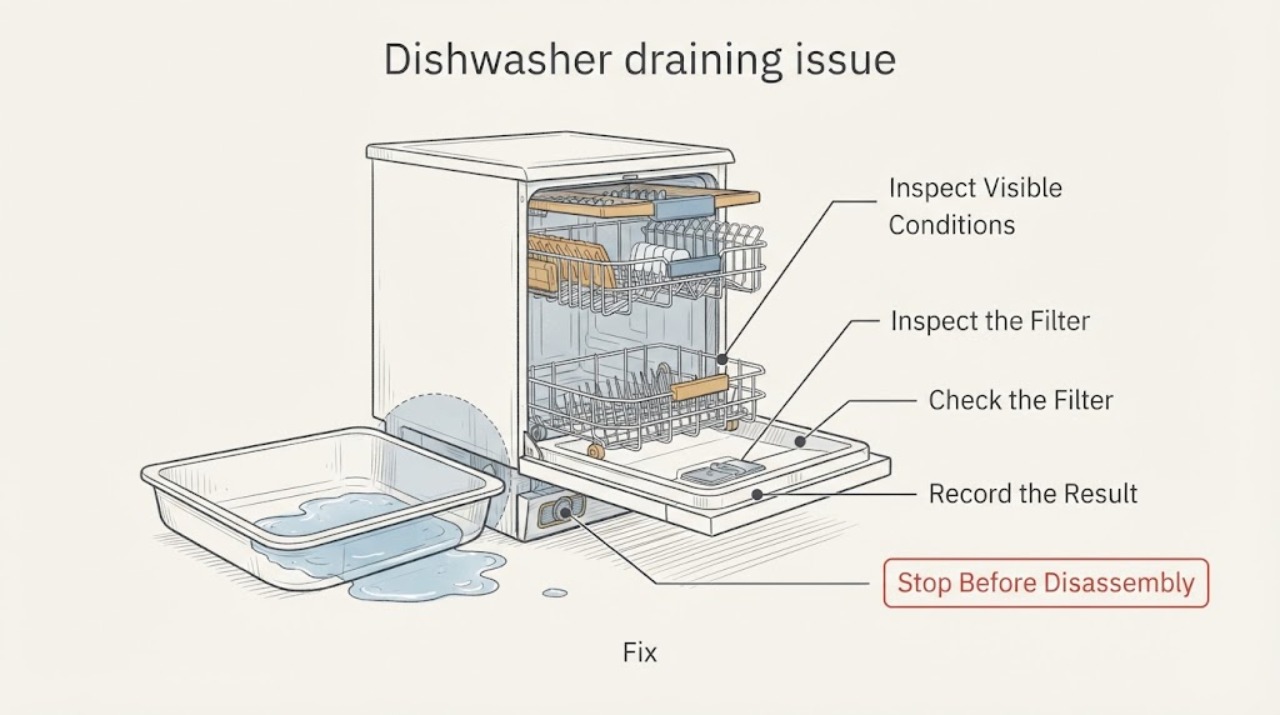
Work through in order
Diagnostic checks
Use only checks that match the exact appliance or system and its official guide.
-
Check 1
Observe the remaining water with the dishwasher stopped and record whether water is pooled on the bottom after a completed cycle, whether the cycle stopped mid-programme, and whether a code is displayed.
Expected result: Standing water remains after the cycle, the appliance stopped while draining, or there is no standing water and the complaint is only wet dishes.
Next step: Use the drain checks only for persistent standing water or a drain-stage stop. If another code is displayed, follow the exact model manual for that code rather than importing E24 guidance.
Why this matters
Why: Bosch treats standing water at the bottom as evidence that the dishwasher is not pumping water out. Wet dishes without pooled water do not by themselves prove a drain blockage.
-
Check 2
Switch the dishwasher off and use the exact Bosch owner's manual to locate and remove the filter; do not force a filter, spray arm, or cover that the manual does not identify for the model.
Expected result: The model manual confirms a removable bottom filter, or the filter cannot be identified or removed without force.
Next step: If the manual supports removal, continue with the filter-cleaning check. If not, leave the appliance off and arrange model-specific service.
Why this matters
Why: Bosch says the filter is at the bottom and that the owner's manual explains removal. A different layout or a part that resists removal is a model-scope boundary, not evidence that the pump is defective.
-
Check 3
Clean the removed filter under running water with mild soap and a soft brush, then reinstall it and the spray arm exactly as the manual shows; use gloves or care around sharp debris.
Expected result: Food particles or grease are trapped in the mesh, or the filter is visibly clean and correctly reseated.
Next step: After a correct reseat, reassess the next drain stage only if the appliance is otherwise safe to operate. If water remains, stop testing and move to the hose/service branch rather than guessing a part.
Why this matters
Why: Bosch says food debris in the filter can hinder performance and protect the pump from clogging. A clean filter does not prove that the pump, hose, or internal drain path is working.
-
Check 4
If the exact model manual or Bosch's E24 page applies to the displayed condition, inspect only the accessible drain hose, siphon connection, air gap, or garbage-disposal dishwasher inlet for a visible kink, loose seal, or remaining knockout plug; do not disconnect a hose blindly.
Expected result: The drain hose is visibly kinked, the accessible siphon connection is loose, the air gap is visibly blocked, or the dishwasher connection is attached to a new disposal whose knockout plug may still be present; or none of these conditions is visible.
Next step: Correct only a plainly accessible condition allowed by the manual, then arrange service if standing water remains. If inspection requires moving the built-in appliance, disconnecting plumbing, or opening the cabinet, stop and call a qualified technician.
Why this matters
Why: Bosch lists hose blockage/kinking, a siphon connection, air-gap or disposal connection as possible drain-path causes in its E24 guidance. That page does not establish a pump failure and its details must not replace the exact model manual.
-
Check 5
Escalate when water remains after the model-supported filter and accessible drain-path checks, or when the appliance leaks, smells electrical, makes a harsh pump-area noise, or cannot be safely isolated.
Expected result: The dishwasher drains normally after the external check, or standing water and the original symptom persist.
Next step: Stop using the dishwasher, close its water supply if there is a leak, and give Bosch or qualified service the model/E-Nr, displayed code, cycle stage, water level, and checks already performed.
Why this matters
Why: A successful drain supports a blockage or connection condition. Persistence does not identify a failed pump or other internal part from outside, and Bosch directs owners to support when water still does not drain.
Use your observations
Decision map
Find the observation that best matches what you see, then follow the next safe action.
-
PATH 01Next step
What you see
Standing water remains after a completed cycle and the exact manual confirms a removable filter that is visibly clogged.
Do this next
Switch the appliance off, clean and reseat the filter exactly as the manual shows, and reassess only if the appliance remains safe to operate.
Why this path and its safety boundary
Why it matters: This matches Bosch's documented filter/debris pathway for a dishwasher that is not draining.
-
PATH 02Next step
What you see
The filter is clean and correctly seated, but a visible kink or accessible sink-side drain connection problem is present and the model manual allows that check.
Do this next
Correct the plainly accessible condition without disconnecting plumbing blindly, then use service if water still remains.
Why this path and its safety boundary
Why it matters: The accessible drain path remains a plausible cause; it does not prove a pump or control failure.
-
PATH 03Next step
What you see
The exterior drain path looks clear, or the filter/pump cover cannot be reached without moving, tipping, or opening the appliance.
Do this next
Leave the dishwasher off and arrange qualified service; do not guess a pump, force a cover, or pull a built-in unit out.
Why this path and its safety boundary
Why it matters: The remaining obstruction or component is not safely identifiable from the available model-free evidence.
-
PATH 04Next step
What you see
Water is leaking outside the appliance, an electrical or burning odor is present, or the appliance cannot be safely switched off or isolated.
Do this next
Do not continue drain tests. Keep away from wet electrical areas, close the water supply only if safely accessible, and obtain qualified appliance or electrical help.
Why this path and its safety boundary
Why it matters: The symptom has a water or electrical safety boundary beyond routine filter care.
Helpful context
Understand the symptom
Confirm that the symptom is a drain failure
The useful distinction is water that remains pooled at the bottom after the programme versus a cycle that simply pauses or ends with dishes wet. Bosch says standing water at the bottom indicates that the dishwasher is not pumping water out. Record when the water appears and any display code before changing settings; an E24-specific instruction should not be transferred to a different code or model.
Use the model manual for every removable part
Bosch places the filter at the bottom of the dishwasher and says the owner's manual controls filter removal. Its general filter page describes washing the removable filter under running water with mild soap and a soft brush. Because no model number is assigned here, the article keeps the filter and hose checks model-bounded and does not identify a failed pump or prescribe cabinet work.
When checks do not resolve it
Need a professional?
Arrange Bosch or qualified dishwasher service if standing water remains after the exact model's filter and accessible drain-path checks, if the filter or pump cover does not match the manual, or if the appliance leaks, smells electrical, or makes a harsh internal noise. Do not order or replace a drain pump, hose, valve, or control board from a general draining symptom.
Common questions
FAQ
Why is my Bosch dishwasher leaving water in the bottom?
Bosch says standing water at the bottom means the dishwasher is not pumping water out, and food debris in the filter or pump is a common cause. Start with the exact model manual and the filter check; do not assume a failed pump from the symptom alone.
Can I clean the Bosch dishwasher filter myself?
Bosch directs owners to the model manual for filter removal, then describes washing the removable filter under running water with mild soap and a soft brush before reinstalling it and the spray arm. Stop if the layout differs or a part will not release without force.
Does a draining problem mean the Bosch pump needs replacement?
No. Bosch lists filter debris and drain-path conditions among possible causes. If the filter and accessible model-supported checks do not restore draining, arrange service rather than ordering a pump or opening the appliance.
Read the exact guide
Official sources
- Bosch Dishwasher Error Code E24: How to Fix & Reset | Bosch – Dishwasher Drain Filter Clogged and Not DrainingBSH Home Appliances Corporation / Bosch Home · Conditional Bosch E24 drain-path observations, including drain hose, siphon, air-gap, and garbage-disposal connection checks for the US support scope; not a universal code interpretation
- Dishwasher Troubleshooting: Dishwasher is not drainingBSH Home Appliances Corporation / Bosch Home · Bosch dishwasher general draining symptom, filter/pump debris check, owner-manual boundary, and service escalation for the US support scope
- How to Properly Clean Your Dishwasher FilterBSH Home Appliances Corporation / Bosch Home · Bosch dishwasher filter location, model-manual removal boundary, and mild-soap/soft-brush cleaning guidance for the US support scope
Community feedback
Share a repair observation
Share a plain-text repair observation. Accepted observations are published automatically; this page may take a moment to update.