
On this page
Start here
Quick answer
If detergent or a tablet remains in a Bosch dishwasher, first check where it is left: inside the dispenser, in the collecting tray, or as residue on the tub and dishes. Bosch says the dispenser and tablet collecting tray must be clean, the tablet should lie flat, and cookware or utensils must not block the lid or tray. Check that the spray arms rotate freely and their nozzles are not blocked, because they provide the water needed to dissolve the tablet. Low filling or low water temperature can also leave detergent undissolved; a short programme or old, lumpy detergent may contribute as well. Use only the exact model's normal detergent instructions, keep the dispenser dry, and make one safe recovery attempt after the dishwasher has cooled. Do not touch a partially dissolved tablet during a running or recently hot cycle, pour chemicals into the machine, or dismantle the inlet or heater. If the dispenser opens normally but detergent still remains, arrange Bosch service for the water, spray, heating, or control path.
Before you begin
Safety first
- This article covers cool, power-isolated, ordinary-access checks only. Do not touch detergent in a running or hot appliance, loosen water connections, open the heater, pump, control, or electrical covers, bypass sensors or interlocks, mix chemicals, or keep operating with a leak or electrical symptom.
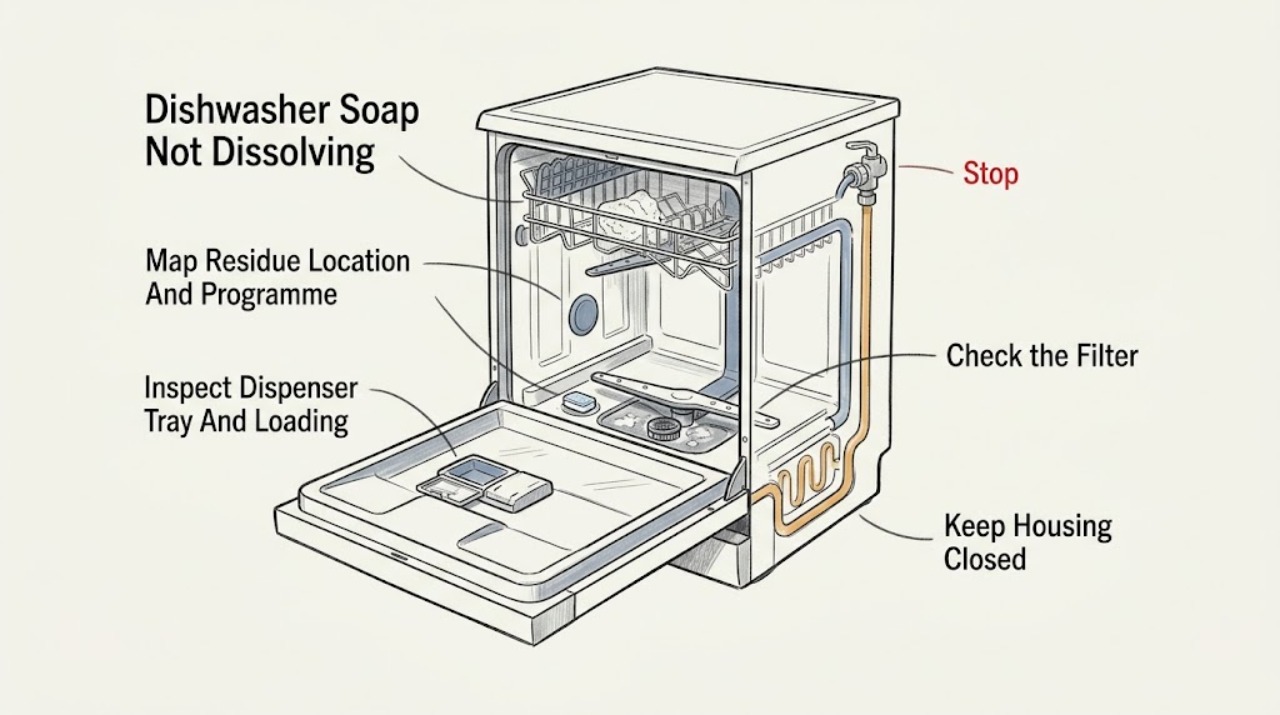
Work through in order
Diagnostic checks
Use only checks that match the exact appliance or system and its official guide.
-
Check 1
After the programme has ended and the appliance is cool enough to open safely, photograph where the detergent remains: in the closed or partly opened dispenser, in the tablet collecting tray, on the tub floor, or on the dishes. Record whether the programme was short, whether the tablet was intact or softened, and whether the dispenser lid appears to have opened.
Expected result: Classify the result as dispenser-trapped, tray-trapped, released-but-undissolved, powder or liquid residue, or no detergent residue with only poor cleaning.
Next step: Use the matching branch below and do not run another cycle until the visible, cool, user-accessible checks are complete. Stop for a cracked dispenser, hot standing water, chemical spill, smoke, or an electrical symptom.
Stop if: Do not touch a partially dissolved tablet during a hot or running cycle, taste or handle detergent residue with bare hands, or add chemicals to force dissolution.
Why this matters
Why: Dispenser or tray residue keeps the lid, placement, loading, and detergent condition in view. A released tablet that remains intact makes spray coverage, water filling, temperature, or programme duration more likely. Poor cleaning without detergent residue points to a broader wash result issue.
-
Check 2
With the dishwasher empty, cool, and power isolated as the exact model permits, inspect the detergent dispenser and tablet collecting tray for sticky residue, a blocked opening, a lid that cannot move freely, or an item of tableware positioned above it. Place one tablet flat rather than upright in a clean, completely dry dispenser only when the model manual calls for a tablet.
Expected result: Record whether the dispenser and tray are clean and dry, whether the lid closes and releases normally, whether a pan handle or utensil blocks them, and whether the tablet is flat and free of a damp wrapper or surface.
Next step: Remove only an obvious loading obstruction and clean or dry the dispenser as the exact manual permits. Make one normal cycle attempt with the model-specified detergent; arrange service for a damaged, sticky, or non-opening dispenser.
Stop if: Do not pry the dispenser lid, place extra objects in the tablet tray, use a wet dispenser, or reach into hot water or a running appliance.
Why this matters
Why: Bosch says the dispenser and tray must be clean, the tablet should lie flat, and loading can block the lid or tray. A clear, dry dispenser with a normally released tablet makes the spray, filling, temperature, or programme path more likely than placement.
-
Check 3
With the dishwasher cool and power isolated, rotate the accessible spray arms by hand and inspect their holes for food deposits, cracks, or a loading item that prevents movement. Check the user-accessible filter for heavy soil according to the exact manual, and ensure no item blocks the spray path or detergent tray.
Expected result: Classify the spray system as free and intact, obstructed by loading, blocked at the nozzles, cracked or damaged, or inaccessible without disassembly; record whether the filter is visibly clogged.
Next step: Remove only visible loading obstruction and clean the spray arms or filter as the exact model manual permits. Make one normal recovery attempt after reassembly; arrange service for cracks, inaccessible parts, weak water flow, or recurring residue.
Stop if: Do not run the dishwasher without required filters, use sharp force on a nozzle, remove internal pump covers, or work while the appliance is hot or connected to power.
Why this matters
Why: Bosch says the spray arms must rotate freely and distribute enough water for the tablet to dissolve; blocked nozzles or a clogged filter can disrupt water flow. Damage or a clear spray path with persistent residue shifts suspicion toward filling, heating, programme, or internal control.
-
Check 4
Without opening water or electrical connections, note whether the dishwasher fills to its normal level, whether a water-inlet or programme indication appears, and whether the dishes and interior are unusually cold at the end of a completed programme. Check the accessible inlet hose only for a kink, crush, or visible damage; use the exact manual before changing programme temperature or water settings.
Expected result: Record normal versus insufficient filling, a kinked or damaged hose, a programme or water fault, a cold load after a completed cycle, or no visible water or temperature symptom.
Next step: Correct only an obvious external hose route issue and follow the exact manual for a suitable programme. If filling or heating remains abnormal, book Bosch service rather than opening the inlet or heater path.
Stop if: Do not loosen a pressurized hose, open electrical or heating covers, bypass a water or temperature control, or keep operating with a leak or electrical odor.
Why this matters
Why: Bosch says insufficient filling or low water pressure can prevent a tablet from dissolving and that water not heating properly can do the same. A normal fill and hot programme result make dispenser, spray, detergent condition, or short-programme duration more likely.
-
Check 5
Check the detergent packaging and storage condition without mixing products: note whether the tablet or powder is old, damp, stuck together, or lumpy, and whether the selected programme is short. After the dispenser, spray path, fill, and temperature checks are normal, use the model-specified detergent and one suitable programme for a single recovery attempt.
Expected result: Record whether fresh, correctly stored detergent dissolves, whether a short programme leaves residue while a suitable longer programme does not, or whether residue remains despite normal release and wash conditions.
Next step: Stop repeated detergent trials and arrange Bosch service when residue persists after one model-appropriate recovery attempt. Provide the model, detergent type, programme, residue location, and observations to the technician.
Stop if: Do not overdose detergent, mix cleaners, use industrial chemicals, run repeated hot cycles to force a result, or dismantle the dispenser, heater, pump, or control.
Why this matters
Why: Bosch manuals identify short programmes, prolonged detergent storage, and lumpy detergent as reasons for residue. Persistent residue with fresh detergent, normal release, clear spray arms, sufficient fill, and normal temperature points toward an internal water, heating, dispenser, or control fault.
Use your observations
Decision map
Find the observation that best matches what you see, then follow the next safe action.
-
PATH 01Next step
What you see
The tablet is still in the dispenser or the lid did not open fully, and a pan handle, utensil, sticky residue, wet compartment, or upright tablet is present.
Do this next
With the appliance cool and power isolated, remove only the visible obstruction, clean and dry the dispenser as the manual permits, place the tablet flat, and make one normal attempt.
Why this path and its safety boundary
Why it matters: A dispenser or loading obstruction is more likely than a water-heating fault.
-
PATH 02Next step
What you see
The tablet reached the collecting tray but remains largely intact, and a spray arm cannot rotate freely, has blocked nozzles, or the tray is blocked by tableware.
Do this next
Clear only ordinary loading obstruction and clean the user-accessible spray arms as the exact manual permits. Arrange service for cracks, weak flow, or recurring residue.
Why this path and its safety boundary
Why it matters: Insufficient spray coverage is more likely than incorrect tablet placement; a damaged arm needs service rather than force.
-
PATH 03Next step
What you see
The tablet releases normally, the spray system is clear, and residue occurs mainly with a short programme or detergent that is damp, old, or lumpy.
Do this next
Follow the packaging and exact manual, use fresh correctly stored detergent, and choose a programme appropriate for the detergent. Stop repeated trials if residue persists.
Why this path and its safety boundary
Why it matters: Dissolving time or detergent condition is more likely than a failed dispenser or heater.
-
PATH 04Next step
What you see
The tablet releases and spray arms appear normal, but the dishwasher underfills, shows a water indication, has a kinked inlet hose, or finishes with an unusually cold load.
Do this next
Correct only an obvious external hose route issue and arrange Bosch service for persistent fill or heating symptoms. Do not open the inlet, heater, or electrical system.
Why this path and its safety boundary
Why it matters: Water entry or heating is more likely than detergent placement; the official Bosch guidance treats both as causes of incomplete dissolution.
-
PATH 05Next step
What you see
Fresh model-specified detergent is placed in a dry dispenser, the lid releases, the tray and spray arms are clear, fill appears normal, and residue remains after one suitable programme.
Do this next
Stop repeated cycles and book Bosch service. Provide photos and the exact model, programme, detergent, residue location, fill and temperature observations.
Why this path and its safety boundary
Why it matters: An internal water-flow, heating, dispenser, sensor, or control fault is more likely than a user loading or detergent issue.
Helpful context
Understand the symptom
The residue location distinguishes a dispenser problem from a wash-water problem
A dry or partly wet tablet trapped in the dispenser points toward the lid, tray, placement, or detergent condition. A tablet released into the collecting tray but left largely intact points more toward spray coverage, filling, water temperature, or programme duration. Powder or liquid residue can also reflect a wet dispenser or blocked opening. Photograph the result after the cycle and avoid reaching into a hot appliance.
Loading can block both the detergent lid and the spray path
Bosch's support guidance treats loading as part of tablet dissolution: a pan handle or another item can prevent the dispenser lid or collecting tray from working, and tableware can stop spray arms from rotating. Reposition only ordinary loading obstructions. Do not use the tablet tray as a basket handle after a programme has started because a partly dissolved tablet may be there.
A short programme can be a compatibility issue, not a failed dispenser
Bosch manuals note that tablets may not have enough time to dissolve fully in short programmes and recommend powder for those programmes in the applicable models. Detergent that has been stored for a long time or has become lumpy may also dissolve poorly. Follow the exact model and detergent packaging instructions rather than increasing the dose or adding another chemical.
Only after diagnosis
Potential parts
- dishwasher detergent dispenser assembly
Consider this category only if a technician confirms that the dispenser lid or release mechanism fails after loading, cleaning, and placement are verified.
Confirm the full Bosch model, dispenser revision, latch geometry, and manufacturer fit information; detergent residue alone does not establish a dispenser failure. - dishwasher spray arm or spray system component
Consider this category only if qualified diagnosis confirms a cracked arm, blocked internal spray path, or inadequate water distribution after user-accessible cleaning.
Match the exact model and manufacturer part information; do not force a spray arm or substitute a part based on appearance. - dishwasher inlet valve, heater, or circulation component
Consider this category only when a technician confirms insufficient fill, low water temperature, or inadequate circulation as the reason detergent remains.
Confirm the exact model, electrical and hydraulic specifications, and complete manufacturer service assembly. These are internal service parts.
When checks do not resolve it
Need a professional?
Arrange Bosch service when the dispenser does not open, spray arms or the pump path are damaged or inaccessible, the dishwasher underfills, water does not heat normally, or detergent remains after one model-appropriate recovery attempt with normal release and spray. Stop using the appliance for leaks, hot standing water, chemical exposure, smoke, burning odor, or an electrical fault; do not open the heater, inlet, pump, or control system.
Safety scope: This article covers cool, power-isolated, ordinary-access checks only. Do not touch detergent in a running or hot appliance, loosen water connections, open the heater, pump, control, or electrical covers, bypass sensors or interlocks, mix chemicals, or keep operating with a leak or electrical symptom.
Common questions
FAQ
Why is my Bosch dishwasher tablet still in the dispenser?
Check whether a pan handle or utensil blocked the lid, whether the dispenser was damp or sticky, and whether the tablet was placed flat. With the appliance cool and power isolated, remove only visible loading obstruction and clean and dry the dispenser as the exact model manual permits.
Why is my Bosch dishwasher tablet released but not dissolving?
Check that the spray arms rotate freely and their nozzles are clear, then consider insufficient filling, low water temperature, a short programme, or old or lumpy detergent. Arrange service if those checks are normal and residue remains after one suitable cycle.
Can a short Bosch dishwasher programme leave soap residue?
Yes. Bosch manuals note that tablets may not have enough dissolving time in short programmes and recommend powder for those programmes in applicable models. Follow the exact manual and detergent packaging rather than increasing the dose or mixing products.
Should I use a higher temperature when a Bosch tablet does not dissolve?
If the exact model offers a normal higher-temperature programme, Bosch says low water temperature can prevent complete dissolution. Do not open the heater or attempt a repair; book service if the water remains cold or the problem persists.
When does undissolved Bosch dishwasher detergent need service?
Arrange service when the dispenser will not open, spray arms or water flow are abnormal, the dishwasher underfills or does not heat, or fresh model-specified detergent remains after normal release and one suitable programme. Stop for leaks, hot standing water, smoke, burning odor, or an electrical symptom.
Read the exact guide
Official sources
- Bosch dishwasher instruction manual 9000417831_ABosch · Opened official Bosch dishwasher manual for a specific appliance family; dispenser layout, programme names, and dosing details must be checked against the user's exact model.
- Dishwasher not cleaning properlyBosch UK · Official Bosch UK dishwasher support guidance for cleaning results and undissolved tablets; exact model cleaning instructions control removal of user-accessible parts.
- Dishwasher tablet not dissolvingBosch UK · Official Bosch UK dishwasher support guidance; exact model manual, detergent instructions, and regional service conditions control a particular appliance.
- Information for Use SMI4HTS01ABosch · Opened official Bosch manual for the specific SMI4HTS01A model family; exact appliance controls and maintenance instructions may differ for another Bosch model.
Community feedback
Share a repair observation
Share a plain-text repair observation. Accepted observations are published automatically; this page may take a moment to update.