
On this page
Start here
Quick answer
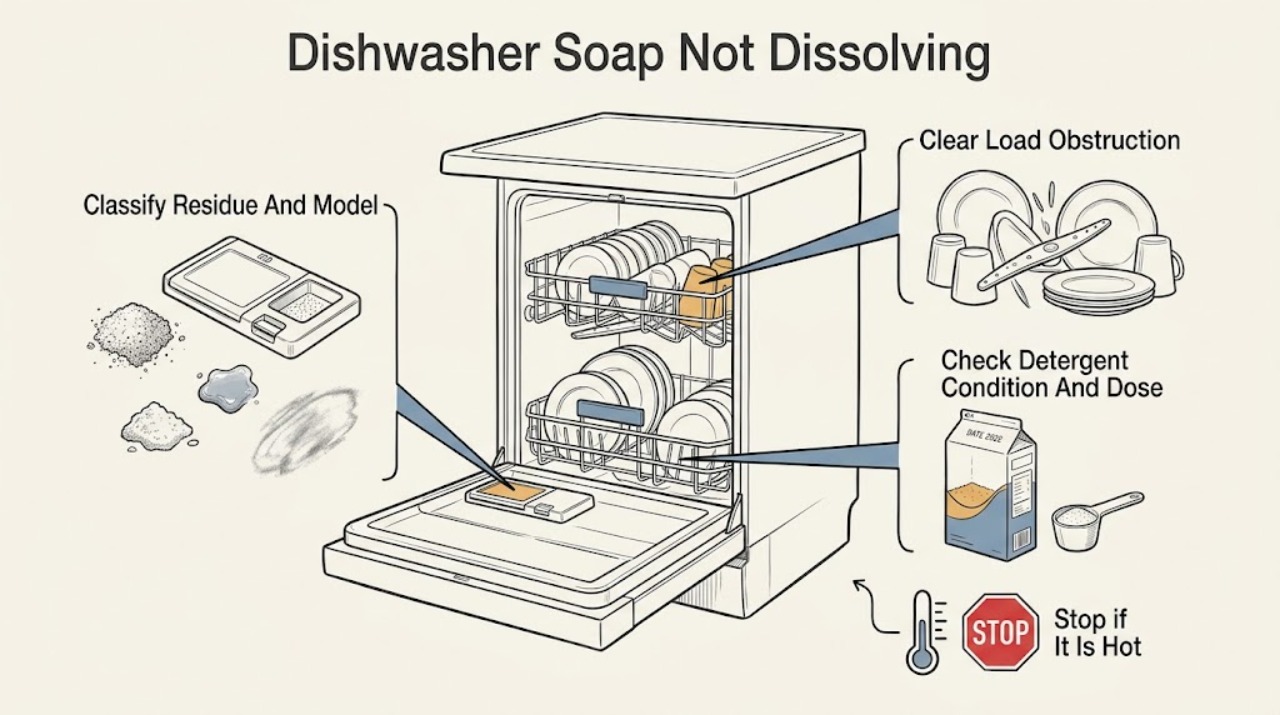
First check what actually happened: the detergent cover may not have opened, the cover may have opened but the product remained, or the cycle may have used a model-specific tablet location. Frigidaire says a dish or pan can block the covered dispenser or keep spray-arm water from reaching it, while damp, caked, old, or incorrectly dosed automatic dishwasher detergent may not dissolve. The manufacturer recommends water at about 120°F at the start of a cycle; low water supply or low pressure can also reduce cleaning and spray action. With the dishwasher stopped, clear only visible loading obstructions, use fresh automatic dishwasher detergent at the model's documented amount, and follow the exact instructions for quick or fast cycles. If the cover stays closed with a clear load, or fresh detergent still remains after normal water and spray checks, arrange service for the dispenser, inlet, pump, heater, sensor, or control. Never use hand dish soap, mix chemicals, pry the cup open, or perform live testing.
Before you begin
Safety first
- The user may stop the cycle, isolate power before handling the load or owner-accessible filter and spray areas, clear visible loading obstructions, use fresh model-approved automatic dishwasher detergent at the documented amount, and observe the cup after a normal cycle. Qualified personnel must handle the dispenser assembly, latch actuator, pump, heater, inlet system, sensors, controls, wiring, live testing, and any wet or electrically damaged appliance.
Work through in order
Diagnostic checks
Use only checks that match the exact appliance or system and its official guide.
-
Check 1
After the cycle is complete and the dishwasher is stopped, identify the exact Frigidaire model and record the programme, detergent form, placement, and cup result. Inspect whether the covered cup stayed closed, opened with product still inside, opened with only a damp film, or released product but left residue elsewhere in the tub.
Expected result: The cover is closed; the cover is open but a tablet, powder, or gel remains; the product is caked; the product is on the tub floor; or the detergent is gone but dishes are still dirty.
Next step: Follow the branch that matches the physical result and the exact model's Owner's Guide. Do not assume a quick-cycle tablet instruction or SmartBoost feature applies to every Frigidaire dishwasher.
Stop if: Do not pry the cover, insert a tool into the latch, reach into a running dishwasher, or start another cycle while detergent or an unknown chemical spill is present.
Why this matters
Why: A closed cup makes loading interference, the latch or actuator, and programme behavior more likely. An opened cup with residue makes product condition, water temperature, fill, spray reach, filter blockage, or cycle choice more likely. Detergent that is gone with poor cleaning is not proof of a dispenser fault.
-
Check 2
With the dishwasher stopped and power isolated before handling the load, inspect the visible space in front of the detergent cup. Look for a tall plate, pan, utensil, rack edge, or handle that could prevent the cover from opening or shield the cup from the spray arm. Check that the racks are positioned as the model guide shows and rotate an accessible spray arm only by hand while the appliance is off.
Expected result: A dish or pan was directly in front of the cup; a rack or handle blocked the spray-arm path; the spray arm turns freely and the cup has clear space; or no visible obstruction is found.
Next step: Reposition only the visible obstruction and run one model-approved cycle with the cup and spray path clear. Inspect the cup afterward; do not treat a single obstructed load as evidence that a part needs replacement.
Stop if: Do not hold the cover open, bend a rack, remove the dispenser, or put hands near spray arms while the dishwasher has power or is operating.
Why this matters
Why: A clear load obstruction can leave a whole tablet or cupful of detergent behind without a failed dispenser. If the load is clear and the cover remains shut, the latch, programme, actuator, or control path becomes more likely; if the cover opens but water cannot reach the cup, spray or fill checks are next.
-
Check 3
Check the detergent container and the amount used without tasting or mixing the product. Confirm it is automatic-dishwasher detergent, fresh, dry, and stored in a cool, dry place. Compare powder, gel, liquid, or one-tablet/pack use with the exact Frigidaire manual and water-hardness guidance; do not exceed a fill line.
Expected result: The detergent is damp, caked, old, clumped in the cup, a hand-dishwashing product was used, too much was added, the dose is wrong for the water hardness, or the product is fresh and correctly measured.
Next step: Discard compromised product according to its label, use fresh automatic dishwasher detergent, store it dry, and make one normal cycle using the model's amount. Do not increase the dose because residue was found.
Stop if: Do not use hand dish soap, mix products, combine detergent with bleach or another cleaner, scrape hardened product with a sharp object, or pour detergent into a rinse-aid reservoir.
Why this matters
Why: Damp or caked detergent can remain even when the dispenser and spray path work. A wrong detergent or excessive dose can create residue or foam rather than improve cleaning. Fresh, correctly measured automatic detergent with a clear cup shifts attention to water temperature, fill, spray action, or the dispenser mechanism.
-
Check 4
Compare the selected programme with the exact model instructions before starting another test. Pay particular attention to quick, fast, rinse-only, or short cycles and to whether that model directs a tablet or pack into the main cup or another documented location. If your model has SmartBoost, treat its separate detergent spray arm as a model-specific feature rather than a universal assumption.
Expected result: The cycle was rinse-only or too short for the load; the quick/fast instructions specify different tablet placement; a supported SmartBoost indicator or spray feature is present; or the detergent was used in the normal documented location on a full wash cycle.
Next step: Use one model-approved normal wash programme with the documented detergent placement, clear loading, and fresh product. Record the cycle name and whether the cup opened before deciding that the dispenser has failed.
Stop if: Do not put detergent in an undocumented location, override a cycle instruction by guessing, or run a chemical test cycle with mixed cleaners or excess detergent.
Why this matters
Why: A cycle can change how much time and water act on the detergent, and Frigidaire explicitly gives separate guidance for quick or fast cycles. SmartBoost can alter the spray path only on models equipped with it. A correct full-cycle setup with residue remaining points away from a simple programme mismatch.
-
Check 5
Check the water-heating and supply conditions without opening the dishwasher or testing live wiring. Frigidaire recommends water at approximately 120°F at the start of a cycle; check the household water-heater setting using its normal controls or readout, and, if appropriate, run the kitchen tap until hot before starting. Note whether water is being used elsewhere, the dishwasher fills normally, and the supply valve and line are visibly open and unrestricted.
Expected result: The incoming water starts cold; other fixtures are using water; the dishwasher fills weakly or not at all; the supply valve is closed or the line is visibly restricted; or temperature, fill, and household water use appear normal.
Next step: Correct only a visible supply condition, reduce simultaneous household water use, and make one normal cycle with hot starting water. If the dishwasher still does not fill normally or detergent remains, arrange service instead of opening the inlet or heater circuit.
Stop if: Do not disconnect water hoses, open the inlet valve, remove panels, measure live voltage, or touch hot water or electrical parts while testing.
Why this matters
Why: Cool starting water can slow detergent activation, while competing water use or low supply can reduce cleaning and spray action. A weak or absent fill points to a water-supply or inlet path rather than detergent chemistry alone. Normal external water conditions leave spray, filter, dispenser, heating, or control faults unresolved.
-
Check 6
With power safely isolated, inspect only the spray-arm openings, filter, and glass trap areas that the exact Owner's Guide identifies as owner-accessible. Remove loose visible debris using the manual's method, reinstall parts correctly, and then run one normal cycle without opening the door during operation. Afterward record whether the cup opened and whether water reached or dissolved the product.
Expected result: The spray arm or filter has visible debris; the cup opened and the detergent is gone; the cup opened but remains dry or caked; or the visible path is clear and the same residue returns.
Next step: Clean only the documented accessible parts and repeat one normal observation. If the visible path is clear but the dispenser, water action, or heating remains abnormal, stop user troubleshooting and provide the observations to qualified Frigidaire service.
Stop if: Do not remove the dispenser body, pump, heater, wiring, or control; do not run the unit with a leak, foam overflow, burning odor, smoke, sparking, or exposed parts.
Why this matters
Why: Debris in the spray or filter path can reduce water action and cleaning. A cup that opens and receives water but leaves fresh detergent points toward temperature, detergent, dose, or a deeper wash/heating issue. A cup that stays closed with clear loading and normal controls points toward its latch, actuator, or control.
-
Check 7
Prepare a service record after the safe external checks: exact model and control style, selected programme, detergent type and age, dose and storage, cover position after the cycle, loading and spray-arm result, water-temperature and fill observations, and any error, leak, foam, heat, or electrical symptom.
Expected result: The problem disappears after clearing a load or replacing damp detergent; residue persists with fresh product and normal water; the cover never opens; the dishwasher fills or sprays abnormally; or a hazard appears.
Next step: Use the dishwasher only after a normal cycle completes without residue or hazard. Otherwise leave it off and contact Frigidaire or a qualified appliance technician with the service record and exact model manual.
Stop if: Do not order or install a dispenser, pump, heater, valve, sensor, or control board solely from a detergent-residue symptom, and do not perform live or internal testing.
Why this matters
Why: A resolved load, product, programme, or supply condition supports that user-level cause. A persistent failure can involve the dispenser latch or actuator, inlet, circulation pump, heater, sensor, or electronic control, but the external residue pattern cannot identify a safe replacement part.
Use your observations
Decision map
Find the observation that best matches what you see, then follow the next safe action.
-
PATH 01Safety boundary
What you see
The detergent cover is still closed after a cycle, especially when the load was tall or crowded.
Do this next
Clear the visible obstruction, confirm the exact programme instructions, and observe one normal cycle. Arrange service if the cover stays closed with a clear load.
Why this path and its safety boundary
Why it matters: A plate, pan, utensil, or rack position can block the automatic cover; if the load is clear, a cover/latch, cycle, actuator, or control problem becomes more likely than detergent chemistry.
Safety stop: Do not pry, hold, or bypass the detergent cover or latch.
-
PATH 02Safety boundary
What you see
The cover opened, but a tablet, powder, gel, or caked mass remains in the cup or on the tub floor.
Do this next
Use fresh dry automatic dishwasher detergent at the model amount, clear the load and visible spray path, verify hot starting water and the cycle instruction, then make one normal observation. Escalate if residue returns.
Why this path and its safety boundary
Why it matters: The dispenser did release or attempt to release the product, so damp/old detergent, incorrect dose, low starting temperature, weak fill, blocked spray reach, filter or spray-arm debris, and programme choice are more likely than a cover-latch failure.
Safety stop: Do not add extra detergent, use hand soap, mix chemicals, or scrape the cup with a sharp tool.
-
PATH 03Safety boundary
What you see
Residue occurs only on a quick or fast programme, or the manual gives a different tablet/pack placement for that programme.
Do this next
Follow the exact model guide for that cycle, or use one normal wash cycle with the documented placement for comparison. Keep the product and loading unchanged so the result is meaningful.
Why this path and its safety boundary
Why it matters: Frigidaire's detergent guidance treats quick or fast cycles as a model- and programme-specific placement case. A short cycle can also provide less time for a product to dissolve; this does not by itself prove a broken dispenser.
Safety stop: Do not guess a tablet location or place detergent where the model guide does not permit it.
-
PATH 04Safety boundary
What you see
The water starts cold, another fixture is using water, the dishwasher fills weakly, or spray action and cleaning are poor across a normal cycle.
Do this next
Verify the normal household supply and hot start without opening the appliance. If fill or spray remains weak, stop and arrange service for the inlet, circulation, or related internal system.
Why this path and its safety boundary
Why it matters: Frigidaire recommends approximately 120°F starting water and notes that low water pressure or restricted water supply can affect cleaning. Reduced water action can leave detergent even when the product and cup are correct.
Safety stop: Do not remove the inlet valve, heater, pump, or wiring, and do not perform a live water or electrical test.
-
PATH 05Safety boundary
What you see
The cup has clear loading space but a spray arm or filter has visible debris, or the detergent dissolves only after the visible path is cleaned.
Do this next
Keep the spray arms and filter maintained using only the exact model instructions and recheck on a normal cycle. If the path is clear and residue persists, arrange service.
Why this path and its safety boundary
Why it matters: A blocked spray or filter path can prevent water from reaching the cup and can reduce overall cleaning. Improvement after owner-accessible cleaning supports a water-action cause rather than a failed detergent product.
Safety stop: Do not dismantle the circulation system, insert tools into spray holes, or operate with parts incorrectly installed.
-
PATH 06Safety boundary
What you see
Fresh correctly dosed detergent, clear loading, correct programme, normal external water conditions, and accessible spray/filter checks do not resolve the residue, or the cover never opens.
Do this next
Leave the dishwasher off and give qualified Frigidaire service the exact model, cycle, detergent, cup position, water, spray, filter, and hazard observations.
Why this path and its safety boundary
Why it matters: A dispenser latch or actuator, inlet or circulation system, heater, sensor, or electronic control may be involved. The residue pattern cannot distinguish these parts safely, and a SmartBoost feature cannot be assumed unless the model has it.
Safety stop: Do not open the door panel or control area, bypass the cover, probe wiring, run live tests, or replace a part based only on this symptom.
Helpful context
Understand the symptom
Separate a closed dispenser from residue after it opened
“Soap not dissolving” can describe three different observations: the cover stayed shut, the cover opened but a powder or tablet remained, or the detergent dissolved but cleaning was poor. Check the cup after the cycle and note the selected programme. Frigidaire's covered cup is designed to open automatically, but a tall dish or pan can block the cover or keep spray water from reaching the open cup. A residue problem after an open cover points instead toward detergent condition, water temperature, fill or spray action, or programme instructions.
Use the exact model and programme instructions
Frigidaire dishwasher racks, dispenser shapes, and options are not identical. Some supported models have SmartBoost, a separate spray arm that directs water toward the detergent compartment; that feature must not be assumed on a model without it. Frigidaire also notes that quick or fast programmes may have a separate instruction for where to place a tablet or pack. Use the exact model Owner's Guide for any cycle-specific placement, amount, and maintenance instruction instead of forcing a universal workaround.
Keep detergent and cleaning chemicals in their proper roles
Use only fresh automatic dishwasher detergent and the amount allowed by the model guide and water-hardness instructions. Frigidaire warns that non-dishwasher detergents can cause oversudsing; ordinary hand dish soap is not a safe substitute. Do not mix detergent with rinse aid, bleach, descaler, or another cleaner, and do not add extra product to compensate for residue. Stop for foam overflow or a chemical spill that cannot be safely contained, and arrange service if water or foam reaches electrical areas.
Safety boundary
Stop conditions
- Stop the dishwasher for foam overflow, a chemical spill that cannot be safely contained, water near electrical parts, smoke, burning odor, sparking, a hot or damaged cord or outlet, or a repeated electrical trip.
- Use only automatic dishwasher detergent in the documented reservoir and amount. Do not use hand dish soap, mix detergent with bleach, rinse aid, descaler, or another cleaner, or add extra detergent to compensate for residue.
- Do not pry or bypass the detergent cover, remove the dispenser assembly, access wiring, dismantle the pump or heater, or perform live testing.
- Isolate power before handling the load, dispenser area, filter, or spray arms, and use only owner-accessible maintenance described in the exact model manual.
- A persistent closed cover, weak fill or spray, repeated residue with fresh product, or any internal diagnosis requirement needs qualified service rather than a guessed replacement part.
When checks do not resolve it
Need a professional?
Safety scope: The user may stop the cycle, isolate power before handling the load or owner-accessible filter and spray areas, clear visible loading obstructions, use fresh model-approved automatic dishwasher detergent at the documented amount, and observe the cup after a normal cycle. Qualified personnel must handle the dispenser assembly, latch actuator, pump, heater, inlet system, sensors, controls, wiring, live testing, and any wet or electrically damaged appliance.
Common questions
FAQ
Why is detergent still in my Frigidaire dishwasher dispenser after the cycle?
First see whether the cover opened. If it stayed closed, clear a plate, pan, utensil, or rack obstruction and follow the exact cycle instruction. If it opened, check fresh dry automatic dishwasher detergent, the documented amount, starting water near 120°F, fill and spray action, filter/spray-arm debris, and any quick-cycle placement rule. A repeated failure with a clear load needs service; do not pry the cup open.
Can a dish or pan stop a Frigidaire detergent cup from working?
Yes. Frigidaire says the dispenser must open freely and receive water from the spray arm. A tall item or handle can block the cover or shield the cup, leaving detergent behind. Reposition the load with the dishwasher stopped and test one normal cycle; if the cover still does not open, arrange service instead of forcing it.
Does water temperature affect Frigidaire dishwasher detergent?
It can. Frigidaire says detergent is designed to dissolve and activate around 120°F and recommends hot starting water for cleaning performance. You can use the normal water-heater readout or run the kitchen tap until hot before starting, but do not open the dishwasher's heater or wiring. Persistent cold fill or poor heating needs service.
Can I put a detergent tablet somewhere else on a short Frigidaire cycle?
Only if the exact model and programme guide says so. Frigidaire's general guidance notes that quick or fast cycles may have separate tablet-placement instructions. Do not guess, and do not assume a SmartBoost spray path exists on every model.
Can I use hand dish soap or mix cleaners to dissolve the detergent?
No. Use only automatic dishwasher detergent in the documented amount. Frigidaire warns that non-dishwasher soap can cause oversudsing and leakage. Do not mix detergent with bleach, rinse aid, descaler, or another cleaner; stop for foam overflow, an uncontrolled spill, water near electrical parts, smoke, odor, or a repeated electrical trip and arrange qualified service.
Read the exact guide
Official sources
- Dishwasher - Loading GuideFrigidaire · Supports keeping large items away from the detergent dispenser, ensuring spray arms can rotate, and recognizing that rack and separator layouts can vary by model.
- Dishwasher - Not FillingFrigidaire · Supports checking the visible water valve, open supply, and unrestricted supply line and escalating if the dishwasher does not fill; it does not authorize opening the inlet system.
- Dishwasher - Not CleaningFrigidaire · Supports distinguishing detergent left after a blocked dispenser from broader cleaning issues and checking the filter, glass trap, and spray arms; it is not an internal repair guide.
- Dishwashers - How much detergent to use in my dishwasher?Frigidaire · Supports one-tablet guidance, water-hardness and manual-based dosing, dispenser opening clearance, spray reach, fresh storage, and quick/fast-cycle tablet placement; exact model instructions control.
- Dishwasher - Dispenser and Detergents GuideFrigidaire · Supports the covered automatic-opening cup, model-specific SmartBoost qualification, detergent placement, fresh/dry storage, and the boundary for service; exact model instructions govern variations.
- Dishwasher Detergent Not DissolvingFrigidaire · Applies to Frigidaire dishwashers and supports checking water action to the dispenser, water temperature, detergent choice, and detergent freshness.
- Dishwasher - Water LeakingFrigidaire · Supports the safety boundary against hand dish soap, excess detergent, spills, and oversudsing; it does not diagnose the dispenser actuator.
- Dishwashers - How can I ensure the best cleaning results?Frigidaire · Supports approximately 120°F starting water, running the sink until hot before starting, avoiding simultaneous water use, and the effect of low water pressure; it does not identify a specific failed part.
Community feedback
Share a repair observation
Share a plain-text repair observation. Accepted observations are published automatically; this page may take a moment to update.