
On this page
Start here
Quick answer
A Frigidaire dishwasher can leave dishes dirty when the selected cycle is only a rinse or short wash, dishes block the spray arms or detergent dispenser, the filter or glass trap is clogged, detergent is damp or incorrectly dosed, incoming water is too cool or pressure is low, or the unit is not draining. Start by noting which rack is dirty, whether the detergent cup opened, whether water remains, and whether the problem affects every load or only heavily soiled items. With the dishwasher stopped and safe to access, correct the loading, clean the filter and glass trap, clear the spray arms, use fresh automatic dishwasher detergent in the model-approved amount, and check visible drain-hose routing. Run one suitable supervised cycle after the checks. Stop for smoke, a burning or electrical odor, a leak, water near electrical parts, or a damaged component; arrange service when a clean filter, correct load, detergent, water supply, and drain path do not restore washing.
Before you begin
Safety first
- Keep the dishwasher off for smoke, burning or electrical odor, unusual heat, arcing, a hot plug, a leak, or water near electrical parts. Do not open the cabinet, bypass the door latch, test energized wiring, or repeat cycles to test a hazardous condition.
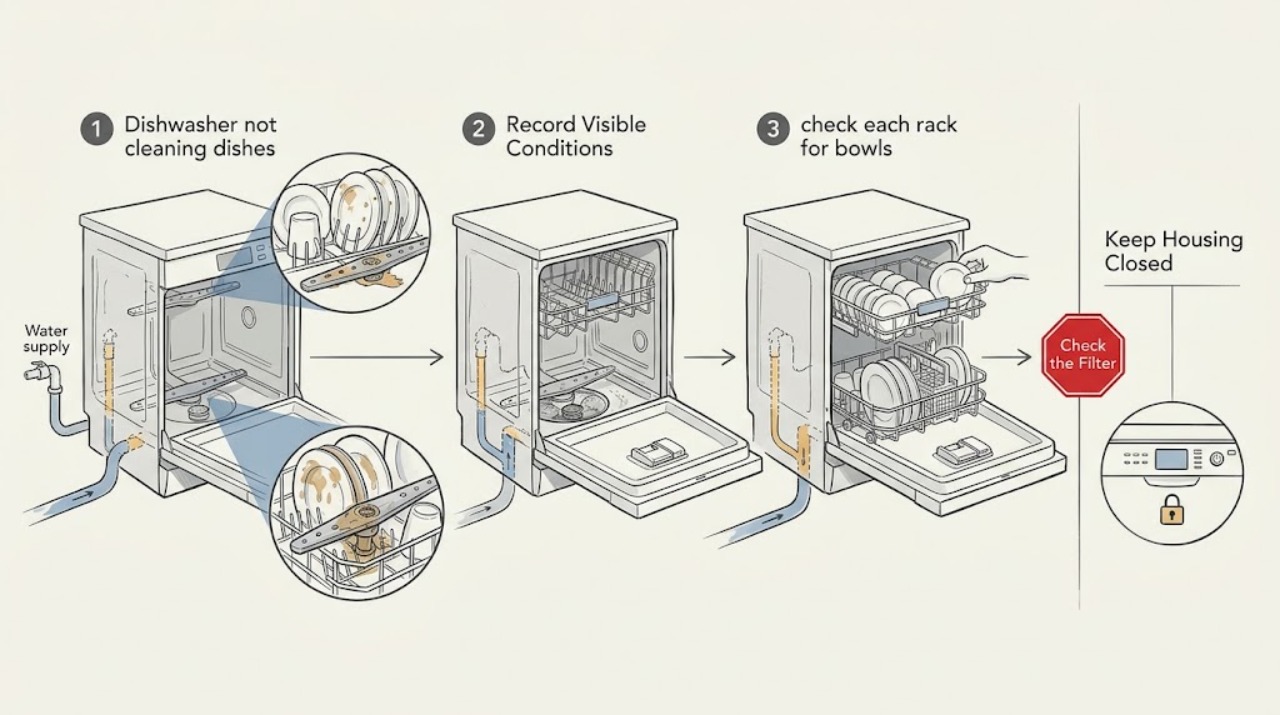
Work through in order
Diagnostic checks
Use only checks that match the exact appliance or system and its official guide.
-
Check 1
Stop the dishwasher and record the selected cycle, which rack or dishes remain dirty, whether the detergent cup opened, whether water remains in the tub, and any displayed code. Look from a dry, safe position for smoke, a burning odor, a hot plug, a leak, or water near electrical parts before doing any further check.
Expected result: Only a rinse or short cycle was used, one rack is worse than another, detergent remains in the cup, water remains, a code is shown, or a hazardous heat, smoke, odor, or leak is present.
Next step: For smoke, burning or electrical odor, unusual heat, a leak, or water near electrics, keep the dishwasher off and arrange qualified help. Otherwise select the matching cycle, loading, detergent, or drainage branch below and do not assume one cause from the symptom alone.
Stop if: Do not restart a dishwasher that is smoking, leaking near electrics, overheating, or producing a burning or electrical odor.
Why this matters
Why: The first results separate a cycle or loading problem from detergent release, drainage, or a safety event; a hazard is not an ordinary wash-performance problem.
-
Check 2
With the unit off, check each rack for bowls nested together, plates or pan handles blocking a spray arm, items protruding through the rack, or a large item in front of the detergent cup. Rotate the accessible spray arms by hand only when they are stationary and confirm nothing prevents rotation.
Expected result: A dish blocks an arm or dispenser, the spray arm does not rotate freely, one rack is much dirtier than the other, or the load and arms are clear.
Next step: Rearrange the load so soiled surfaces face the spray and the arms and dispenser have clearance, then use a normal or heavy cycle suited to the soil. If an arm is cracked, loose, or still cannot rotate, stop using that configuration and arrange service.
Stop if: Do not run the dishwasher with a rack item touching a spray arm, a loose arm, or a pan handle protruding through the rack.
Why this matters
Why: Blocked rotation or spray coverage can leave one rack dirty even when the pump and detergent are working; a clear, freely rotating load makes loading a less likely primary cause.
-
Check 3
Remove and clean the Frigidaire glass trap and filter using the exact owner manual for the model. Rinse the filter and trap under running water, remove loose food residue with a suitable soft brush or sponge, and reinstall every piece fully before testing.
Expected result: The filter or glass trap contains food soil, broken fragments, or a greasy film; the sump area is visibly dirty; or the parts are clean but damaged or cannot be reseated.
Next step: After cleaning, run the next diagnostic branch with the filter correctly seated. If glass, sharp debris, a damaged filter, or an unclear removal step is involved, use gloves and the model manual; stop and arrange service if the assembly will not lock.
Stop if: Disconnect power before accessing any internal pump area, do not reach blindly into standing water, and do not force a filter or handle sharp broken glass.
Why this matters
Why: Food debris can restrict the wash and drain paths, while a damaged or poorly seated filter can allow debris to circulate or leave the problem unresolved.
-
Check 4
Inspect the spray arms for blocked holes or mineral and food buildup. Remove them only as the model manual permits, rinse the holes, clear visible buildup without enlarging the openings, and refit the arms so they sit securely and turn freely.
Expected result: Spray-arm holes are blocked, an arm is loose or damaged, one rack receives little spray, or all arms are intact and clear.
Next step: Correct a visible blockage and run one suitable cycle with a properly loaded rack. If an arm does not seat, rotate, or spray after cleaning, leave the unit off and arrange model-specific service rather than forcing the support.
Stop if: Do not operate with a cracked, loose, or unseated spray arm, and do not use a sharp tool where it could damage the arm or tub.
Why this matters
Why: Blocked or damaged arms reduce water coverage and can make a rack remain dirty; intact arms make detergent, water supply, loading, or circulation faults more likely.
-
Check 5
Check the detergent dispenser after a completed cycle and verify that no dish or pan blocked its opening. Use only fresh automatic dishwasher detergent, place it in the dispenser as the manual directs, and match the amount to the model instructions and local water hardness; never use hand dish soap.
Expected result: Detergent is still caked in the cup, the cup could not open, the detergent is damp or old, the amount is excessive or too small for the water hardness, or the dispenser released detergent normally.
Next step: Clear the loading obstruction, replace damp or old detergent, and use the manual's dose. Run one appropriate cycle and compare the same rack and soil pattern; do not add extra detergent as a blind fix.
Stop if: Do not use hand or liquid dish soap intended for a sink, exceed the dispenser's fill line, or put detergent directly in the tub unless the exact manual says to do so.
Why this matters
Why: A blocked dispenser or detergent that does not dissolve can leave dishes dirty and residue on the tub. Correct dispensing with persistent soil shifts suspicion toward circulation, water temperature, or drainage.
-
Check 6
With no hazardous symptom, verify the dishwasher has water supply and that the visible supply line is not pinched. If your model and household installation allow it, note whether the kitchen water is hot at the faucet before starting and avoid running a shower or laundry load at the same time; do not change a water-heater setting beyond safe household guidance.
Expected result: The unit fills weakly or not at all, water is cool at the start, other fixtures are using water, the supply line is restricted, or filling and incoming water appear normal.
Next step: Restore only a closed valve or visible hose-routing issue and perform one supervised cycle. If flow remains weak, the unit does not fill, or a valve or internal heater needs testing, stop and arrange qualified service.
Stop if: Do not open the dishwasher cabinet or perform energized electrical or water-valve tests; stop for a leak or water near electrical parts.
Why this matters
Why: Insufficient flow or cool incoming water can reduce detergent dissolution and wash performance. Normal filling and water conditions make the filter, spray coverage, dispenser, drain, or circulation system more likely.
-
Check 7
Check for water left after the cycle and inspect only the visible drain hose for a kink, crushing, poor high-loop routing, or a recently changed disposer connection. If the display shows i20 or i40, follow the matching Frigidaire guidance after the filter and glass trap are clear; do not dismantle the pump.
Expected result: Water remains, the hose is restricted, an applicable disposer knockout plug was not removed, i20 or i40 appears, or the tub drains completely with no drain indication.
Next step: Correct only a visible hose-routing issue or documented disposer connection, then run one supervised drain or wash cycle. If water remains, an error returns, or the hose and connection are inaccessible, leave the dishwasher off and arrange appliance or plumbing service.
Stop if: Do not loosen a pressurized connection, pour drain chemicals into the dishwasher, or run repeated cycles with standing water, a leak, or a returning drain fault.
Why this matters
Why: Standing water and i20 point to incomplete draining, while i40 points to food soil in the filter or sump. A clear drain path with no standing water makes drainage a less likely cause of dirty dishes.
Use your observations
Decision map
Find the observation that best matches what you see, then follow the next safe action.
-
PATH 01Next step
What you see
The dishwasher cleans on a normal or heavy cycle but not on Rinse, Quick Wash, or a short cycle, and no blockage or code is present.
Do this next
Use a cycle suited to the soil and load, following the model manual. If dishes remain dirty on the suitable cycle, continue with loading, filter, detergent, and water checks.
Why this path and its safety boundary
Why it matters: Cycle selection and soil load are more likely than a failed component; Frigidaire notes that a rinse cycle does not clean and short cycles may not handle heavily soiled dishes.
-
PATH 02Next step
What you see
Only one rack is dirty, and the other rack cleans normally; a dish, pan handle, or nested item is close to that rack's spray path.
Do this next
Rearrange items so the spray arm rotates freely and soiled surfaces face the spray. If the arm is damaged or still fails to rotate, arrange service.
Why this path and its safety boundary
Why it matters: Localized obstruction or spray coverage is more likely than a whole-appliance detergent or water failure.
-
PATH 03Next step
What you see
Both racks are dirty, the filter or glass trap is coated with food soil, or i40 appears.
Do this next
Power off safely, clean the filter and glass trap according to the model manual, reseat them, and run one suitable cycle. Escalate if the code or poor cleaning returns.
Why this path and its safety boundary
Why it matters: A blocked filter or sump is a strong explanation for reduced wash circulation and the i40 condition.
-
PATH 04Next step
What you see
The detergent cup is blocked or still contains damp detergent after the cycle, or the detergent is old, excessive, or unsuitable.
Do this next
Clear the loading obstruction, use fresh automatic dishwasher detergent in the model-approved dose, and run one cycle. If the cup still does not open or dissolve, arrange service for the dispenser or water-heating path.
Why this path and its safety boundary
Why it matters: Detergent is not reaching or dissolving in the wash water, so the poor result is not evidence of a failed spray pump by itself.
-
PATH 05Next step
What you see
A white film or spots affect many dishes, water is hard, detergent dose is uncertain, or the water is cool at the start, while there is no standing water.
Do this next
Use the exact manual and water-hardness guidance to correct the detergent amount, use fresh product, and allow hot water to reach the dishwasher safely. Do not exceed fill lines or use hand soap.
Why this path and its safety boundary
Why it matters: Water hardness, detergent amount, and water temperature can produce filming or poor dissolution; this pattern is different from food chunks left on one rack.
-
PATH 06Next step
What you see
Standing water, an i20 code, a kinked drain hose, or an uncleared disposer connection accompanies the dirty dishes.
Do this next
Inspect visible hose routing and the filter or glass trap, correct only documented installation issues, and arrange appliance or plumbing service for a recurring drain fault or inaccessible connection.
Why this path and its safety boundary
Why it matters: Incomplete draining can leave soil-laden water and prevent a clean wash; the drainage branch takes priority over changing detergent.
-
PATH 07Next step
What you see
The load and spray arms are clear, the filter and glass trap are clean, detergent is released correctly, the unit fills and drains, but both racks remain dirty on a suitable cycle.
Do this next
Stop repeated test cycles and arrange qualified appliance service. Provide the model, cycle, rack pattern, detergent result, water and drain observations, and any code.
Why this path and its safety boundary
Why it matters: A circulation pump, wash-arm support, inlet, heater, or control problem is possible and cannot be confirmed safely from an external inspection.
-
PATH 08Next step
What you see
Smoke, a burning or electrical odor, unusual heat, water near electrical parts, a leak, or a damaged wire or component appears at any stage.
Do this next
Stop immediately, keep clear, isolate power only from a safe dry location, close the water valve if safe, and obtain qualified or emergency help. Do not restart to test.
Why this path and its safety boundary
Why it matters: This is a potential fire, shock, or water-damage event, not a wash-performance adjustment.
Helpful context
Understand the symptom
Use the dirty pattern to choose the first check
If every rack is dirty, start with water circulation, the filter and glass trap, detergent release, and the selected cycle. If only the upper or lower rack is dirty, loading or an obstructed spray arm is more useful to check first. A rinse cycle is not intended to clean dishes, and Frigidaire notes that short cycles may not handle heavily soiled loads. Record the model before copying any access or control step because rack and filter designs vary.
Cleaning performance depends on water and detergent reaching the soil
A plate can remain dirty even with a clean filter if a pan blocks spray-arm rotation or the dispenser cannot open. Frigidaire also says fresh automatic dishwasher detergent, an amount matched to water hardness, and water hot enough to dissolve the detergent affect results. Use the exact owner's manual for the dose and cycle; do not compensate for poor cleaning by adding extra detergent or hand soap.
Standing water changes the diagnosis
Water left after a cycle points toward drainage rather than simply dirty dishes. Frigidaire's drainage guidance calls out a kinked or poorly routed drain hose, a blocked glass trap or filter, and an uncleared disposer knockout plug on applicable installations. Clear only visible, model-documented obstructions and use service when the drain problem returns or a leak is present.
Safety boundary
Stop conditions
- Stop for smoke, a burning or electrical odor, unusual heat, arcing, a hot plug, a leak, or water near electrical parts. Keep clear, isolate power only from a safe dry location, and arrange qualified help.
- Disconnect power before reaching into the filter, glass-trap, or pump-adjacent area. Do not reach into standing water or handle broken glass without suitable protection.
- Do not use hand dish soap, exceed detergent fill lines, combine cleaning chemicals, pour drain cleaner into the dishwasher, or run repeated cycles with standing water or a recurring code.
- Do not open the cabinet, test energized wiring, force the spray arm or filter, bypass the door latch, or replace a pump or valve without model-specific diagnosis and safe installation procedures.
Only after diagnosis
Potential parts
- dishwasher spray arm
Consider this only if a spray arm is cracked, warped, loose, or confirmed by diagnosis to have poor coverage after the holes are cleared and the arm is correctly seated.
Spray arms and supports vary by Frigidaire series and model. Confirm the exact model and service diagnosis before selecting a replacement. - dishwasher circulation pump
Consider this only when the dishwasher fills and drains but both racks remain dirty with a clean filter, clear spray arms, correct detergent release, and qualified evidence of inadequate wash circulation.
Circulation pumps and seals are model-specific and may require professional installation. Do not infer pump failure from dirty dishes alone. - dishwasher filter
Consider this only if the filter or glass trap is cracked, missing, or cannot be cleaned and securely reseated after the model-specific inspection.
Filter and glass-trap designs differ across Frigidaire models. Confirm exact fit and installation before ordering or using a replacement.
When checks do not resolve it
Need a professional?
Request service for persistent poor cleaning after the model-specific checks, a returning i20 or i40, detergent that remains in the dispenser, weak filling, abnormal wash noise, damaged wash components, standing water, a leak, or any burning or electrical odor.
Safety scope: Keep the dishwasher off for smoke, burning or electrical odor, unusual heat, arcing, a hot plug, a leak, or water near electrical parts. Do not open the cabinet, bypass the door latch, test energized wiring, or repeat cycles to test a hazardous condition.
Common questions
FAQ
Why is my Frigidaire dishwasher running but not cleaning the dishes?
Start with the cycle, loading, spray-arm clearance, filter and glass trap, detergent release, water supply, and drainage. A rinse or short cycle may not handle heavy soil, while a blocked filter, arm, dispenser, or drain can affect all racks. Use the dirty-rack pattern to choose the next check.
What should I check if only the top rack is dirty?
Check for a dish, pan handle, nested item, or rack piece blocking spray-arm rotation or water coverage. Rotate the stationary spray arm by hand, rearrange the load so the arm and dispenser have clearance, and arrange service if the arm is damaged or still does not rotate freely.
Can a dirty filter make a Frigidaire dishwasher stop cleaning?
Yes. Frigidaire says food debris can collect in the filter and glass trap and cause blockages. Power off safely, clean the model-specific filter and glass trap, reseat them fully, and continue to service if poor cleaning or i40 returns.
Why is detergent still in my Frigidaire dishwasher dispenser?
A dish may have blocked the dispenser or the detergent may be damp, old, or unsuitable. Use fresh automatic dishwasher detergent in the model-approved amount, ensure water can reach the cup, and do not use hand dish soap or exceed the fill line.
Does water temperature affect Frigidaire dishwasher cleaning?
Yes. Frigidaire links cool incoming water and low pressure with poorer results and says detergent may not dissolve properly when the water is not hot enough. Use the exact manual and safe household settings; do not make an unsafe water-heater adjustment or perform cabinet work.
What does i20 or i40 mean on a Frigidaire dishwasher?
Frigidaire uses i20 for incomplete draining and i40 for a clogged filter or sump. Check the visible drain hose, disposer connection, filter, and glass trap as the matching official guidance allows. A returning code or standing water needs appliance or plumbing service.
When should I stop using a Frigidaire dishwasher that is not cleaning?
Stop for smoke, a burning or electrical odor, unusual heat, a hot plug, arcing, a leak, water near electrical parts, a damaged component, or recurring standing water. Isolate power only from a safe dry location, close the water valve if safe, and arrange qualified help rather than restarting to test.
Read the exact guide
Official sources
- Dishwasher Detergent Not DissolvingFrigidaire · Frigidaire owner-support article; use model instructions for controls and safe water settings.
- Dishwashers - How can I ensure the best cleaning results?Frigidaire · Frigidaire owner-support article; water-heater and plumbing changes require safe local practice.
- Dishwasher - Water LeakingFrigidaire · Frigidaire owner-support leak article; installation and model details vary.
- Dishwasher Error Code i40 - Clogged filter or sumpFrigidaire · Frigidaire owner-support i40 article; apply only when the appliance displays i40.
- Dishwasher Error Codes and Alarms GuideFrigidaire · Frigidaire owner-support error guide; codes and reset controls are model-dependent.
- Dishwasher - Dispenser and Detergents GuideFrigidaire · Frigidaire owner-support detergent guide; follow the exact model manual for dose and dispenser differences.
- Dishwasher - Loading GuideFrigidaire · Frigidaire loading guidance; rack features vary by model.
- Dishwasher Glass Trap and Filter GuideFrigidaire · Frigidaire support guidance; this page is on the Canadian support site and filter designs vary by model.
- Dishwasher - Not CleaningFrigidaire · Frigidaire owner-support article for dishwashers; exact controls and access depend on model.
- Dishwasher Error Code i20 - Unit did not drain properlyFrigidaire · Frigidaire owner-support i20 article; error behavior and controls can vary by model.
- Dishwashers - Not DrainingFrigidaire · Frigidaire owner-support drainage article; hose routing and controls vary by model and installation.
Community feedback
Share a repair observation
Share a plain-text repair observation. Accepted observations are published automatically; this page may take a moment to update.