
On this page
Start here
Quick answer
If a Bosch freezer is not making ice, first confirm that the ice maker is switched on, the ice container is seated, the freezer is cold enough, and the connected water supply has no visible kink or shut-off issue. A newly enabled ice maker may need the model's stated recovery time; if there is no water, a persistent fault indicator, a leak, repeated freezing in the inlet path, or no ice after these checks, stop and arrange qualified Bosch service rather than opening the water or electrical system.
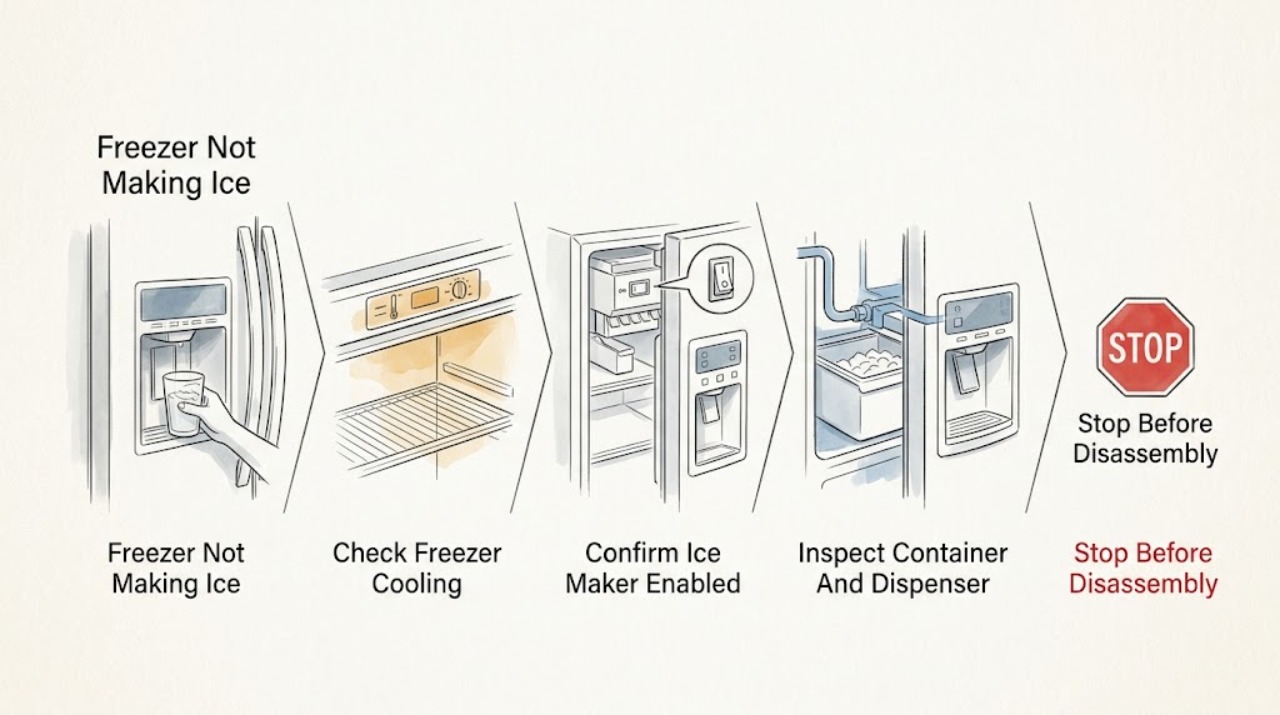
Work through in order
Diagnostic checks
Use only checks that match the exact appliance or system and its official guide.
-
Check 1
Check the freezer display, temperature alarm, and the condition of stored food without leaving the door open unnecessarily. Confirm that the freezer is actually cold and that no recent power interruption, long-open door, or large fresh-food load explains a temporary temperature rise.
Expected result: The freezer is warm or showing an alarm, or it is cold while only ice production is missing.
Next step: If warm, follow the Bosch freezer cooling checks and keep the door closed; if cold, continue with the ice-maker and water checks. Record any alarm symbol without guessing its meaning.
Stop if: Stop if food has thawed and follow current food-safety guidance; do not use this troubleshooting article to decide whether questionable food is safe.
Why this matters
Why: An ice maker cannot complete its cycle reliably when the freezer is too warm. If the compartment is cold, focus on the ice-maker status and water path rather than general cooling.
-
Check 2
Use the appliance control panel or the matching Bosch manual to confirm that the ice maker is enabled. Look for the model's ice-maker indicator and note whether the control responds normally.
Expected result: The ice maker was switched off, the indicator confirms it is on, or the control will not enable it and shows a lock or fault indication.
Next step: Enable it using the exact manual procedure and allow the documented time for production. If it cannot be enabled or a fault remains, record the indicator and arrange service.
Stop if: Do not bridge the ice-maker switch, force a control, or open the control housing.
Why this matters
Why: An off ice maker will not produce ice. A control that will not enable it may indicate panel lock, a model-specific mode, or a fault rather than a water-supply problem.
-
Check 3
Remove and reseat the ice-cube container only as the manual shows. Check for cubes frozen together, an overfilled bin, or a visible obstruction at the dispenser opening; use only the blunt, model-approved method for a reachable obstruction.
Expected result: The container was not fully seated, cubes are clumped or jammed, or the container is correctly seated and empty.
Next step: Correct the seating or clean the container as directed, then allow a normal cycle. If the bin repeatedly freezes together or the obstruction is behind a cover, arrange service.
Stop if: Never use a knife, screwdriver, drill, or other sharp tool to break ice or reach the auger, chute, or internal mechanism.
Why this matters
Why: A mis-seated container or clumped ice can prevent dispensing and may make an operating ice maker appear not to work. An empty, correctly seated container moves the diagnosis toward filling and water delivery.
-
Check 4
For a plumbed model, inspect the accessible water line behind or below the appliance for a kink, visible leak, or closed shut-off valve. If the model uses a water filter, check its installation/status indicator and follow the manual before removing or replacing it.
Expected result: The line is kinked, the shut-off is closed, a filter indicator is active, there is a leak, or the visible connection looks normal.
Next step: Correct only a clearly visible kink or manual-approved valve position without moving a built-in appliance. Follow the manual for filter handling; arrange a plumber or appliance service for leaks, damaged tubing, or uncertain water pressure.
Stop if: Do not loosen a pressurized connection, disconnect tubing, or continue if water is reaching electrical parts.
Why this matters
Why: No water or restricted flow prevents the ice maker from filling. A leak or damaged connection is a service/water-safety issue; a normal visible path does not prove that an internal valve or pressure condition is healthy.
-
Check 5
After enabling the ice maker or correcting a simple container/water-path issue, close the freezer and allow the cycle/refill period stated in the model manual. Note whether the first batch is small, misshapen, or absent and whether the freezer remains at its normal operating temperature.
Expected result: Ice production resumes after the waiting period, or no ice is made despite a cold freezer, enabled ice maker, seated container, and apparently normal visible water connection.
Next step: If production resumes, monitor for repeat failure. If it does not, record the exact model, indicators, and checks and move to qualified service rather than attempting internal tests.
Stop if: Do not repeatedly power-cycle the appliance or run an undocumented diagnostic sequence.
Why this matters
Why: Recovery after a wait points to a delayed start, recent dispensing demand, or temporary interruption. No production after the documented period makes a valve, filter, sensor, inlet path, or ice-maker fault more likely.
-
Check 6
Record the complete Bosch model/E-Nr, whether the freezer is cold, ice-maker status, container position, water/filter observations, fault or alarm symbols, recent power or water interruption, and how long the ice maker has been enabled.
Expected result: A fault indicator persists, the ice maker has no water after the documented checks, the inlet path repeatedly freezes, there is a leak, or no ice appears after the model's cycle time.
Next step: Arrange Bosch or qualified appliance service and provide the record. If the visible water connection itself is at fault, use a qualified plumber or appliance technician as appropriate.
Stop if: Stop using the appliance and isolate power/water when safe if there is a leak near electrical parts, damaged wiring, smoke, burning odor, or a damaged power cord.
Why this matters
Why: The remaining possibilities include an inlet valve, filter/pressure issue, sensor, wiring, motor, or ice-maker control fault that cannot be confirmed safely from visible checks.
Use your observations
Decision map
Find the observation that best matches what you see, then follow the next safe action.
-
PATH 01Next step
What you see
The freezer is warm or its temperature alarm remains active.
Do this next
Follow the Bosch freezer cooling checks for power, setting, door, airflow, and frost, then arrange service if temperature does not recover.
Why this path and its safety boundary
Why it matters: The ice maker may be unable to complete a cycle because the compartment is not cold enough; the root problem is broader than ice production.
-
PATH 02Next step
What you see
The ice maker indicator shows that the feature is disabled.
Do this next
Enable it using the exact model manual and wait for the documented production period before judging the result.
Why this path and its safety boundary
Why it matters: The appliance is not being asked to make ice.
-
PATH 03Next step
What you see
The container is not seated, cubes are clumped, or a visible dispenser obstruction is present.
Do this next
Reseat or clean the container as directed and use only the manual-approved blunt method for a reachable jam. Arrange service for repeated clumping or inaccessible ice.
Why this path and its safety boundary
Why it matters: Ice may be produced but blocked from dispensing, or the mechanism may not be able to complete its cycle.
-
PATH 04Next step
What you see
The ice maker is enabled and the freezer is cold, but the accessible water line is kinked, the valve is closed, or a filter indicator is active.
Do this next
Correct only a visible kink or manual-approved valve/filter condition. Use qualified help for leaks, pressure problems, or any connection that must be opened.
Why this path and its safety boundary
Why it matters: The ice maker may not be receiving enough water to fill its mold.
-
PATH 05Next step
What you see
The freezer is cold, the ice maker is enabled, the container is seated, and no ice appears after the model's documented cycle/refill period.
Do this next
Record the symptom and arrange Bosch or qualified appliance service; do not remove panels or energize the mechanism for testing.
Why this path and its safety boundary
Why it matters: A water inlet, filter, sensor, motor, wiring, or ice-maker control fault is more likely than a simple delay.
-
PATH 06Next step
What you see
Water leaks near electrical parts, the cord or wiring is damaged, there is smoke/burning odor, or the appliance repeatedly trips power.
Do this next
Stop using the appliance. Close the water shut-off if it can be reached safely, isolate power without touching water or damaged wiring, and arrange qualified service.
Why this path and its safety boundary
Why it matters: This is a safety hazard, not a routine ice-maker adjustment.
Helpful context
Understand the symptom
First identify what has stopped: the ice maker may be off, the freezer may be too warm, the water path may be empty or restricted, or ice may be present but unable to leave the container. Bosch's support guidance treats these as separate checks, and the exact controls depend on the appliance model. A freezer that is also warm needs cooling diagnosis before the ice maker itself is blamed.
Use the model manual before changing a setting, removing a filter, or handling a water connection. Check only visible and user-accessible items: ice-maker status, container seating, freezer temperature indication, water line condition, accessible shut-off position, and any alarm or fault symbol. Do not pull panels, probe the inlet valve, or bypass an ice-maker switch.
After an ice maker is switched on or a large amount of ice is dispensed, production is not immediate; wait for the model's documented cycle or refill period. If the freezer stays cold but the ice maker never fills, the water path, filter, valve, sensor, or ice-maker assembly may need service. Protect food during any cooling fault and stop for leaks, damaged wiring, or an electrical smell.
Safety boundary
Stop conditions
- Do not remove covers, bypass the ice-maker switch, energize an exposed mechanism, or make electrical measurements as a home troubleshooting step.
- Do not use sharp tools to break ice or reach the auger, feeder tube, mold, wiring, or inlet path.
- Do not loosen a pressurized water connection or continue when water is near electrical parts.
- Stop immediately for a damaged cord or wiring, smoke, burning odor, arcing, repeated power trips, or suspected refrigerant damage.
- Protect frozen food during a cooling fault and follow current food-safety guidance for food that has thawed; do not refreeze food solely because the ice maker begins working again.
When checks do not resolve it
Need a professional?
Arrange Bosch or qualified appliance service when the ice maker cannot be enabled, the freezer remains warm, no ice appears after the model's documented cycle, water does not reach the maker, a filter/pressure or leak problem persists, an error indicator remains, or any electrical or water hazard is present.
Have this ready
- Complete Bosch model/E-Nr, freezer temperature/alarm behavior, ice-maker status, container and dispenser observations, water-line/filter condition, recent power or water interruption, and elapsed time since enabling or last ice production.
Common questions
FAQ
Why is my Bosch freezer not making ice?
Check whether the ice maker is enabled, the freezer is cold, the ice container is seated, and the visible water line/filter path is normal. A new or recently emptied ice maker may need the model's documented production time.
How do I turn on the Bosch ice maker?
Use the control panel and exact instruction manual for the model. Bosch manuals use model-specific controls, so do not copy a button sequence from another freezer.
How long should a Bosch ice maker take to make ice?
Allow the production or refill period stated for the model. Bosch support and one Bosch instruction manual describe a substantial wait after enabling the maker or dispensing a large amount; judge it only after the model's documented time has passed.
Can a warm freezer stop the Bosch ice maker?
Yes. Bosch troubleshooting lists excessive freezer temperature as a reason for ice-maker failure. Check the freezer cooling problem first, including power, setting, door, ventilation, and frost, then arrange service if it remains warm.
When should I call for Bosch ice-maker service?
Call when no ice appears after the model-specific wait despite a cold freezer and enabled maker, a fault indicator persists, water does not reach the maker, a line leaks or repeatedly freezes, the container cannot be reseated, or electrical damage is present.
Read the exact guide
Official sources
- Bosch instruction manual 8001076170_FBosch Home Appliances · This official manual is a model-specific example, not a universal Bosch procedure. Its ice-maker troubleshooting lists ice-maker status, water supply, freezer temperature, startup/refill time, water pressure, filter condition, container seating, and water-line issues.
- Freezer repair | Freezer TroubleshootingBosch Home Appliances · Bosch distinguishes routine user-guide checks from more serious freezer problems that require professional Bosch assistance.
- Common Freezer problemsBosch Home Appliances · Bosch's general freezer guidance covers a freezer not running, excessive frost, and a freezer that is too warm, and recommends checking the supply, door, thermostat, and owner's manual.
- Bosch Refrigeration Error CodesBosch Home Appliances · Bosch's error-code page shows that some refrigeration displays identify ice-maker or ice-water-control faults and directs unresolved errors to Bosch support; exact codes remain model and market specific.
- Fridge is not making iceBosch Home Appliances · Bosch's support page covers an ice maker being switched off, water-supply connection, the time needed after enabling or dispensing, container access, appliance leveling, and model-specific manuals.
Community feedback
Share a repair observation
Share a plain-text repair observation. Accepted observations are published automatically; this page may take a moment to update.