
On this page
Start here
Quick answer
First separate a freezer ice maker that is not producing cubes from an ice dispenser that cannot deliver cubes. Confirm that your Frigidaire freezer model actually includes an ice maker, that it is switched on, that its signal arm or model-specific control is in the ON position, that the water valve is open, and that the supply line is not kinked. Frigidaire says a newly installed unit may need several hours to cool and up to 24 hours to begin making ice, while air in new plumbing can cause a few empty cycles. If the freezer is too warm, the filter is restricted, water flow is slow, the bin or auger is jammed, or the unit still makes no ice after the model-specific checks, stop guessing at parts and arrange qualified service.
Before you begin
Safety first
- The reader may check normal controls, visible water-line routing, bin seating, door seal, vents, and the exact manual's filter procedure. Do not open sealed cooling systems, probe live wiring, bypass the ice-maker control, force the tray or auger, or disconnect a pressurized line.
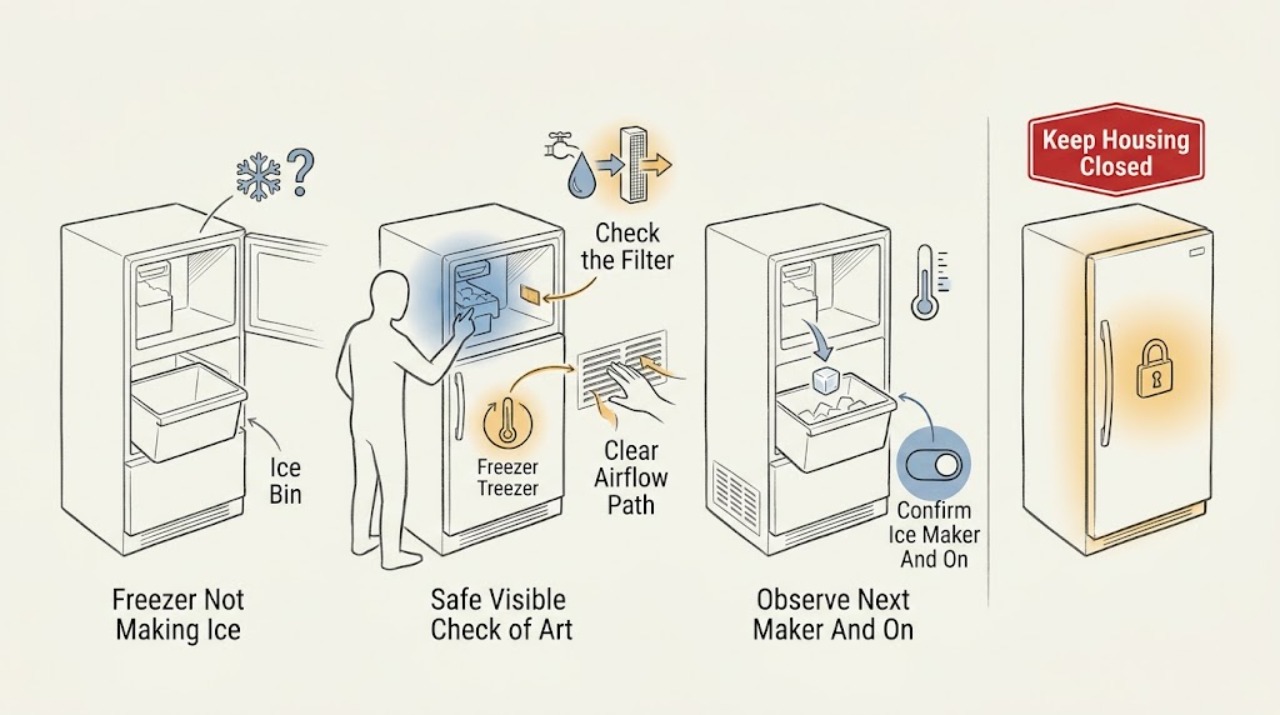
Work through in order
Diagnostic checks
Use only checks that match the exact appliance or system and its official guide.
-
Check 1
With the freezer door open only as long as needed, confirm from the model manual or visible factory controls that this freezer has an ice maker. Check that the ice-maker control is ON and, on models with a wire signal arm, that the arm is down in the ON position; make sure the ice bin is seated under the maker.
Expected result: The freezer has no ice maker, the control or signal arm is OFF, the bin is missing or mis-seated, or the ice maker is ON with a correctly seated bin.
Next step: Correct only the documented ON position and bin seating, close the door, and continue to the water and temperature checks if no ice is produced. Do not force the arm or tray.
Stop if: Stop for a cracked ice-maker housing, exposed wiring, a jammed mechanism that resists ordinary movement, or any need to remove panels or bypass a control.
Why this matters
Why: A freezer without an installed ice maker cannot produce ice, and an OFF arm/control or mis-seated bin can prevent production or make the maker stop. An ON state with no cubes shifts the check to water, temperature, installation, or an ice-maker fault.
-
Check 2
Inspect the visible water supply connection and line without pulling the appliance. Confirm the water valve is open and the line is not kinked; if the refrigerator/freezer has a water filter, check its status and the dispenser flow using the model's normal controls.
Expected result: The valve is closed, the line is kinked, dispenser water is slow or absent, the filter is overdue or restricted, or water flow is normal.
Next step: Open the valve or straighten only an accessible gentle kink if the installation manual permits it. Replace a filter only with the exact model-approved procedure and then allow the ice maker time to cycle; arrange service if flow remains absent or a line connection leaks.
Stop if: Do not disconnect a pressurized line, force a fitting, pull out the appliance, bypass a filter, or continue if there is a leak or damaged tubing.
Why this matters
Why: Frigidaire links poor ice production to a kinked supply line, a clogged or overdue filter, and slow or absent water flow. Normal water flow makes the supply path less likely but does not prove that the inlet valve or ice-maker fill path works.
-
Check 3
Read the freezer temperature setting and observe whether the freezer is actually cold, the door closes and seals, vents are blocked, or heavy frost is restricting airflow. Adjust only the normal temperature control as the manual allows and avoid repeatedly opening the door.
Expected result: The freezer is warmer than its normal setting, the door does not seal, food blocks vents, frost is excessive, or the freezer is cold with clear airflow.
Next step: Correct only visible loading or door-seal issues and allow the freezer to stabilize before judging production. Do not chip frost with a sharp tool or dismantle the cooling system; request service if the freezer cannot maintain temperature.
Stop if: Stop for a damaged seal, heavy frost that requires defrosting beyond the model procedure, exposed refrigerant tubing, abnormal heat, smoke, or any electrical fault.
Why this matters
Why: Frigidaire says a freezer set too warm can reduce ice production and recommends allowing time for temperature stabilization after a change. A poor seal, blocked airflow, or heavy frost can make the compartment too warm; a cold, unobstructed freezer shifts attention back to water and ice-maker operation.
-
Check 4
If the freezer was newly installed, recently connected to water, or recently unplugged, record when it reached operating temperature and whether the water system was primed according to the exact manual. Keep the doors closed as much as practical while the unit stabilizes.
Expected result: The unit is within its initial cooling or plumbing period, several empty cycles occurred, the supply was never primed, or the freezer has been stable well beyond that period with no ice.
Next step: Follow the model's water-priming and first-ice instructions, discard initial ice if the manual says to do so, and reassess only after the documented stabilization period. Continue to service if the maker remains inactive.
Stop if: Do not run the ice maker without a connected water supply when the model warns this can make the fill valve chatter, and do not repeatedly cycle an unprimed or leaking system.
Why this matters
Why: Frigidaire says air in new plumbing can cause two or three empty ice cycles and that the freezer may need several hours to cool before ice production begins, with up to 24 hours cited for initial production. No ice after a stable, correctly connected installation is not explained by startup time alone.
-
Check 5
If the bin contains cubes but the dispenser delivers none, check that the display is not locked, the door is fully closed, and the bin is seated. Remove the bin only as the model instructions allow and look for cubes frozen together or jammed around the auger; do not rotate the auger by force.
Expected result: The bin is empty, cubes are fused or jammed, the display is locked, the bin is mis-seated, or the bin contains loose cubes but dispensing still fails.
Next step: Unlock the display or reseat the bin only by the model instructions, thaw and dry a confirmed jam without sharp tools, then test normal dispensing. If the bin contains ice but the drive still fails, arrange service rather than forcing the auger.
Stop if: Do not put hands near a moving auger, chip ice with a sharp object, rotate the auger to make the bin fit, or continue if the door cannot close.
Why this matters
Why: Frigidaire identifies display lock, a missing bin, door position, and ice jam after melting/freezing cycles or power outages as dispenser causes. This branch does not prove that the ice maker is failing; an empty bin returns the diagnosis to production, water, and temperature.
-
Check 6
After the documented ON, water, temperature, and startup checks are correct, close the freezer and observe whether a new cycle produces cubes during the model's normal interval. Record whether the ice maker is silent, fills with water but does not freeze/eject, or produces cubes intermittently.
Expected result: Ice production resumes, the maker never fills, water enters but cubes are not harvested, or production remains absent after a stable freezer and supply path.
Next step: Keep the appliance in normal operation if production is restored. If production remains absent, provide the model and recorded observations to qualified appliance service instead of replacing a part by symptom alone.
Stop if: Stop for repeated clicking or chattering, water leakage, exposed wiring, abnormal heat, a damaged ice maker, or any need to bypass or electrically test components.
Why this matters
Why: Resumed production supports an installation, setting, water-flow, or stabilization cause. No fill, no harvest, or persistent failure requires separating the inlet valve, ice-maker assembly, thermostat/sensor, and control diagnosis; these cannot be confirmed from the bin alone.
Use your observations
Decision map
Find the observation that best matches what you see, then follow the next safe action.
-
PATH 01Safety boundary
What you see
The freezer model does not include an ice maker or it was never installed.
Do this next
Use the exact model documentation to determine whether an approved ice-maker installation exists; do not improvise water or electrical connections.
Why this path and its safety boundary
Why it matters: No ice production is expected from the freezer without the model-approved ice-maker installation.
Safety stop: Stop if installation would require modifying cabinet, water, or electrical systems without qualified help.
-
PATH 02Safety boundary
What you see
The ice maker is OFF, the signal arm is up where applicable, or the bin is not seated correctly.
Do this next
Set ON and seat the bin only as the exact model instructions show, then allow normal production time.
Why this path and its safety boundary
Why it matters: The maker may be intentionally disabled or unable to operate its shutoff position.
Safety stop: Do not force the arm, tray, or bin into position.
-
PATH 03Safety boundary
What you see
The supply valve is closed, the line is kinked, dispenser flow is slow or absent, or the filter is overdue/restricted.
Do this next
Correct the accessible supply condition or replace the exact approved filter, then reassess after the model's normal cycle period.
Why this path and its safety boundary
Why it matters: The ice maker may not be receiving enough water even though its control is ON.
Safety stop: Stop for leaks, damaged tubing, a pressurized connection, or any need to disconnect the water line.
-
PATH 04Safety boundary
What you see
The freezer is not maintaining its normal cold condition, the door seal is poor, vents are blocked, or frost restricts airflow.
Do this next
Correct visible loading or door issues and allow stabilization; arrange service if cooling remains inadequate.
Why this path and its safety boundary
Why it matters: Ice production can slow or stop because the compartment is not reaching the required operating condition.
Safety stop: Do not chip frost with sharp tools or open sealed cooling components.
-
PATH 05Safety boundary
What you see
The freezer is newly installed, recently connected or primed, or recently recovered from a power interruption.
Do this next
Follow the exact model's prime and startup instructions, keep doors closed, and reassess after the documented initial period.
Why this path and its safety boundary
Why it matters: Air in the plumbing and temperature stabilization can account for initial empty cycles.
Safety stop: Do not run the maker without water when the model warns of valve chatter, and stop for a leak.
-
PATH 06Safety boundary
What you see
The bin contains ice but the dispenser does not deliver it.
Do this next
Follow the model-safe bin and jam check; service the dispenser path if loose ice still will not dispense.
Why this path and its safety boundary
Why it matters: A display lock, bin position, door state, or auger jam may be blocking dispensing even though production works.
Safety stop: Do not force or rotate the auger, put hands near moving parts, or run the dispenser continuously.
-
PATH 07Safety boundary
What you see
The ice maker is ON, the bin is seated, water and temperature are normal, startup time has passed, and no cubes are produced.
Do this next
Keep the freezer operating normally and arrange qualified service with the model and observed fill/harvest behavior.
Why this path and its safety boundary
Why it matters: An ice-maker, inlet-valve, sensor, control, or internal water-path fault remains unconfirmed.
Safety stop: Do not bypass controls, jumper wiring, force a harvest cycle, or replace an assembly without model-specific diagnosis.
Helpful context
Understand the symptom
Start with production, not dispensing
If the ice bin is empty, the ice maker, water path, temperature, or installation state is the focus. If cubes are present but do not come out, the dispenser may be locked or the auger may be jammed; that is a different branch. Do not keep pressing a dispenser paddle or dismantle the ice maker before confirming which symptom you have.
Give a new or recently powered freezer time
Frigidaire says a new installation can have air in the plumbing and produce a few empty cycles. After the freezer has cooled for several hours, ice may begin within 24 hours, and a newly installed system may take longer to fill the bin. If the freezer was recently unplugged or lost power, allow the temperature to stabilize before judging production.
Keep model differences visible
Not every top-freezer model includes an ice maker, and controls vary. The wire signal arm and ON/OFF control described by Frigidaire apply only where that hardware is installed. Use the exact model manual for electronic controls, filter access, and any test or harvest procedure; do not force a tray or bypass a thermostat, sensor, or shutoff arm.
Safety boundary
Stop conditions
- Do not probe live wiring, bypass an ice-maker shutoff arm or sensor, force a harvest cycle, or open sealed cooling components.
- Do not disconnect a pressurized water line, pull the appliance out alone, or continue after a leak or damaged tubing is found.
- Do not chip frozen ice with a sharp tool, force the tray or bin, or rotate the auger to make a mis-seated bin fit.
- Stop for burning odor, abnormal heat, smoke, exposed wiring, repeated electrical trips, or a freezer that is losing its safe cold condition.
- Do not assume a dispenser jam means the ice maker is not producing, or assume an empty bin proves a failed ice-maker assembly before checking ON state, water, temperature, and startup time.
Only after diagnosis
Potential parts
- Frigidaire water filter
Consider this category only when the exact model's filter is overdue or restricted and water flow is slow or absent during the documented check.
Confirm the exact model and approved filter specification; follow the manual's installation and flushing procedure and do not use a filter replacement to hide a kinked or leaking line. - ice-maker assembly
Consider this category only after service or model-specific diagnosis confirms that the ice maker does not fill or harvest despite normal temperature, water supply, and control state.
Confirm the exact freezer model, connector, mounting, and control arrangement before ordering; do not force a generic assembly or bypass its shutoff mechanism. - ice-maker water inlet valve
Consider this category only when service confirms that the ice-maker water-valve path fails after the supply line and filter checks are normal.
Confirm the exact model and valve configuration; water-line and electrical access should follow the model manual or be handled by qualified service.
When checks do not resolve it
Need a professional?
Arrange qualified service when the freezer remains at its normal condition but produces no ice after the exact startup period and accessible checks, when the maker never fills or harvests, water leaks, the freezer cannot cool, or diagnosis would require panels, wiring, refrigerant, or internal water-valve access.
Safety scope: The reader may check normal controls, visible water-line routing, bin seating, door seal, vents, and the exact manual's filter procedure. Do not open sealed cooling systems, probe live wiring, bypass the ice-maker control, force the tray or auger, or disconnect a pressurized line.
Have this ready
- Frigidaire model and serial details and whether the unit is a top-freezer refrigerator, standalone freezer, or another configuration
- Whether an ice maker is installed, its ON/OFF or signal-arm state, and whether the bin is empty or contains cubes
- Freezer temperature condition, door-seal or frost observations, water-flow and filter result, and any recent installation or power interruption
- Whether the maker fills, harvests, clicks, chatters, leaks, or remains silent
Common questions
FAQ
Why is my Frigidaire freezer not making ice?
Check that an ice maker is installed and ON, the bin is seated, the water valve is open, the line is not kinked, the filter is not restricting flow, and the freezer is cold enough. A new installation may need several hours to cool and up to 24 hours to begin making ice.
How long does a new Frigidaire freezer ice maker take to make ice?
Frigidaire says a newly installed freezer may need several hours to cool and can produce ice within 24 hours; air in new plumbing can cause two or three empty cycles. Use the exact model's priming instructions and allow stabilization before judging a new installation.
How do I turn on a Frigidaire top-freezer ice maker?
On models with the described wire signal arm, Frigidaire says to confirm the water valve is open, seat the ice bin, and lower the arm to its ON position. Other models may use an electronic control, so follow the exact manual and do not force the arm or tray.
Could a warm freezer stop a Frigidaire ice maker?
Yes. Frigidaire says a freezer set too warm can reduce ice production. Check the normal temperature setting, door seal, blocked vents, and heavy frost; allow temperature stabilization after a setting or power change and arrange service if the freezer cannot stay cold.
What if my Frigidaire freezer has ice but will not dispense it?
That is a dispenser branch rather than proof that the ice maker is not producing. Check the display lock, door closure, bin seating, and a fused ice jam as the model instructions allow. Do not force or rotate the auger; service is appropriate if loose cubes still will not dispense.
Read the exact guide
Official sources
- Freezer - Not Freezing or Not CoolingFrigidaire · Frigidaire standalone freezers and refrigerators with freezers when cooling condition may affect ice production
- Refrigerators - How do I use my ice maker in my Top-Freezer refrigerator?Frigidaire · Frigidaire top-freezer refrigerator/freezer models with the described wire-arm ice maker
- What should I do if my ice maker is not making enough ice in my refrigerator?Frigidaire · Frigidaire refrigerators with freezers, including top-freezer models; exact model manual controls model-specific behavior
- What should I do if the dispenser on my refrigerator is not dispensing ice?Frigidaire · Frigidaire refrigerator/freezer models with an ice dispenser; this is a dispensing branch, not proof of ice-maker production failure
- My refrigerator was just installed and the ice maker is not working, how do I fix it?Frigidaire · Frigidaire refrigerator/freezer models after installation or water connection; top-freezer models use their specific instructions
Community feedback
Share a repair observation
Share a plain-text repair observation. Accepted observations are published automatically; this page may take a moment to update.