
On this page
Start here
Quick answer
If a GE freezer is not making ice, first confirm that the icemaker is turned on, the freezer is cold enough, and the water supply and filter are not restricting flow. Check that the feeler arm or paddle can move and that clumped cubes are not blocking the mold or bin. A newly installed icemaker may need time to reach its cycling temperature. If the icemaker remains inactive after these model-specific checks, a fill tube is frozen, an internal connection is suspect, or the problem returns after a reset, stop forcing parts and arrange GE-authorized service.
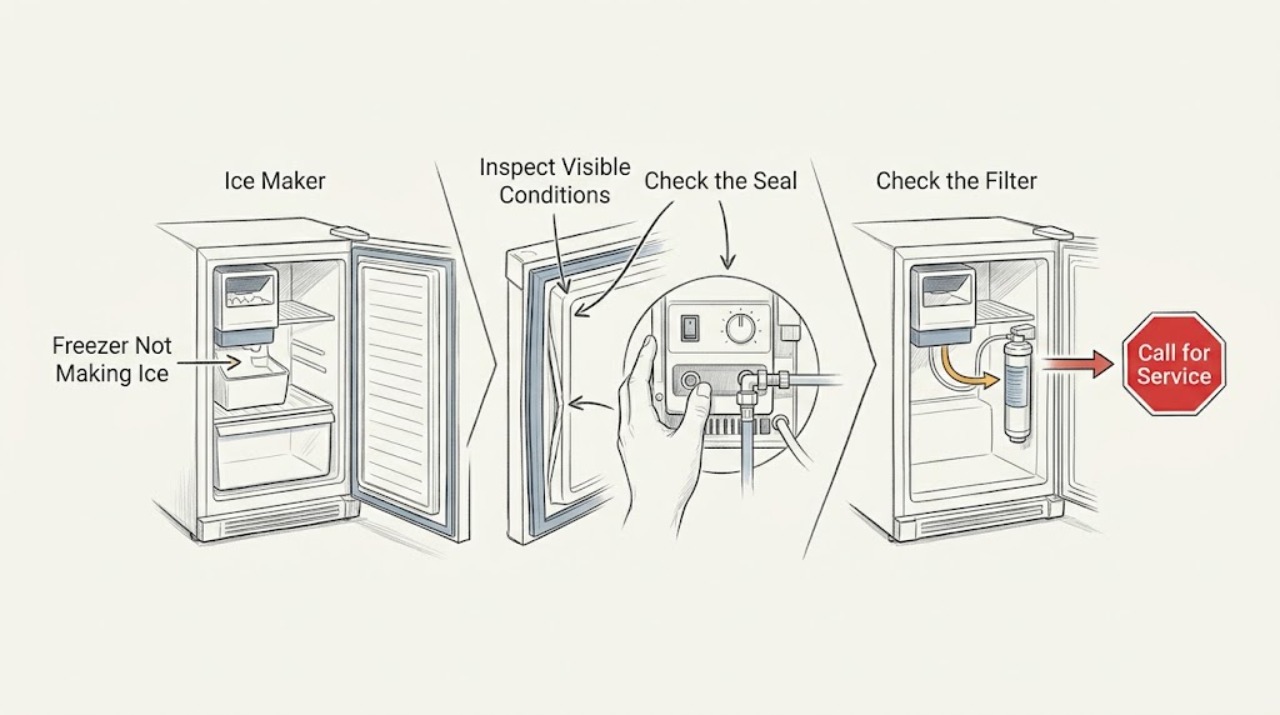
Work through in order
Diagnostic checks
Use only checks that match the exact appliance or system and its official guide.
-
Check 1
Check the model's icemaker control, switch, or freezer control panel and confirm that the icemaker is On. Look for a normal indicator or display response, and make sure the appliance has household power without opening electrical covers.
Expected result: The icemaker is Off or has no power indication, or it is On and the panel responds normally.
Next step: Enable the icemaker using the documented model procedure and allow it to cycle. If the appliance has power but the icemaker remains unresponsive, stop at the external check and request service rather than bypassing a control.
Why this matters
Why: An Off setting or missing appliance power can make a working icemaker appear failed. A powered, enabled icemaker moves the diagnosis toward temperature, water delivery, the mold, or the ejector mechanism.
-
Check 2
Check the freezer temperature display or the model's documented setting, and note whether the compartment is holding food at a stable frozen temperature. If the freezer is warmer than expected, inspect only the door seal and loading arrangement for an obvious obstruction and follow the manual before changing the setting.
Expected result: The freezer is too warm or unstable, or it is at the documented setting and remains consistently cold.
Next step: Correct only an accessible door or loading issue and allow the freezer to stabilize before judging ice production. If it cannot hold temperature, stop treating this as an icemaker-only fault and arrange refrigerator/freezer service.
Why this matters
Why: GE states that the icemaker will take longer or may not make ice when the freezer is too warm. A consistently cold freezer makes a water, control, filter, or ejector issue more likely.
-
Check 3
Check that the refrigerator's water supply valve is open and that the visible supply line is not kinked. If a water filter is fitted, use the model instructions to confirm it is seated correctly and replace it only with the specified filter; do not disconnect a pressurized line to test it.
Expected result: The supply is off or restricted, the filter is overdue or incorrectly seated, or water supply and filter conditions appear normal.
Next step: Restore the valve or reseat/replace the filter using the manual, then allow the system to refill. If flow remains absent or a line leaks, turn off the water supply and arrange service; do not loosen internal fittings.
Why this matters
Why: GE identifies a clogged filter as a restriction on water flow to the icemaker and says the water supply must be on. A normal visible supply shifts attention to the fill valve, internal line, or icemaker control.
-
Check 4
With the icemaker off and the bin safely accessible, look for clumped cubes in the bin or cubes lodged in the mold or ejector rake. Move only loose cubes by hand when the appliance is safe to handle; never force the rake, use a sharp tool, or bypass the feeler arm or paddle.
Expected result: Cubes are blocking the rake, mold, or feeler arm, or the mold is empty and the ejector path is clear.
Next step: Remove only loose obstruction as the model manual allows, restore the documented icemaker setting, and observe one cycle. If the rake will not move normally or the obstruction is frozen in place, leave it alone and request service.
Why this matters
Why: GE says clumped ice can prevent the feeler arm from operating and that a stuck ejector rake prevents the cycle from completing. An empty, unobstructed mold points more strongly to water delivery, temperature, power, or an internal icemaker fault.
-
Check 5
If the icemaker was recently installed, confirm from the manual that its electrical connector and fill cup are installed and that the water connection was completed. If the mold is empty on an older installation, do not remove the icemaker to investigate a suspected frozen fill tube; record whether the water dispenser works and give that information to service.
Expected result: The unit is newly installed or the mold remains empty; the water dispenser works normally or also has poor/no flow.
Next step: For a new installation, complete only the documented connections and allow the stated initial waiting period. For a persistent empty mold or suspected frozen tube, stop user-level checks and arrange service.
Why this matters
Why: GE notes that a new icemaker needs time to reach its cycling temperature and that a missing connection can prevent operation. GE also says a frozen fill tube requires icemaker removal to verify, while dispenser behavior helps distinguish a broader water issue.
Use your observations
Decision map
Find the observation that best matches what you see, then follow the next safe action.
-
PATH 01Next step
What you see
The icemaker is Off, the freezer has no normal power indication, or the panel does not respond.
Do this next
Check the plug and household supply from a dry, safe position and enable the icemaker using the model manual. If power is present but the icemaker remains inactive, request service without opening covers.
-
PATH 02Next step
What you see
The freezer is warmer than its documented setting or temperature is unstable.
Do this next
Address only the visible door, loading, and setting checks in the manual and allow the compartment to stabilize. If it remains warm, request freezer service before diagnosing the icemaker further.
-
PATH 03Next step
What you see
The water valve is off, the filter restricts flow, or the dispenser also has poor/no water flow.
Do this next
Restore the documented supply or filter condition. If flow is still absent, a line leaks, or the filter bypass/connection is unclear, shut off water if safe and request service.
-
PATH 04Next step
What you see
Clumped cubes or a stuck ejector rake blocks the mold or feeler arm.
Do this next
Remove only loose ice as the manual permits. Do not pry, heat, or force the mechanism; if the cubes are frozen in place or the rake remains stuck, arrange service.
-
PATH 05Next step
What you see
The icemaker is enabled, the freezer is cold, visible water conditions are normal, and the mold remains empty or no ice is produced.
Do this next
Leave the icemaker in the safe state specified by the manual and request GE-authorized service. Do not remove the icemaker, thaw an internal fill tube, or bypass the feeler arm yourself.
Helpful context
Understand the symptom
“GE freezer not making ice” usually refers to a bottom-freezer refrigerator or an optional freezer icemaker. The controls and connections vary by model, so identify whether the icemaker is completely silent, has an empty mold, has frozen cubes that will not eject, or has water but no finished cubes. Use the exact model manual whenever a switch, arm, filter, or display differs from the description below.
Do not pry frozen cubes with a sharp tool, bypass the feeler arm, force a stuck rake, or remove the icemaker to thaw a fill tube. Before handling the bin, filter, or an accessible connection, turn the appliance controls off as the manual directs and keep hands dry. Water-line and internal electrical work belong with a qualified technician.
Only after diagnosis
Potential parts
- GE icemaker assembly
Consider this only after service testing confirms that the icemaker assembly itself fails to cycle or eject; an empty mold can also result from temperature or water-delivery faults.
Confirm the complete GE model and the manufacturer's fit information before ordering any component. - GE water inlet valve or fill-tube component
Consider this only if service confirms that the freezer is cold and enabled but water is not reaching the mold because of a valve or fill-path fault.
Do not infer compatibility from a similar-looking part; use the full model identification and authorized parts information. - GE refrigerator water filter
Consider a filter replacement only when the exact model uses a filter and testing or service indicates restricted flow; do not use an unspecified filter or bypass arrangement.
Match the exact model and documented filter specification before replacement.
When checks do not resolve it
Need a professional?
Arrange service when the GE icemaker remains inactive after the power, temperature, filter, water-supply, and accessible mold checks, or when internal removal would be needed to verify a frozen fill tube or electrical fault.
Have this ready
- Provide the full refrigerator/freezer model number, whether the icemaker is On, the freezer temperature behavior, whether the mold is empty or contains stuck cubes, filter age or recent replacement, water-dispenser flow, any leak, and whether the unit is newly installed.
Common questions
FAQ
Why is my GE freezer not making ice?
Confirm the icemaker is On, the freezer is cold enough, the water supply and filter are not restricted, and the mold or feeler arm is not blocked by clumped ice. If the mold stays empty after those checks, service may be needed.
How cold does a GE freezer need to be for ice production?
GE says ice production depends on the freezer reaching the proper temperature and identifies a warmer freezer as a reason cubes may take longer or not form. Use the exact model manual and display for the correct setting.
Can a GE water filter stop the freezer icemaker?
Yes. GE says a clogged filter can restrict water flow to the icemaker. Confirm the filter type and replacement procedure for the exact model instead of fitting an unspecified filter.
Should I remove the GE icemaker to thaw a frozen fill tube?
No. GE states that removing the icemaker is required to verify a frozen fill tube, so that check should be handled by a service technician.
Read the exact guide
Official sources
- Bottom Freezer Refrigerator - Not Making IceGE Appliances · GE bottom-freezer refrigerator models; control-panel steps vary by model
- Refrigerator - Icemaker Doesn't Fill With WaterGE Appliances · GE refrigerator icemakers; internal fill-tube inspection requires service
- Icemaker - New Installation Tips & TroubleshootingGE Appliances · GE refrigerator icemakers after installation
- Refrigerator - Icemaker Not Producing IceGE Appliances · GE refrigerator icemakers, including freezer-mounted assemblies
Community feedback
Share a repair observation
Share a plain-text repair observation. Accepted observations are published automatically; this page may take a moment to update.