
On this page
Start here
Quick answer
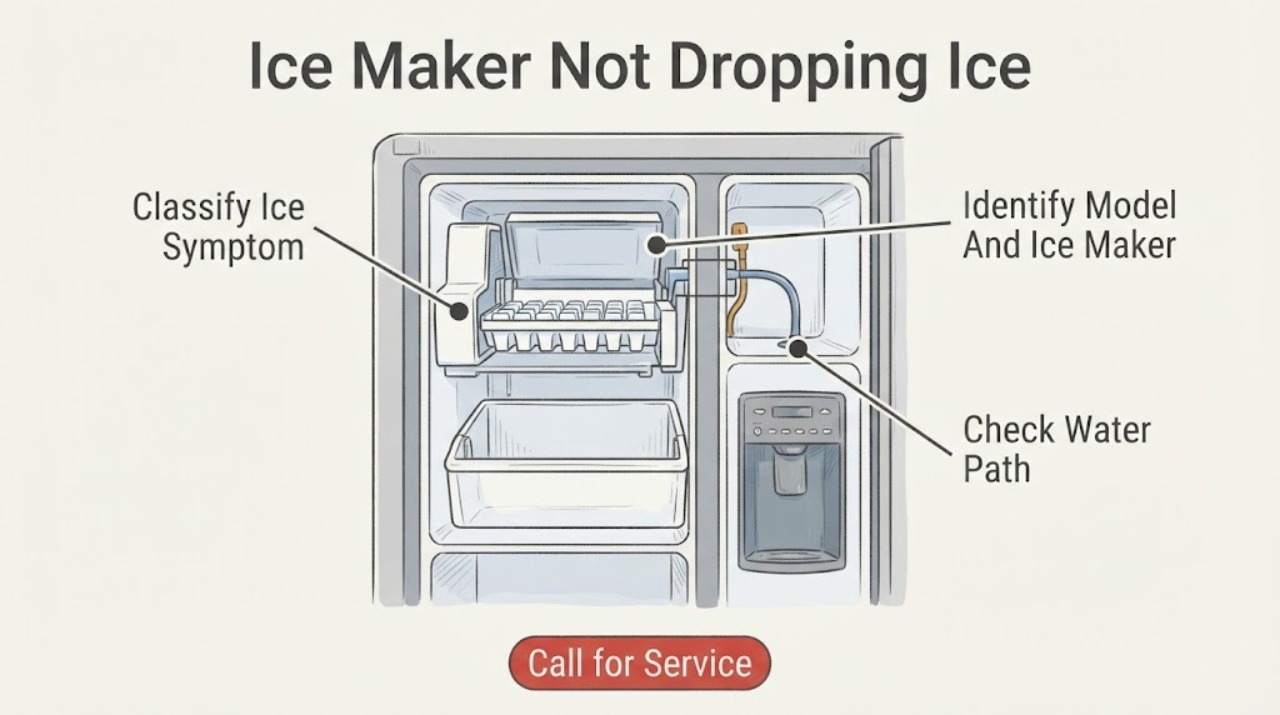
First decide what is missing: no new cubes are forming or leaving the ice-maker tray, or cubes are already in the bin but are not coming through the dispenser. Bosch's official refrigerator guidance says the ice bin must be inserted and aligned correctly, while Bosch manuals for specific refrigerator families also list the ice-maker power/on state, water supply, freezer temperature, water-line kinks, filter condition and bin position as possible checks. Read the complete E-Nr and use the matching manual before changing a control or part. Keep the refrigerator's water and electrical areas dry; if there is a leak, an electrical fault, a visible damaged line, or the model-specific checks do not restore operation, stop and arrange Bosch service.
Work through in order
Diagnostic checks
Use only checks that match the exact appliance or system and its official guide.
-
Check 1
With the refrigerator operating normally, inspect the ice bin from outside its mechanism and record whether it is empty, contains cubes that are stuck together, contains cubes that do not reach the dispenser, or contains no usable tray output.
Expected result: No cubes are being made/released, cubes are present but frozen together, or cubes are present but the dispenser does not deliver them.
Next step: Use the branch that matches the observation and keep hands out of the tray, auger and chute; use the exact manual for any model-specific bin or dispenser procedure.
Why this matters
Why: These observations separate ice-maker production/ejection from bin or dispenser delivery; they do not identify a motor, valve, board or auger failure.
-
Check 2
Read the complete Bosch E-Nr/model and FD information from the rating plate or owner record, then confirm in that manual that the ice maker is switched on and that the ice bin is fully inserted and aligned.
Expected result: The model is known and the ice maker is off, the bin is misaligned, or neither condition is present.
Next step: If the manual shows the ice maker off or the bin misaligned, correct only that documented user-level condition. If the model is unknown or the state is already correct, continue with the external water and freezer checks.
Why this matters
Why: Bosch's official tips state that an incorrectly inserted or aligned ice bin can prevent ice creation, while model manuals document different controls and bin arrangements.
-
Check 3
From outside the appliance, verify that the water supply is on and that the accessible supply hose is not kinked; inspect for a leak without loosening a pressurized connection, and follow the exact manual's filter guidance only if the refrigerator has that filter arrangement.
Expected result: The supply is off, a hose is visibly kinked, a filter alert/condition is documented by the manual, water pressure is reported low, or the path appears normal.
Next step: Restore only the accessible supply condition allowed by the manual. If there is a leak, shut off the water and arrange service; if the path is normal or the problem returns, stop before internal disassembly.
Why this matters
Why: A supply interruption, kink, low pressure or model-documented filter condition can prevent filling, but a normal external path does not prove an internal inlet valve or ice-maker fault.
-
Check 4
Check the freezer temperature display or setting and the freezer door seal/closure from outside; use the exact Bosch manual to decide whether the freezer is too warm for ice production and whether a temperature adjustment is permitted.
Expected result: The freezer is warmer than the model's expected operating condition, the door is not closing/sealing, or the freezer condition appears normal.
Next step: Correct an obvious door obstruction or use only the model manual's temperature setting. If the freezer is not maintaining temperature, protect food and arrange refrigerator service rather than repeatedly cycling the ice maker.
Why this matters
Why: Bosch manuals identify a warm freezer as a possible reason for ice-maker failure or low production, but the symptom alone does not distinguish cooling, airflow or ice-maker components.
-
Check 5
After the exact manual's external checks, record whether the ice maker begins producing/releasing cubes, the dispenser delivers cubes, or the no-ice condition remains; note any displayed refrigeration code such as E02 without treating it as a component diagnosis.
Expected result: The fault remains, an E02/E03 or other error persists, the ice-maker mechanism is jammed internally, or water/electrical damage is visible.
Next step: Keep the water/electrical area safe, shut off water for a leak, and contact Bosch or an authorized servicer. Do not force the ejector, bypass a fill-level device, remove panels or make live measurements.
Why this matters
Why: A persistent or hazardous condition requires model-specific diagnosis; Bosch's current refrigeration error page routes persistent ice-maker and dispenser errors to support.
Use your observations
Decision map
Find the observation that best matches what you see, then follow the next safe action.
-
PATH 01Next step
What you see
The ice bin is empty and the ice maker is off, the bin is not aligned, or the freezer is too warm according to the exact model manual.
Do this next
Correct only the applicable external condition in the matching Bosch manual, then allow the appliance to operate normally; escalate if production does not resume.
Why this path and its safety boundary
Why it matters: A documented user-setting, bin-position or freezer-condition path is more plausible than a confirmed internal ice-maker failure.
-
PATH 02Next step
What you see
The ice maker is on, the bin is aligned, the freezer condition is normal, and the accessible water supply is off, kinked, leaking or documented as low pressure.
Do this next
Use the shut-off valve and model manual for the safe external supply check; shut off water and call service for a leak or a connection that needs disassembly.
Why this path and its safety boundary
Why it matters: The fill path is not confirmed healthy, so the symptom should not be diagnosed as a failed ice-maker motor or control.
-
PATH 03Next step
What you see
Cubes are already in the bin but do not come through the dispenser, while the ice maker continues to make cubes.
Do this next
Use the exact model's dispenser and bin instructions; stop if the chute or drive mechanism is jammed and arrange service rather than forcing it.
Why this path and its safety boundary
Why it matters: The observed problem is dispenser delivery or an ice-bin/chute condition, not proof that the ice maker is failing to drop cubes into the bin.
-
PATH 04Next step
What you see
No model-specific external cause is found, or a refrigeration error persists with a leak, electrical concern or a mechanism that would require internal access.
Do this next
Keep water and electrical hazards controlled and contact Bosch or an authorized servicer with the E-Nr, FD number, exact symptom and any displayed code.
Why this path and its safety boundary
Why it matters: The available official evidence cannot identify a safe user repair or a specific failed component for an unknown Bosch refrigerator.
Helpful context
Understand the symptom
Separate tray/ejection from dispenser delivery
Look at the ice container without reaching into a moving mechanism. If the bin is empty because no cubes are being formed or released from the tray, investigate the ice-maker state, water path and freezer conditions. If cubes are already in the bin but do not come out through the door, the dispenser chute, selection or interface may be the relevant path. The two symptoms do not prove the same failed part.
Use the exact Bosch refrigerator manual
The task has no E-Nr/model. Bosch manuals opened for different refrigerator families show different control layouts and ice-maker instructions. Record the complete rating-plate identity and use its manual for the ice-maker on/off control, bin removal, water-filter procedure and any reset or test function. Do not press a test sequence copied from another Bosch refrigerator.
Keep water and electrical checks external
The documented user-level checks are the accessible water supply, visible kinks, the ice-maker state, freezer temperature and correct ice-bin position. Turn off the water at the shut-off valve before handling an accessible water connection, keep water away from electrical parts, and stop when the manual's next step requires internal access or the condition includes a leak or electrical fault.
When checks do not resolve it
Need a professional?
Call Bosch or an authorized servicer when the ice maker stays inactive after the exact manual's external checks, a leak or electrical fault is present, an error persists, or internal access would be required.
Have this ready
- Provide the complete Bosch E-Nr and FD number, refrigerator region, whether cubes are absent from the tray/bin or only from the dispenser, freezer condition, water-supply observations and any displayed error.
Common questions
FAQ
Why is my Bosch ice maker not dropping ice?
First establish whether no cubes are being made or released into the bin, or whether cubes are already in the bin but are not being dispensed. Bosch's documented checks include the ice-maker on/off state, correctly aligned bin, water supply, freezer temperature and model-specific hose or filter conditions.
Can I use another Bosch refrigerator's ice-maker reset or test sequence?
Do not assume it applies. Bosch manuals opened for different refrigerator families show different controls and procedures. Use the complete E-Nr/model manual and stop if the next step requires internal access.
Does an empty ice bin prove that the ice-maker motor failed?
No. Bosch documentation also lists an off ice maker, incorrect bin position, no water, a kinked line, a warm freezer and other model-specific conditions. The symptom alone does not identify a motor, valve or control fault.
What should I do if an E02 code appears with the ice-maker problem?
Bosch's current refrigeration error page describes E02 as an ice-maker or ice-water-control communication fault and directs owners to reset power as instructed and contact Bosch support if it remains. Use the exact model guidance and do not open the control area.
Read the exact guide
Official sources
- Operating instructions — Refrigerator B1..CB..2Bosch / BSH Home Appliances · Opened the official Bosch PDF and verified its cover identifies a B1..CB..2 refrigerator. Page 17 lists ice-maker power, water, freezer temperature, water supply state, switch state, fill-level gauge and power-failure causes; it is an example family manual, not a universal Bosch procedure.
- Instruction for Use — CIB..2Bosch / BSH Home Appliances · Opened the official Bosch PDF and verified its cover identifies the CIB..2 refrigerator family. Pages 17-18 document the ice-maker switch, water supply, freezer temperature, water hose kinks, container position and filter/pressure conditions; this is a family example and not a cross-model fitment claim.
- Get Support - Refrigeration | Bosch Home AppliancesBSH Home Appliances Corporation / Bosch US · Opened Bosch's refrigeration support page. It provides model-specific Service Assistant, owner-manual, parts and service routes; it is used to keep procedures gated by the exact E-Nr.
- Fridge and Fridge Freezer Spare Parts | BoschBSH Home Appliances Corporation / Bosch US · Opened Bosch's refrigerator parts page. It requires the model number to show part diagrams and fitment and directs owners to Bosch or an authorized servicer for repair; no generic ice-maker part is recommended.
- Refrigerator FAQs | Top Tips | BoschBSH Home Appliances Corporation / Bosch US · Opened Bosch's official refrigeration tips page. It says to keep the complete model and FD number available and states that an ice bin that is not inserted/aligned correctly can prevent the ice maker from creating ice.
- Instructions for use and installation — B20CS30SNS2Bosch / BSH Home Appliances · Opened the official Bosch PDF and verified its cover identifies B20CS30SNS2. Page 28 distinguishes ice-maker not working from low production, no ice, water supply, freezer temperature, bin position and dispenser-related conditions; use only for the matching family.
- Refrigeration | Error Codes | BoschBSH Home Appliances Corporation / Bosch US · Opened Bosch's current refrigeration error page. E02 is described as an ice-maker or ice-water-control communication/fault condition, E03 as a dispenser interface fault, and persistent errors are routed to Bosch support.
Community feedback
Share a repair observation
Share a plain-text repair observation. Accepted observations are published automatically; this page may take a moment to update.