
On this page
Start here
Quick answer
A Bosch induction zone that does not heat is not automatically a failed coil. First test an induction-compatible pan with a magnet, place it centrally on the correct zone, select that zone, and set a power level. Bosch identifies cookware compatibility, size, placement, controls, and displayed errors as checks before service. Do not apply CPU thermal paste to the glass, coil, or power electronics: it is not a Bosch repair procedure or a substitute for a matched part. If a known-good pan still fails on one zone, an error returns, the cooktop overheats, or the glass, wiring, or power supply is damaged, stop using the cooktop and arrange qualified Bosch or appliance service.
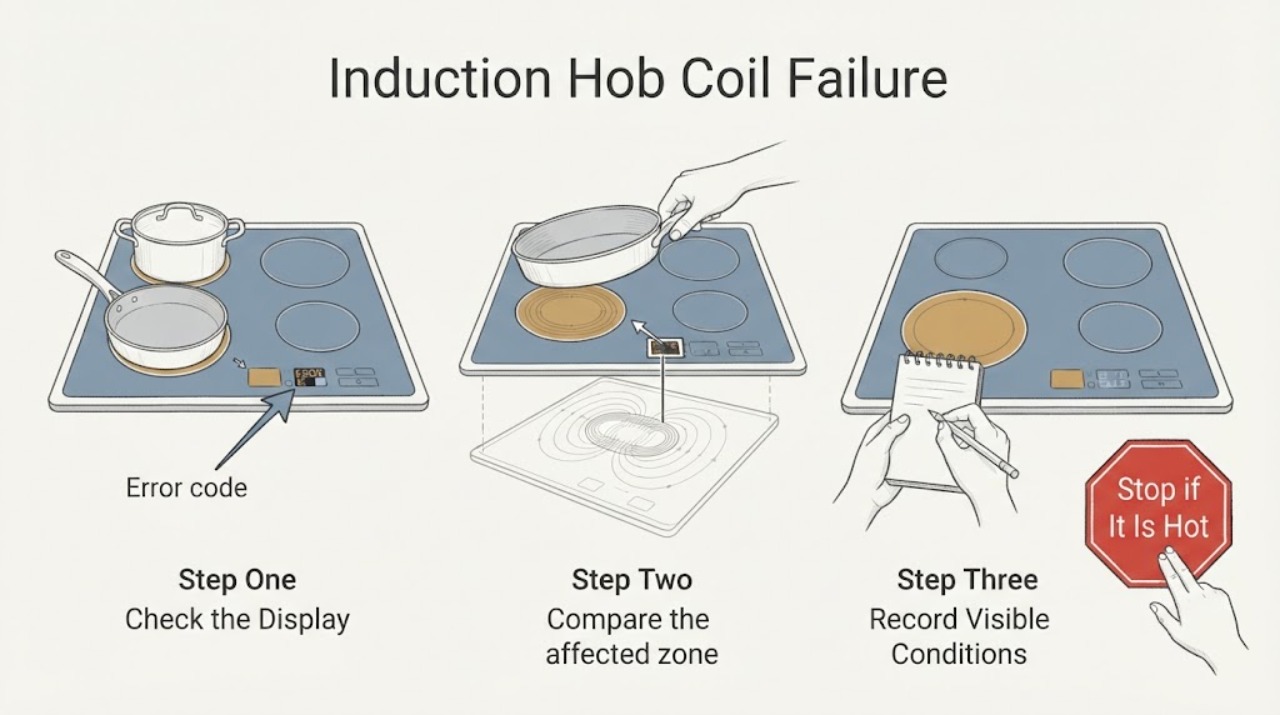
Work through in order
Diagnostic checks
Use only checks that match the exact appliance or system and its official guide.
-
Check 1
With the zone off, place a known induction-compatible pan on the affected zone and test the pan's base with a magnet. Center the pan, choose the correct cooking zone, and set a power level according to the cooktop controls.
Expected result: The magnet sticks and the zone heats, the pan is magnetic but the zone does not detect it, or the magnet does not stick or the pan is too small or off-center.
Next step: Use a suitable pan of the correct size and placement. If the correctly tested pan still fails on one zone, record the result and continue to the display and comparison check.
Stop if: Do not test with a cracked pan, touch a hot surface, or place tools or loose metal on the zone.
Why this matters
Why: A magnetic pan that heats supports normal zone detection. A non-magnetic, undersized, or misplaced pan can mimic a coil failure; a correctly placed known-good pan that remains cold leaves a cooktop fault open.
-
Check 2
Compare the affected zone with another zone using the same known-good pan and the same power setting. Keep the pan centered and avoid moving it while the test is running.
Expected result: The pan heats on another zone but not the affected zone, neither zone heats, or the affected zone begins heating after correcting placement or controls.
Next step: Stop repeated tests if one zone remains cold with the known-good pan. Record which zones work and arrange model-specific service rather than opening the cooktop.
Stop if: Stop immediately for smoke, burning odor, sparking, cracked glass, a hot plug, or uncontrolled heating.
Why this matters
Why: A pan that works elsewhere makes cookware incompatibility less likely and a zone-specific detection, control, or heating fault more likely. If no zone heats, power, settings, lock, or a broader fault remains possible. Recovery after placement points away from a failed coil.
-
Check 3
Read the display and record every exact letter, number, flashing symbol, tone, lock indicator, or pause state. Check the Bosch error-code guide using the full cooktop model number; do not treat a residual-heat symbol as proof that the zone is energized or failed.
Expected result: The code is listed with a documented user check, the display shows an unlisted code, or no code is shown while one zone remains cold.
Next step: Follow only the matching Bosch instruction for a listed condition. For an unlisted or recurring code, keep the cooktop out of use and contact Bosch with the model and exact display record.
Stop if: Do not bypass a lock or protection message, repeatedly cycle power, or substitute a code from another Bosch model.
Why this matters
Why: Bosch assigns different meanings to cookware, overheating, voltage, control, and time-limit conditions. An unlisted code or a persistent cold zone needs the exact model's support path and does not identify a coil or part by itself.
-
Check 4
Inspect only the accessible exterior for a wet control panel, object over a touch key, blocked ventilation, cracked glass, damaged cord or plug, smoke, burning smell, or water near electrical parts. Keep hands dry and do not remove the glass or cabinet.
Expected result: The panel is wet or obstructed, the cooktop has overheated but is cooling normally, no external hazard is visible, or a crack, odor, smoke, electrical damage, or uncontrolled heating is present.
Next step: Dry and clear the panel only when safe, then follow the exact model instructions. For any hazard or persistent control or heating fault, isolate power only from a safe accessible control and arrange qualified service.
Stop if: Do not apply water to energized controls, use CPU thermal paste, open the electronics, probe wiring, or continue cooking with a cracked surface.
Why this matters
Why: A wet or covered panel can prevent normal input, and Bosch documents cooling for certain overheating conditions. A crack or electrical hazard changes this from a cookware diagnosis to an immediate safety and service issue.
Use your observations
Decision map
Find the observation that best matches what you see, then follow the next safe action.
-
PATH 01Next step
What you see
A magnetic pan of suitable size heats when centered on the affected zone after the correct zone and power level are selected.
Do this next
Continue using compatible cookware with the documented placement and settings. Do not apply thermal paste or alter the cooktop.
Why this path and its safety boundary
Why it matters: The apparent coil failure was caused by cookware detection, size, placement, or controls rather than a confirmed failed coil.
-
PATH 02Next step
What you see
The same known-good magnetic pan heats on another Bosch zone but the affected zone remains cold, with correct placement and no listed user-resolvable message.
Do this next
Stop using the affected zone and arrange Bosch or qualified appliance service with the model, zone location, pan test result, power setting, and display record.
Why this path and its safety boundary
Why it matters: A zone-specific detection, control, power, or heating-assembly fault is more likely, but the external test cannot identify the failed component or a compatible replacement part.
-
PATH 03Next step
What you see
The display shows an unlisted or recurring error, the supply voltage is implicated, the cooktop will not respond, or smoke, burning odor, a crack, sparks, or uncontrolled heating is present.
Do this next
Stop using the cooktop and isolate power only if safely accessible without touching wiring; contact Bosch or qualified electrical/appliance service with the exact model and display.
Why this path and its safety boundary
Why it matters: This is a model-specific service or safety stop. A code or symptom does not make CPU thermal paste, a coil, or another part a confirmed repair choice.
Helpful context
Understand the symptom
Rule out pan detection before calling it a coil failure
Induction heating depends on the cooktop detecting suitable cookware. Bosch says to test the pan for ferromagnetic properties with a magnet, use a size appropriate to the zone, and center it correctly. A pan that is non-magnetic, too small, or off-center can look like a dead coil even when the zone is operating normally.
Why CPU thermal paste is the wrong repair
CPU thermal paste is not a Bosch induction-hob repair material. Do not spread it on the glass, under cookware, over the induction coil, or inside the control electronics. Bosch's user guidance stays at external cookware, control, error, and model-specific service checks; a heating assembly or power module requires the correct model parts and a qualified technician.
When a professional diagnosis is needed
If a known-good compatible pan is centered on one zone and that zone still will not heat, record the model, display, selected power level, and whether the other zones work. Bosch's error-code guidance says to have the exact model ready and contact support when the displayed fault is not covered. Do not remove the glass or test live wiring yourself.
When checks do not resolve it
Need a professional?
Contact Bosch or qualified appliance service when a known-good compatible pan does not heat on one correctly selected zone, an error is unlisted or returns, the supply voltage is implicated, or the cooktop will not respond. Stop immediately for smoke, burning odor, sparks, cracked glass, damaged wiring, water near electrical parts, or uncontrolled heating.
Common questions
FAQ
Can CPU thermal paste fix a Bosch induction-hob coil?
No. It is not a Bosch user repair procedure or a substitute for a model-matched heating or control part. First verify the pan, placement, controls, and exact display; leave internal diagnosis and repair to qualified service.
How can I tell whether one Bosch induction zone has failed?
Use a known induction-compatible pan that heats on another zone, center it on the affected zone, select that zone, and set a power level. If it remains cold without a user-resolvable message, the result supports a zone-specific service diagnosis but does not identify the failed part.
Read the exact guide
Official sources
- Bosch Induction Cooktop Error CodesBosch Home Appliances · Opened Bosch's official induction error-code guide. It documents listed code responses and directs owners to provide the exact model and contact support for faults that are not listed.
- Bosch Induction Cooktop TroubleshootingBosch Home Appliances · Opened Bosch's official US induction-cooktop troubleshooting page. Its external cookware and control checks apply to Bosch induction cooktops; internal coil or electronics diagnosis remains model-specific service work.
Community feedback
Share a repair observation
Share a plain-text repair observation. Accepted observations are published automatically; this page may take a moment to update.