
On this page
Start here
Quick answer
If a Bosch microwave sparks or arcs, stop it immediately, keep the door closed if there is flame or smoke, disconnect power only when it is safe to do so, and do not run it again to test the result. After the cavity and cookware are cold and de-energized, remove only ordinary visible causes such as metal utensils, foil, metal twist ties, metallic trim, packaging, or burned food residue. Bosch warns that metal and aluminum foil can cause sparks and damage, and its manual says not to operate a damaged appliance or service it except through qualified personnel. If the spark left a burn mark, the inner door or sealing surface is damaged, the cord or outlet is hot or damaged, there was smoke or fire, or sparking occurred with no visible removable cause, leave the microwave disconnected and arrange qualified Bosch service.
Before you begin
Safety first
- The user may stop the appliance, disconnect power from a safe position, wait for cooling, remove ordinary visible metal or packaging, and gently clean an intact accessible surface. Internal covers, the waveguide area, door or seal repairs, wiring, interlocks, magnetron, capacitor, and other high-voltage or electrical work belong to qualified service.
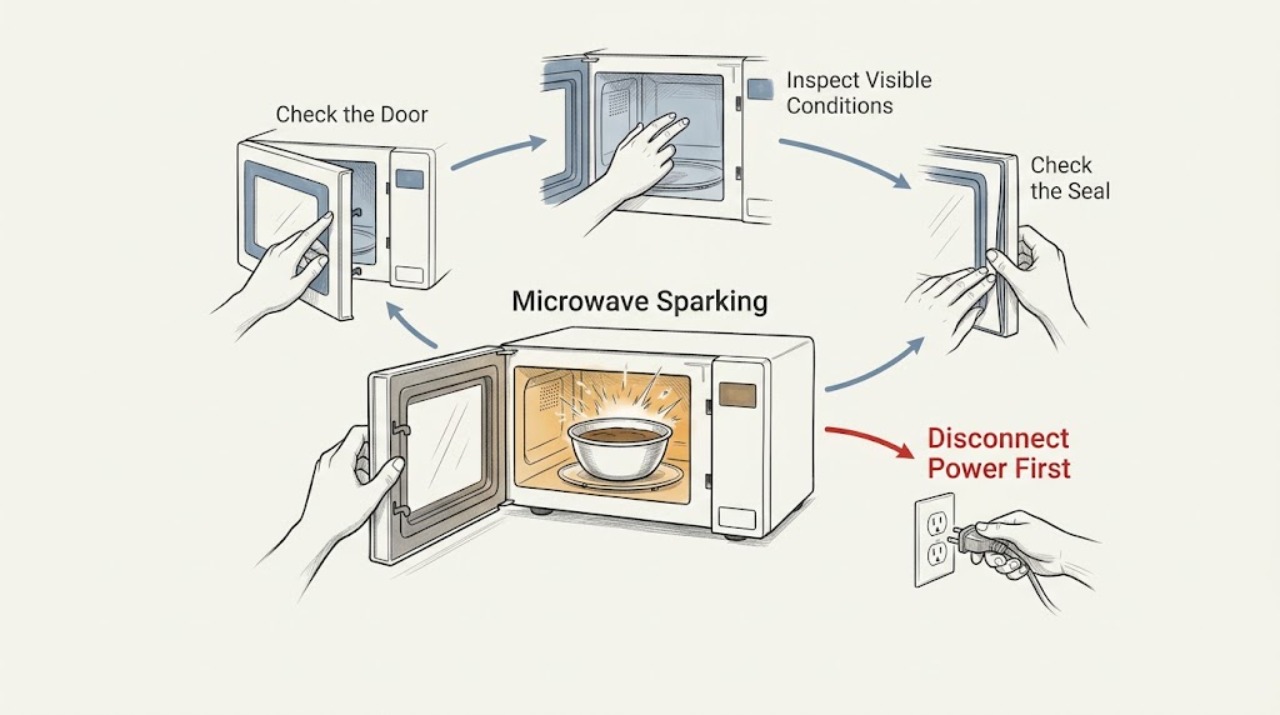
Work through in order
Diagnostic checks
Use only checks that match the exact appliance or system and its official guide.
-
Check 1
Stop the microwave immediately when the arc, flash, smoke, or flame appears. Press Stop or turn it off, keep the door closed if anything inside is burning, and disconnect the power only from a safe position; do not reach through fire or touch a hot, wet, damaged, or arcing plug or receptacle.
Expected result: There is active flame or smoke, a burning smell, a hot or damaged cord/receptacle, continued noise after stopping, or only a brief flash with no fire.
Next step: For flame or smoke, keep the door closed and leave the area if the fire does not stop; contact emergency services as appropriate. For any hot, wet, damaged, or arcing electrical area, keep clear and obtain qualified electrical or appliance help. Otherwise allow the microwave to cool fully before the disconnected visual checks.
Stop if: Do not open the cavity to investigate while there is flame, smoke, or active arcing, and do not operate the microwave again during this diagnosis.
Why this matters
Why: Fire, smoke, heat, or electrical damage raises the risk beyond a removable cookware issue. A brief flash without those signs still means the appliance should remain off until the visible cause is identified; it does not justify a restart test.
-
Check 2
With the microwave cold and power disconnected, remove the food and inspect the container and anything that was inside it. Look for metal utensils, foil, metal twist ties, metallic decoration or trim, a metal-lined package, or packaging that is not identified as microwave-safe; do not handle anything that is hot or fused to a surface.
Expected result: A metal item, foil edge, metallic trim, twist tie, or suspect package was touching or close to the cavity wall or door, or no such item is visible.
Next step: Remove the item from service and follow the exact Bosch manual for suitable cookware. Do not substitute a different load or run the microwave to verify the diagnosis; if no visible cause is found, continue only with the cold, disconnected cavity inspection and service boundary.
Stop if: Never restart the microwave as a cookware test, and do not use foil or a container with metallic trim to see whether the spark returns.
Why this matters
Why: A visible metal or metal-edged item is a credible cause of arcing and can damage the oven. If no removable metal or packaging cause is visible, the cause is not isolated; a hidden or appliance-side fault remains possible.
-
Check 3
After the cavity has cooled and remains disconnected, inspect only the visible floor, walls, ceiling, door window, door seal, sealing surfaces, turntable, and any visible cover for splattered or burned food, loose packaging, scorch marks, cracks, holes, peeling, or a part that is visibly out of position. Wipe ordinary residue gently only if the exact manual permits it and no damage is present.
Expected result: There is removable food residue or packaging with no apparent structural damage; there is a scorch mark, cracked or perforated surface, damaged door/seal, loose cover, or the visible cavity looks normal.
Next step: Clean only accessible, intact surfaces with a soft, non-abrasive cloth or sponge after cooling. If any damage, loose cover, or persistent burned area is present, leave the appliance disconnected and arrange qualified service; if nothing visible explains the spark, do the same rather than testing it.
Stop if: Do not scrape, sand, paint, bend, remove, or replace a cavity or door component, and do not remove the waveguide or any other cover.
Why this matters
Why: Ordinary residue or packaging can be a removable visible contributor, but a scorch mark or damaged cavity, door, seal, or cover means the microwave may no longer be safe to operate. A normal-looking cavity does not rule out an internal arcing fault.
-
Check 4
Record the safe facts for Bosch or a qualified appliance technician: the exact model and serial information, whether the event was a flash, repeated arc, smoke, or flame, what item was inside, where the mark appeared, and whether the cord, plug, door, seal, or cavity shows visible damage. Keep the appliance disconnected while requesting help.
Expected result: Sparking repeats whenever the appliance is used, occurred with a known microwave-safe setup, left a mark, or cannot be explained by a removable visible item; alternatively, it was a single event clearly associated with visible metal or packaging and no damage is seen.
Next step: Contact Bosch support or a qualified service provider and provide the recorded observations. Ask the provider to assess the cavity, door and sealing surfaces, and internal microwave system before any further operation; do not order or install a part from the symptom alone.
Stop if: Keep the microwave out of service until qualified personnel have cleared it whenever the cause is unexplained, damage is visible, or there was smoke, flame, or electrical overheating.
Why this matters
Why: Repeat or unexplained sparking, a known-safe load, or any visible damage needs model-specific inspection. A single event with a clear visible cause still does not authorize a user retest, because the event may already have damaged the cavity or door.
Use your observations
Decision map
Find the observation that best matches what you see, then follow the next safe action.
-
PATH 01Next step
What you see
Sparking happened with foil, a metal utensil, a metal tie, metallic trim, or suspect packaging, and the cold cavity and door show no visible damage.
Do this next
Remove that item from microwave use, follow the model manual for cookware, and do not restart the Bosch microwave as a confirmation test. Seek service if there is any mark, smell, repeat event, or uncertainty.
Why this path and its safety boundary
Why it matters: The removable item is the leading visible explanation, but the absence of visible damage does not prove that no damage occurred.
-
PATH 02Next step
What you see
The only visible finding is food splatter or loose packaging on an otherwise intact, cold cavity, and there was no smoke, flame, electrical heat, or door damage.
Do this next
Clean only the accessible intact area as the Bosch manual permits, keep the appliance disconnected, and contact qualified service before any further use if sparking returns or the source is not certain.
Why this path and its safety boundary
Why it matters: The residue or packaging is a plausible visible contributor, but a safe cleaning observation cannot certify the appliance for operation.
-
PATH 03Next step
What you see
There is a scorch mark, crack, hole, peeling or loose cavity surface, damaged door or seal, a damaged cord or plug, smoke or flame, or sparking with no removable visible cause.
Do this next
Leave the microwave disconnected and arrange Bosch or qualified appliance service. If there was an active fire, follow the fire response guidance and do not re-enter or handle the appliance until safe.
Why this path and its safety boundary
Why it matters: The symptom has crossed the safe user-check boundary. A damaged microwave or unexplained arc may involve the cavity, door/sealing system, or internal high-voltage circuitry, none of which can be identified safely from the spark alone.
Helpful context
Understand the symptom
Treat sparking as a stop condition
Do not press Start again, run an empty-cavity check, or keep heating to see whether the arc stops. Press Stop or turn the appliance off. If there is flame or smoke, keep the door closed; disconnect the power cord or switch off the circuit at the panel only if that can be done without touching a hot, wet, damaged, or arcing area. Let the cavity cool before opening it. A microwave that is damaged, dropped, not working properly, or has a damaged cord or plug must not be operated.
Why a visible spark does not prove a single failed part
A spark can be caused by an item in the cavity, a metal edge or tie, packaging, or residue, but the same symptom can also follow damage to the cavity, door, or sealing surfaces. The checks below are for identifying and removing ordinary visible causes only. They are not permission to remove a cover, probe wiring, handle a high-voltage component, or replace an internal part.
Clean only after the appliance is cold and disconnected
For a removable glass tray or accessible cavity surface, use a soft cloth or sponge with mild, non-abrasive soap as allowed by the model manual. Do not use metal scouring pads, scrape a suspected damaged area, remove a cover, or flood a hot cavity with water. If residue cannot be removed without force, or a surface is scorched, cracked, perforated, or lifting, stop and arrange service.
When checks do not resolve it
Need a professional?
A qualified technician should assess any unexplained or recurring arc, any visible cavity or door damage, any smoke or fire event, and any microwave that is not working properly or has a damaged cord or plug.
Safety scope: The user may stop the appliance, disconnect power from a safe position, wait for cooling, remove ordinary visible metal or packaging, and gently clean an intact accessible surface. Internal covers, the waveguide area, door or seal repairs, wiring, interlocks, magnetron, capacitor, and other high-voltage or electrical work belong to qualified service.
Common questions
FAQ
Should I keep using a Bosch microwave after it sparks once?
No. Stop it, disconnect power when safe, and do not run it again as a test. After it is cold and disconnected, inspect only visible cookware, packaging, residue, and damage. If the cause is not certain or any mark or damage is present, arrange qualified service.
Can aluminum foil or metal cause a Bosch microwave to spark?
Yes. Bosch warns that metal dishes and aluminum foil may cause sparks and damage. Metal utensils, twist ties, metallic trim, and metal-lined packaging should be treated as visible possible causes, but removing one does not justify a restart test.
What can I safely inspect after a microwave sparks?
Only after the appliance is cold and disconnected, inspect the container, packaging, visible cavity surfaces, turntable, door window, seal, and sealing surfaces for ordinary residue or obvious damage. Do not remove covers, scrape damaged areas, probe wiring, or inspect live parts.
What if there is a burn mark inside the Bosch microwave?
Leave it disconnected and arrange qualified service. A scorch mark, crack, hole, peeling surface, damaged door, seal, or loose cover is beyond a safe cleaning check and may mean the microwave should not be operated.
What should I do if the microwave catches fire while sparking?
Keep the door closed, turn the appliance off, and disconnect power or shut off the circuit only if safe, as Bosch's manual directs. Do not reach through fire. If the fire does not stop or the area is unsafe, leave and contact emergency services; do not use the microwave again.
Read the exact guide
Official sources
- Cleaning a microwave | Bosch Home AppliancesBosch Home Appliances · Bosch general cleaning guidance for a cold, disconnected microwave with intact accessible surfaces
- Get Support - Microwaves | Bosch Home AppliancesBosch Home Appliances · Bosch microwave model-specific support after a sparking incident or when service is required
- What not to put in the microwave? | Safety Tips | Bosch Home AppliancesBosch Home Appliances · Bosch general microwave safety guidance for identifying visible cookware and material causes of sparking
- Microwave repair | Microwave Troubleshooting | Bosch Home AppliancesBosch Home Appliances · Bosch microwave problems that are not resolved by the applicable owner manual or safe visible checks
- Use and Care ManualBosch · Bosch HMV3052C2 microwave manual used for manufacturer safety instructions and model-specific sparking guidance; model-specific manuals may differ.
Community feedback
Share a repair observation
Share a plain-text repair observation. Accepted observations are published automatically; this page may take a moment to update.