
On this page
Start here
Quick answer
If a GE microwave sparks, stop the cycle immediately with Clear/Off or Cancel/Off if safe. Do not continue cooking to see whether it stops, and never run the microwave empty. Once the cavity is cool, identify whether metal/foil, a metal-trimmed dish, twist tie, probe, food spill or a rack in the wrong position was involved. GE says arcing can also occur when a rack is upside down or when metal touches the cavity; the exact tray and rack rules differ between Microwave, Convection, Combination and Advantium modes. Remove only a cool, loose item that can be handled without reaching into the appliance, then follow the exact owner's manual. If the sound is electrical or mechanical, sparks continue with approved cookware, the cavity is scorched/holed, or the interior coating is peeling, discontinue use and arrange qualified service or replacement guidance. Do not remove the microwave cover, test the magnetron or capacitor, bypass the door interlock, or perform live tests: GE warns that an internal high-voltage capacitor can retain a dangerous charge even after unplugging.
Before you begin
Safety first
- The owner may stop the cycle, let the cavity cool, identify visible food/cookware/rack issues, clean a cool spill as directed and record the model/mode. Qualified personnel must handle the door interlock, high-voltage capacitor, magnetron, transformer, wiring, cavity, heater, control and live testing.
Work through in order
Diagnostic checks
Use only checks that match the exact appliance or system and its official guide.
-
Check 1
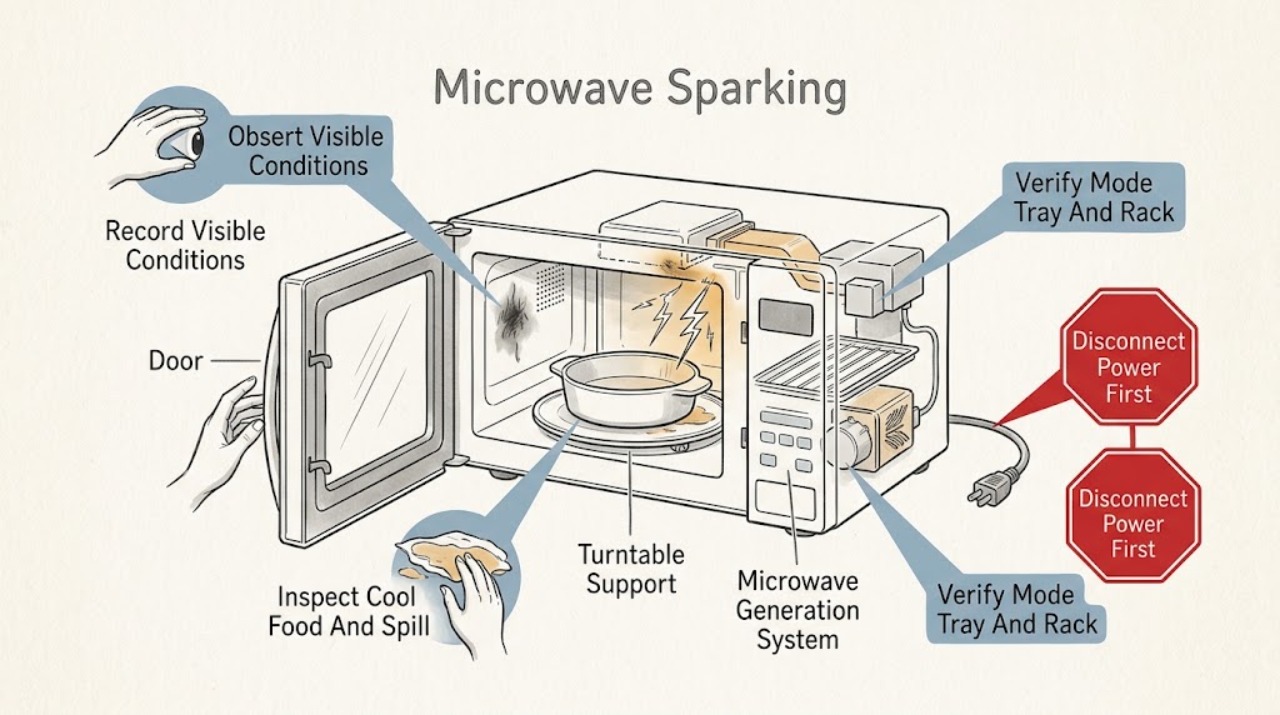
Press Clear/Off or Cancel/Off if it is safe, keep the door closed until the cycle stops, and record where the spark appeared: on food, on a rack/tray, at the side or back wall, under the turntable, or near the door. Note the exact mode and whether smoke, odor or a breaker trip occurred.
Expected result: The event stops immediately; it is tied to food or a spill; it is at metal/foil/rack; it is electrical/mechanical in sound; or it continues after stopping.
Next step: Keep the oven out of service while the cavity cools. Continue only with a cool, external cookware/cavity inspection; arrange service for electrical/mechanical popping, smoke, odor or persistent arcing.
Stop if: Do not restart the oven to reproduce the spark, run it empty, open the case or touch a hot cavity.
Why this matters
Why: Location and timing distinguish a food or cookware interaction from cavity, control or microwave-system trouble. A continuing electrical sound, smoke or odor is a stop-use hazard.
-
Check 2
After the cavity and food are cool, inspect the visible interior for a food spill, grease, a tight food membrane, metal trim, twist tie, probe left in the cavity, or a damaged container. Clean a cool spill only with the exact manual's non-abrasive method and remove ordinary loose debris without reaching behind panels.
Expected result: The spark came from a spill or food; a metal or probe item is present; no food/cookware cause is visible; or the coating is burned, peeling or holed.
Next step: Discard or reposition the food/cookware only when cool and model-approved. Discontinue use for peeling, a hole, active scorching or repeated sparks and arrange service or replacement guidance.
Stop if: Do not scrape the coating, paint over burns, use abrasive cleaners, touch hot food, or continue if an electrical odor is present.
Why this matters
Why: GE lists food spills, certain foods, metal items and an uninserted probe as possible causes. Peeling coating or a hole changes the issue to cavity damage and is not corrected by cleaning.
-
Check 3
With power off and the cavity cool, compare the glass/ceramic tray, metal tray, wire rack and turntable support with the exact model instructions for Microwave, Convection, Combination, Speedcook, Broil, Toast, Warm or Proof. Check only that an accessible rack is seated in the prescribed orientation; do not force it.
Expected result: A tray/rack/support is missing, upside down, touching a wall, used in the wrong mode, or correctly installed for the selected mode.
Next step: Remove only a cool, accessible item and reinstall the model-approved support. If the support is bent, cannot seat, or sparks continue with the correct setup, stop use and arrange service.
Stop if: Do not use metal cookware or foil in a microwave mode unless the exact manual permits it, do not insert a rack while energized, and do not test an empty cavity.
Why this matters
Why: GE assigns different supports and cookware by mode. An incorrect or poorly seated metal rack can arc, while a glass/ceramic microwave tray or turntable support may be required for microwave energy.
-
Check 4
Record whether the event occurred during Microwave, Convection, Combination, Speedcook or another mode, and whether it followed a particular food or container. Do not deliberately run a failed mode; only use a normal, model-approved program after the manual permits it and the cavity is intact.
Expected result: Sparking occurs only with one food/container; only in Microwave or Combination; only in Speedcook; only with a rack/foil; or across modes with approved setup.
Next step: Remove the implicated food or cookware and follow the exact mode instructions. Persistent or cross-mode arcing, electrical popping or cavity damage requires qualified service.
Stop if: Do not use a water-cup or empty-cavity experiment to test microwave output, and do not bypass any safety control.
Why this matters
Why: Food and metal interactions can be mode-dependent. Advantium can arc in Speedcook as well as Microwave, while a repeat across approved modes makes an internal or cavity fault more likely.
-
Check 5
Inspect the door and visible latch area for damage, confirm the door closes normally without forcing it, and note any outlet heat, cord damage, smoke, electrical/chemical odor, repeated breaker trip or sudden power loss. Make no adjustment to the latch or interlock.
Expected result: The door is bent or does not close, power trips during arcing, the cord/outlet is hot or damaged, an electrical odor is present, or the door and power hardware appear normal.
Next step: Stop using the oven for any door, power, smoke or odor warning and arrange qualified appliance/electrical service. If all are normal, continue only with the manual-based cool cookware check; persistent sparks still require service.
Stop if: Do not tape, bend, lubricate, defeat or test a door interlock, and do not restore power to reproduce an electrical event.
Why this matters
Why: A microwave must have an engaged door safety system, and power or odor symptoms can indicate a hazardous electrical fault. A normal-looking door does not clear the high-voltage system if arcing remains.
-
Check 6
Record the full model and serial number, installation type, mode, food/container, tray/rack position, spark location and duration, cavity condition, door response, breaker/outlet behavior and any smoke or odor. Keep the appliance unplugged when directed by the manual or service provider.
Expected result: A cool, model-approved cookware correction prevents recurrence; sparks return; the cavity is damaged; or a safety symptom is present.
Next step: Arrange qualified GE microwave/Advantium service and provide the record. For a hole or peeling coating, discontinue use and request replacement guidance rather than a cavity patch.
Stop if: Do not remove covers, test microwave components, discharge capacitors, perform live measurements or order an internal part from the spark symptom alone.
Why this matters
Why: A one-time food or cookware interaction may be corrected externally. Recurrence with approved setup, electrical/mechanical sound or cavity damage needs internal or replacement-level diagnosis.
Use your observations
Decision map
Find the observation that best matches what you see, then follow the next safe action.
-
PATH 01Safety boundary
What you see
The spark or pop occurred at food, grease or a spill, stopped when the cycle was canceled, and there is no cavity, power or electrical-odor warning.
Do this next
Let the cavity cool, clean the spill with the model-approved method, and use only an intact microwave-safe container with venting appropriate to the food. Stop if the event repeats.
Why this path and its safety boundary
Why it matters: GE says food characteristics and spills can cause popping or sparking; this pattern is less suggestive of a failed microwave system.
Safety stop: Do not continue cooking with smoke, an electrical smell, scorching or repeated arcing.
-
PATH 02Safety boundary
What you see
Sparks occurred at metal, foil, a metal-trimmed container, probe, rack or cavity wall, or the rack/support was wrong for the mode.
Do this next
After cooling, remove or correct only the accessible item according to the exact manual. If the rack is bent, the wall is scorched, or sparks return with approved setup, arrange service.
Why this path and its safety boundary
Why it matters: GE identifies these placement and material errors as common arcing causes; the exact permission for foil or a metal rack depends on the model and mode.
Safety stop: Do not use unapproved metal, hold foil against a wall, operate empty or reach into a hot cavity.
-
PATH 03Next step
What you see
The event is limited to Advantium Speedcook, Microwave or another specific combination mode and the food/tray setup differs by mode.
Do this next
Use the model's mode-specific tray, rack and cookware instructions. Persistent arcing in one or more approved modes requires qualified service.
Why this path and its safety boundary
Why it matters: Advantium uses distinct heating and support rules; arcing can occur in both Speedcook and Microwave, so a mode-specific setup error remains possible.
-
PATH 04Safety boundary
What you see
Arcing is electrical/mechanical, repeats with approved cookware, leaves a hole/peeling/burn damage, or is accompanied by smoke, electrical odor, hot power hardware or a breaker trip.
Do this next
Stop using the microwave and arrange qualified appliance/electrical service or replacement guidance. Isolate power only from a safe, dry, accessible point and do not restore it for testing.
Why this path and its safety boundary
Why it matters: This is not a user cookware correction. GE treats a hole or actively peeling interior coating as a discontinue-use condition, and internal microwave diagnosis is hazardous even after unplugging.
Safety stop: Do not open the case, repair cavity coating, perform live tests, discharge a capacitor, adjust an interlock or continue cooking.
Helpful context
Understand the symptom
The first split is food-related versus electrical arcing
A fat-rich food, a tight food membrane, a spill or certain vegetables can pop or spark at the food. Metal, foil, a probe, a misplaced rack or an empty cavity can arc against the oven. Electrical or mechanical popping, repeated sparks after the food and cookware are corrected, or any cavity damage is not a food experiment; stop and arrange service.
Mode and support hardware matter
A GE convection microwave may use microwave-only, convection-only or Combination Cooking. Advantium uses mode-specific glass/ceramic trays, metal trays and racks. A support that is correct for convection can be wrong for Microwave, and a rack that is not seated can create arcing. Use the full model number and the exact mode manual rather than a generic microwave rule.
Sparking is not an invitation to inspect high-voltage parts
The owner can stop the cycle, cool the cavity, inspect visible cookware and clean a cool spill according to the manual. The owner must not remove the case, test the microwave output, discharge a capacitor or adjust an interlock. GE says a high-voltage capacitor may hold a charge even after unplugging and that special equipment is generally needed for diagnosis.
Safety boundary
Stop conditions
- Press Clear/Off or Cancel/Off and stop using the microwave for repeated sparks, electrical or mechanical popping, smoke, burning/electrical odor, hot or damaged cord/plug/outlet, repeated breaker trips, a cavity hole, active peeling, scorching or water near electrical parts.
- Do not run the microwave empty, continue cooking to reproduce an arc, remove the case, test microwave output, discharge a capacitor, probe wiring, bypass or adjust a door interlock, or attempt a cavity-coating repair.
- Use only the exact model's tray, rack, turntable support, cookware and foil rules. A support that is correct for Convection or Speedcook may be wrong for Microwave or Combination.
- Disconnect power only from a safe, dry, accessible point. If the plug or receptacle is hot, wet, smoking or damaged, do not touch it; use qualified electrical service.
When checks do not resolve it
Need a professional?
Arrange qualified GE microwave or Advantium service when sparks repeat with the correct model-approved food, tray, rack and cookware; when the sound is electrical or mechanical; when the unit runs but does not heat; or when the door, power, control or cavity is damaged. Discontinue use for a cavity hole, actively peeling coating, smoke, burning/electrical odor, hot or damaged power hardware, water near electricity or repeated breaker trips. GE does not provide DIY internal microwave repair because a high-voltage capacitor can retain charge after unplugging.
Safety scope: The owner may stop the cycle, let the cavity cool, identify visible food/cookware/rack issues, clean a cool spill as directed and record the model/mode. Qualified personnel must handle the door interlock, high-voltage capacitor, magnetron, transformer, wiring, cavity, heater, control and live testing.
Common questions
FAQ
What should I do first when my GE microwave sparks?
Press Clear/Off or Cancel/Off if safe and stop the cycle. Do not run it empty or restart it to reproduce the event. After the cavity cools, record the spark location and inspect visible food, spills, metal, foil, rack and cavity damage.
Can food cause a GE microwave to spark?
Yes. GE lists food spills and certain foods or tight membranes as causes of popping or food-related sparking. Clean a cool spill as directed and use an appropriate container, but stop if the sound is electrical/mechanical, repeats, or leaves scorch/cavity damage.
Why does a metal rack or foil cause arcing?
Metal can arc when it touches the cavity or is used in a mode that does not permit it. A rack may also be upside down or improperly seated. Use the exact model's mode-specific tray/rack and foil instructions; do not continue if sparks return.
Is sparking in a GE Advantium different from a regular microwave?
Advantium can arc during both Speedcook and Microwave modes and uses different glass/ceramic trays, metal trays and racks by mode. Identify the exact model and follow its support-hardware instructions rather than applying a standard microwave rack rule.
Can I repair a burned or peeling microwave cavity?
Do not paint, scrape or patch it. GE says a cavity hole is non-repairable and actively peeling interior coating requires discontinuing use and replacement guidance. Arrange qualified service or replacement support.
Why should I not remove the microwave cover after sparking?
GE says a high-voltage capacitor can retain a dangerous charge even after the microwave is unplugged and does not provide DIY internal repair advice. Stop at external food, cookware, door and visible-cavity checks; arrange qualified service for persistent or electrical arcing.
Read the exact guide
Official sources
- Advantium - MicrowavingGE Appliances · Use only for Advantium microwave operation; exact manual controls tray and foil exceptions.
- Microwave - Runs But Does Not HeatGE Appliances · General GE microwave guidance for the microwave portion of a combination appliance; not an internal repair guide.
- Microwave - OdorsGE Appliances · Use for distinguishing food/new-heater odor from electrical burning odor; stop-use advice takes priority.
- Advantium Oven - Reasons for Sparking And ArcingGE Appliances · Use for Advantium models only; exact manual controls foil and cookware permissions.
- Microwave Arcing In CavityGE Appliances · General cavity guidance; do not infer that a visible correction makes a damaged cavity safe.
- Microwave - Arcing or Making SoundsGE Appliances · General GE microwave arcing guidance for standard, convection and combination microwave use; exact model manual controls exceptions.
- Microwave - Cavity Repair Needed Due to Arcing, Chipping, Peeling or ScorchingGE Appliances · Use for visible cavity damage and stop-use decisions; it is not an internal repair procedure.
- Microwave - Convection CapabilityGE Appliances · General convection microwave explanation; exact supported modes and cookware remain model-specific.
- Advantium - Glass & Metal Trays, Rack, and Turntable SupportGE Appliances · Use for Advantium mode-specific support selection; exact model manual controls variations.
- Microwave - Will Not StartGE Appliances · General no-start guidance for GE microwave-combi units; door/control design varies by model.
Community feedback
Share a repair observation
Share a plain-text repair observation. Accepted observations are published automatically; this page may take a moment to update.