
On this page
Start here
Quick answer
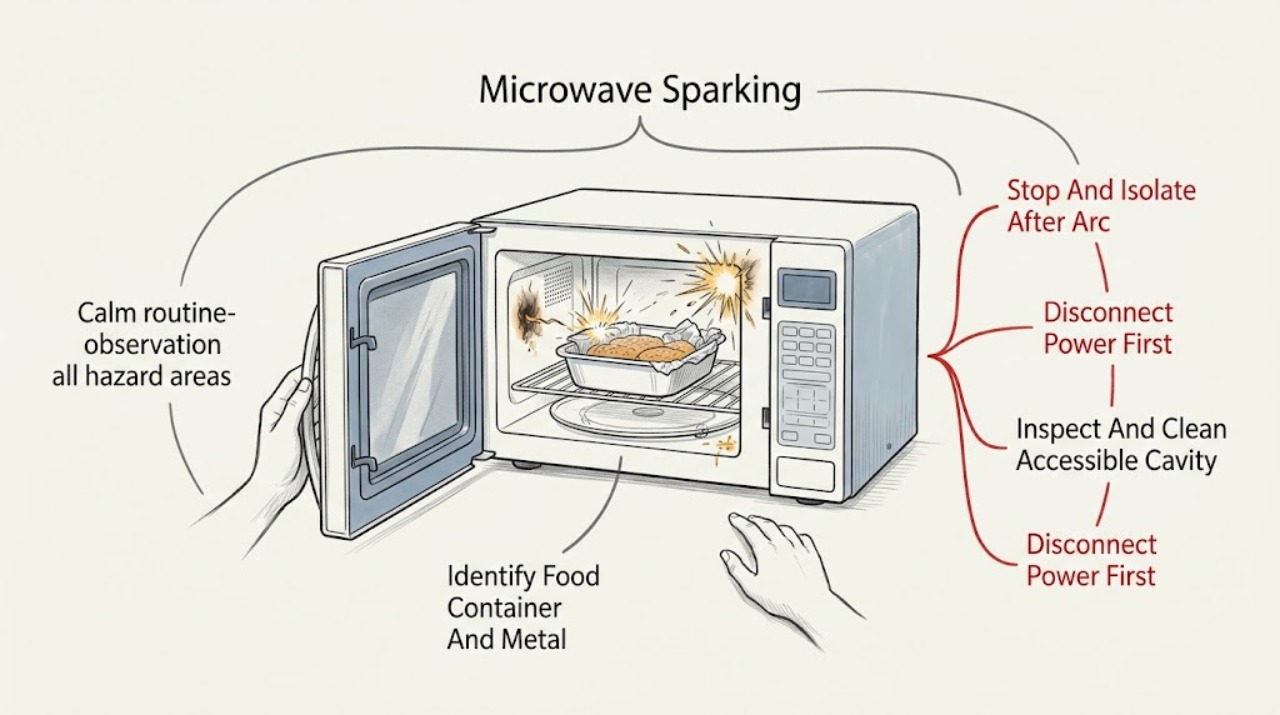
Stop the microwave immediately when you see sparks or arcing, cancel the cycle if the controls respond, and disconnect power from a safe position after the interior has stopped. Do not repeat the event to see whether it happens again. Once cool and unplugged, remove the food and inspect only the container, turntable, rack, cavity walls, and the visible sidewall waveguide cover. Metal, foil, metallic trim, a metal rack used contrary to the exact manual, a container touching the cavity, food splatter or carbonized residue, a damaged cover, or a damaged cavity can cause arcing. Frigidaire says splatters on the waveguide cover should be wiped gently and the cover must never be removed; its popcorn guidance also shows that a model's metal turntable may require a special plate to keep metal away from the bag. Clean only with the model-approved method and use a nonmetal, microwave-safe container for any later operation. If sparking returns with clean, correct cookware, if the waveguide cover or cavity is burned or damaged, if there is smoke, flame, a burning smell, a hot cord, or a tripped breaker, leave the microwave unplugged and arrange qualified service. Never open the cabinet, probe high-voltage parts, bypass the door interlock, or operate it empty.
Before you begin
Safety first
- The user may stop the cycle, isolate power from a safe position, remove cooled food and cookware, wipe ordinary visible splatter gently with the unit unplugged, and consult the exact model guide. Qualified personnel must handle the waveguide cover, door interlock, cabinet, magnetron, capacitor, diode, transformer, control, wiring, live testing, and any damaged or hard-wired appliance.
Work through in order
Diagnostic checks
Use only checks that match the exact appliance or system and its official guide.
-
Check 1
When sparking, flashing, popping, or arcing occurs, cancel the cycle if the normal control responds, keep the door closed until the microwave stops, and disconnect power from a dry, safe position after the event has ended. Do not move close to a smoking or damaged unit to reach a plug; use the accessible breaker only if it is safe to do so.
Expected result: The event stops with the cycle; smoke or flame remains; the door, cord, outlet, or cabinet is hot or damaged; the breaker trips; or the microwave appears normal after stopping.
Next step: Leave the unit unplugged for smoke, flame, damage, heat, odor, or a trip and arrange qualified service. If the event stopped without a hazard, wait for the interior to cool before removing the food and inspecting only accessible items.
Stop if: Do not restart the microwave to reproduce the spark, operate it empty, bypass the door switch, or open the cabinet.
Why this matters
Why: Any arc is an abnormal stop-use symptom until the accessible cause is identified. Smoke, flame, heat, damage, or a trip raises an electrical or fire risk and is not a reason to reset and retry. A normal-looking exterior does not make an internal high-voltage fault safe.
-
Check 2
With power disconnected and the cavity cool, record what was being heated and inspect the container, lid, label, foil, twist tie, metallic trim, rack, and any accessory without putting it back into the microwave. Check whether the food or container touched the cavity wall, ceiling, door, rack, or sidewall cover.
Expected result: Foil or metal was present; the container had metallic paint or trim; a rack or accessory was used; the container touched the cavity; or the food and container were nonmetal and model-approved.
Next step: Discard or remove the suspected metal/foil arrangement and consult the exact Frigidaire model guide for any rack or accessory. Do not assume that a metal turntable, rack, or browning accessory is interchangeable with another model.
Stop if: Do not put the suspected item back in, bend foil into a new shape, add a metal rack to test it, or handle hot food or metal without cooling.
Why this matters
Why: Metal, foil edges, metallic decoration, an unapproved rack, or contact with the cavity can create an arc path. A nonmetal container with no contact makes splatter, carbonization, cavity/waveguide damage, door issues, or an internal fault more important, but it still does not justify a live test.
-
Check 3
After unplugging the unit, inspect the visible cavity floor, ceiling, walls, turntable, support, door-facing surfaces, and the metal-looking sidewall waveguide cover for food splatter, grease, carbonized spots, peeling, cracks, or a loose cover. Wipe ordinary splatter gently using the Frigidaire cleaning method and dry the surfaces; do not remove or loosen the waveguide cover.
Expected result: Fresh splatter wipes away; a hard black or burned mark remains; the waveguide cover is cracked, blistered, scorched, loose, or missing; the cavity coating is damaged; or all visible surfaces are clean and intact.
Next step: Leave the unit unplugged if a mark, cover, cavity, or door surface is damaged. If only ordinary splatter was removed and there is no damage or hazard, continue to the container and model-instruction checks without running a spark test.
Stop if: Do not scrape, sand, paint, tape, replace, or remove the waveguide cover; do not use harsh or abrasive cleaners; do not wipe an energized or hot microwave.
Why this matters
Why: Food residue can become a local arc source, while a persistent carbonized mark, damaged cavity coating, or damaged waveguide cover can continue to arc and needs service. Clean, intact visible surfaces shift the concern toward the container, door/interlock, or internal microwave system.
-
Check 4
Use the exact Frigidaire Owner's Guide to verify the container, turntable, rack, shelf, and cooking mode that were used. Check whether the unit is a countertop, over-the-range, built-in, convection, or combination model and whether the manual allows the rack or accessory in microwave mode. Use only a plain microwave-safe nonmetal container for any future operation after the unit has been cleared for use.
Expected result: The manual disallows the rack, foil, or accessory; the model has a metal turntable with a special documented plate requirement; the container is microwave-approved and correctly placed; or the exact model rule cannot be confirmed.
Next step: Remove the unapproved accessory and record the model number for service or manual lookup. Do not operate again if the cavity, cover, or door was damaged or if sparking occurred with a documented nonmetal setup.
Stop if: Do not improvise a browning plate, rack position, foil shield, or container test; do not use an unconfirmed accessory in microwave mode.
Why this matters
Why: Frigidaire's public guidance shows that cookware and turntable construction can change the metal rule. An accessory that is safe in convection or a different model may be unsafe in microwave mode. If the model rule cannot be confirmed, the correct decision is no restart, not a trial.
-
Check 5
Inspect only the exterior door, latch area, window, seal, cord, plug, outlet, and normal display after the microwave is cool and unplugged. Look for a bent or loose door, damaged seal or window, scorch marks, a hot or damaged plug, or a breaker/GFCI event. Do not remove the door, outer cover, or control panel.
Expected result: The door or window is damaged; the seal or latch appears misaligned; the cord or outlet is hot/scorched; the breaker trips; the display is dead; or the exterior and household supply appear normal.
Next step: Leave the microwave unplugged and arrange qualified service for any door, window, seal, cord, outlet, breaker, display, or internal concern. Do not use an external power reset as a spark test.
Stop if: Do not straighten the door, tape a seal, bypass an interlock, reset repeatedly, probe the outlet or appliance live, or open the cabinet.
Why this matters
Why: A damaged door or interlock area is a stop-use condition because microwave containment and safety interlocks cannot be verified by appearance alone. A normal exterior and supply still leave the waveguide, magnetron, high-voltage circuit, control, or hidden damage unresolved.
-
Check 6
Prepare the service handoff with the exact model, microwave type, food and container, metal or foil details, cooking mode, spark location and duration, visible residue or damage, door and power observations, and whether the event occurred with no load or with a correct plain nonmetal setup. Do not perform another cooking run to fill in a missing detail.
Expected result: The event had an obvious removable metal/foil or splatter cause with no damage; the event recurs after that cause is removed; it occurred with a plain nonmetal setup; it occurred empty; or any smoke, flame, odor, heat, damage, or trip is present.
Next step: Only resume use after the exact model guidance and a qualified assessment support it. Otherwise keep the microwave unplugged and arrange Frigidaire or qualified microwave service with the record.
Stop if: Do not buy or install a magnetron, diode, capacitor, waveguide cover, fuse, or control board from a spark symptom and do not open the cabinet.
Why this matters
Why: An isolated cookware or residue cause can be corrected without asserting that the microwave itself is repaired. Recurrence, an empty-cavity event, a damaged cover/cavity, or a hazardous symptom raises the probability of a concealed waveguide, high-voltage, magnetron, control, or interlock problem.
-
Check 7
If service is needed, give the technician the exact model and the safe external findings rather than attempting internal diagnosis. State whether the microwave was countertop, over-the-range, built-in, convection, or combination, and whether the spark was near the waveguide cover, turntable, rack, door, or container.
Expected result: The location is known from a safe observation; the location is uncertain; or the microwave is damaged, wet, hot, smoky, or electrically abnormal.
Next step: Keep the unit unplugged and arrange qualified service for any recurrence, uncertainty, damage, or hazard. If the unit is hard-wired, use qualified service rather than opening a connection box.
Stop if: Do not perform high-voltage testing, discharge a capacitor, remove a magnetron or waveguide cover, bypass a door switch, or open a hard-wired connection.
Why this matters
Why: A location and cookware history can help service distinguish an external arc source from hidden high-voltage or containment faults, but neither can make cabinet opening or live testing safe for a user. Uncertain location is not a reason to reproduce the event.
Use your observations
Decision map
Find the observation that best matches what you see, then follow the next safe action.
-
PATH 01Safety boundary
What you see
Sparking occurred with foil, metal trim, a wire rack, a metal turntable, a browning accessory, or another item not explicitly confirmed for that model and cooking mode.
Do this next
Remove the item after cooling, consult the exact model guide, and do not reuse it in microwave mode unless the guide explicitly permits it and specifies placement. Inspect for damage before any further decision.
Why this path and its safety boundary
Why it matters: The cookware/accessory is a plausible arc source. Frigidaire documents that metal can interfere with microwave cooking and that some models with metal turntables require a special popcorn/bacon plate.
Safety stop: Do not reshape foil, add a rack to compare, or repeat the cycle with another metal arrangement.
-
PATH 02Safety boundary
What you see
The spark occurred near food splatter, grease, a hard black spot, or a carbonized mark on the cavity or visible waveguide-cover area.
Do this next
Unplug and cool the unit, wipe ordinary splatter gently as Frigidaire directs, and leave it unplugged for persistent carbonization, scorch, blistering, cracks, or a loose/missing cover. Arrange service.
Why this path and its safety boundary
Why it matters: Residue can support arcing, but a persistent burn mark or damaged sidewall cover may continue to arc even after wiping. The visible mark cannot be repaired by sanding or paint.
Safety stop: Do not scrape, sand, paint, tape, remove, or replace the waveguide cover yourself.
-
PATH 03Safety boundary
What you see
Sparking occurred with a plain nonmetal container and food, after the visible cavity and waveguide cover looked clean and undamaged.
Do this next
Keep the microwave unplugged and arrange qualified appliance or microwave service. Provide the model, power setting/mode, spark location, and the fact that the setup was nonmetal.
Why this path and its safety boundary
Why it matters: A concealed waveguide, magnetron/high-voltage, control, door/interlock, or cavity fault becomes more concerning. A clean appearance does not make a repeat test safe.
Safety stop: Do not repeat the cycle, operate empty, or open the cabinet for a high-voltage inspection.
-
PATH 04Safety boundary
What you see
The microwave sparked empty, or the food/container was touching the cavity wall, ceiling, rack, or door area.
Do this next
Leave the unit unplugged and arrange service, especially if the event occurred empty or left a mark. Do not repeat the test with a cup of water or a different container.
Why this path and its safety boundary
Why it matters: An empty-cavity event is not a safe user experiment, while contact can create an arc path. Either pattern requires a stop-use decision until the cause and any damage are assessed.
Safety stop: Do not operate empty, move the container closer to a wall, or test a suspected clearance by running the microwave.
-
PATH 05Safety boundary
What you see
Sparking is accompanied by smoke, flame, burning odor, a hot/damaged cord or outlet, a tripped breaker, a damaged door/window/seal, or repeated electrical failure.
Do this next
Keep people away, cancel if safe, disconnect power from a safe location after the event stops, and arrange qualified service or electrical inspection as appropriate.
Why this path and its safety boundary
Why it matters: This is a fire, electrical, or microwave-containment hazard, not a cookware troubleshooting branch. The appliance should not be reset or operated.
Safety stop: Do not open the cabinet, touch a hot or smoking surface, reset the breaker repeatedly, or resume use after the hazard appears to clear.
-
PATH 06Safety boundary
What you see
The user cannot confirm whether the turntable, rack, foil, container, or cooking mode is permitted for the exact Frigidaire model.
Do this next
Keep the unit unplugged, locate the exact model guide or contact Frigidaire service, and provide the cookware and mode details. Do not run an experiment to resolve the uncertainty.
Why this path and its safety boundary
Why it matters: Frigidaire's own guidance shows that turntable material and model accessories can change the safe setup. Uncertainty prevents a safe conclusion that the appliance is repaired.
Safety stop: Do not copy an accessory rule from another Frigidaire model or use a metal rack/plate without exact documentation.
Helpful context
Understand the symptom
Sparking is a stop-use symptom, not a normal test condition
A brief flash can come from a container, foil edge, rack, food splatter, carbonized residue, or a damaged cavity surface, but the visible flash cannot prove which mechanism is involved. Cancel the cooking cycle, let the interior stop, and unplug the unit from a safe, dry position. Do not run another cycle with a different cup, run the microwave empty, or stand close to the door to watch for a repeat. If smoke, flame, burning odor, damage, or a hot cord appears, keep the unit unplugged and arrange service.
Metal rules depend on the exact Frigidaire model
Do not turn a general metal warning into a universal cookware rule. Frigidaire's popcorn guidance explains that a microwave with a metal turntable may need a popcorn/bacon plate to lift the bag away from metal, while other models use a glass tray. Foil, metallic trim, wire racks, and browning accessories must be used only when the exact Owner's Guide explicitly allows them and gives their placement. After an arc, the safest user check is to remove the suspected metal or foil and stop; it is not to experiment with another metal arrangement.
The waveguide cover is visible but not user-removable
The sidewall waveguide cover can collect food splatter, and Frigidaire says to wipe it gently with a damp cloth as soon as splatters appear. It also explicitly says never to remove the cover. A cover that is scorched, cracked, blistered, loose, or repeatedly arcing after gentle cleaning is a service boundary, as are burn marks or peeling on the cavity. Do not sand, paint, tape, replace, or probe the cover yourself.
Safety boundary
Stop conditions
- Stop immediately for sparks, arcing, smoke, flame, burning odor, a hot/damaged cord or outlet, a tripped breaker, a damaged door/window/seal, or a damaged cabinet/cavity; keep the microwave unplugged and arrange qualified service.
- Do not operate the microwave empty or repeat a cycle to reproduce or locate the spark.
- Do not use a knife, pick, scraper, sandpaper, paint, tape, hair dryer, heat gun, flame, boiling water, or abrasive chemical to clear or repair an arc mark.
- Never remove the visible waveguide cover, open the cabinet, discharge a capacitor, test high-voltage parts, repair wiring, or bypass a door interlock.
- Metal, foil, racks, turntables, and browning accessories are model- and mode-dependent; use only the exact Frigidaire manual and do not improvise a test arrangement.
When checks do not resolve it
Need a professional?
Safety scope: The user may stop the cycle, isolate power from a safe position, remove cooled food and cookware, wipe ordinary visible splatter gently with the unit unplugged, and consult the exact model guide. Qualified personnel must handle the waveguide cover, door interlock, cabinet, magnetron, capacitor, diode, transformer, control, wiring, live testing, and any damaged or hard-wired appliance.
Common questions
FAQ
What should I do first if my Frigidaire microwave sparks?
Stop the cycle, let the microwave stop, and disconnect power safely. Do not repeat the event or run the microwave empty. After it cools, remove the food and inspect only the container, metal/foil, turntable, rack, cavity, and visible waveguide cover; leave it unplugged for any damage, odor, smoke, heat, or recurring spark.
Can foil or metal cause a Frigidaire microwave to spark?
Yes, metal or foil can be an arc source, but the exact rule depends on the model and mode. Frigidaire notes that some models with a metal turntable require a special plate for popcorn. Do not repeat a test with reshaped foil, a rack, or another metal accessory unless the exact Owner's Guide explicitly permits it.
Can I remove or replace the waveguide cover after sparking?
No. Frigidaire says to wipe splatters from the metal-looking sidewall cover gently and never remove it. A cracked, loose, blistered, scorched, missing, or repeatedly arcing cover needs qualified service; do not tape, paint, sand, or replace it yourself.
What if the microwave sparks with a plain glass or ceramic container?
Keep it unplugged and do not repeat the cycle. A clean, plain nonmetal setup with sparking makes concealed waveguide, cavity, door/interlock, control, or high-voltage problems more concerning, even if no damage is visible. Arrange qualified service and provide the model, mode, and spark location.
When is Frigidaire microwave sparking an emergency service issue?
Treat smoke, flame, burning odor, a hot or damaged cord/outlet, a breaker trip, a damaged door/window/seal, an empty-cavity spark, recurring arcing, or a burned/cracked waveguide cover or cavity as stop-use symptoms. Do not open the cabinet, touch high-voltage parts, bypass the door interlock, or reset and retry.
Read the exact guide
Official sources
- Microwaves - Do I need a special plate to cook popcorn in my microwave?Frigidaire · Supports the conditional metal/turntable branch: models with a metal turntable may require a special plate to lift a popcorn bag away from metal; it is not a universal permission for racks or foil.
- How do I clean my microwave?Frigidaire · Applies to Frigidaire microwaves and supports unplugging before cleaning, wiping interior splatter, gentle waveguide-cover cleaning, and never removing the waveguide cover.
- Microwaves - No PowerFrigidaire · Supports the external power and stop-use branch for a tripped breaker, GFI, display, or electrical issue; it does not authorize live microwave testing or internal repair.
- Owner Center Resource LibraryFrigidaire · Supports the manufacturer identity and official support boundary for Frigidaire microwaves; it is not an internal repair manual.
Community feedback
Share a repair observation
Share a plain-text repair observation. Accepted observations are published automatically; this page may take a moment to update.