
On this page
Start here
Quick answer
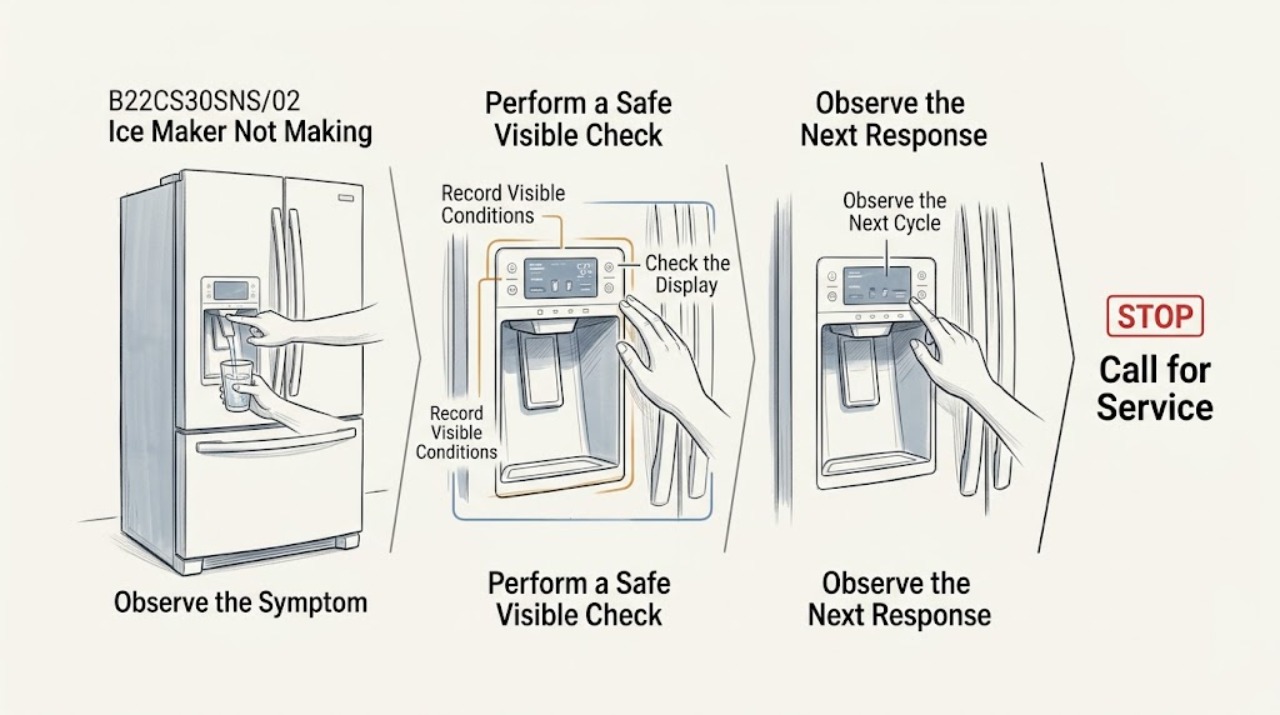
On the Bosch B22CS30SNS/02, normal water from the door dispenser does not prove that the ice maker can fill or harvest. Bosch's manual treats the water tap, ice-maker switch, ice-cube container engagement, freezer temperature, and the roughly 24-hour production period as separate checks. First confirm the complete E-Nr. and that the ice maker is enabled, then reseat the ice-cube container without reaching into the mechanism. Because the door dispenser works, record that water flow is normal and focus next on the ice-maker switch, bin engagement, freezer temperature, filter or ice-specific fill path, and whether the ice maker is making any sound or water. Do not force a harvest cycle, remove covers, disconnect tubing, or assume the inlet valve, filter, or ice-maker assembly has failed. If the ice maker remains dry after the manual's waiting period, or if there is a leak, abnormal noise, or a fault indication, leave it off and arrange Bosch service.
Work through in order
Diagnostic checks
Use only checks that match the exact appliance or system and its official guide.
-
Check 1
Read the complete model number from the refrigerator rating plate, including the slash suffix, and record whether the door dispenser provides a normal stream. Confirm that the symptom is no newly produced ice rather than only a jam at the dispenser outlet.
Expected result: The rating plate confirms B22CS30SNS/02; water flow is normal but the ice bin stays empty; the model suffix differs; or ice exists in the bin but will not dispense.
Next step: Keep the complete E-Nr. with the service notes. If ice is already in the bin but cannot exit, use the container/outlet branch rather than diagnosing a no-fill condition.
Stop if: Do not apply a different Bosch model's button sequence or open the dispenser chute to inspect it.
Why this matters
Why: The Bosch support page identifies B22CS30SNS/02 as a specific side-by-side refrigerator, while the manual distinguishes making ice from dispensing ice. A different suffix or a dispensing jam changes which manual and branch apply.
-
Check 2
Use the normal ice-maker control for this model to verify ice making is enabled, then remove and reinsert the ice-cube container only as the manual describes. Keep fingers and tools away from the ice-making mechanism.
Expected result: The ice maker was disconnected; the container was not engaged with its support; the display shows the ice-and-water function off; or the control and container were already correct.
Next step: Restore only the documented control and container position, close the freezer door, and allow the manual's normal production period. If the switch will not enable or the container will not engage, arrange service.
Stop if: Do not bypass a bin or door sensor, force the container, or reach into a moving or energized mechanism.
Why this matters
Why: Bosch lists a disconnected ice maker, a switched-off ice-and-water dispenser, and a container that is not engaged as independent reasons for no ice. These conditions can stop production even when the door water dispenser still works.
-
Check 3
Check the freezer display and door closure through ordinary user controls. Note whether the freezer is at its documented freezing setting, the door closes fully, and the ice maker was recently started or a large amount of ice was removed.
Expected result: The freezer is too warm, the door was left open or cannot seal, the ice maker was newly enabled, or the bin was recently emptied; otherwise the freezer and door appear normal.
Next step: Correct only a visible door obstruction or the model-documented control setting, then wait the manual's stated period once. Persistent warmth, a damaged seal, or no ice after the wait requires qualified service.
Stop if: Do not adjust leveling hardware, move the refrigerator, or repeatedly change temperature settings to force production.
Why this matters
Why: Bosch says the ice maker waits for freezing temperature and may take about 24 hours after startup or a large ice removal to begin or refill. A warm freezer or poor closure can prevent production without proving an ice-maker component failure.
-
Check 4
Without pulling the refrigerator or loosening a connection, check the accessible water shutoff, visible supply line, and filter status or seating as described for this model. Keep the working dispenser observation in the record rather than using it as a pressure test.
Expected result: The shutoff is closed or unknown, the visible line is kinked, the filter is overdue or not seated, dispenser flow is weak, or dispenser flow is normal while the ice maker remains dry.
Next step: Open only an accessible documented shutoff or follow the exact filter procedure. Stop for leaks or an unidentified connection; use a plumber for household plumbing and Bosch service for the appliance-side path.
Stop if: Do not bypass the filter, disconnect the water line, pull the appliance out, or test live water-valve wiring.
Why this matters
Why: A supply or filter restriction remains possible, but normal dispenser flow narrows the issue toward the ice-specific fill path, ice-maker control, sensor, or assembly. It does not prove an inlet valve or filter failure, and the manual's low-pressure warning is not a license to test by disconnecting tubing.
-
Check 5
Listen from outside the closed freezer for a normal ice-making sequence—water entering, the ice maker operating, or cubes dropping—without initiating a forced cycle. Record whether it is silent, repeatedly clicks or buzzes, fills but does not harvest, or leaks.
Expected result: There is no sound or water after the safe waiting period; water enters but cubes never form; cubes form but do not discharge; there is repeated abnormal clicking or buzzing; or water leaks.
Next step: Leave the ice maker off for a leak, abnormal noise, or repeated fault. For a dry ice maker after the documented wait with normal temperature, provide the E-Nr. and observations to Bosch service rather than entering a service mode.
Stop if: Do not remove covers, insert tools, force the ejector, chip ice with a sharp object, or make live measurements.
Why this matters
Why: The sound pattern separates a delayed or no-fill symptom from a possible harvest, sensor, control, or water-control issue, but it cannot identify a failed component without service diagnosis. A leak or abnormal repeated sound is a stop condition.
Use your observations
Decision map
Find the observation that best matches what you see, then follow the next safe action.
-
PATH 01Next step
What you see
The door dispenser stream is normal, the ice maker is enabled, the container is engaged, and the freezer is cold enough, but the ice maker remains completely dry after about 24 hours.
Do this next
Keep the ice maker off if it is abnormal or repeatedly failing and arrange Bosch service with the complete B22CS30SNS/02 E-Nr.; do not force a harvest or replace a part by symptom alone.
Why this path and its safety boundary
Why it matters: The working dispenser rules out a simple total loss of household water as the only explanation, while the dry mold points toward an ice-specific fill path, control, sensor, wiring, or ice-maker fault. It does not identify the inlet valve or assembly by itself.
-
PATH 02Next step
What you see
The ice maker was off, the container was not engaged, or the ice-and-water function showed off, and production resumes after the documented correction.
Do this next
Leave the container engaged and ice making enabled in its normal state, then monitor ordinary production. If the same condition returns without a new obstruction, request service.
Why this path and its safety boundary
Why it matters: A control or seating condition is more likely than a failed internal component. The fact that door water worked was consistent with this separate ice-maker control path.
-
PATH 03Next step
What you see
The freezer is too warm, the door cannot close or seal, the ice maker was recently enabled, or a large amount of ice was just removed.
Do this next
Correct only the documented ordinary condition and wait once for the stated production period. Escalate persistent warmth, seal damage, or no recovery to service.
Why this path and its safety boundary
Why it matters: Temperature, door recovery, or the manual's normal startup/refill delay can explain no or low ice without proving an ice-maker failure.
-
PATH 04Next step
What you see
The dispenser works normally but the visible water line is kinked, the filter is not seated, the shutoff is closed, or water is leaking.
Do this next
Use only the exact manual's accessible filter or shutoff guidance. Stop at any leak or connection work and use a plumber or Bosch appliance technician as appropriate.
Why this path and its safety boundary
Why it matters: A restriction or installation-side water problem remains possible despite dispenser operation; the working dispenser cannot prove the pressure or ice-maker branch is healthy.
-
PATH 05Next step
What you see
The ice maker clicks or buzzes abnormally, leaks, shows a fault, remains stuck, or would require a cover removal, forced cycle, wiring test, or tubing disconnection.
Do this next
Stop using the ice maker, isolate water or power only when that can be done safely, and arrange qualified Bosch service with the model and recorded observations.
Why this path and its safety boundary
Why it matters: The symptom has reached an internal or water/electrical service boundary. The manual's self-test and customer-service directions are not a basis for consumer disassembly.
Helpful context
Understand the symptom
Why a working water dispenser does not clear the ice maker
The exact symptom has a useful split: water comes from the door, but the automatic ice maker produces no new cubes. Bosch's manual describes water entering the ice maker only after the freezer reaches freezing temperature, and it separately lists the ice-maker switch, container engagement, freezer temperature, and low water pressure as ice-related checks. Normal dispenser flow therefore makes a complete household water interruption less likely, but it does not identify an ice-specific restriction, control, fill path, sensor, or ice-maker fault.
What the community report adds
A Reddit post matches the assigned B22CS30SNS/02 condition: the door dispenser works and even dispensing bagged ice works, but the appliance does not make new ice. The post does not establish a repair or failed part, so it is useful for symptom identity only, not as permission to repeat breaker cycling or replace a component.
Only after diagnosis
Potential parts
- refrigerator ice-maker assembly
Consider this category only after the exact model, control, bin, temperature, water, filter, and safe waiting checks are normal and Bosch service confirms an internal ice-maker fault.
The opened Bosch support page identifies the exact /02 appliance, but no part fit is established here; confirm the complete E-Nr. and Bosch compatibility before ordering. - refrigerator water inlet valve
Consider this category only if model-specific service testing confirms the ice-maker fill path or valve is the failed stage; normal door-water flow alone is not enough.
Do not infer valve compatibility or failure from a working dispenser. Bosch service should match any replacement to the complete E-Nr.
When checks do not resolve it
Need a professional?
Arrange Bosch or qualified appliance service when the ice maker remains dry after the documented control, bin, freezer, water, filter, obstruction, and waiting checks; when the control will not enable; or when the ice maker clicks abnormally, leaks, repeatedly faults, or would require internal access.
Common questions
FAQ
If the door water dispenser works, is the refrigerator definitely getting enough water for ice?
No. It makes a complete household water interruption less likely, but Bosch lists ice-maker-specific causes such as a disconnected ice maker, low pressure, freezer temperature, and the ice-maker fill/harvest sequence. Normal dispenser flow cannot prove the ice-specific path or a valve is good.
How long should I wait after turning the ice maker on or emptying the bin?
The B22CS30SNS manual says approximately 24 hours for ice production to start after recent startup and approximately 24 hours for the container to fill again after a large amount of ice is removed. Use that period once after the normal checks; repeated cycling is not a diagnostic test.
Should I run the Bosch self-test or force the ice maker to harvest?
Do not force a harvest or open the ice maker. The manual describes a self-test that reports faults for customer service, but the safe user boundary here is to record the exact model and observations and arrange service if the normal checks do not restore production.
Read the exact guide
Official sources
- Appliance Information - Freestanding Counter-Depth Side-by-Side Refrigerator | B22CS30SNS/02BSH Home Appliances Corporation · Exact Bosch US product-service page for the assigned model and suffix; it links the model's manuals, owner support, replacement-parts lookup, and service resources.
- B22CS.. USE AND CARE GUIDEBSH Home Appliances Corporation · Official B22CS family PDF opened for the assigned Bosch B22CS30SNS/02. It covers the ice maker, door dispenser, water connection, ice-cube container, temperature, waiting period, safety, and troubleshooting; use the complete E-Nr. if a suffix-specific instruction differs.
- Bosch B22CS30SNS/02 Ice Dispenser Not Making IceReddit r/appliancerepair · Lived-experience symptom match only; it does not verify a repair, part failure, or safe diagnostic procedure.
Community feedback
Share a repair observation
Share a plain-text repair observation. Accepted observations are published automatically; this page may take a moment to update.