
On this page
Start here
Quick answer
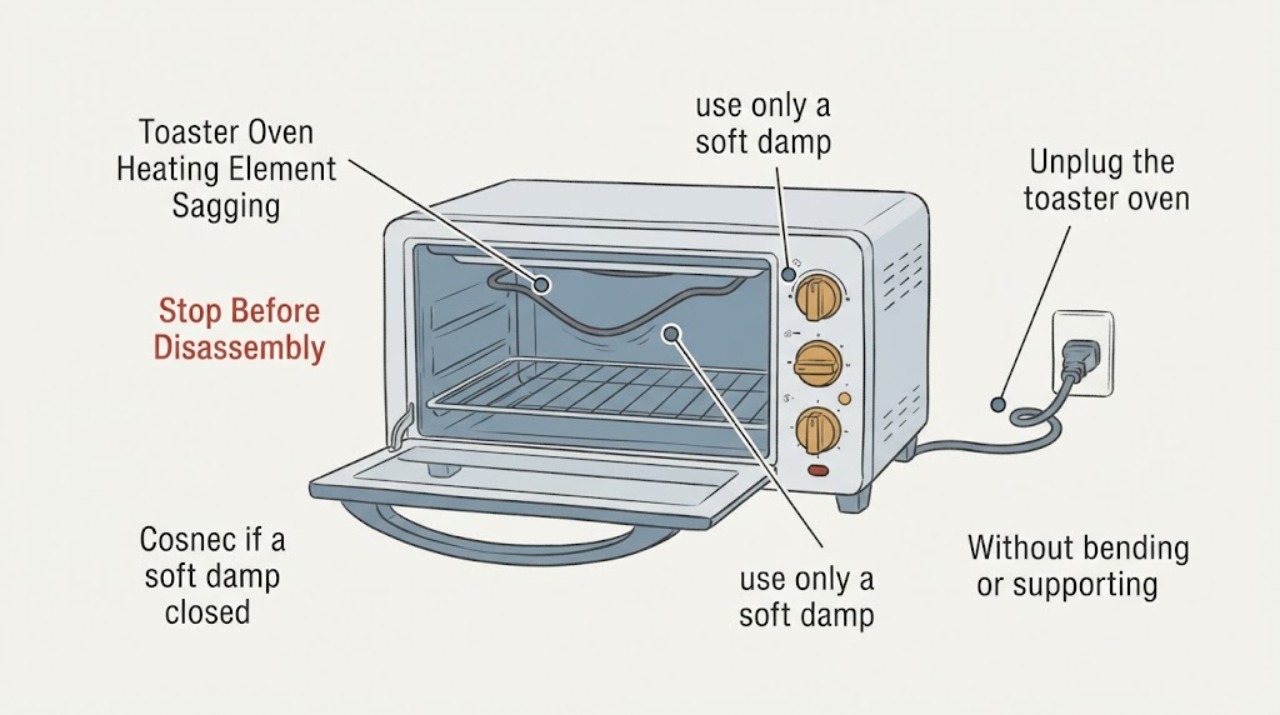
A sagging Breville toaster-oven heating element should be treated as a safety check, not a part-ordering decision. Unplug the oven and let it cool completely. Inspect only for loose debris or cleaner residue; Breville says to use a soft damp cloth, no cleaning agents, and to ensure the element is dry and debris-free before reconnecting power. If the element is cracked, loose, touching another surface, remains sagged, or produces smoke or odor, keep the oven unplugged and arrange service.
Work through in order
Diagnostic checks
Use only checks that match the exact appliance or system and its official guide.
-
Check 1
Unplug the toaster oven and allow it to cool completely before looking at the sagging element.
Expected result: The element is cool and merely displaced, or it is cracked, loose, touching the tray or wall, or showing damaged insulation.
Next step: Do not plug it in to test a damaged or contacting element. Photograph the condition and arrange Breville or qualified service.
Why this matters
Why: Breville’s cleaning guidance requires the oven unplugged and cool; visible damage or contact creates a fire or electrical hazard beyond cleaning.
-
Check 2
Without bending or supporting the element, inspect for crumbs, cleaner residue, or a foreign object that could hold it down.
Expected result: Debris is present, the element is clean, or the element remains sagged without an obstruction.
Next step: Remove only loose debris from a fully cool, unplugged surface. Do not reshape, pull, or fasten the element.
Why this matters
Why: Debris can obstruct a sensitive heating element, but a clean element that sags may indicate a mechanical support or element fault.
-
Check 3
If the exact model guide permits cleaning, use only a soft damp cloth and no cleanser on the quartz element.
Expected result: The element remains intact and returns to its normal position without force, or it stays sagged or wet.
Next step: Let all surfaces dry fully. If the element stays sagged, keep the oven unplugged and request service rather than ordering a part from appearance alone.
Why this matters
Why: Breville warns against cleaning agents and requires the element dry and debris-free before power is restored.
-
Check 4
Before any possible reuse, check that the element is dry, has clearance from accessories, and has no smoke or odor history.
Expected result: The element is dry and stable, or any clearance, smoke, odor, or electrical warning remains.
Next step: Do not energize the oven when the element is unstable or damaged. Give service the model, photos, and cleaning history.
Why this matters
Why: Dry and debris-free is a prerequisite for safe restoration; instability or warning signs are unresolved.
Use your observations
Decision map
Find the observation that best matches what you see, then follow the next safe action.
-
PATH 01Next step
What you see
The element is intact, dry, unobstructed, and stable after cooling and permitted cleaning.
Do this next
Use the exact model instructions and stop immediately if the element moves, smokes, or heats abnormally.
Why this path and its safety boundary
Why it matters: A cleaning residue or loose debris may have contributed, but the visual condition still needs the model guide’s approval.
-
PATH 02Next step
What you see
The element is cracked, loose, touching another surface, remains sagged, or cannot be made dry and stable.
Do this next
Keep the toaster oven unplugged and arrange qualified service.
Why this path and its safety boundary
Why it matters: A support or heating-element fault is possible and cannot be safely corrected by reshaping.
-
PATH 03Next step
What you see
Smoke, burning odor, arcing, or damaged cord appears during or after a test.
Do this next
Disconnect power if safe and keep the toaster oven out of use until qualified service evaluates it.
Why this path and its safety boundary
Why it matters: This is an electrical/fire safety stop condition.
Helpful context
Understand the symptom
A sagging Breville toaster-oven heating element should be treated as a safety check, not a part-ordering decision. Unplug the oven and let it cool completely. Inspect only for loose debris or cleaner residue; Breville says to use a soft damp cloth, no cleaning agents, and to ensure the element is dry and debris-free before reconnecting power. If the element is cracked, loose, touching another surface, remains sagged, or produces smoke or odor, keep the oven unplugged and arrange service.
When checks do not resolve it
Need a professional?
Provide the exact model and the observed pattern to the manufacturer or a qualified technician.
Common questions
FAQ
What should I do first?
A sagging Breville toaster-oven heating element should be treated as a safety check, not a part-ordering decision. Unplug the oven and let it cool completely. Inspect only for loose debris or cleaner residue; Breville says to use a soft damp cloth, no cleaning agents, and to ensure the element is dry and debris-free before reconnecting power. If the element is cracked, loose, touching another surface, remains sagged, or produces smoke or odor, keep the oven unplugged and arrange service.
Read the exact guide
Official sources
- How to clean a toaster oven: Tips & tricksBreville · Breville toaster oven heating element sagging during cleaning
Community feedback
Share a repair observation
Share a plain-text repair observation. Accepted observations are published automatically; this page may take a moment to update.