
On this page
Start here
Quick answer
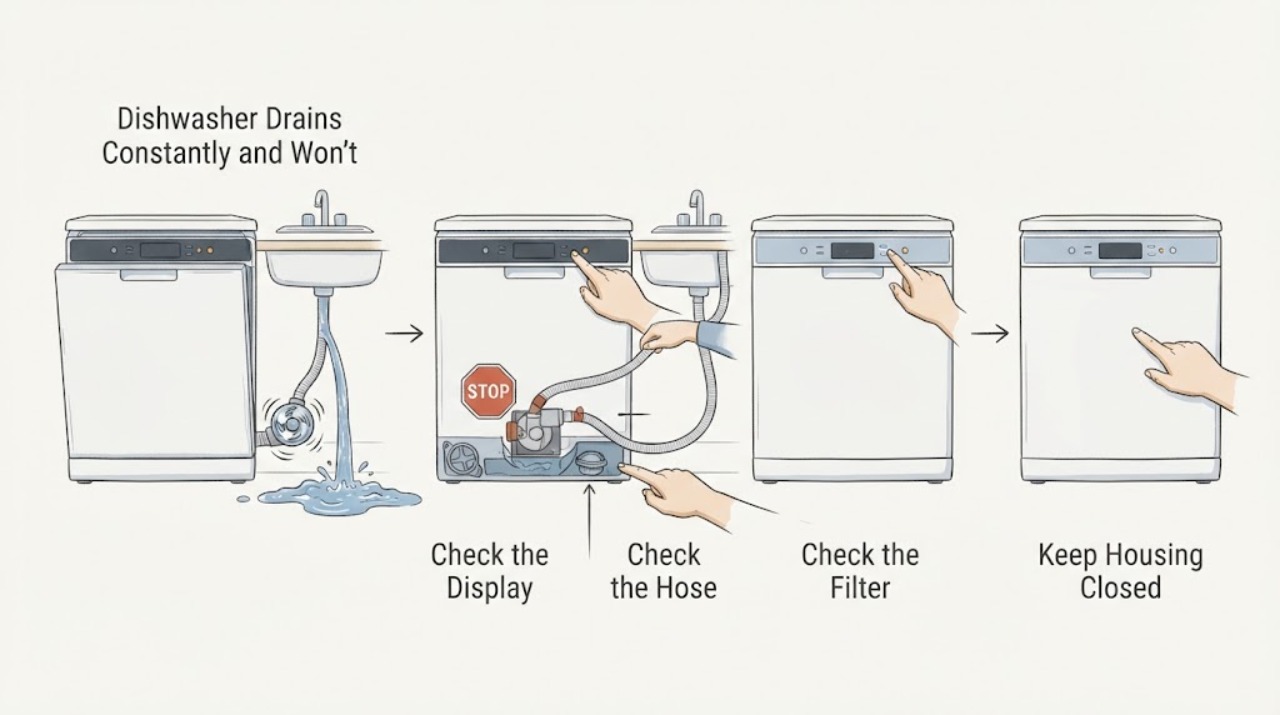
If the Candy CDPN 2L350SA-47 starts draining as soon as the door closes and never starts a wash programme, stop repeated start attempts. Close the dishwasher's water tap and disconnect power only if the area is dry and the disconnect is safely accessible. Candy's drainage guidance points first to the drain hose, sink connection, filters, and pump, while a recurring problem after those external checks can involve a leak, water-level or safety response, pump, or electronic control. Check the hose for a kink, crushing, a loose connection, or a drain setup that allows siphoning; with power isolated, clean only the accessible filter area as the model manual permits. Do not tilt the dishwasher, open its base, bypass the door or water-safety system, or replace a pump or control based on the symptom. Use Candy's official manual portal with the exact model CDPN 2L350SA-47 and arrange authorised service if the pump still runs continuously, there is water under the appliance, an error or flashing programme light appears, or the dishwasher will not start after the external checks.
Work through in order
Diagnostic checks
Use only checks that match the exact appliance or system and its official guide.
-
Check 1
Turn the programme control off, close the dishwasher water tap, and disconnect power only if the floor, plug, and disconnect are dry and safely accessible.
Expected result: The pump stops after power is isolated, or water, a wet electrical area, smoke, a burning smell, or repeated electrical trips is present.
Next step: Keep the dishwasher out of use and arrange authorised Candy or qualified appliance service. Seek urgent help for active smoke, fire, or an immediate electrical hazard.
Stop if: Do not reach into wet areas, run another programme, tilt the dishwasher, or open its base to search for a leak.
Why this matters
Why: A continuous pump with a no-start condition is not a normal reason to keep retrying. Water or electrical signs raise the urgency because the cause may involve a leak or water-safety response.
-
Check 2
From the accessible exterior, trace the drain hose to the sink or waste connection and check for kinks, crushing, a loose connection, or a low or submerged arrangement that could allow siphoning. Do not force the appliance out of cabinetry.
Expected result: The hose is kinked, crushed, loose, incorrectly routed, or visibly clear and connected.
Next step: Correct only an obvious accessible routing or connection issue according to the exact Candy manual and installation instructions. If the pump still runs, stop and request service.
Stop if: Do not disconnect a pressurised or wet hose, dismantle the sink trap without a safe setup, or make an unverified permanent plumbing change.
Why this matters
Why: A hose restriction, poor connection, or siphoning setup can disturb the intended water path and make the dishwasher appear unable to start. A clear visible hose does not rule out an internal fault.
-
Check 3
With power isolated and the water supply closed, remove and rinse only the accessible tub filters as described by the exact model manual. Inspect the filter seat for loose food debris or a visible glass fragment, then refit the filters fully.
Expected result: The filters or accessible filter seat are blocked, damaged, incorrectly seated, or clear and correctly seated.
Next step: Remove only loose accessible debris, refit the filters, and make at most one cautious test only if there was no leak or electrical hazard. If continuous draining returns, keep the unit off and call service.
Stop if: Do not put fingers or tools into an unseen pump, remove the pump cover, or operate the dishwasher without its filters.
Why this matters
Why: Candy identifies blocked filters and pump areas as possible drainage problems. A clear filter makes an obstruction less likely but cannot clear an internal pump, sensor, leak, or control fault.
-
Check 4
Use Candy's official manual portal to retrieve the instructions for CDPN 2L350SA-47, then check the documented programme-cancel or reset sequence and the meaning of any flashing programme light or beep.
Expected result: The manual documents a cancellation or reset that clears the condition, or the pump immediately resumes and the dishwasher still will not start.
Next step: If one documented cancellation resolves the symptom and the dishwasher completes a normal cycle, monitor it. Otherwise stop repeated resets and provide the indicators to authorised service.
Stop if: Do not guess button combinations, bypass the door interlock, or open the control panel.
Why this matters
Why: A documented control sequence can clear a stored programme, but a continuous drain that returns immediately points beyond an ordinary selection or delay setting.
-
Check 5
Record whether the pump starts when the door closes, whether it continues with the door open, whether any water is under the unit, and the exact lights, beeps, or displayed code. Include the model and product code in the service request.
Expected result: The pump runs only with the door closed, runs regardless of door position, stops after an external correction, or continues with all visible conditions normal.
Next step: Send the record and photographs of safe, dry external connections to Candy support or an authorised technician. Keep the dishwasher unused until a persistent condition is diagnosed.
Stop if: Do not restore power repeatedly to reproduce the symptom, probe wiring, or replace an internal component based only on pump noise.
Why this matters
Why: The timing helps a technician separate a door or programme interaction from an ongoing drainage, water-safety, pump, sensor, wiring, or control issue; it does not identify a replaceable part by itself.
Use your observations
Decision map
Find the observation that best matches what you see, then follow the next safe action.
-
PATH 01Next step
What you see
The pump runs continuously, the programme never starts, and there is water under the dishwasher, a wet base area, or another leak sign.
Do this next
Close the water tap, isolate power only if safe and dry, do not tilt or open the base, and arrange authorised Candy service.
Why this path and its safety boundary
Why it matters: A leak or water-safety response is more likely than an ordinary delayed start. The pump may be responding to a water condition that cannot be safely diagnosed from the controls.
-
PATH 02Next step
What you see
The drain hose or sink connection is kinked, crushed, loose, low, submerged, or routed contrary to the model's installation instructions, and there is no electrical hazard.
Do this next
Correct only the accessible routing or connection using the CDPN 2L350SA-47 instructions, then make at most one normal start attempt. If the pump still runs, call service.
Why this path and its safety boundary
Why it matters: An external drainage or siphoning condition is more likely than a confirmed failed control board or pump.
-
PATH 03Next step
What you see
The hose, sink connection, and accessible filters are clear and correctly fitted, but the pump still runs continuously and no programme begins.
Do this next
Keep the appliance off and request authorised service with the exact model, pump timing, indicator pattern, and any water observations.
Why this path and its safety boundary
Why it matters: An internal pump, water-level or leak sensor, wiring, or control fault is more likely. The symptom does not prove which component has failed.
-
PATH 04Next step
What you see
The pump stops after one documented programme cancellation or after correcting an obvious external hose or filter condition, and the dishwasher completes a normal cycle without a leak or abnormal noise.
Do this next
Monitor the next normal use and stop immediately if continuous draining, a leak, an error, or an electrical symptom returns.
Why this path and its safety boundary
Why it matters: The result supports a stored control state or accessible drainage condition, but it does not guarantee that a recurring fault is gone.
Helpful context
Understand the symptom
Why continuous draining changes the diagnosis
A short drain phase can be part of a normal programme, but a pump that keeps running while the selected programme never begins is a different pattern. It can reflect an external drainage or siphoning problem, water detected where it should not be, a blocked or damaged drain path, or an internal pump, sensor, or control fault. Treat that list as a set of diagnostic branches, not as proof that one component has failed.
Start with the external drainage path
With the dishwasher off, inspect the visible drain hose from the back to the sink or waste connection. Look for a kink, crushing, a loose connection, or an arrangement that lets the hose siphon continuously. Candy's guidance says a badly positioned or obstructed hose can disrupt drainage and directs owners to follow the manufacturer's installation recommendations. Do not pull the appliance out or change the plumbing if doing so would strain a connection or expose water near electricity.
Clean only the accessible filter area
If the floor and electrical area are dry, close the water tap and isolate power before opening the door. Remove standing water with a cloth, then inspect the removable filters at the bottom of the tub for food debris or glass. Candy says blocked filters and pump areas can disrupt drainage. Refit every filter correctly before any future test. A clean filter does not prove that the pump, water-level sensing, leak response, or control circuit is healthy.
Use the exact model manual for controls
The CDPN 2L350SA-47 uses model-specific programme and cancellation controls. Candy's official manual portal asks you to select the product line and exact model or product code before downloading the matching instructions. Use that manual to identify the normal cancellation or reset sequence and any visible indicator meaning. Do not keep repeating a reset while the pump runs continuously, and do not treat a flashing programme light as proof of a particular failed part.
When service is the next safe step
If the hose, sink connection, accessible filters, and documented control sequence do not stop the continuous drain, the remaining possibilities include an internal leak or water-safety response, a pump or sensor problem, wiring, or the control system. Candy's official guidance says persistent drainage faults can require a repairer. Give service the exact model, when the pump starts, whether it stops with the door open, any water under the unit, and every light or beep pattern. Do not select a replacement pump or control from a similar Candy model.
When checks do not resolve it
Need a professional?
Contact Candy or an authorised appliance technician when continuous draining returns after the exact manual's external checks, when there is water under the dishwasher, a persistent error or flashing programme light, a pump that runs with no programme, or any electrical or water hazard. Provide CDPN 2L350SA-47, product code if available, serial information, pump timing, hose and filter observations, and photographs of safe external connections. Do not replace the drain pump, sensor, or control board without an exact-model diagnosis.
Common questions
FAQ
Why does my Candy CDPN 2L350SA-47 keep draining and refuse to start?
The combined symptom can come from a drainage or siphoning condition, water detected where it should not be, a blocked or damaged drain path, or an internal pump, sensor, wiring, or control fault. Check the accessible hose connection and filters with power isolated and use the exact Candy manual for the documented cancellation sequence. If the pump continues, keep the dishwasher off and arrange authorised service.
Should I keep pressing Start until the dishwasher begins?
No. Repeated starts can mask a persistent drainage or water-safety condition. Close the water tap and isolate power only when safe, perform the limited external checks, and stop if the pump immediately resumes or any leak or electrical warning appears.
Could the drain pump itself be broken?
It is one possibility, but continuous pump operation can also be associated with the hose, filter, siphon, water-level or leak response, wiring, or control system. The symptom alone cannot identify a compatible replacement pump. Ask authorised service to diagnose the exact CDPN 2L350SA-47 before ordering parts.
Where can I find the correct Candy manual?
Use Candy's official manual portal and enter the exact product model or product code. Select CDPN 2L350SA-47 rather than relying on a similar CDPN model, because programme cancellation, indicators, maintenance access, and installation details can vary.
Read the exact guide
Official sources
- Manuales de usuario para tus electrodomésticosCandy Spain · Official Candy manual portal; enter the exact CDPN 2L350SA-47 model or product code to obtain the matching manual before using a reset, programme, or maintenance instruction.
- Vidanger un lave-vaisselle : 5 astuces d'entretienCandy France · Official Candy dishwasher drainage guidance used for the safe external checks and the boundary that persistent drainage problems involving the pump or internal fault require a repairer; exact model instructions still control.
- De l'eau remonte dans mon lave-vaisselleCandy France · Official Candy drainage support article used for external hose routing, siphoning, filter, pump, installation, and service branches; use the exact CDPN 2L350SA-47 manual for model-specific dimensions or controls.
- Everything You Need To Know About Your Dishwasher LeakingCandy · Official Candy dishwasher leak guidance used for the water and electrical stop boundary and for separating visible hose or drainage leaks from internal faults.
Community feedback
Share a repair observation
Share a plain-text repair observation. Accepted observations are published automatically; this page may take a moment to update.