
On this page
Start here
Quick answer
If a Candy washing machine leaves water in the drum, first check that the selected programme was not designed to hold water or skip the final drain or spin. Keep children and pets away from the water, turn the machine off, and disconnect it from power only when the plug, floor, and drain area are dry and safely accessible. Candy identifies a kinked or blocked drain hose, a blocked pump filter or pump, foreign objects in the pump, excessive suds, and an obstructed household drain as common causes. Check the hose and its connection, then use the exact Candy manual for a controlled filter drain and cleaning procedure; residual water may be hot. If the pump still does not run, the machine leaks, the breaker trips, a filter cannot be opened safely, water remains after the approved check, or internal electrical work is needed, stop and arrange qualified Candy appliance service.
Before you begin
Safety first
- This article covers programme identification, dry external hose observations, and only the exact Candy manual's user-accessible filter or drain procedure. Do not force the door, work near hot or wet electrical parts, test live circuits, open panels, or dismantle the pump or water-level system.
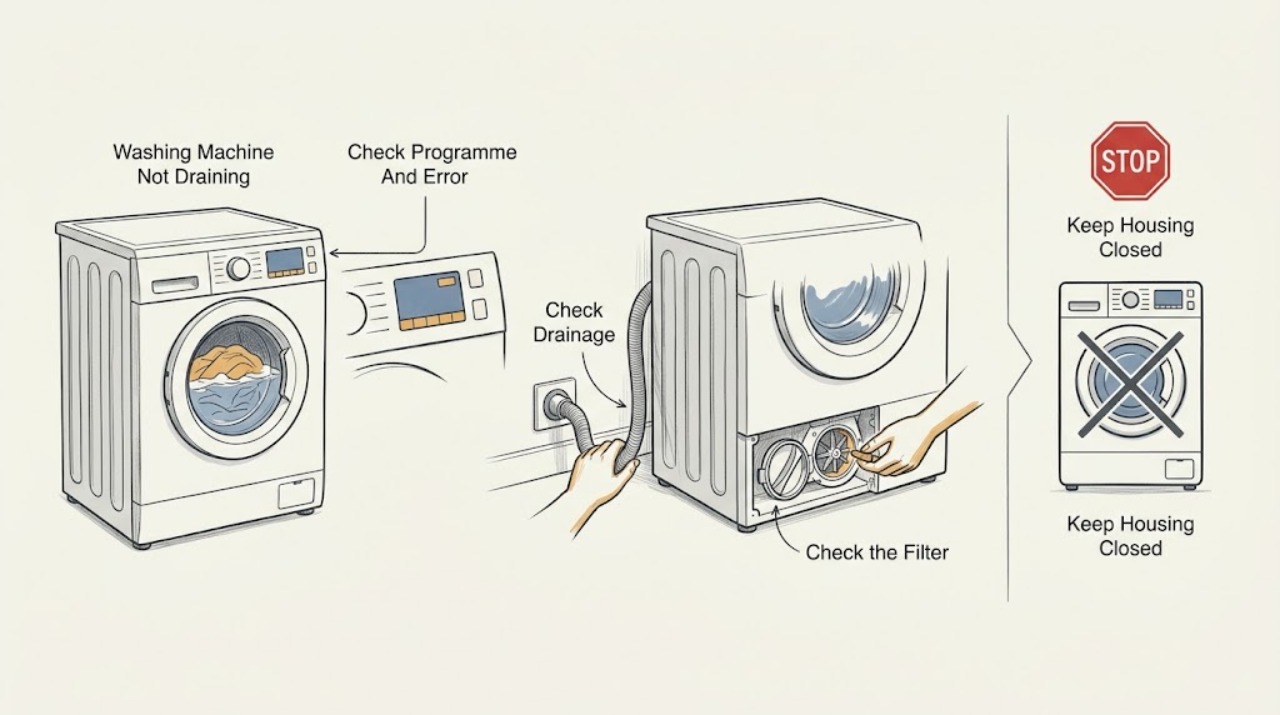
Work through in order
Diagnostic checks
Use only checks that match the exact appliance or system and its official guide.
-
Check 1
Keep the door closed if possible and read the selected Candy programme and display. Check whether the programme intentionally holds water, skips final drain or spin, or shows a drainage message such as a model-specific filter or drain error. Note whether the drum is full, partly full, or simply has damp laundry.
Expected result: A hold-water or anti-crease-style option is selected, a drainage error is shown, the drum contains significant water, or no programme or error explains the symptom.
Next step: Use the exact manual to cancel or select a drain programme only when the machine and floor are safe. If water remains or a drain error returns, switch off and isolate power safely before inspecting the external hose.
Stop if: Do not force the door, reach through standing water, repeatedly restart a blocked cycle, or test an unknown programme with the machine unattended.
Why this matters
Why: Candy says some programme options exclude final drainage or spin, while its manuals identify drainage errors when water is not fully drained in the expected time. A true full-drum symptom needs a controlled drain-path check rather than a new wash cycle.
-
Check 2
With the machine off, inspect the visible drain hose from the back to its sink, standpipe, or waste connection. Look for kinks, crushing, a loose or submerged end, an incorrect connection, or a blocked household drain; do not pull the machine out if it is heavy, built in, or unsafe to access.
Expected result: The hose is kinked or crushed, its end is submerged or incorrectly positioned, the household drain is blocked, or the external path appears clear and secure.
Next step: Correct only an obvious accessible hose position or connection using the exact manual, and clear only a household drain obstruction that can be addressed without opening the appliance. Run one appropriate drain test if safe.
Stop if: Do not extend or cut the hose, move a heavy machine alone, disconnect a pressurized connection, or open the appliance to reach an internal hose.
Why this matters
Why: Candy identifies a bent or blocked drain hose and an obstructed household drain as causes of retained water. Its manual warns that incorrect hose placement can cause siphoning or drainage problems; a clear external path leaves the filter, pump, or internal sensing path in consideration.
-
Check 3
If the external path is clear and the exact Candy manual provides a user-accessible filter procedure, disconnect power from a dry accessible plug, protect the floor with towels and a low container, drain slowly, and clean the filter. Inspect only the accessible pump inlet for lint, coins, buttons, or other debris; do not force the impeller.
Expected result: Water drains through the filter, the filter is blocked, a foreign object is visible, the pump impeller cannot move freely, or little or no water exits despite a clear filter.
Next step: Reinstall the filter securely only as the model manual shows, check for leaks with a small safe test if permitted, and run one drain test. If the pump remains silent, water does not leave, or the filter is unsafe to open, arrange service.
Stop if: Do not open the filter while powered, handle hot water, push tools into the pump, force a stuck cap, or remove panels or electrical parts.
Why this matters
Why: Candy says a blocked filter, pump obstruction, or small object can prevent drainage and that the pump turbine must be able to turn. Little or no flow with a clear filter can indicate a pump, hose, or deeper restriction rather than a reason to dismantle the machine.
-
Check 4
After the drain path and filter are safe, note whether the drum contains excessive foam, whether water returns after a drain, and whether the problem began with a detergent change, a very small or heavy load, or a recent installation. Do not add more detergent or run repeated full cycles to clear the symptom.
Expected result: The drum is full of suds, the drain works but water returns, the issue follows a particular programme or detergent load, or the symptom persists with normal detergent and an empty test.
Next step: Use the exact manual and detergent guidance, correct only an obvious external hose or drain arrangement, and run one suitable rinse or drain test. Arrange service for repeated re-entry, error messages, or persistent no-drain behavior.
Stop if: Do not pour chemicals into the machine, use an improvised siphon, dismantle the inlet valve, or keep operating with a leak or electrical moisture.
Why this matters
Why: Candy identifies excess detergent suds as a factor that can compromise both spinning and drainage. Water returning after a successful drain points toward hose installation, a household drain, or a valve or water-level issue rather than a simple pump blockage.
-
Check 5
Record the Candy model and serial information, programme and error message, water level, hose route, filter condition, pump sound, whether the impeller was accessible, detergent or suds condition, and the result of any approved drain test. Stop before opening panels or testing wiring.
Expected result: Drainage returns after a safe correction, the pump remains silent, an error returns, water leaks, the breaker trips, or the machine drains normally after the approved filter or hose check.
Next step: Keep the appliance off if the fault persists or water is unsafe, protect the floor, and arrange qualified Candy appliance or electrical service with the model and observation record.
Stop if: Do not continue a wash with standing water, a leak, a tripping breaker, a damaged cord, water near electrical parts, or any need for internal access.
Why this matters
Why: Recovery after a visible hose, programme, detergent, or filter correction supports that branch. Persistent or recurring failure can involve the pump, pressure or water-level system, wiring, control, valve, or household drain; the symptoms do not identify a replacement part alone.
Use your observations
Decision map
Find the observation that best matches what you see, then follow the next safe action.
-
PATH 01Safety boundary
What you see
The selected Candy programme intentionally holds water or omits final drainage or spin.
Do this next
Use the exact manual to cancel the hold or select a drain programme once, if safe.
Why this path and its safety boundary
Why it matters: The appliance may be following the programme rather than suffering a drain failure.
Safety stop: Arrange service if water remains after the correct drain command or a drainage error returns.
-
PATH 02Safety boundary
What you see
The external hose is kinked, crushed, submerged, incorrectly installed, or the household drain is obstructed.
Do this next
Correct only an obvious accessible hose or connection issue and clear a safe household drain obstruction according to the manual.
Why this path and its safety boundary
Why it matters: An outlet or installation restriction can stop or reverse drainage without proving that the pump has failed.
Safety stop: Do not move a heavy appliance alone, extend the hose, or open internal plumbing.
-
PATH 03Safety boundary
What you see
The hose path is clear and the filter contains debris, the pump inlet is obstructed, or the manual shows a filter or drain error.
Do this next
Isolate power safely, drain slowly, and clean the accessible filter and pump inlet only by the exact manual.
Why this path and its safety boundary
Why it matters: A blocked filter, pump, or foreign object can prevent the pump from moving water.
Safety stop: Arrange service for hot water, a stuck filter, no flow after cleaning, a silent pump, a leak, or any internal access.
-
PATH 04Safety boundary
What you see
The machine has excessive foam, drains but water returns, or the symptom follows a detergent or installation change.
Do this next
Use the exact detergent and hose guidance, perform one safe rinse or drain test, and arrange service if the issue recurs.
Why this path and its safety boundary
Why it matters: Suds can interfere with spin and drainage, while returning water points toward hose installation, the household drain, or a water-level or valve issue.
Safety stop: Do not add chemicals, dismantle valves, or continue with a leak or unsafe water level.
-
PATH 05Safety boundary
What you see
The filter and external path are clear but the pump is silent, drainage remains incomplete, or the pump works only intermittently.
Do this next
Keep the machine off, protect the floor, preserve the error and sound record, and arrange qualified Candy service.
Why this path and its safety boundary
Why it matters: A pump, control, wiring, pressure or water-level system, or deeper restriction may be involved and cannot be identified by sight alone.
Safety stop: Do not test live circuits, remove panels, or keep retrying a blocked drain cycle.
-
PATH 06Safety boundary
What you see
Water is near an outlet or electrical part, the machine leaks heavily, the breaker trips, the cord is damaged, or the filter cannot be opened safely.
Do this next
Use a safe accessible shutoff only if it can be reached without contact with water or damage, keep people away, and arrange qualified appliance or electrical service.
Why this path and its safety boundary
Why it matters: Flood, shock, and fire prevention take priority over drainage troubleshooting.
Safety stop: Do not step into water, touch wet electrical parts, pull a damaged cord, or restart the machine.
Helpful context
Understand the symptom
A full drum needs a controlled first response
Do not repeatedly start a wash or force the door when water remains. A Candy programme may intentionally hold water, or a drain failure may leave the door locked. Identify the programme and any display message first; then isolate power only from a dry, safe position before opening a low filter or drain point. The exact model manual controls whether an emergency hose, filter, or another drain arrangement is fitted.
Work from the outlet back toward the pump
A drain hose can be kinked, blocked, submerged, badly positioned, or connected to a blocked household standpipe or sink connection. Candy's manual also warns that incorrect hose height or a hose end in water can cause siphoning or installation problems. Inspect the external path before opening the pump area; this separates a plumbing or installation restriction from a filter or pump fault.
Residual water and electricity require a hard stop
Water trapped in the machine may be hot and can spill quickly when a filter cap is loosened. Put down towels and use a low container only if the exact manual permits the procedure and the area is dry and stable. Do not reach into a pump while powered, use live-voltage tests, force a stuck filter, or continue when water is near an outlet, damaged cord, or control board.
Safety boundary
Stop conditions
- Stop immediately for water near an outlet or electrical part, a damaged cord, a repeat breaker trip, heavy leakage, smoke, burning odor, or a filter that cannot be opened safely.
- Do not force the door, reach into a powered pump, handle hot residual water, use live-voltage tests, or remove panels or electrical components.
- Do not extend or cut the drain hose, use an improvised siphon, pour chemicals into the machine, or dismantle an inlet valve, pressure system, or pump.
- Disconnect power before an exact manual-approved filter or drain procedure only when the plug, floor, water, and drain area are dry and safely accessible.
- Arrange qualified Candy service when the correct programme, hose, filter, pump-access, and detergent checks do not restore drainage or when internal diagnosis is needed.
Only after diagnosis
Potential parts
- Candy-compatible drain pump or pump filter assembly
Consider this category only if the external drain path and accessible filter are clear and qualified diagnosis confirms a failed or obstructed pump.
Confirm the exact Candy model, pump configuration, filter arrangement, and manufacturer fit information before ordering or replacing a pump. - Candy-compatible drain hose
Consider this category only if inspection or testing confirms a split, crushed, restricted, or model-specific hose that cannot be corrected by safe repositioning.
Confirm the exact Candy model, hose length and fittings, approved routing, and leak-check procedure before replacement. - Candy-compatible pressure or water-level sensor
Consider this category only if qualified diagnosis links persistent drain errors or water re-entry to the water-level sensing system after the drain path is clear.
Confirm the exact Candy model, sensor type, hose routing, connector, and manufacturer fit information; do not bypass a water-level safety system. - Candy-compatible drain control or wiring assembly
Consider this category only when qualified electrical testing confirms a control or wiring fault after the pump and drain path are assessed.
Confirm the exact Candy model, board or harness revision, electrical diagnosis, and approved service procedure before replacement.
When checks do not resolve it
Need a professional?
Arrange qualified Candy appliance service when a correct programme, clear external hose and household drain, approved filter procedure, and safe detergent check do not restore drainage, or when the pump is silent, a drainage error returns, water re-enters, the machine leaks, or a pressure, control, valve, pump, or wiring diagnosis is needed. Stop immediately for water near electricity, a damaged cord, heavy leakage, smoke, burning odor, or a repeat breaker trip and use qualified electrical service for a supply concern.
Safety scope: This article covers programme identification, dry external hose observations, and only the exact Candy manual's user-accessible filter or drain procedure. Do not force the door, work near hot or wet electrical parts, test live circuits, open panels, or dismantle the pump or water-level system.
Common questions
FAQ
Why is water still in my Candy washing machine after the cycle?
Check whether the programme intentionally held water, then inspect the external drain hose and household drain. If those are clear, use the exact Candy manual for a safe filter and pump check; a blocked filter, foreign object, or pump fault can prevent drainage.
Can too much detergent stop a Candy washer from draining?
Candy identifies excessive suds as a possible cause that can compromise drainage and spinning. Follow the model's detergent guidance and stop if water remains, an error returns, or the machine leaks rather than running repeated full cycles.
Is it safe to open a Candy washing-machine pump filter with water in the drum?
Only follow the exact model manual when the machine is disconnected from power, the plug and floor are dry, and towels and a low container can control the water. Residual water may be hot. Do not force a stuck filter or work near wet electrical parts; arrange qualified service instead.
Read the exact guide
Official sources
- The washing machine won't drain, what should I do?Candy · Applies to Candy washing machines as general guidance; the exact model manual controls filter location and drain procedure.
- Technical assistance for our appliancesCandy · Applies when a Candy washing-machine drainage fault needs model-specific support or qualified repair.
- Candy Washing Machine User Manual CO CSO3D 3TEUKCandy · A Candy washing-machine manual used for general drain and safety semantics; the user's exact model manual controls the final procedure.
Community feedback
Share a repair observation
Share a plain-text repair observation. Accepted observations are published automatically; this page may take a moment to update.