
On this page
Start here
Quick answer
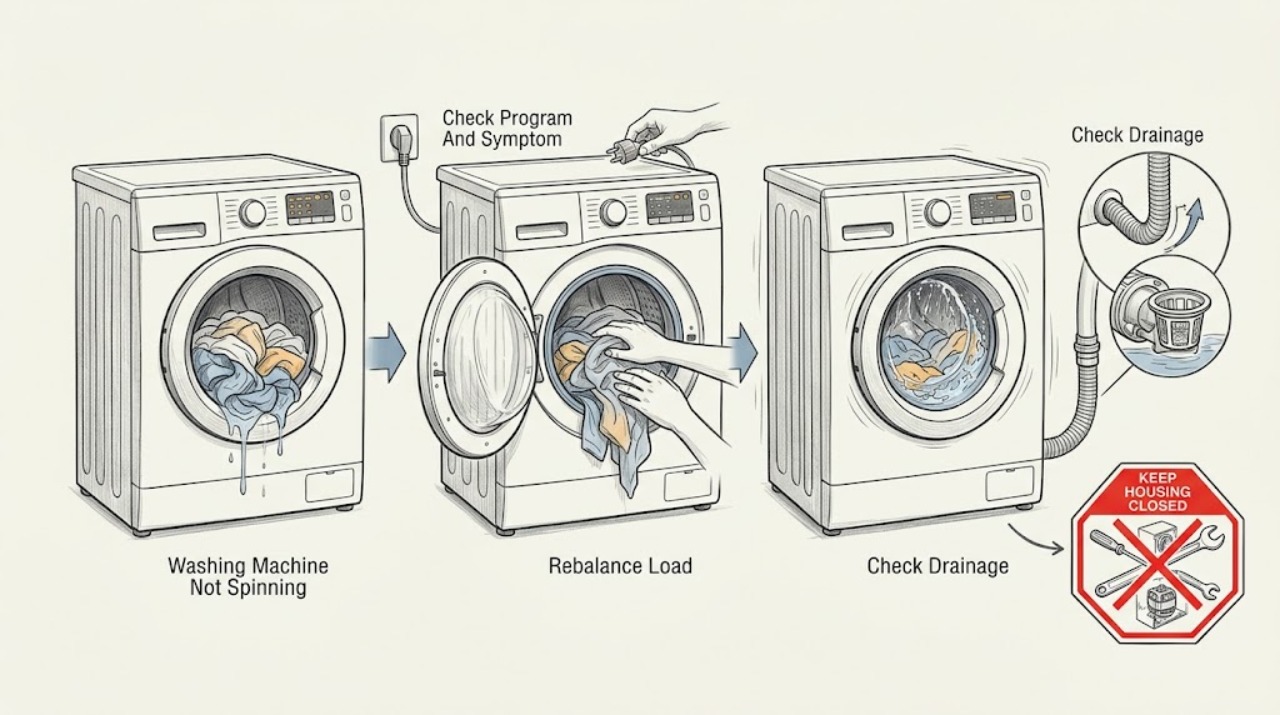
If a Candy washing machine will not spin, first check whether the selected program intentionally omits final spinning, whether water remains in the drum, and whether the load is too heavy or gathered on one side. Candy explains that an imbalanced drum and an overloaded washer can make spinning ineffective, and that a blocked filter, drain hose, or pump can leave water in the drum and prevent the spin stage. Stop before reaching into the machine, disconnect power only when the plug and area are dry and safe, and use the exact model manual for any filter procedure. Do not keep testing if the machine rocks violently, makes a sharp mechanical sound, leaks, smells hot, trips power, or has a damaged cord. If the drum still will not spin after safe program, load, and drain checks, arrange qualified repair rather than guessing at a motor, belt, lock, pump, or control part.
Before you begin
Safety first
- This article supports safe program review and ordinary accessible checks only. Keep the appliance out of service for persistent or dangerous no-spin. Do not bypass the door lock, open the cabinet, test live wiring, reach into moving parts, or handle wet electrical components.
Work through in order
Diagnostic checks
Use only checks that match the exact appliance or system and its official guide.
-
Check 1
Read the selected program and options on the display or control panel, then note whether the cycle ended with water in the drum, an unlocked door, an error, or only wet clothes. Do not start another cycle yet.
Expected result: Some options or programs may omit final spinning or final drainage; standing water, a locked door, or an error is a different symptom from a dry but wet load after a low-spin fabric program.
Next step: Use the exact Candy manual to confirm the program and option behavior. If water remains, continue with the safe drain-path check; if no water remains, continue with load and stability checks.
Stop if: Stop for smoke, burning smell, a damaged cord, shock, a leak, a severe error, or a door that will not safely unlock after the program ends.
Why this matters
Why: A skipped option can be normal program behavior, while water remaining in the drum can inhibit or prevent the spin stage and directs the next check toward drainage.
-
Check 2
With the cycle stopped and power safely disconnected, open the door only if it is unlocked and safe. Redistribute a single heavy item or a load gathered on one side, and remove obvious excess items so the load follows the capacity and fabric guidance in the exact Candy manual.
Expected result: A bunched or very heavy load may leave the drum wet and cause repeated attempted acceleration, thumping, or cabinet movement. An empty or reasonably distributed load that still will not spin points elsewhere.
Next step: After a permitted redistribution, use the model manual's rinse-and-spin or spin-only procedure once under supervision if no hazard exists. Stop if the machine remains still, rocks, leaks, or makes a harsh sound.
Stop if: Do not force a locked door, reach into moving parts, or continue if the floor is wet, the cabinet is damaged, or the machine moves violently.
Why this matters
Why: Candy identifies an imbalanced drum and an overloaded washer as common reasons for ineffective spinning, but a balanced load does not rule out a drain, lock, motor, or internal mechanical fault.
-
Check 3
If water remains or the pump runs without a spin, inspect the visible drain hose and household drain connection from a dry safe position for a kink, displacement, split, or overflow. Do not dismantle the plumbing or reach behind a wet appliance.
Expected result: Candy describes a bent or blocked drain hose and an obstructed household drainage line as possible causes of retained water; a pump-area blockage may instead be inside the appliance.
Next step: Correct only visible routing permitted by the model manual, then keep hands away from internal parts. Arrange service if the hose and household drain are clear but water remains or spin does not begin.
Stop if: Stop for an overflowing or contaminated drain, uncontrolled water, water near electrical parts, or any need to move or open the appliance.
Why this matters
Why: An external drain-path problem can prevent the machine from reaching or completing spin, while a clear hose with retained water leaves a filter, pump, sensor, or internal fault unresolved.
-
Check 4
Only if the exact Candy manual identifies a front filter as user-accessible, disconnect power safely, place towels and a shallow container, and follow that manual's slow-drain and filter-cleaning procedure. Do not open an access point that the manual does not identify for the owner.
Expected result: Candy's drain guidance says its machines may have a low front filter and warns that residual water can flow out; coins, buttons, pins, or other small objects can obstruct the pump and stop its turbine turning freely.
Next step: Reseat and close the filter only as the manual directs. If the filter is clear, the seal will not close, water flow is large or hot, or the pump still does not drain, leave the appliance off and arrange qualified service.
Stop if: Stop for a large or hot flow, water near electrical parts, a damaged filter seal, a stuck cap, or any instruction requiring cabinet disassembly.
Why this matters
Why: An accessible blockage can explain retained water and a skipped spin, but the article cannot establish that every Candy model has the same filter location, access, seal, or user procedure.
-
Check 5
If there is no retained water, check from a dry safe position that the appliance is stable on its feet and has not shifted away from its installation position. If the symptom began after moving or installation, compare the installation with the exact Candy booklet rather than altering transport or leveling hardware by guesswork.
Expected result: A machine that rocks or walks during acceleration can interrupt or suppress spin, while a stable appliance that never starts the drum points toward a control, lock, motor, or drive diagnosis.
Next step: Use only the model manual's permitted leveling and installation checks. Do not lift or tilt the appliance; call qualified help if it remains unstable or the cabinet, feet, or floor are damaged.
Stop if: Stop for violent movement, a damaged cabinet, a wet or weak floor, a stacked installation that has shifted, or any need to lift the appliance without suitable equipment.
Why this matters
Why: Stability is a plausible external cause of spin trouble, but it does not prove a failed foot, suspension, motor, belt, or bearing.
-
Check 6
When the machine is dry, stable, free of visible damage, and the manual permits it, run one short supervised rinse-and-spin or spin-only test with a small permitted load. Observe from outside and keep hands away from the drum, cabinet edges, hoses, and moving parts.
Expected result: Record whether the drum accelerates, drains then stops, hums without movement, repeatedly attempts to start, or produces vibration, a harsh sound, an error, or a leak.
Next step: Stop at the first recurrence of no-spin, severe vibration, unusual noise, leak, odor, or error. Preserve the exact stage and conditions for the technician.
Stop if: Do not test if the appliance has any electrical hazard, sharp mechanical sound, burning smell, active leak, unstable cabinet, or suspected internal damage.
Why this matters
Why: A successful spin after a program, load, or drain correction supports that external explanation; a drum that remains still when empty or after drainage needs service diagnosis rather than more cycles.
-
Check 7
Record the full Candy model or product code, program and options, water remaining or absent, load condition, drain observations, sound, vibration, error, and the result of any one permitted test. Use Candy's manual lookup and technical-assistance page to identify the correct support route.
Expected result: A precise record may show a skipped program, imbalanced load, drain blockage, or a drum that never turns despite normal drainage. It may also show an internal symptom such as a hum, scrape, or repeated failed acceleration.
Next step: Keep the machine out of service and arrange qualified repair when it still will not spin after safe checks, when the noise is internal or severe, or when water, an error, poor drainage, or electrical symptoms are present.
Stop if: Stop all user troubleshooting if the appliance cannot be safely isolated or the symptom is worsening.
Why this matters
Why: Motor, belt, lock, sensor, pump, suspension, bearing, and control faults cannot be distinguished safely by a generic no-spin complaint or by ordering a part from a symptom alone.
Use your observations
Decision map
Find the observation that best matches what you see, then follow the next safe action.
-
PATH 01Safety boundary
What you see
The selected Candy program or option intentionally omits final spin or final drainage, and there is no error or dangerous symptom.
Do this next
Use the exact manual to select a permitted rinse-and-spin or spin-only program suitable for the load, then monitor one cycle.
Why this path and its safety boundary
Why it matters: The wet load may reflect the chosen program rather than a failed component.
Safety stop: Stop if the machine will not drain, the door remains locked, a leak appears, or the drum will not turn on a permitted spin program.
-
PATH 02Safety boundary
What you see
The drum contains a heavy or bunched load and the appliance becomes unstable or repeatedly fails to accelerate.
Do this next
Redistribute or reduce the load according to the model manual and run one permitted supervised test only when the appliance is stable and safe.
Why this path and its safety boundary
Why it matters: Candy identifies imbalance and overload as common reasons for ineffective spinning, but a persistent no-spin after redistribution needs another diagnosis.
Safety stop: Do not continue if the cabinet moves violently, the floor or appliance is damaged, or the noise is sharp or mechanical.
-
PATH 03Safety boundary
What you see
Water remains in the drum, the pump runs without draining, or the machine stops before spin.
Do this next
Check visible drain routing, then use only the exact manual's user-accessible filter procedure. Call service if the path is clear or the water cannot be safely contained.
Why this path and its safety boundary
Why it matters: A blocked filter, drain hose, household drain, or pump may prevent the spin stage; the model and safe access procedure still matter.
Safety stop: Stop for hot or uncontrolled water, contaminated overflow, electrical exposure, or any cabinet access.
-
PATH 04Safety boundary
What you see
The drum remains still after the selected program, load, and drain path are appropriate, including a safe permitted test.
Do this next
Keep water and power isolated when safe and arrange qualified Candy or appliance repair with the recorded symptoms and model information.
Why this path and its safety boundary
Why it matters: A door-lock, sensor, motor, drive, pump, control, suspension, or other internal fault remains possible; no single part is proven.
Safety stop: Do not open the cabinet, bypass the door lock, test live wiring, or order a part based only on the symptom.
-
PATH 05Safety boundary
What you see
The machine drains and spins normally after a manual-approved program, load, or visible drain correction, with no leak, error, instability, or unusual sound.
Do this next
Monitor the next permitted use and stop if no-spin, retained water, unusual sound, or movement returns.
Why this path and its safety boundary
Why it matters: The external condition may have caused the original symptom, but recurrence is not ruled out.
Safety stop: Do not continue operating if any electrical or mechanical warning appears.
Helpful context
Understand the symptom
Separate a skipped spin from a blocked drain
Wet laundry at the end of a cycle does not by itself prove that the motor or drive failed. A program can be selected without a final spin, or the machine can hold the spin stage because water has not drained. Candy's own guidance connects ineffective spinning with an imbalanced or overloaded drum and points to the filter, drain hose, household drain, and pump when water remains. Record the program, water level, and sound before changing settings or opening an access point.
Keep hands, water, and moving parts separate
Do not reach into a moving drum, defeat a door lock, remove a cabinet panel, or tilt the appliance. If water is present, isolate it according to the model manual and disconnect power only when the plug, outlet, and surrounding floor are dry and reachable without contact with water. Candy's published drain guidance uses a towel or container for residual water, but a model-specific manual controls the actual access procedure and its safety limits.
Safety boundary
Stop conditions
- Stop for smoke, burning smell, shock, a damaged cord, exposed wiring, water near electrical parts, or a tripped protective device.
- Stop for violent movement, a sharp metal or grinding sound, a damaged drum or cabinet, an active leak, or a door that cannot be safely unlocked.
- Do not bypass the door lock, open the cabinet, test live wiring, tilt the appliance, or repeatedly run cycles to force a spin.
- If the drum remains still after safe program, load, and drain checks, keep the appliance out of service and arrange qualified repair.
When checks do not resolve it
Need a professional?
Arrange qualified repair when the machine still will not spin after the program, load, and visible drain checks; when water remains after the manual-approved filter procedure; when the drum is still on an empty or permitted test; or when no-spin is accompanied by an error, leak, harsh sound, poor drainage, violent movement, burning smell, or electrical symptom.
Safety scope: This article supports safe program review and ordinary accessible checks only. Keep the appliance out of service for persistent or dangerous no-spin. Do not bypass the door lock, open the cabinet, test live wiring, reach into moving parts, or handle wet electrical components.
Common questions
FAQ
Why is my Candy washing machine not spinning but the drum is full of water?
A blocked filter, drain hose, household drain, or pump can leave water in the drum and prevent the spin stage. Check the visible drain path, then use only the exact model manual's user-accessible filter procedure. Call repair if water remains or cannot be safely contained.
Can an unbalanced load stop a Candy washer from spinning?
Yes. Candy identifies an imbalanced drum and an overloaded washer as common reasons for ineffective spinning. Redistribute or reduce the load according to the model manual, but call service if the machine still will not spin, rocks violently, or makes a harsh sound.
Could I have selected a Candy program without a final spin?
Some programs or options can exclude the final spin or final drainage. Check the selected program in the exact Candy manual and use a permitted rinse-and-spin or spin-only program suitable for the load. Do not keep testing if water remains or a fault symptom appears.
Should I clean the Candy washing-machine filter?
Only if the exact model manual identifies the filter as user-accessible. Disconnect power safely, use towels and a shallow container for residual water, and follow the manual's slow-drain procedure. Stop for hot or uncontrolled water, a damaged seal, or any need to open the cabinet.
When should I call for Candy washing-machine no-spin repair?
Arrange repair when the drum remains still after safe program, load, and drain checks, or when no-spin is paired with an error, leak, harsh sound, poor drainage, violent movement, burning smell, or electrical symptom. Do not bypass the door lock or guess at a part.
Read the exact guide
Official sources
- The washing machine won't drain, what should I do?Candy · Official Candy troubleshooting article used for program options that omit spin or final drainage, visible drain-path checks, and the conditional filter procedure; exact model instructions control access.
- Product user manualsCandy · Official Candy manual lookup used to identify model-specific programs, load limits, installation, filter access, and safe operating procedures.
- Technical assistance for our appliancesCandy · Official Candy support page used for the escalation boundary and for directing appliance-malfunction questions to model manuals, FAQs, or specialised service.
- Spin cycle: all you need to knowCandy · Official Candy article used for the relationship between draining, spinning, load balance, overload, and filter checks; a particular model's manual controls its settings and procedures.
Community feedback
Share a repair observation
Share a plain-text repair observation. Accepted observations are published automatically; this page may take a moment to update.