
On this page
Start here
Quick answer
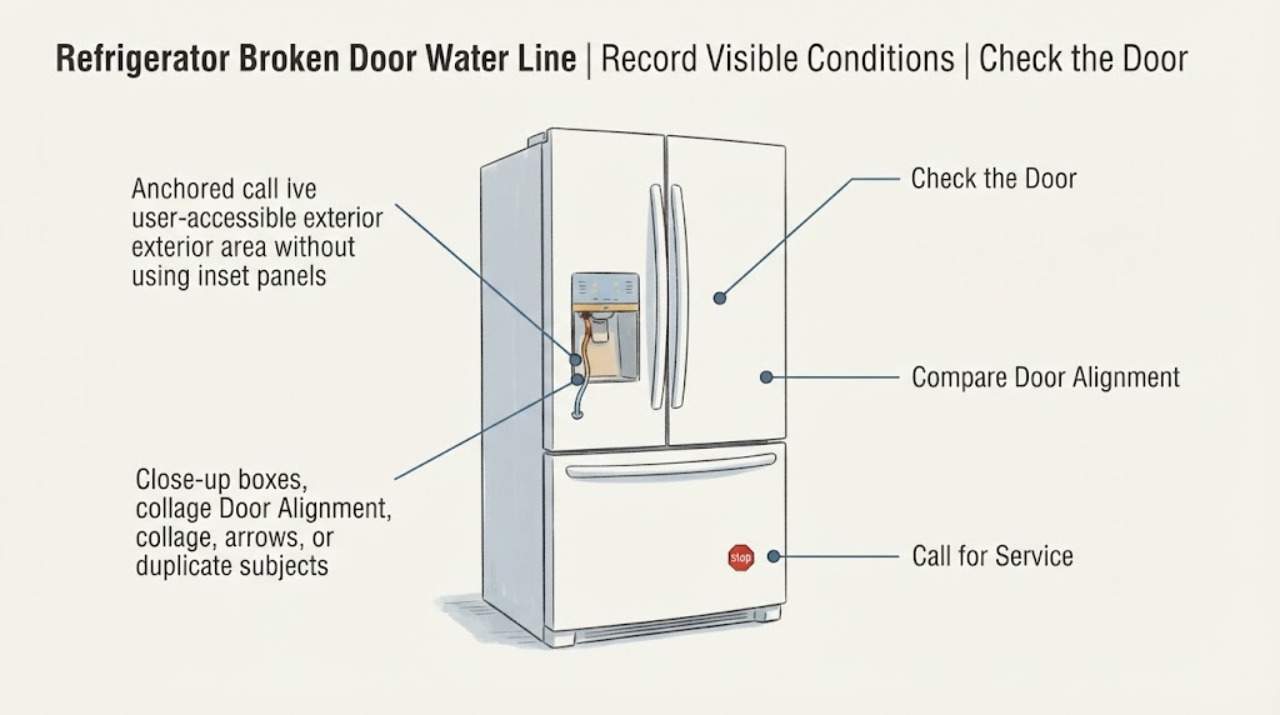
Do not remove the Daewoo refrigerator door or cut and reconnect a tube without the exact model manual. First identify the model, stop the refrigerator water supply, stop using the water and ice dispenser, and dry only the accessible area. Daewoo’s official product pages show that ice-and-water dispenser construction is model-specific and provide a model manual link; without the model, the door-tube route, connector style and compatible replacement line cannot be confirmed. If the leak is inside the door, reaches a hinge or electrical area, or cannot be isolated at an accessible connection, leave the dispenser unused and arrange Daewoo or qualified appliance service.
Work through in order
Diagnostic checks
Use only checks that match the exact appliance or system and its official guide.
-
Check 1
Read the model and serial label from the refrigerator cabinet or door area without removing panels, and record whether the appliance has an in-door water dispenser, an ice dispenser, both, or neither. Search Daewoo support using the full model code and open that model’s own manual before looking for a replacement line.
Expected result: A full model code and a matching Daewoo manual are available, or the label/manual cannot be matched and the dispenser configuration is uncertain.
Next step: Use the matching manual or service channel for the identified model. If the model remains unknown, stop at the external containment checks below and do not order a tube or begin door disassembly.
Why this matters
Why: Daewoo’s official pages show that dispenser features and product documents are tied to specific refrigerator models. A brand-only description cannot establish the tube route or compatible connector.
-
Check 2
Close the refrigerator’s accessible household water shutoff or the dedicated refrigerator supply valve before wiping the leak. Do not press the dispenser to test flow, make ice, or reconnect a visibly split tube. Place a container or towel under an accessible drip without opening the door or rear cover.
Expected result: The leak stops when the external supply is closed, continues with the supply closed, or the shutoff cannot be identified safely.
Next step: Keep water and ice dispensing disabled. If water continues, the shutoff is inaccessible, or water is reaching electrical or hinge areas, arrange prompt qualified service rather than reopening the line.
Stop if: Stop immediately for water near an outlet, cord, hinge wiring, control, or any sign of electrical damage.
Why this matters
Why: A leak that stops with the supply closed is contained at least at the incoming-water level; continued dripping may be residual water or a leak within the appliance. Neither observation identifies a door tube or valve.
-
Check 3
With the water supply closed, inspect only the visible external supply hose, filter housing, rear/bottom connection and the area around the lower door hinge for a kink, split, loose coupling, or water trail. Do not remove the rear cover, hinge cover, door, dispenser trim or insulation.
Expected result: Water is visibly coming from an external hose or coupling, the accessible path is dry but water appears from the door skin or hinge area, or the source cannot be seen.
Next step: Photograph the location with the model label and keep the supply closed. For a door/hinge source or an unseen source, do not probe or cut the insulation; request model-specific service.
Why this matters
Why: An accessible supply-side defect can be documented for the correct model manual or technician. Water emerging from the door or hinge area is consistent with an internal route but does not prove which tube, coupling or dispenser component failed.
-
Check 4
Record whether the leak occurs only while dispensing water, while the ice maker fills, whenever the supply is open, or even when the dispenser is idle. Note whether ice production, water flow, cooling and door closure remain normal; do not use repeated dispensing as a test.
Expected result: The leak is demand-related, continuous with the supply open, limited to the door/hinge, or accompanied by poor dispensing, ice problems, cooling loss, or door damage.
Next step: Keep the water and ice functions unused and provide the timing, photos, model and serial information to Daewoo or qualified service. Do not assume a filter, valve, tube or dispenser assembly is compatible from appearance alone.
Why this matters
Why: The timing helps the technician distinguish an incoming-line leak from a dispenser or door-path symptom, but it cannot identify a part without the model’s plumbing diagram and manual.
-
Check 5
Do not remove the door, disconnect hinge wiring, cut tubing, splice a line, or install a generic replacement. Use only the exact Daewoo manual if it explicitly identifies a user procedure; otherwise have a qualified technician contain and replace the line.
Expected result: The exact model manual gives a clearly matched procedure, or it is unavailable/unclear, the line is inside the door, or the door/hinge area is wet or damaged.
Next step: Follow the exact model manual only when the model and procedure match completely; otherwise leave the water supply closed, keep the refrigerator electrically and mechanically intact, and arrange qualified service.
Stop if: Stop for exposed wire, water entering electrical areas, a loose or falling door, damaged hinge, burning odor, sparking, or repeated breaker action.
Why this matters
Why: Door plumbing and door wiring vary by model, and CPSC records show that refrigerator-door wiring can create a serious shock hazard in affected products. A symptom alone cannot establish a safe DIY route for this Daewoo refrigerator.
Use your observations
Decision map
Find the observation that best matches what you see, then follow the next safe action.
-
PATH 01Next step
What you see
The leak is visible at the external supply hose, filter housing or an accessible coupling and stops after the refrigerator water supply is closed.
Do this next
Keep the supply closed, photograph the connection and model label, and use the exact manual or qualified service for the matched replacement; do not guess a fitting.
Why this path and its safety boundary
Why it matters: The source is at least reachable from the supply side, but the compatible hose, fitting and tightening procedure still depend on the exact Daewoo model and configuration.
-
PATH 02Next step
What you see
Water appears from inside the door skin, dispenser area, hinge, or a door-to-cabinet transition, or the visible source cannot be isolated.
Do this next
Keep the water supply and dispenser unused, do not remove the door or cut tubing, and arrange Daewoo or qualified appliance service after providing photos and the full model code.
Why this path and its safety boundary
Why it matters: The symptom may involve an internal door water route or another concealed connection, and the no-model task does not establish the construction or safe access path.
-
PATH 03Next step
What you see
The label identifies a Daewoo refrigerator that has no water/ice dispenser, or the model cannot be matched to the reported configuration.
Do this next
Stop the water-line repair path, verify the original appliance and model identity, and route the question to the correct product manual/service channel.
Why this path and its safety boundary
Why it matters: The assigned symptom and physical configuration are inconsistent or unresolved; dispenser-line instructions would risk addressing the wrong appliance.
-
PATH 04Next step
What you see
Water reaches a cord, outlet, hinge wiring or control area, or there is sparking, burning odor, a hot connection, a damaged door or a repeated breaker trip.
Do this next
Do not touch wet electrical areas or restore use. Keep people away from the hazard and arrange qualified appliance/electrical service; retain the model and photos for the service call.
Why this path and its safety boundary
Why it matters: The leak is accompanied by an electrical or mechanical safety hazard that cannot be evaluated by dispenser checks.
Helpful context
Understand the symptom
The task identifies a Daewoo refrigerator with a broken water line affecting cold water and ice dispensing, but it does not include a model number. Daewoo’s current product pages show dispenser-equipped refrigerators as particular models and expose model-specific user-manual links. That is enough to establish the appliance family and the need for an exact manual, not enough to select a tube, connector, door route or removal procedure.
Treat water at the door as a containment problem first. A water line that is actually inside a door may require door, hinge or dispenser disassembly; do not infer that construction from the symptom or borrow instructions from another Daewoo series.
When checks do not resolve it
Need a professional?
Tell service that the Daewoo refrigerator has a reported broken water line, whether the issue affects cold-water dispensing, ice dispensing or both, where water was observed, whether closing the external supply stopped it, the full model/serial label, and whether water reached the hinge or electrical area.
Common questions
FAQ
Can I replace the water line inside a Daewoo refrigerator door without the model number?
No. Daewoo’s official dispenser product pages show model-specific designs and manual links, but the task has no model. Keep the water supply closed and obtain the exact manual or qualified service; do not remove the door or cut tubing by guesswork.
What should I do first if the refrigerator water line is leaking?
Close the accessible refrigerator water shutoff, stop using the water and ice dispenser, and inspect only visible external connections without opening covers. If water continues or reaches a hinge or electrical area, leave the appliance unused and arrange service.
How do I know which replacement tube or connector fits?
You cannot establish fit from the Daewoo brand alone. Record the full model code and use that model’s manual or service channel; do not buy a generic tube based on appearance or another Daewoo refrigerator series.
Read the exact guide
Official sources
- DAEWOO CSMSBS4ELVB8 90 CM Side by Side with E Class, 513 LDaewoo Electronics · Opened the official Daewoo product page. It identifies a specific Side by Side refrigerator, states that it has an Ice & Water Dispenser, and exposes a User Manuals document area; it is used to show why exact model matching is necessary, not to transfer its construction to the unknown task appliance.
- Refrigerator Repair Program AnnouncedU.S. Consumer Product Safety Commission · Opened the CPSC recall notice. It is not evidence about Daewoo model construction or a Daewoo defect; it is used only for the conservative boundary that door/hinge wiring can be a serious hazard and must not be handled by guessing from a water-line symptom.
- DAEWOO CSMSBS4EDVA8 90 CM Side by Side with E Class, 513 LDaewoo Electronics · Opened the official Daewoo product page. It identifies a different specific Side by Side refrigerator with an Ice & Water Dispenser and a User Manuals area; it is used as a second demonstration that dispenser documentation is model-scoped, not as a source for a replacement line on the unknown appliance.
Community feedback
Share a repair observation
Share a plain-text repair observation. Accepted observations are published automatically; this page may take a moment to update.