
On this page
Start here
Quick answer
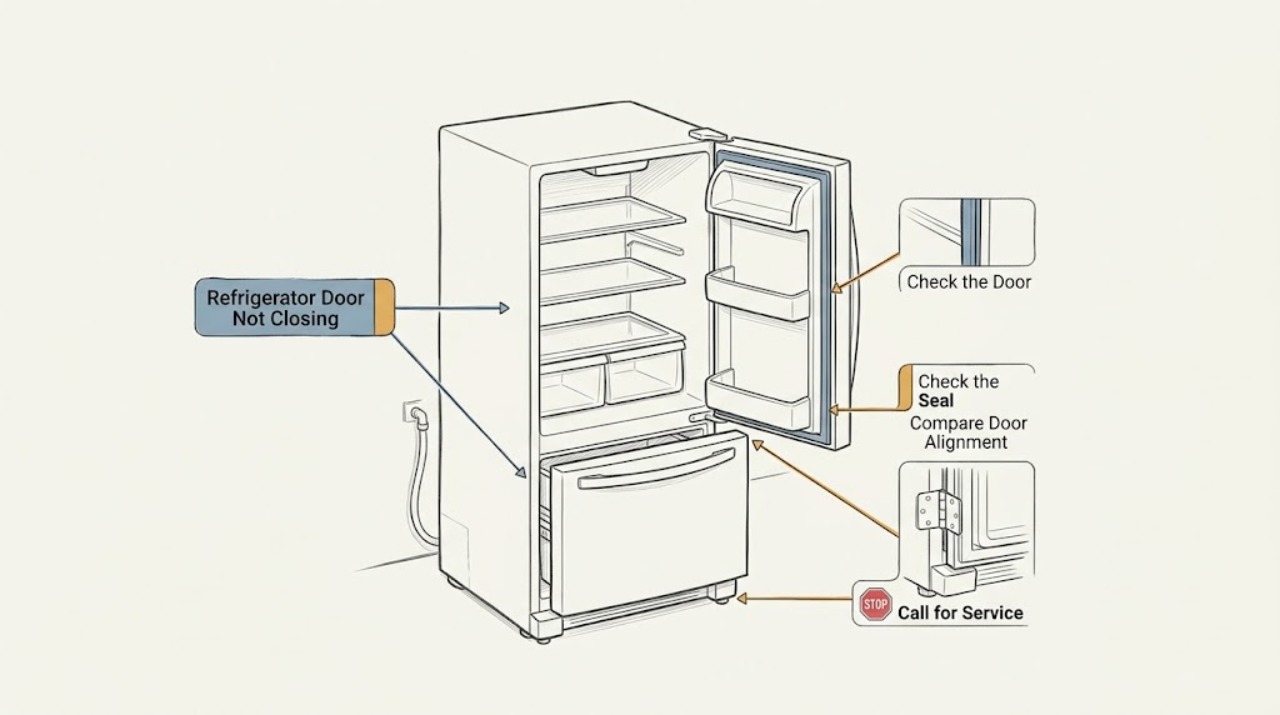
Start with the door or drawer fully open and remove only the item that is visibly blocking closure. Check that shelves, door bins, crisper drawers, freezer baskets, and tall containers are seated and not projecting into the opening. Then inspect the gasket for dirt, folds, tears, or a section that stays separated from the cabinet, and check from the front and side whether the refrigerator rocks or the door sits low or skewed. Daewoo's official refrigerator manual lists food or packaging, damaged door joints, and an appliance that is not level as the first checks when a door does not open or close properly; its care guidance says the gasket should be clean and pliable and replaced when worn. Do not force a heavy door, lift it by the handle, remove hinges, change hinge direction, pull out a built-in unit, or disturb water tubing or wiring. A door that closes only when lifted, drops, scrapes, will not latch after an obstruction is removed, or has a loose hinge, torn gasket, crushed line, pinched wire, or cabinet damage needs model-specific qualified service. Keep the door closed as much as possible while testing so food does not warm, and arrange service promptly if the door cannot seal or the interior temperature is rising.
Before you begin
Safety first
- The user may remove a visible obstruction, inspect and gently clean an accessible gasket, observe level and clearances without tipping or pulling the appliance, and document the model and symptom. Heavy-door support/removal, hinge adjustment or replacement, door-swing changes, built-in extraction, water-line disconnection, wiring, cabinet repair, and internal access are for qualified personnel.
Work through in order
Diagnostic checks
Use only checks that match the exact appliance or system and its official guide.
-
Check 1
Open the affected Daewoo door or drawer fully and inspect the opening at eye level. Move only visibly misplaced food, bottles, shelves, bins, crisper drawers, freezer baskets, or packaging that projects into the closing path. Check the top, bottom, hinge side, and the opposite door on multi-door models; do not push the door harder against an obstruction.
Expected result: A container, shelf, bin, drawer, basket, package, or ice/frost buildup is touching the door; or the opening is clear but the door still stops or rebounds.
Next step: Correct the visible obstruction once, close the door gently, and check whether it now seals evenly. If the door still will not close, continue to the gasket and cabinet checks rather than forcing it.
Stop if: Do not chip ice with a sharp tool, force a drawer or shelf, remove hinge hardware, or use the door handle as a lifting point.
Why this matters
Why: A contact point explains a door that stops at one location and may be corrected by reseating or repositioning that item. If the opening is clear, the remaining possibilities include gasket contact, level/cabinet alignment, hinges, closing hardware, or a model-specific line/wire issue.
-
Check 2
With the door unloaded enough to inspect safely, look around the entire gasket and the matching cabinet face. Check for food residue, a folded or twisted corner, a tear, hardening, a section pulled out of its channel, or a visible gap after the door is gently closed. Do not use heat, adhesive, oil, or a sharp object on the gasket.
Expected result: The gasket is dirty or folded, a section does not contact the cabinet, there is condensation or frost near a gap, the gasket is torn/hardened, or the contact looks even all around.
Next step: Clean and dry the accessible gasket and cabinet contact surface only as the exact manual permits, reseat a visibly displaced edge without stretching it, and test the seal gently. If it remains damaged or separated, keep the door closed as much as possible and arrange service.
Stop if: Do not heat the gasket with a hair dryer, glue or trim it, pry magnetic sections apart, or continue using the refrigerator if the door cannot seal and food temperature is not being maintained.
Why this matters
Why: A dirty or folded gasket can prevent magnetic contact and allow warm air and moisture in. Frost or condensation near one area supports a seal gap but does not prove the gasket alone is defective. A torn, hardened, detached, or distorted gasket needs model-specific replacement or service; an even seal shifts attention to level, alignment, or obstruction.
-
Check 3
From the front and side, observe whether the cabinet rocks, leans, is pushed against surrounding cabinetry, or has a door that sits noticeably low or skewed relative to the cabinet. Check the accessible floor and leveling-foot area without tipping or moving the loaded appliance. Compare the gap around the affected door with the opposite side.
Expected result: The refrigerator rocks or leans, the door gap changes from top to bottom, the door rubs at one corner, the cabinet is constrained by nearby cabinetry, or the cabinet and door appear level with an even gap.
Next step: Remove nearby loose items and use only the exact model's documented leveling method if the adjustment is clearly accessible and does not require tipping, unloading a heavy door, or moving a built-in unit. Otherwise stop and arrange qualified service; retest the gasket after any approved leveling adjustment.
Stop if: Do not tip a loaded refrigerator, place improvised shims under it, loosen structural hardware, pull out a built-in unit, or adjust feet while the appliance could fall.
Why this matters
Why: Daewoo identifies a level surface as a check for a door that does not close properly. A changing gap or corner rub is consistent with cabinet leveling or alignment, but it does not prove that a hinge or foot is the failed part. An even cabinet with a persistent gap makes gasket, obstruction, or hinge alignment more likely.
-
Check 4
With the door supported by its handle only for normal opening—not lifted—observe whether it sags, drops, scrapes, springs back, or closes only when you lift or push the hinge-side corner. Check whether unusually heavy door bins or a mis-seated drawer load changes the symptom. Do not remove the door or hinge covers.
Expected result: The door is visibly low, hinge-side gaps are uneven, a hinge is loose or damaged, the symptom changes with a heavy door load, or the door behaves normally but still has a perimeter gap.
Next step: Remove only a clearly excessive or misplaced door load and retest gently. If the door remains low, the hinge is damaged/loose, or the door must be lifted to close, leave it supported in a safe closed position and arrange qualified service.
Stop if: Do not lift or hold a heavy door while loosening hardware, remove hinge pins, change door swing, or work under the door without qualified support and model procedures.
Why this matters
Why: Sagging, scraping, or a hinge-side gap makes hinge, closing hardware, door weight, or cabinet alignment more likely than a simple gasket fold. A heavy load can expose marginal alignment, but it does not authorize tightening or replacing hinge parts without model-specific instructions. A normal hinge motion with a perimeter gap points back to the gasket or obstruction.
-
Check 5
If the refrigerator has a dispenser, ice maker, bottom drawer, or built-in installation, look only at accessible exterior clearances for a pinched water tube, exposed wire, crushed trim, cabinet interference, or a line that becomes taut as the door moves. Do not pull the appliance out, disconnect tubing, remove hinge covers, or probe wiring to make the door close.
Expected result: A tube or wire is visibly pinched or taut, a line leaks, cabinet trim restricts travel, the unit is built in and inaccessible, or no line/wire/cabinet interference is visible.
Next step: Keep the door closed if possible, isolate the water supply only when the shutoff is accessible and dry, and arrange qualified appliance service for a taut/damaged line, leak, wiring, built-in access issue, or any internal adjustment. Do not operate a dispenser or ice maker with a leaking line.
Stop if: Do not pull a built-in refrigerator, disconnect a water line, splice a wire, remove electrical covers, or reach into a hinge passage.
Why this matters
Why: A line, wire, trim, or built-in clearance problem can prevent full travel or create a separate water/electrical hazard. A visible leak, crushed line, or exposed conductor is not a door-adjustment problem. No visible interference makes the mechanism, seal, level, or alignment checks more relevant, but hidden routing cannot be ruled out.
-
Check 6
After the safe visible checks, close the door gently and inspect whether the gasket contacts continuously without holding the handle or lifting the door. Note any alarm, interior light that stays on, rising frost or condensation, warm food, repeated reopening, or inability to keep the door closed. Record the model label and whether the problem affects a refrigerator door, freezer door, French door, or drawer.
Expected result: The door seals evenly after a visible correction, or it still springs open, leaves a gap, rubs, sags, or cannot remain closed; a leak, damaged wire, or cabinet damage is also present.
Next step: Keep the door closed and minimize openings if it seals. If it does not seal or any hazard/damage is present, protect the food and arrange qualified Daewoo/appliance service, giving the technician the model, symptom pattern, photos, and completed checks.
Stop if: Do not tape the door shut as a repair, continue running with a damaged seal or leaking line, or attempt internal hinge, wiring, water-line, or cabinet work.
Why this matters
Why: An even seal after removing an obstruction or correcting an approved surface issue supports a user-level cause. Persistent gaps, sagging, rubbing, alarms, frost, temperature rise, leaks, or damage indicate that alignment, hinge, gasket, line, wiring, or cabinet service is needed; the symptom does not identify a part.
Use your observations
Decision map
Find the observation that best matches what you see, then follow the next safe action.
-
PATH 01Next step
What you see
The door stops at one shelf, bin, bottle, drawer, basket, package, ice buildup, or cabinet edge.
Do this next
Remove or reseat only the visible obstruction and test the door gently. If the contact returns with the opening clear, proceed to the gasket and level checks.
Why this path and its safety boundary
Why it matters: A closing-path obstruction is more likely than a failed hinge or gasket. A door that closes after the item is reseated should still be checked for continuous gasket contact.
-
PATH 02Next step
What you see
The opening is clear, but the gasket is folded, dirty, torn, hard, displaced, or separated from the cabinet at one area; frost or condensation is near that gap.
Do this next
Clean and dry the accessible contact surface as the exact manual permits and arrange model-specific gasket service if damage or separation remains. Keep the door closed and protect food if the seal cannot hold.
Why this path and its safety boundary
Why it matters: A seal-contact problem is more likely. Daewoo says the gasket should be clean and pliable and replaced when worn, but a visible gap does not by itself prove the gasket is the only cause.
-
PATH 03Safety boundary
What you see
The cabinet rocks or leans, the door gap changes top-to-bottom, or the door rubs at one corner while the gasket is otherwise intact.
Do this next
Use a documented, safe leveling adjustment only when the exact model allows it without tipping or moving the appliance; otherwise arrange qualified service for alignment and stability.
Why this path and its safety boundary
Why it matters: Leveling or alignment is more likely than a simple obstruction. A changed gap can also result from hinge wear or a damaged cabinet, so it is not proof that a leveling foot alone will fix the door.
Safety stop: Do not tip a loaded unit, pull out a built-in appliance, or loosen structural or hinge hardware as a first-line check.
-
PATH 04Safety boundary
What you see
The door sags, scrapes, sits low, closes only when lifted, has a loose/damaged hinge, or changes alignment with door-bin weight.
Do this next
Remove only an obviously excessive load and retest gently. If sagging or damage remains, leave the appliance stable and arrange qualified service; do not remove the door or hinge.
Why this path and its safety boundary
Why it matters: Hinge, closing hardware, door loading, or cabinet alignment is more likely than a gasket-only problem. Heavy doors can contain wiring or water routing near the hinge on some configurations.
Safety stop: Do not support or lift the door while loosening hardware, pull hinge covers, or change swing direction without model-specific qualified procedures.
-
PATH 05Safety boundary
What you see
A dispenser/ice-maker tube or wire is taut, pinched, leaking, or exposed, cabinet trim restricts movement, or the refrigerator is built in and the hinge area cannot be safely accessed.
Do this next
Stop moving the appliance, isolate water only if a safe accessible shutoff exists, keep the door closed, and arrange qualified appliance service for the line, wire, built-in clearance, or hinge area.
Why this path and its safety boundary
Why it matters: This is a routing, installation, water, or electrical boundary rather than an ordinary door adjustment. Continued movement can worsen a leak or damage wiring.
Safety stop: Do not pull out the unit, disconnect tubing, splice wiring, or operate a leaking dispenser/ice maker.
Helpful context
Understand the symptom
The closing pattern identifies the next safe check
A door that stops at one shelf or bottle is an obstruction problem; a door that rebounds around the entire perimeter points more toward the gasket, cabinet position, or alignment. A door that sags, rubs at one corner, or closes only when lifted can involve a hinge or heavy-door alignment issue. These patterns overlap, so inspect the visible condition before considering any part.
Daewoo refrigerator layouts vary
Daewoo sells single-door, top- or bottom-freezer, combi, and other refrigerator configurations. A drawer, reversible door, dispenser tube, or hinge wiring may be present on one model and absent on another. Use the rating label and exact manual before removing a door, changing its opening direction, adjusting a hinge, or accessing a built-in installation.
A gasket can look intact and still leak
Dirt, a folded corner, a twisted magnetic seal, or a section held away by a shelf can leave a gap without a visible tear. Clean and dry only the accessible gasket surface using the model's care instructions, then check contact all the way around. Do not heat, glue, stretch, or trim the gasket; a worn or distorted seal needs model-specific replacement or service.
Heavy-door and hinge work belongs behind the service boundary
A refrigerator door can be heavy and may contain wiring, a water tube, or a dispenser connection near a hinge. If the door is sagging, the hinge is loose or damaged, or the unit must be moved to reach the hinge, stop rather than supporting it with improvised blocks. A technician can identify the correct alignment and protect the cabinet, tubing, and wiring.
Safety boundary
Stop conditions
- Stop if the door is heavy, sagging, scraping, or must be lifted to close; do not remove or support the door as a household adjustment.
- Stop for a torn or detached gasket that will not seal, cabinet damage, a loose or damaged hinge, or a refrigerator that cannot remain stable and level.
- Stop for a leaking, crushed, taut, or exposed water line or wire near a hinge, dispenser, ice maker, or built-in installation.
- Do not pull out a built-in refrigerator, remove hinge covers, change door swing, disconnect tubing, splice wiring, or open internal panels without qualified model-specific procedures.
- Protect food and arrange qualified service if the door cannot seal, the interior temperature is rising, frost/condensation is increasing, or the issue persists after safe visible checks.
When checks do not resolve it
Need a professional?
Arrange qualified Daewoo/appliance service when the door remains misaligned after visible obstructions are removed, the gasket is torn, hardened, detached, or cannot maintain contact, the cabinet rocks or the door gap is uneven, or the door sags, scrapes, or closes only when lifted. Use service immediately for a leaking or pinched water line, exposed or trapped wiring, cabinet damage, an unstable appliance, a built-in unit that must be pulled out, or any hinge/door work requiring removal or support of the heavy door. Keep the door closed and minimize openings while protecting temperature-sensitive food; do not tape, heat, glue, or force the seal and do not dismantle the hinge area.
Safety scope: The user may remove a visible obstruction, inspect and gently clean an accessible gasket, observe level and clearances without tipping or pulling the appliance, and document the model and symptom. Heavy-door support/removal, hinge adjustment or replacement, door-swing changes, built-in extraction, water-line disconnection, wiring, cabinet repair, and internal access are for qualified personnel.
Common questions
FAQ
Why will my Daewoo refrigerator door not close?
First look for food, packaging, shelves, bins, drawers, baskets, or ice blocking the closing path. If the opening is clear, inspect the gasket for a fold, dirt, tear, or gap and check whether the refrigerator rocks or the door sits low. Daewoo's manual lists obstruction, damaged door joints, and an unlevel surface as the main initial checks.
Can a Daewoo refrigerator that is not level keep the door from closing?
Yes. Daewoo specifically says to check that the appliance is on a level surface when its door does not open or close properly. Look for rocking and an uneven door gap, but do not tip a loaded unit or pull out a built-in refrigerator; use the exact model's leveling instructions or arrange service.
How do I check the gasket on a Daewoo refrigerator door?
Inspect the entire accessible gasket for dirt, folds, tears, hardening, displacement, and sections that do not touch the cabinet when the door is gently closed. Clean and dry it only as the exact manual permits. Daewoo says the gasket should be clean and pliable and should be replaced when worn; do not heat, glue, stretch, or trim it.
What if my Daewoo refrigerator door closes only when I lift it?
That pattern makes sagging, hinge alignment, closing hardware, door load, or cabinet alignment more likely than a simple obstruction. Do not lift a heavy door while loosening hardware or remove the hinge. Keep it stable and arrange qualified service, especially if the door scrapes or the gasket gap is uneven.
Should I adjust or reverse the door on a Daewoo refrigerator myself?
Only follow an exact model procedure when the manual explicitly permits a safe user adjustment. Door reversal and hinge work can involve a heavy door and, on some configurations, wiring or water routing. If the door must be removed, supported, or the refrigerator pulled from built-in cabinetry, use qualified service.
Can a water line or wire stop a Daewoo refrigerator door from closing?
On models with a dispenser or ice maker, a visibly taut, pinched, leaking line or exposed/trapped wire can interfere with door movement or create a separate hazard. Do not pull out the refrigerator, disconnect tubing, splice wiring, or remove hinge covers. Keep the door closed and arrange qualified service; isolate water only if a safe accessible shutoff is available.
Read the exact guide
Official sources
- DAEWOO CKL0278DWMA0-EU 54 CM Fridge-Freezer with D Class, 268 LDaewoo · Confirms model-specific refrigerator configuration, bottom-mounted freezer, reversible door, integrated handle, and ice-tray layout; it supports the need to check the exact model before applying door or hinge procedures.
- DAEWOO BKF243FXP1UA Fridge-Freezer User ManualDaewoo · Model-specific guidance for door-closing checks, door joints, level surface, gasket care, appliance stability, transport, and authorized service boundaries; other Daewoo models may differ.
Community feedback
Share a repair observation
Share a plain-text repair observation. Accepted observations are published automatically; this page may take a moment to update.