
On this page
Start here
Quick answer
First protect yourself and the floor: if water is near the plug, socket, controls, or wiring, do not reach through the water to unplug the refrigerator; isolate power from a dry, safe location and stop the water supply if the model has one. Then dry the outside and identify when the leak returns. Water that appears only after dispensing or ice making points to the model's supply, filter, dispenser, or ice-maker path. Water that appears inside or under the cabinet without a connected water line can be a spill, condensation, or a defrost-drain problem. Daewoo refrigerators are not all built alike: some current models have automatic or Total No Frost defrosting and an ice-and-water dispenser, while other models are single-door units with no freezer or ice maker. Do not remove panels, pull a heavy refrigerator forward, probe a drain, or open a valve or internal waterway; persistent, hidden, or electrical-area leaks need qualified appliance service.
Before you begin
Safety first
- The user may observe and dry accessible exterior/interior surfaces, close a safely accessible water shutoff, remove an obvious spill, and check ordinary door closure. Qualified personnel must handle wet electrical areas, internal tubing, inlet valves, dispenser/ice-maker assemblies, drain paths and pans behind covers, live tests, and any sealed refrigeration work.
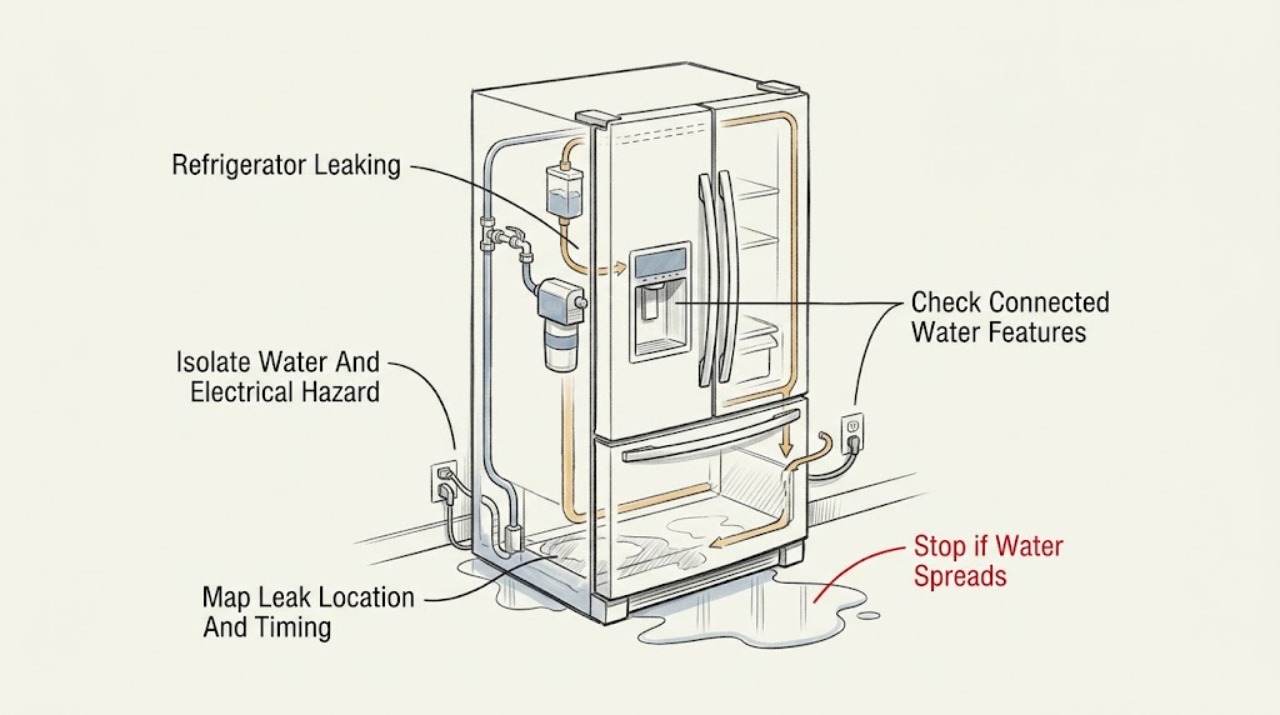
Work through in order
Diagnostic checks
Use only checks that match the exact appliance or system and its official guide.
-
Check 1
From a dry, stable position, look at the puddle, plug, socket, power cord, lower cabinet, and accessible controls without touching wet electrical parts. If the refrigerator is connected to a water supply and the shutoff is safely accessible, close that supply. If water is near the plug, socket, controls, or wiring, isolate the refrigerator circuit at the fuse board or breaker only from a dry, safe location; do not reach through water to unplug it.
Expected result: Water is near electrical parts, the flow is fast or spreading, there is a damaged cord, burning odor, sparking, a tripped breaker, or the leak is slow and clearly isolated from electrical parts.
Next step: For any electrical-area water, fast flow, damage, odor, sparks, or repeated tripping, keep the refrigerator out of service and arrange prompt qualified help. Otherwise place a container or towels only where this can be done without touching wet electrical parts, and continue to locate the source.
Stop if: Do not touch a wet plug or socket, stand in water to operate a switch, restart the refrigerator to reproduce the leak, or use the appliance while water can reach electrical parts.
Why this matters
Why: Water near electrics or a protection trip is an electrical hazard, not an ordinary cleaning task. A slow, contained leak away from electrics permits only the external source-identification steps below after the appliance is safely isolated as needed.
-
Check 2
After the safety check, dry the accessible floor and cabinet exterior. Without pulling the refrigerator forward or removing panels, place dry paper towels at separate safe locations around the front corners, dispenser area if present, and visible lower edges. Note whether new water appears while idle, immediately after dispensing water or ice, after an ice-making cycle, after a defrost period, or only after a spill or door opening.
Expected result: The first wet spot is at the dispenser/front, under the rear or bottom edge, inside below a shelf or crisper, around the door opening, or no new water appears after drying.
Next step: Follow the matching branch. If the source cannot be localized without moving the appliance or removing a cover, stop the inspection and give the technician the location, trigger, and timing record.
Stop if: Do not tilt or drag the refrigerator, remove a rear/bottom cover, pour water into a drain opening, or use a probe, wire, or chemical drain cleaner.
Why this matters
Why: The first wet location and trigger are more useful than the size of the puddle. A dispenser or ice trigger keeps the supply path in view; an internal or underside leak without a water-line trigger keeps condensation or defrost drainage in view; no recurrence may indicate a spill rather than an active leak.
-
Check 3
Only if the exact Daewoo model has a water dispenser, ice maker, or external filter, inspect the visible supply tube, shutoff area, filter housing, and accessible couplers with the water supply closed and power safely isolated. Look for a loose fitting, a kinked or cracked visible tube, a filter housing that is visibly wet, or water that returns only after a dispenser/ice request. Use the exact model manual for filter seating; do not disconnect an internal line.
Expected result: The leak starts after dispensing or ice making, a visible external connection or filter housing is wet, the tube is damaged, the water continues with the appliance idle, or the connected-water path is dry.
Next step: Keep the water supply closed and arrange service for a persistent leak, damaged tube, wet filter housing, or any leak behind the door or cabinet. If a filter was recently changed, do not repeatedly reseat it or continue dispensing; verify only the exact manual's user procedure after the leak is isolated.
Stop if: Do not open an inlet valve, remove a door panel, disconnect internal tubing, bypass an ice-maker or dispenser control, or turn the water back on to watch a hidden leak.
Why this matters
Why: A feature-triggered leak or wet visible connection makes the external supply, filter, dispenser, or ice-maker path more likely. Continuous water with the water supply open suggests a valve or line may be passing water, but a user observation cannot identify the internal valve or hose. A dry connected-water path shifts attention to the interior, defrost, or condensation path.
-
Check 4
If the refrigerator has no connected water feature, or the supply path stayed dry, inspect only user-accessible areas: shelves, containers, the floor below the crisper, the door gasket, and the door closing path. Remove a spilled container or package that is touching the gasket, wipe the spill, and confirm the door closes without being held open. Do not remove an interior back panel or pour water into any opening.
Expected result: A container is spilled or overfilled, a package holds the door open, the gasket is visibly torn or out of position, water is isolated to a shelf or door pocket, or water returns from beneath the interior rear area after the cabinet is dry.
Next step: Correct only the obvious spill or loading obstruction and monitor once with the door closed. If the gasket is damaged, the door will not close, or water returns from beneath the rear interior, keep the refrigerator dry and arrange service rather than removing panels.
Stop if: Do not reshape a gasket with heat, dismantle door parts, scrape ice with a sharp tool, or access a drain channel behind a liner.
Why this matters
Why: A localized shelf or door-pocket spill can mimic a refrigerator leak. A door that cannot close normally can increase condensation, but water returning from beneath an interior rear area is not identified by this check and may involve a defrost or drain path, especially on a model with automatic defrost.
-
Check 5
For a model identified as automatic or Total No Frost, record whether the leak returns after the refrigerator has been running and whether the water is pooled beneath the interior rear area or appears under the cabinet without a dispenser/ice trigger. Check only for visible loading that blocks an air outlet; do not remove frost, open the evaporator cover, or attempt to clear a hidden drain.
Expected result: Water returns after a cooling/defrost period, the connected water path is dry or absent, water is beneath the interior rear area or cabinet, or there is only a one-time puddle with no recurrence.
Next step: Keep the appliance safely isolated if water is near its electrical area, protect food, and arrange service for recurring interior/underside water or inaccessible frost and drain symptoms. Provide the model number and whether the leak follows a defrost period.
Stop if: Do not pour water into the refrigerator, insert a wire or tool into a drain, use a heat source, chip ice, or remove an evaporator, fan, drain, or rear cover.
Why this matters
Why: On models that list automatic defrost, recurrence from an interior rear or underside location can be consistent with a condensate or defrost-drain overflow, but the product information does not establish one drain layout for every Daewoo model. A one-time nonrecurring puddle is less suggestive of an active drain fault; a recurring hidden leak needs inspection by a technician.
-
Check 6
After one safe external correction, such as closing the water shutoff, removing an obvious spill, or clearing a loose door-loading obstruction, dry the area and record whether new water returns. Write down the exact model, whether it has a water line/dispenser/ice maker, the first wet location, the trigger, and whether the refrigerator was near a defrost period. Do not reopen the water supply merely to reproduce a hidden leak.
Expected result: The leak stops after an obvious spill or external supply was isolated, the leak returns while the supply is closed, the source is behind/under the cabinet, or water has reached electrical parts.
Next step: Keep the water supply closed where applicable and contact Daewoo-authorized or qualified appliance service for any recurring, concealed, or internal leak. Preserve the observation record and move perishable food to a known-safe cold appliance if cooling may be interrupted.
Stop if: Do not continue operating after water reaches electrical parts, do not repeatedly cycle the dispenser or ice maker, and do not select a replacement valve, hose, filter housing, drain part, or control from the symptom alone.
Why this matters
Why: A stopped leak after a documented external cause supports that immediate cause but does not prove that every component is sound. Recurrence with the supply closed makes internal condensate, defrost, or a hidden waterway more likely; a concealed source cannot be safely localized by operating the appliance. Electrical-area water overrides all ordinary diagnosis.
Use your observations
Decision map
Find the observation that best matches what you see, then follow the next safe action.
-
PATH 01Safety boundary
What you see
Water is flowing quickly or is near the plug, socket, controls, wiring, or other electrical equipment, or the breaker trips when the refrigerator is used.
Do this next
Keep people away, isolate electricity from a dry and safe location, close the water supply if safely accessible, and arrange prompt qualified appliance/electrical help. Contain water only without touching wet electrical parts or moving the refrigerator.
Why this path and its safety boundary
Why it matters: This is an electrical and property-safety event, not a normal refrigerator maintenance check.
Safety stop: Do not touch the wet appliance, plug, or socket, stand in water to operate a switch, or restore power to test it.
-
PATH 02Safety boundary
What you see
The exact model has an ice maker, dispenser, or water filter, and water appears after dispensing/ice making or at a visible supply connection/filter housing.
Do this next
Close the water supply, stop using the dispenser/ice maker, and arrange service if the visible connection is not a simple model-documented user adjustment or if water is behind the cabinet or door.
Why this path and its safety boundary
Why it matters: The supply, filter, dispenser, or ice-maker path is more likely than a condensation-only explanation. A leak that continues with the water supply open can involve an internal valve or line, which cannot be selected from the symptom alone.
Safety stop: Do not remove internal tubing, open the valve, remove door panels, or turn the water back on to reproduce the leak.
-
PATH 03Safety boundary
What you see
There is no connected water feature or the supply path is dry, and water returns inside below the rear area or underneath the cabinet after the refrigerator runs or defrosts.
Do this next
Keep the area dry, avoid opening liners or clearing hidden passages, protect food, and arrange qualified service for a recurring or inaccessible leak.
Why this path and its safety boundary
Why it matters: A spill, condensation, or defrost-drain overflow is more likely than a dispenser leak. Automatic/Total No Frost confirms a defrost architecture on some Daewoo models, but not the exact drain route or failed part for this refrigerator.
Safety stop: Do not pour water into a drain, insert a tool, chip frost, use heat, or remove the rear, evaporator, fan, or drain cover.
-
PATH 04Safety boundary
What you see
The wet area is limited to a shelf or door pocket, an overfilled container or package explains it, or the leak stops after the spill is removed and the door closes normally.
Do this next
Clean and dry the accessible area, remove the loading obstruction, and monitor once without repeatedly opening the door. Arrange service if the gasket or door cannot close, or if water returns from beneath the interior.
Why this path and its safety boundary
Why it matters: A user spill or door/condensation condition is more likely than an active internal water-line fault, although recurrence should be treated as a new leak pattern.
Safety stop: Do not heat, glue, or reshape a damaged gasket, dismantle the door, or access a hidden drain.
-
PATH 05Safety boundary
What you see
Water keeps returning after an obvious spill is removed and the connected water supply is closed, or the first wet point is behind/under the cabinet and cannot be seen safely.
Do this next
Keep the refrigerator and water supply out of service as appropriate and book Daewoo-authorized or qualified appliance service. Provide the exact model, feature set, leak timing, first wet location, and electrical observations.
Why this path and its safety boundary
Why it matters: A hidden internal waterway, valve, drain, pan, or cabinet-area fault is more likely; the user checks cannot identify a safe replacement part.
Safety stop: Do not drag the refrigerator, remove panels, disconnect hoses, test a valve live, or continue running it to make the leak easier to find.
Helpful context
Understand the symptom
A Daewoo refrigerator leak has more than one water path
Start with the feature set, not the brand name. A side-by-side Daewoo model may have an ice-and-water dispenser and a plumbed water circuit, while another Daewoo refrigerator may have no freezer or ice maker at all. If there is no water connection, skip supply-line and filter checks. If there is a dispenser or ice maker, note whether the puddle appears only after that feature is used or also while the refrigerator is idle.
Use timing and location to separate the likely paths
A leak at the front dispenser after dispensing is a different observation from water under the back of a connected refrigerator, and both differ from water inside the cabinet beneath a crisper. A spill or door-condensation issue can be visible immediately, whereas a blocked or misdirected defrost path may show up inside or below the cabinet after the appliance has run. The accessible checks can classify the pattern, but they cannot safely prove a failed inlet valve, internal hose, drain tube, or sealed-system component.
Stop early when water and electricity can meet
Do not step into pooled water to reach a plug, touch a wet socket, or operate a wet control. If water is near the electrical connection or the leak is fast, isolate the circuit from a dry, safe location and keep people away. Once the appliance is safely isolated, contain water without moving the refrigerator or removing covers; a technician can then inspect the internal line, valve, drain path, and electrical areas.
Safety boundary
Stop conditions
- Stop immediately if water is near a plug, socket, control, wiring, or other electrical equipment; isolate power only from a dry, safe location and do not touch the wet appliance.
- Stop for a fast or spreading leak, smoke, burning odor, sparks, a damaged cord, a repeated breaker trip, or any sign that the refrigerator has become electrically unsafe.
- Do not drag or tilt the refrigerator, remove rear, bottom, door, evaporator, fan, or control covers, or perform live electrical testing.
- Do not probe or pour water into a hidden drain, chip frost, use a heat source, disconnect internal water tubing, open a valve, or bypass an ice-maker/dispenser control.
- If a leak recurs after one safe external correction, or the source is concealed, close the water supply where applicable and arrange qualified service rather than choosing a part from the symptom alone.
When checks do not resolve it
Need a professional?
Safety scope: The user may observe and dry accessible exterior/interior surfaces, close a safely accessible water shutoff, remove an obvious spill, and check ordinary door closure. Qualified personnel must handle wet electrical areas, internal tubing, inlet valves, dispenser/ice-maker assemblies, drain paths and pans behind covers, live tests, and any sealed refrigeration work.
Common questions
FAQ
Why is my Daewoo refrigerator leaking from the front?
If the exact model has a dispenser or ice maker, water that appears immediately after using it keeps the dispenser, filter, ice-maker, or connected supply path in view. If it appears only around a shelf or door pocket, first look for a spilled container or a door that is not closing normally. Close the water supply and arrange service if the leak persists, comes from behind the door, or reaches electrical areas.
Can a Daewoo refrigerator without a water line still leak?
Yes. A Daewoo model without a connected dispenser or ice maker can still have a spill, condensation, or a defrost-drain issue. Daewoo lists automatic defrost on multiple current refrigerator examples, but the exact drain layout is model-specific. Do not probe or flush a hidden drain; recurring water inside or under the cabinet needs service.
Should I unplug a leaking Daewoo refrigerator?
Only from a dry, safe position and only if the plug and socket are not wet or inaccessible. If water is near the electrical connection, do not reach through it; isolate the circuit from a safe location and keep the appliance out of service. Government leak guidance treats water near electrical equipment as an emergency, and electrical-safety guidance says unsafe equipment should be stopped and checked by a competent person.
Do I need a replacement drain hose, water valve, or filter?
Not from the word leaking alone. A filter or water-supply component is relevant only when the exact model has that path and the leak follows dispenser or ice use. A drain, valve, hose, or pan behind a cover requires model-specific inspection, so record the model, first wet location, trigger, and whether closing the water supply stops it before ordering anything.
Read the exact guide
Official sources
- Problems with your water supply and leaksOxford City Council · Government local-authority safety guidance used for the leak/electrical stop boundary, not Daewoo-specific appliance construction.
- DAEWOO FLN390EWR0ES 60 CM NF Single Door Refrigerator with E Class, 389 LDaewoo · Official Daewoo product page used to show that a current Daewoo refrigerator may be a single-door, no-freezer model with no ice maker; it is not a universal leak procedure.
- Work using electrically powered equipmentHealth and Safety Executive · Government electrical-safety guidance used for the safe inspection and competent-repair boundary, not Daewoo-specific leak diagnosis.
- DAEWOO CSMSBS4ELVB8 90 CM Side by Side with E Class, 513 LDaewoo · Official Daewoo product page used for this model's Total No Frost, automatic defrost, ice-and-water dispenser, inverter compressor, and sensor features; these features are not universal across Daewoo refrigerators.
- Cooling TechnologiesDaewoo · Official Daewoo technology overview; descriptions such as High-Tech No Frost and automatic defrost apply only to models that list those technologies.
Community feedback
Share a repair observation
Share a plain-text repair observation. Accepted observations are published automatically; this page may take a moment to update.