
On this page
Start here
Quick answer
If a Dacor refrigerator is leaking, first keep water away from the plug, outlet, cord, controls, and other electrical parts. If water is near them, stop using the refrigerator and isolate power only from a safe, dry position; do not touch a wet plug. Dry the accessible water and identify the first wet point without removing panels. Water at the filter, dispenser, ice maker, or an external supply connection points to the water system; water under drawers or after a recent power interruption can instead be condensation, a spill, or a defrost-drain problem. Dacor sells several refrigerator formats and some models have an internal water dispenser or dual icemakers, so filter seating, drain layout, and controls are model-dependent. Check only visible, removable items using the exact model instructions. Shut the accessible household water valve for a continuing supply-side leak, but leave internal water lines, valves, drain tubes, drain pans, wiring, and any panel removal to a qualified Dacor servicer.
Before you begin
Safety first
- The user may stop the refrigerator, protect food and flooring, close an accessible household water shutoff, dry visible surfaces, inspect visible tubing and removable filter or ice parts when the exact manual permits it, and monitor from a dry position. Internal water lines, valves, drain tubes, drain pans, evaporator or rear panels, wiring, electrical tests, refrigerant work, and any repair requiring panel removal are for qualified service personnel.
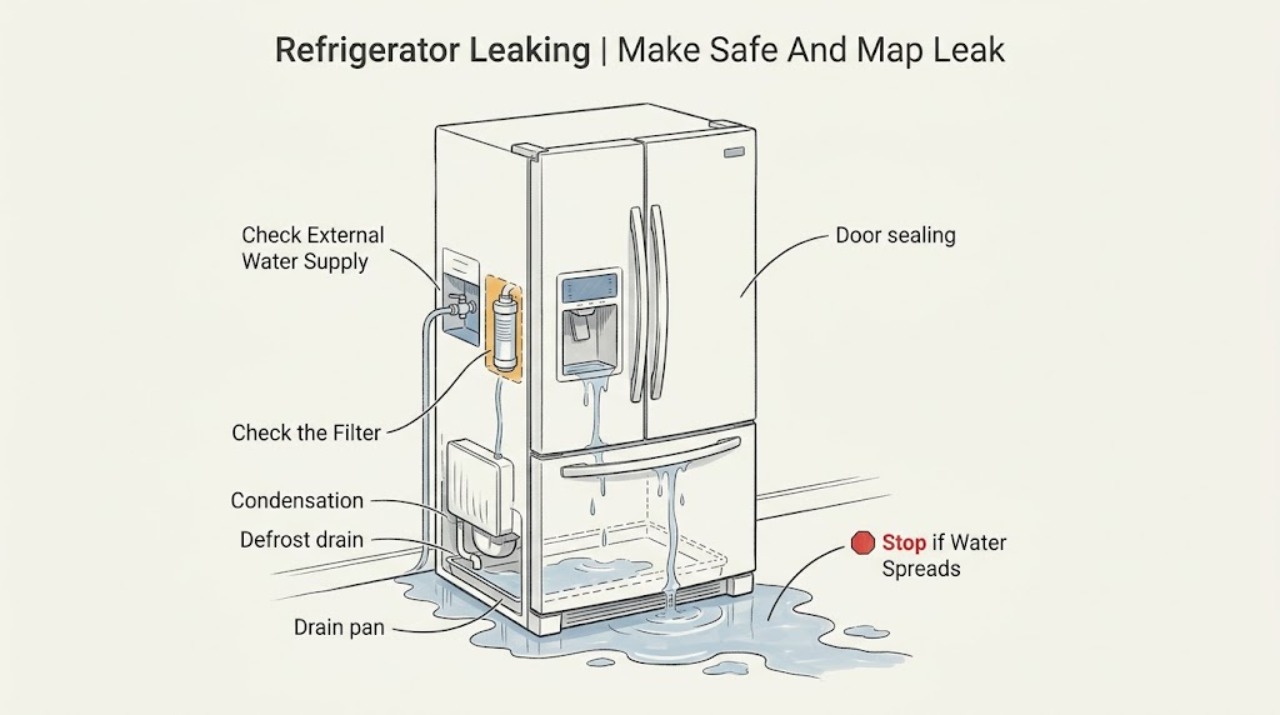
Work through in order
Diagnostic checks
Use only checks that match the exact appliance or system and its official guide.
-
Check 1
Stop the ice maker, dispenser, and any recent water use. Keep hands away from wet electrical areas and identify the first wet point from outside: filter or dispenser area, ice-maker door or chute, inside below a drawer, front floor, side seam, or behind/under the cabinet. If water is near the plug, outlet, cord, controls, or wiring, stop immediately and isolate power only from a safe, dry position.
Expected result: Water appears only at a water feature, starts inside the fresh-food compartment, collects under the unit, follows a recent spill or power interruption, or comes from an inaccessible base or rear area.
Next step: If the source is a visible removable item, continue with the matching check below after making the area dry. If the source is hidden, persistent, or electrically exposed, leave the refrigerator out of use and arrange qualified service.
Stop if: Do not tilt, pull out, open panels, or power-cycle the refrigerator solely to reproduce a leak.
Why this matters
Why: The first wet point separates a supply/filter/ice path from condensation, a spill, a defrost-drain path, or a hidden internal leak. Water near electrical parts is a safety event rather than a routine troubleshooting branch.
-
Check 2
When the refrigerator has a dispenser or ice maker and the first wet point is at the supply side, inspect only the visible household shutoff, exposed tubing, and accessible connection for a loose fitting, kink, crack, or fresh water trail. If it is safe to reach without touching water or electrics, close the household water shutoff while keeping the refrigerator upright. Do not remove the rear cover or disconnect an internal line.
Expected result: The leak stops after the external water supply is closed, fresh water begins at an exposed connection, or water continues even with the household supply closed.
Next step: Keep the water supply closed and dry the area. Have a plumber or qualified Dacor appliance servicer correct a leaking or damaged supply connection, and use the exact model instructions for any accessible installation connection.
Stop if: Do not tighten fittings against a cracked tube, use tape as a substitute for a damaged connection, or open an internal valve or water-line compartment.
Why this matters
Why: A change when the external supply is closed makes the connected water circuit more likely than condensation. Continued leaking can be residual water or an internal reservoir, valve, line, drain, or pan; it cannot be localized safely by opening the appliance.
-
Check 3
If water is around a fitted filter, dispenser, ice chute, or ice-maker area, stop dispensing and wipe the accessible surfaces dry. Using the exact Dacor manual, verify only that a removable filter or cover is the correct model part, fully seated, and not visibly cracked; check that an ice chute or bucket is aligned and its accessible seal is not obstructed by ice. Do not remove a door, hinge cover, dispenser panel, or internal tubing to reach a coupler.
Expected result: The leak began after a filter change or installation, comes from a visibly mis-seated or damaged removable part, occurs only as a few drips after dispensing, or continues while the dispenser and ice maker are idle.
Next step: Correct a clearly documented seating issue once and monitor from a dry position. If the housing or removable part is damaged, the leak recurs, or the source is inside the door or cabinet, keep the water supply closed and arrange model-specific service.
Stop if: Do not force a filter, use an unverified filter or seal, bypass the ice maker, or dismantle the dispenser or ice-maker assembly.
Why this matters
Why: A recent filter change or a visible seating problem can explain a feature-area leak, while a few drops immediately after dispensing may be normal on some designs. A leak at idle, a cracked housing, or water that continues after correct seating points to a valve, fitting, line, or housing fault.
-
Check 4
If water is below drawers, on a shelf, or on the floor without a clear supply-side wet point, remove only food or containers that are safe to handle and inspect for a spill, an uncovered liquid container, a damaged package, or a door that was left open. Dry the visible water and observe whether it returns after normal closed-door operation. Do not insert a tool, wire, cleaner, or hand into a drain opening unless the exact Dacor manual explicitly describes that user step.
Expected result: The water does not return after a spill is removed, appears after the refrigerator was recently off or without power, returns below drawers, or reappears at the floor or rear with no visible spill.
Next step: If the dry-and-observe check confirms a one-time spill or condensation event, continue monitoring. If water returns, stop short of clearing an inaccessible drain or pan and arrange Dacor service with the location and timing recorded.
Stop if: Do not pour hot water into the refrigerator, use a sharp object to clear ice, remove interior panels, or access a drain pan beneath the cabinet.
Why this matters
Why: A spill or condensation event can mimic a refrigerator leak. Repeated water under drawers can indicate a blocked or frozen defrost-drain path; water under or behind the cabinet can involve the drain pan or another internal path. Location alone does not identify a replaceable part.
-
Check 5
If the leak returns after visible spill, filter, and seating checks, record the exact model, first wet point, whether it occurs while idle or when dispensing/making ice, whether the household water valve was closed, and whether water reached electrics. Keep the refrigerator upright and out of use; leave the water supply closed for a supply-side leak. Use Dacor's servicer-finder or the exact owner support route rather than opening the cabinet.
Expected result: Water is inside a side or rear panel, under the cabinet, in a drain pan or internal line, near electrics, accompanied by a tripped breaker, or still present after the household supply is closed.
Next step: Leave the appliance disconnected if electrically exposed and arrange a qualified Dacor servicer; use a plumber as appropriate for a household supply leak. Provide the model and the recorded leak pattern so the technician can retrieve the correct documentation.
Stop if: Do not remove panels, test live voltage, probe a drain, disconnect internal tubing, replace a valve or pan, or run repeated leak tests.
Why this matters
Why: These patterns can involve an internal water line, valve, drain tube, defrost pan, structural seal, or wiring. The symptom does not identify a safe part or repair procedure for an unidentified Dacor model.
Use your observations
Decision map
Find the observation that best matches what you see, then follow the next safe action.
-
PATH 01Safety boundary
What you see
Water reaches the plug, receptacle, cord, controls, interior electrical area, or the base around wiring.
Do this next
Stop dispensing and ice-making. Isolate power only from a dry, safe position, keep clear if that cannot be done, and arrange qualified appliance or electrical help.
Why this path and its safety boundary
Why it matters: The immediate risk is electrical exposure, and the leak source cannot be safely diagnosed while energized. A Dacor self-repair page specifically says not to attempt repair when a safety issue is identified and to unplug before repairs.
Safety stop: Do not touch a wet plug, move the refrigerator through water, or open any electrical panel.
-
PATH 02Safety boundary
What you see
The first wet point is a dispenser, filter, ice-maker area, exposed water connection, or the leak changes when the household water supply is closed.
Do this next
Close the accessible household water supply, verify only visible and removable seating or damage, and arrange model-specific service for a recurring leak, housing leak, valve, or internal line.
Why this path and its safety boundary
Why it matters: The connected water/ice path is more likely than a floor spill or condensation. Dacor's feature library shows that water dispensers and dual icemakers are model-dependent, so the exact manual must control filter and access decisions.
Safety stop: Do not open the rear or door panels or operate a visibly leaking feature to see whether it worsens.
-
PATH 03Safety boundary
What you see
Water is isolated to a shelf or drawer, follows a spill or recent loss of power, and does not return after visible liquid is removed and the compartment stays closed.
Do this next
Dry the compartment, protect food, and monitor without opening the cabinet. Escalate if water returns or its first wet point moves to the floor, rear, or a water feature.
Why this path and its safety boundary
Why it matters: A spill or condensation event is more likely than a failed water component. An isolated event is not evidence that a filter, valve, or drain part should be replaced.
Safety stop: Do not dismiss recurring water as condensation solely because the puddle is small.
-
PATH 04Safety boundary
What you see
Water repeatedly collects under drawers, beneath the refrigerator, or at the rear without a visible spill or water-feature source.
Do this next
Do not insert tools or remove panels. Keep water away from electrics, document the timing and location, and arrange Dacor service to inspect the model-specific drain, pan, and water path.
Why this path and its safety boundary
Why it matters: A defrost-drain, drain pan, condensation path, or hidden line may be involved. The official leak guidance treats recurring water under drawers or under the refrigerator as a service branch after simple spill and leveling considerations, while Dacor's documentation is model-specific.
Safety stop: Do not pour chemicals or hot water into a drain, access the pan under a built-in refrigerator, or order a drain or valve from the symptom alone.
Helpful context
Understand the symptom
Start with the first wet point, not the size of the puddle
A Dacor refrigerator may be built as a column, French-door, side-by-side, or another refrigeration format, and the water features are not identical. A puddle under a crisper drawer, a drip at a filter housing, water on a dispenser tray, and a wet floor behind the cabinet require different decisions. Keep the doors closed as much as practical, protect food from the water, and wipe the accessible exterior only after the appliance is safe. Do not pull out a built-in unit or tilt it to search for a hidden source. Dacor's owner resources point to the exact product instructions and repair information for this reason.
Water near electricity changes the job
If water has reached the receptacle, plug, cord, controls, interior lighting, or a wet area beneath the cabinet, stop dispensing and stop testing. Isolate power only when the disconnect is reachable from a dry position; otherwise keep clear and have an electrician or appliance professional make the area safe. Do not touch or unplug a wet connection, spray or pour water into the cabinet, remove a rear cover, or run the refrigerator to make an internal leak appear. Dacor's repair guidance says to stop when a safety issue is identified, unplug before repairs, and use qualified help when the repair safety is uncertain.
Model scope: filter and ice features are not universal
Dacor's current collection lists an internal water dispenser and dual icemaker in its feature library, while other Dacor refrigeration products may not have those features. Do not assume that a filter, dispenser, ice maker, drain opening, or service panel is present or user-accessible. Use the model and rating-label information to open the matching Dacor owner instructions. The checks below deliberately stop at visible connections and removable parts; an internal water line, valve, drain tube, pan, or electrical compartment is a service boundary.
Safety boundary
Stop conditions
- Stop immediately if water reaches the plug, outlet, cord, controls, interior electrical parts, or wiring. Isolate power only from a safe, dry position and keep the refrigerator out of use.
- Close the accessible household water shutoff and stop using the dispenser or ice maker for a continuing supply-side leak; do not disconnect internal water lines or valves.
- Do not remove rear, hinge, dispenser, evaporator, or other panels; probe or flush a drain; access a drain pan; or perform live electrical tests.
- Do not tilt or pull out a built-in Dacor refrigerator through standing water, and do not run repeated cycles to reproduce an inaccessible leak.
- Do not choose a filter, valve, drain part, pan, tube, or seal from the symptom alone. Confirm the exact model documentation and fit through qualified service.
Only after diagnosis
Potential parts
- model-specific water filter or filter seal
Consider only if the leak begins at a fitted filter after a recent replacement and the exact model instructions identify the filter as user-removable; a recurring leak can instead be the housing or an internal connection.
Confirm the complete Dacor model and approved fit in the exact owner documentation before ordering; do not infer compatibility from appearance. - external water-supply tubing or fitting
Consider only when the first wet point is a visibly accessible household connection and the leak stops with the external water supply closed; internal tubing is not a user-repair recommendation.
A plumber or qualified servicer should confirm the connection type, routing, and model requirements before replacement. - ice-maker or dispenser water-path component
Consider only after a model-specific service diagnosis confirms a leak from an ice-maker, dispenser, or valve path; Dacor's water and ice features are not present on every refrigeration model.
Do not order a valve, inlet assembly, or dispenser part from the symptom alone; confirm exact model fit through Dacor documentation or service. - defrost drain or drain-pan component
Consider only when recurring water under drawers or beneath the cabinet is confirmed by qualified diagnosis as a drain or pan fault rather than a spill, condensation, or water-line leak.
Drain paths and pans are model-specific and may require panel or built-in access; professional inspection should establish the compatible part.
When checks do not resolve it
Need a professional?
Arrange qualified Dacor service for water from a side, rear, base, drain pan, internal line, valve, or non-removable panel; a recurring leak after visible spill and filter/seating checks; a leaking filter housing or ice/dispenser assembly; any water near electrical parts; a tripped breaker, damaged cord or plug, or an appliance that has been flooded. Use a plumber for a household supply connection when appropriate, and keep the refrigerator's water supply closed until the leak is resolved.
Safety scope: The user may stop the refrigerator, protect food and flooring, close an accessible household water shutoff, dry visible surfaces, inspect visible tubing and removable filter or ice parts when the exact manual permits it, and monitor from a dry position. Internal water lines, valves, drain tubes, drain pans, evaporator or rear panels, wiring, electrical tests, refrigerant work, and any repair requiring panel removal are for qualified service personnel.
Common questions
FAQ
Why is my Dacor refrigerator leaking from underneath the drawers?
First rule out a spilled container or condensation after a recent power interruption, then dry the visible water and observe from a safe position. If water repeatedly returns under the drawers, a defrost-drain or another internal path may be involved. Do not probe the drain or remove interior panels; record the location and arrange model-specific Dacor service.
What should I do if water is leaking around the Dacor refrigerator filter?
Stop using the dispenser and ice maker, wipe the area dry, and use the exact Dacor manual to verify that a removable filter is the correct part and fully seated. If the filter housing is cracked, the leak continues at idle, or reseating does not stop it, close the accessible household water supply and arrange service. Do not force the filter or open the housing.
Can condensation look like a leak in a Dacor refrigerator?
Yes. A spill, an uncovered food container, or condensation after the refrigerator has been off can leave water below drawers or on the floor. Dry the visible water and see whether it returns with the doors closed. Recurring water, water from a dispenser or filter, or water from the base is not safely explained by condensation alone and needs model-specific diagnosis.
Should I remove a Dacor refrigerator panel to find the leak?
No. Dacor refrigerators have different layouts, and a hidden leak may involve water lines, valves, a defrost drain, a pan, wiring, or another internal component. Keep the refrigerator upright, isolate water and power safely when necessary, and use Dacor's servicer route for panel removal or internal testing.
What if water is near the Dacor refrigerator plug or outlet?
Stop using the refrigerator immediately. Do not touch a wet plug or receptacle; isolate power only from a safe, dry position, and keep clear if the disconnect cannot be reached safely. Have qualified appliance or electrical service make the area safe before any leak diagnosis.
Read the exact guide
Official sources
- For OwnersDacor · Supports using the exact Dacor model's product details, parts, instructions, repair information, and servicer route rather than applying one refrigerator layout to every model.
- Self RepairDacor · Supports stopping when a safety issue is present, using the product-specific repair guide, unplugging before repairs, and using qualified help for uncertain or unsafe work. It does not authorize internal refrigerator water or electrical repair from this symptom alone.
- Water leaks in a Samsung refrigeratorSamsung · Provides a general manufacturer troubleshooting pattern that separates filter, dispenser, under-drawer, under-appliance, condensation, spill, ice-chute, and water-line symptoms. Dacor's exact model documentation controls for Dacor parts and procedures.
- Find a Dacor ServicerDacor · Supports routing persistent or internal refrigerator leakage to a specialized Dacor servicer rather than supplying a generic part or panel-removal procedure.
- RefrigerationDacor · Establishes that Dacor refrigeration spans column, French-door, side-by-side, wine-storage, and undercounter formats and that an internal water dispenser and dual icemaker are listed features, not universal equipment.
Community feedback
Share a repair observation
Share a plain-text repair observation. Accepted observations are published automatically; this page may take a moment to update.