
On this page
Start here
Quick answer
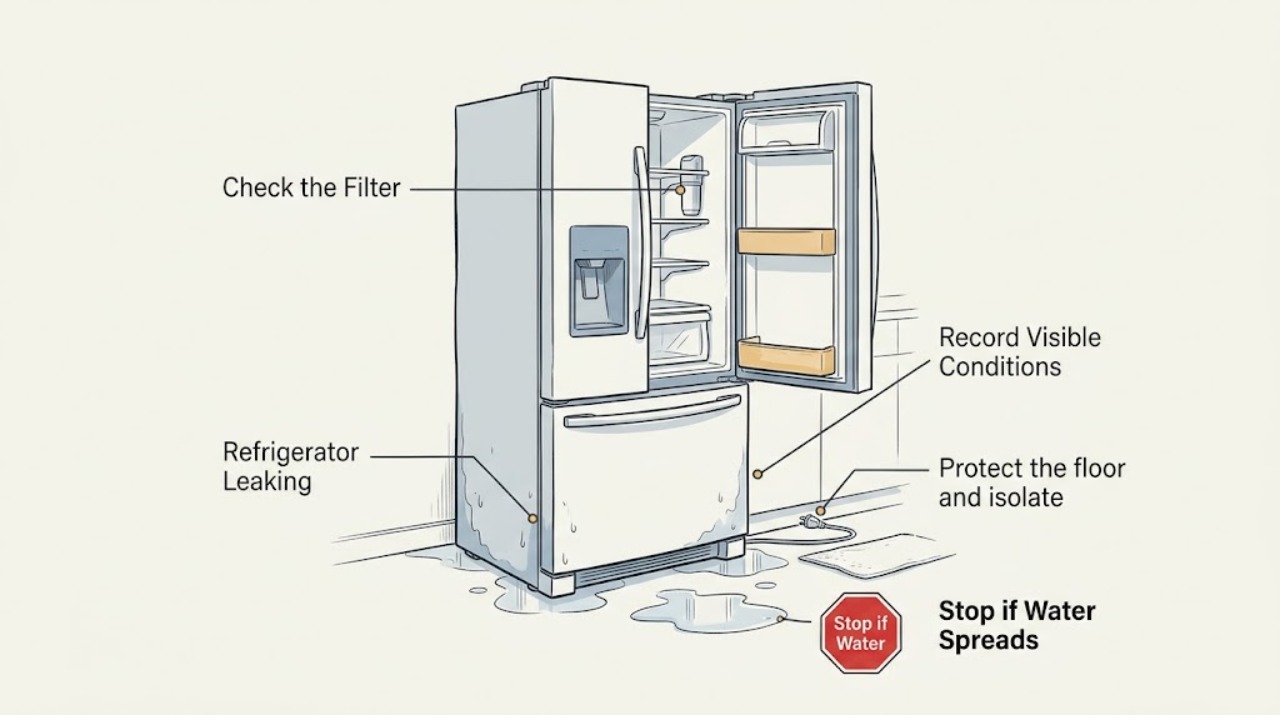
First identify where the water starts and when it appears: the filter area, dispenser or hinge, a shelf, the bottom of the cabinet, behind the refrigerator, or only after dispensing or ice-making. Amana's guidance points to a filter that is not seated or is damaged, loose or cracked supply tubing and shutoff connections, dispenser tubing under a hinge cover, condensation or a leaking container, and model-specific drainage or door-sealing issues. Photograph the source, protect the floor, and use only visible checks that match the refrigerator's exact manual. If the leak is continuous, reaches an outlet or wiring, comes from a cracked fitting or cabinet, or cannot be traced without moving panels or disconnecting tubing, stop using the water system and arrange qualified appliance or plumbing service. Do not pull a connected refrigerator, open sealed panels, or replace a filter or water valve based only on the location of the puddle.
Work through in order
Diagnostic checks
Use only checks that match the exact appliance or system and its official guide.
-
Check 1
Dry the visible water and place a clean towel or shallow container at the edge of the puddle; record the first wet point, amount, color, and whether the leak occurs continuously or only after dispensing, ice-making, a filter change, or door movement.
Expected result: The first wet point is at the filter area, inside shelf, dispenser or hinge, rear supply connection, bottom front, or an inaccessible area beneath the cabinet.
Next step: Photograph the source and find the exact model manual before removing a filter, hinge cover, grille, or panel. If the source is inaccessible or the flow is continuous, keep the water system off and arrange service.
Why this matters
Why: Water location and timing narrow the path, but the lowest or largest puddle may not be the source. The refrigerator's architecture determines which filter, dispenser, ice-maker, drain, and supply checks apply.
-
Check 2
Protect the floor and isolate the water risk before inspecting: unplug the refrigerator only when the plug, floor, and surrounding area are dry and safe to approach, and close the refrigerator's accessible water shutoff when a continuous water-line leak is present.
Expected result: Water is near an outlet or cord, the leak is continuous, a fitting is spraying or cracked, the shutoff will not close, or the area is dry enough for an external inspection.
Next step: Keep clear of wet electrical parts and call qualified appliance or plumbing service. Do not energize a wet connection, repeatedly operate a failed shutoff, or continue troubleshooting a spray leak.
Why this matters
Why: Water near electricity, an uncontrolled supply leak, or a failed shutoff is a safety and property-damage boundary rather than a routine adjustment. A dry, controlled area permits only visible checks.
-
Check 3
If moisture begins at the filter area or appeared after a filter change, follow the exact model instructions to inspect the filter, filter head, housing, and accessible sealing surfaces.
Expected result: The filter is not fully seated, is cross-threaded, has a crack, has a missing or damaged O-ring, shows mineral buildup, or the housing/head is cracked; alternatively, the filter area is dry.
Next step: Reinstall only as the model manual directs and use the model-approved filter specification. If the filter, O-ring, head, or housing is damaged, leave the water system off and arrange the correct replacement or service; do not improvise a seal.
Why this matters
Why: Amana identifies incorrect seating, damaged sealing parts, and a damaged or overdue filter as causes of drips around the filter area. A dry filter area makes the filter a less likely source even if water collects below it.
-
Check 4
Inspect only accessible water-supply tubing and connections at the wall, shutoff valve, and rear of the refrigerator; do not pull the cabinet out or disconnect tubing to reach a hidden point.
Expected result: The line is kinked, cracked, pinched, or wet at a fitting; the shutoff or saddle valve is wet; the refrigerator is pushed tightly against the wall; or all visible connections are dry.
Next step: Keep the water supply closed when a crack or active fitting leak is present. Have a plumber or appliance technician correct the line or connection, especially if access requires moving the refrigerator or changing a valve.
Why this matters
Why: Amana says a damaged or kinked line and loose or improperly tightened fittings can cause leaks or restrict water flow. A dry visible line does not rule out a hidden internal line or drain problem.
-
Check 5
If the leak is under a door, at a hinge, or began after delivery or door removal, inspect only the visible dispenser tubing and hinge-cover area described by the exact model instructions.
Expected result: Water is wetting the hinge area, the dispenser tubing is visibly loose or pinched, the leak follows dispensing, or no visible tubing issue is present.
Next step: Do not remove a hinge cover or reconnect tubing unless the model manual gives that user procedure and the water supply is safely shut off. Otherwise keep dispensing disabled and arrange qualified service.
Why this matters
Why: Amana identifies a loose dispenser connection under a hinge cover as a side-by-side leak possibility, particularly after doors were removed during delivery. A leak tied to dispensing can therefore be in the dispenser path rather than the floor drain.
-
Check 6
For water inside the compartment, inspect shelves, containers, the dispenser outlet, and accessible filter area without removing interior panels; compare the timing with humidity, warm food, or recent dispensing.
Expected result: A cracked or leaking container is above the wet shelf, only a few drops follow dispenser use, minimal condensation appears in humid conditions, or water reappears with no such explanation.
Next step: Remove or replace only the visibly leaking container and follow the model's dispenser and filter instructions. If water returns, reaches food or electrical areas, or comes from behind a liner, stop and arrange service.
Why this matters
Why: Amana says a warm item or cracked container can put water on a shelf, minimal condensation can be normal in humidity, and a few dispenser drops may follow release of the lever. Recurring water without those patterns is more consistent with an unresolved water, seal, or drain issue.
-
Check 7
After one controlled external correction, dry the area and observe whether new water appears at the same source; do not run repeated dispenser or ice-maker cycles to reproduce a suspected leak.
Expected result: The leak stops after a documented filter reseat or visible container correction, returns at the same connection, continues from beneath the cabinet, or cannot be reproduced safely.
Next step: Keep the water system off for a recurring or hidden leak and provide the technician with photos, model number, timing, source location, and checks already performed. Do not order a valve, pump, filter housing, or tubing by symptom alone.
Why this matters
Why: A stopped leak after a clearly identified user-level correction supports that source. A recurring, hidden, or cabinet-bottom leak remains unresolved and cannot safely identify a valve, drain, seal, or control part from the puddle alone.
Use your observations
Decision map
Find the observation that best matches what you see, then follow the next safe action.
-
PATH 01Next step
What you see
Do this next
Close the accessible water shutoff, protect the floor, and have a qualified plumber or appliance technician correct the connection. Do not pull the refrigerator or disconnect the line to chase the leak.
-
PATH 02Next step
What you see
Do this next
Use the exact model instructions to reseat or replace the model-approved filter only when the area is safe. If the head, housing, or seal is damaged, keep the water supply off and arrange service.
-
PATH 03Next step
What you see
Do this next
Disable dispensing and inspect only the visible connection allowed by the exact manual. Have service reconnect or test hidden tubing; do not bypass or force a hinge cover.
-
PATH 04Next step
What you see
Do this next
Remove the leaking container and follow the model's dispenser or filter-flushing instructions. Recheck after drying; request service if water returns without the same trigger or reaches electrical areas.
-
PATH 05Next step
What you see
Do this next
Keep the water system off, avoid moving the refrigerator or removing panels, and arrange qualified appliance service with the model and photos. Use plumbing service if the household supply or shutoff is implicated.
-
PATH 06Next step
What you see
Do this next
Keep clear of the wet electrical area, isolate power only when it is safe to approach, close the water supply if safely accessible, and call qualified appliance or plumbing service. Do not energize or test the refrigerator while wet.
Helpful context
Understand the symptom
The puddle location is only the end of the path
Water can travel along a shelf, liner, door edge, or floor before it becomes visible. Begin with a dry towel and a photograph of the first wet point, not the largest puddle. Note whether the leak follows dispensing, ice production, a filter change, door removal, a defrost period, or a recent installation. A bottom-freezer, top-freezer, and side-by-side Amana refrigerator expose different water connections, so the exact model manual controls the layout and any removal procedure.
Water-filter leaks usually follow a seating or sealing problem
Amana says a filter that is not seated correctly can leak at the filter area, and its filter guidance calls out cracks, mineral buildup, a missing or damaged O-ring, cross-threading, and a housing or filter head that is damaged. If the leak began after a filter change, use the model instructions to remove and reinstall it straight, inspect only the accessible sealing surfaces, and stop if the housing or head is cracked. Do not assume that a different filter will fit because it looks similar.
Back, hinge, and dispenser leaks need different checks
For water behind the refrigerator, Amana directs attention to the household supply line, shutoff or saddle valve, tubing, and their accessible fittings. A kink, crack, or loose connection can leak or restrict flow. On some side-by-side models, dispenser tubing runs under a hinge cover and can be disturbed when doors are removed for delivery. These are installation and water-line boundaries: inspect what is visible, but do not pull the refrigerator or disconnect a fitting unless the exact instructions and a safe shutoff make that work appropriate.
Not every interior drop is a water-system failure
Amana notes that minimal condensation can be normal in humid conditions, and a warm item or cracked container can leave water on a shelf. A few drops after releasing a dispenser lever can also be expected; holding the glass beneath the outlet briefly and following the model's filter-flushing instructions can distinguish that pattern from a continuous leak. Water that returns, spreads, or reaches electrical parts is not a normal-condensation diagnosis and needs service.
Safety boundary
Stop conditions
- Water reaches an outlet, cord, control area, or other electrical part
- The leak is continuous, spraying, or cannot be stopped with a safely accessible water shutoff
- A filter head, housing, tubing, valve, door, or cabinet is cracked or damaged
- Water keeps returning from beneath the cabinet, behind a liner, or another inaccessible location
- The next step would require pulling the refrigerator, opening a panel, disconnecting hidden tubing, or working on wiring
When checks do not resolve it
Need a professional?
Stop and arrange service for a continuous or spraying leak, water near an outlet or wiring, a cracked cabinet or fitting, a recurring leak after the exact model's external filter and connection checks, water from beneath a liner or cabinet, or any check that requires moving the refrigerator or disconnecting hidden tubing. Use plumbing service for a leaking household supply or shutoff connection.
Common questions
FAQ
Why is my Amana refrigerator leaking water onto the floor?
Start at the first wet point rather than the lowest puddle. Amana points to damaged or loose supply tubing and shutoff connections, filter seating or damage, dispenser tubing, and model-specific drainage or door-sealing issues. Keep the water system off and arrange service if the source is hidden or recurring.
Can an Amana water filter cause a refrigerator leak?
Yes. Amana says an incorrectly seated, cross-threaded, cracked, or damaged filter, missing or damaged O-ring, or damaged filter housing can drip at the filter area. Follow the exact model instructions for inspection and fit; do not substitute a filter based only on appearance.
What should I check if water is leaking from behind my Amana refrigerator?
When the area is dry and safe, inspect only visible supply tubing and fittings at the wall, shutoff, and refrigerator. Look for cracks, kinks, pinching, or moisture at a connection. Close the water supply and arrange plumbing or appliance service if a line or fitting leaks or access requires moving the refrigerator.
Why is water coming from under the door or hinge of my Amana refrigerator?
On applicable side-by-side models, Amana identifies dispenser tubing under a hinge cover as a possible source, especially after doors were removed during delivery. If the leak follows dispensing or began after delivery, disable dispensing and have the hidden connection checked rather than removing the hinge cover yourself.
Is water on an Amana refrigerator shelf always a leak?
No. Amana notes that a warm item or cracked container can drip onto a shelf, and minimal condensation can occur in humid conditions. A few drops after releasing a dispenser lever can also be normal. Water that returns without those triggers, spreads, or reaches electrical areas needs service.
Should I pull my Amana refrigerator out to find the leak?
Do not pull a connected refrigerator by force. Check only visible connections and use the exact model instructions. If the source is behind the cabinet, under a liner, or on hidden tubing, close the water supply when safe and arrange qualified appliance or plumbing service.
Read the exact guide
Official sources
- Water Inside RefrigeratorAmana Product Help · Official model-family guidance for water inside the refrigerator; the exact manual controls condensation and dispenser behavior for other models.
- Leaking at the Bottom - Bottom Freezer RefrigeratorAmana Product Help · Official model-family guidance for bottom-freezer refrigerators; do not generalize its filter or connection access to other architectures.
- What to Do if the Water Filter is Damaged or DrippingAmana Product Help · Official Amana filter guidance; filter access and fit are model-specific and the exact manual takes precedence.
- Water Inside of RefrigeratorAmana Product Help · Official top-freezer guidance; filter, dispenser, and shelf layouts vary by model.
- Leaking at the Top - Side by Side RefrigeratorAmana Product Help · Official side-by-side guidance; the hinge-cover location and access should not be generalized to other Amana refrigerator architectures.
- Leaking from the Ice Maker - Side by Side RefrigeratorAmana Product Help · Official side-by-side ice-maker guidance; exact ice-maker, filter, and connection layout varies by model.
- What to Do if There is Water on the FloorAmana Product Help · Official general guidance for Amana full-size refrigerators; exact architecture and model installation instructions control.
- How to Check the Water Supply LineAmana Product Help · Official Amana supply-line guidance for models with a household water connection; use the exact model manual for access and installation details.
Community feedback
Share a repair observation
Share a plain-text repair observation. Accepted observations are published automatically; this page may take a moment to update.