
On this page
Start here
Quick answer
First protect the floor and keep water away from the plug, cord, and controls. Then trace the highest wet point without pulling the refrigerator apart: a connected Bosch refrigerator can leak from a loose or damaged water hose/connection, an overflowing drip tray, a contaminated defrost drain, the ice or water dispenser, or condensation around a drawer or poorly closed door. Bosch manuals direct users to check water connections and hose condition, clean an overflowing drip tray, and address a contaminated defrost drain using the model's instructions. Turn off the water supply for a supply-side leak; if water has reached electrical parts or the leak is substantial or persistent, stop using the refrigerator and arrange professional service. Do not remove sealed-system panels, cut tubing, or work near energized electrical parts.
Before you begin
Safety first
- The user may dry surfaces, trace an accessible source, close the water shut-off valve, inspect an external hose, clean an accessible tray or drain only as the exact Bosch manual directs, and clean a reachable door seal. Water-system fittings under pressure, electrical components, refrigerant circuits, hidden drains, internal trays, and sealed-system repairs are for qualified service personnel.
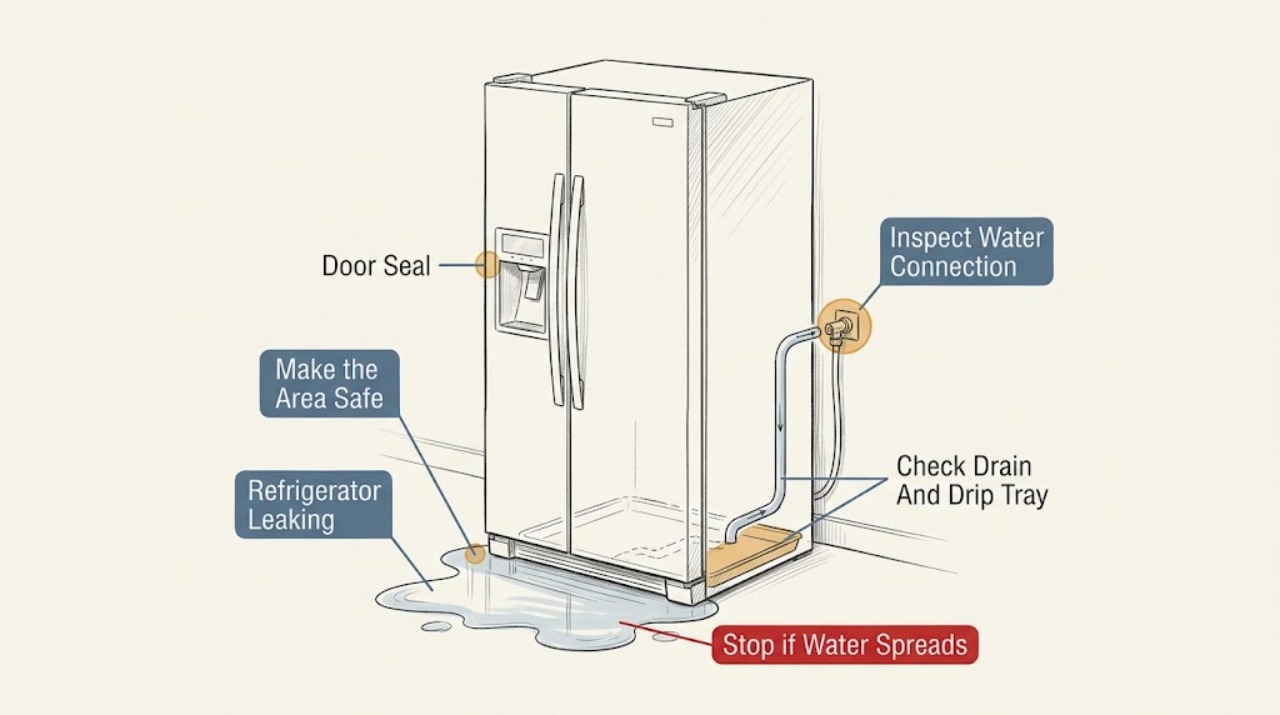
Work through in order
Diagnostic checks
Use only checks that match the exact appliance or system and its official guide.
-
Check 1
Move food and absorbent material away from the puddle, dry the floor, and look from outside the refrigerator for water at the rear, beneath the cabinet, around a dispenser, inside a drawer, or near the power cord and controls. Do not move a heavy built-in unit or reach behind it while standing in water.
Expected result: The water is confined to an accessible food compartment or dispenser area, appears at a hose/connection or under the cabinet, or has reached the cord, outlet, controls, or other electrical parts.
Next step: If water is near electricity, stop using the refrigerator and isolate power only from a safe, dry location before arranging service. Otherwise continue with the matching external check and keep the floor dry.
Stop if: Do not touch an energized wet plug or outlet, pull a built-in refrigerator through water, or remove rear covers to trace the leak.
Why this matters
Why: The location narrows the safe branch: supply-side, drain/tray, dispenser/ice, or condensation/container. Water near electrical parts creates an immediate shock and damage risk regardless of the original leak source.
-
Check 2
If the highest wet point is the rear water connection or external hose, close the refrigerator's water shut-off valve before touching the line. From the accessible outside, check whether each connection is firm and whether the hose is kinked, crushed, cut, or visibly damaged; do not loosen a fitting to test it.
Expected result: The connection is visibly wet or loose, the hose is damaged or kinked, or the connection and hose remain dry while water appears elsewhere.
Next step: Keep the water shut-off valve closed and arrange a qualified installer or Bosch service visit for a damaged line or fitting. If the hose is only visibly kinked and the area is dry, correct it only as the exact installation manual permits; if leaking continues, stop and call service.
Stop if: Do not cut, splice, clamp, over-tighten, replace, or reroute a water line without the exact Bosch model instructions and appropriate qualification; never work on the line with water pressure left on.
Why this matters
Why: A wet or damaged supply line is a water-connection fault, not a defrost-drain symptom. A dry supply line shifts attention to the drip tray, drain, dispenser, condensation, or an internal fault.
-
Check 3
If water is inside the refrigerator compartment, beneath a drawer, or collecting below the appliance rather than at the supply hose, inspect only the accessible drain opening and drip-tray area described in the exact Bosch manual. Remove loose food residue from an accessible opening and wipe the accessible tray; do not dismantle the liner or use sharp tools.
Expected result: The defrost drain or drain hole is visibly contaminated, the accessible drip tray is overflowing, or neither is accessible or explains the water.
Next step: Clean only as the model manual directs and dry the area. If water returns, the tray cannot be safely accessed, or the leak persists after cleaning, keep the refrigerator out of service as needed and arrange Bosch service.
Stop if: Do not remove evaporator or rear panels, puncture ice, pour chemicals into the drain, use a flame or heat gun, or chip at hidden ice.
Why this matters
Why: Bosch identifies a contaminated defrost drain/drain hole as a common reason water cannot drain correctly and identifies an overflowing drip tray as a leak cause in covered models. If the path is blocked beyond the accessible instructions, the leak needs service rather than deeper probing.
-
Check 4
If the water is below the dispenser or ice chute, wipe the area dry and observe whether dripping follows water dispensing, ice dispensing, or melting residue in the chute. Check only accessible ice residue and the dispenser opening; do not remove a pressurized filter or water fitting while the supply is on.
Expected result: The dispenser drips after use, air or splashing is visible in the water stream, ice residue is melting in the chute, or water appears without using the dispenser.
Next step: Follow the exact model manual for dispensing or removing accessible ice residue, wipe splashes dry, and monitor one normal use. Close the water shut-off valve and call service if the dispenser continues to leak or the source is not visible.
Stop if: Do not force the dispenser, insert tools into the chute, remove a water filter under pressure, or open water-system fittings yourself.
Why this matters
Why: Bosch manuals associate dispenser dripping with air in the water system and identify melting ice residue in the ice chute as another source of water in that area. Water that appears without dispenser activity, or a continuing leak after the accessible residue is removed, needs service.
-
Check 5
If water is limited to a produce drawer, shelf, door pocket, or the inside surface of the cabinet, remove the contents and inspect for a spilled container, wet food, condensation, and a door seal that is dirty or not closing fully. Wipe moisture with a soft, dry cloth and confirm that the door closes without forcing it; use only the exact manual's guidance for any ventilation clip or drawer adjustment.
Expected result: The water is a one-time spill, moisture is concentrated in a produce container, condensation is present on cold surfaces, or the door seal is dirty/damaged or the door remains ajar.
Next step: Clean up the spill or condensation, keep door openings brief, and clean the accessible seal with a soft cloth and mild soapy water. If moisture returns despite a properly closed door, or the seal is damaged, arrange Bosch service.
Stop if: Do not puncture a door seal, force the door, remove cabinet trim, or use the condensation branch when water is actually coming from a pressurized line or near electricity.
Why this matters
Why: Bosch explains that warm, humid air can condense on colder surfaces and that condensation in a fruit-and-vegetable container depends on the food and quantity. A door that does not close properly lets cold air escape and can worsen condensation; a damaged seal needs replacement assessment.
-
Check 6
Record the exact Bosch model and rating-plate information, the highest wet point, whether the water supply is connected, whether closing the shut-off valve stops the leak, and any temperature or error symptoms. If the source is hidden, water returns after the model-specific cleaning, or the leak is substantial, leave the refrigerator disconnected or water-isolated as appropriate and request service.
Expected result: The leak stops after a documented low-risk correction, or it continues, returns, cannot be traced, affects cooling, or is accompanied by electrical or refrigerant-related damage signs.
Next step: Contact Bosch or a qualified appliance service provider with the model and symptom record. Keep the water supply closed for a connected-water leak and keep the refrigerator out of service when water has reached electrical parts or the cabinet is damaged.
Stop if: Do not remove sealed-system panels, cut refrigeration tubing, handle refrigerant, open electrical covers, or continue operating a refrigerator that is wet near its electrical parts.
Why this matters
Why: A lasting correction supports a spill, condensation, accessible drain, or documented dispenser condition. A persistent or hidden leak cannot be safely separated into hose, tray, drain, valve, cabinet, or sealed-system work by observation alone.
Use your observations
Decision map
Find the observation that best matches what you see, then follow the next safe action.
-
PATH 01Safety boundary
What you see
The highest wet point is a water connection or hose, the water supply is connected, and closing the shut-off valve stops or reduces the leak.
Do this next
Leave the shut-off valve closed and arrange qualified installation or Bosch service; provide the model and the exact connection that became wet.
Why this path and its safety boundary
Why it matters: A supply connection or hose is more likely than a defrost-drain problem.
Safety stop: Do not work on a pressurized line, cut or splice the hose, or pull the refrigerator through water.
-
PATH 02Safety boundary
What you see
Water is inside the cabinet or under a drawer, the supply-side connections are dry, and the accessible drain or drip-tray area shows contamination or overflow.
Do this next
Use only the exact Bosch manual's accessible cleaning instructions, then call service if water returns or the blocked area is hidden.
Why this path and its safety boundary
Why it matters: A defrost drain/drain-hole blockage or overflowing drip tray is more likely than a hose leak.
Safety stop: Do not remove internal cooling panels, chip ice, or use heat or sharp tools.
-
PATH 03Safety boundary
What you see
Water is concentrated below the water/ice dispenser and follows dispensing, air in the stream, or melting residue in the ice chute.
Do this next
Follow the model manual for the accessible dispenser or ice-chute check, close the water supply if dripping continues, and arrange service for a persistent leak.
Why this path and its safety boundary
Why it matters: A dispenser water-system or ice-chute condition is more likely than a cabinet drain overflow.
Safety stop: Do not remove a pressurized filter or water-system fitting, or force tools into the chute.
-
PATH 04Safety boundary
What you see
Water is limited to a drawer, shelf, or door area; the supply line is dry; and the pattern matches a spill, condensation, or a door that is not sealing fully.
Do this next
Dry the area, clean the accessible seal, keep the door closed as much as possible, and arrange service if moisture returns or the seal is damaged.
Why this path and its safety boundary
Why it matters: A container spill, humid-air condensation, or door-seal condition is more likely than a pressurized leak.
Safety stop: Do not use this branch to excuse water near the cord, controls, or a rear hose.
-
PATH 05Safety boundary
What you see
Water reaches the cord, outlet, controls, or hidden cabinet area, continues after the water supply is closed or accessible cleaning is completed, or is accompanied by cabinet damage or abnormal cooling.
Do this next
Isolate power only from a safe, dry location, close the water supply if present, keep the refrigerator out of service, and request Bosch or qualified appliance service.
Why this path and its safety boundary
Why it matters: The hazard or hidden source outweighs further user troubleshooting; a professional must assess electrical, water, drain, or sealed-system components.
Safety stop: Do not energize a wet appliance, open electrical or sealed-system covers, cut tubing, or handle refrigerant.
Helpful context
Understand the symptom
Find where the water starts
Water can travel along a cabinet or floor, so the puddle is not necessarily the source. Dry the outside first, then use a flashlight and paper towel to trace from the highest accessible wet point. Separate a water-line leak at the rear or dispenser from water inside the fresh-food compartment, below a drawer, or around a drain opening before choosing a next step.
Use only model-appropriate cleaning
Bosch support material links internal water to a contaminated defrost drain or drain hole, and Bosch manuals describe cleaning an overflowing drip tray. Those instructions are model-dependent. Clean only an accessible area exactly as the manual directs; do not push a wire into a drain, melt ice with a flame or heat gun, or remove a panel to reach a hidden tray.
Water and electricity change the decision
A small amount of water in a drawer is different from water at the rear connection, under the appliance, or near the cord and controls. Shut off the water supply before inspecting a connected hose. If water has reached electrical parts, the cord, outlet, or control area, isolate power only from a safe, dry location and keep the refrigerator out of service until it is assessed.
Safety boundary
Stop conditions
- If water reaches the cord, outlet, controls, or other electrical parts, stop using the refrigerator and isolate power only from a safe, dry location; arrange professional service.
- For a connected-water leak, close the water shut-off valve before inspecting the accessible hose or connection. Do not work on a pressurized line.
- Do not remove rear, evaporator, electrical, or sealed-system panels; cut refrigeration tubing; handle refrigerant; or probe hidden drains with sharp tools or heat.
- Do not keep resetting a wet appliance, move a heavy built-in refrigerator through water, or continue operation when the leak is substantial, persistent, or untraceable.
- Do not treat a damaged door seal, cabinet, cord, or water hose as a cleaning problem; arrange service or qualified installation.
Only after diagnosis
Potential parts
- refrigerator water hose or connection seal
Consider this category only if the exact model's external connection or hose is confirmed damaged and a qualified installer or technician approves replacement; a water-line part will not fix a drain or condensation leak.
Confirm the complete Bosch model and the manufacturer's installation requirements before ordering or fitting any water-line part. - refrigerator door seal
Consider this category only if cleaning and correct door closure do not solve recurring condensation and a qualified diagnosis confirms the seal is damaged; it is not a remedy for a hose or drain leak.
Match the complete Bosch model and door configuration; do not order from the symptom alone.
When checks do not resolve it
Need a professional?
Arrange Bosch or qualified appliance service when a leak persists after the exact model's accessible cleaning or door-seal check, comes from a water connection or hidden cabinet area, returns after the water supply is closed, or affects cooling. Treat water near the cord, outlet, controls, or other electrical parts as an immediate stop-use condition.
Safety scope: The user may dry surfaces, trace an accessible source, close the water shut-off valve, inspect an external hose, clean an accessible tray or drain only as the exact Bosch manual directs, and clean a reachable door seal. Water-system fittings under pressure, electrical components, refrigerant circuits, hidden drains, internal trays, and sealed-system repairs are for qualified service personnel.
Common questions
FAQ
Why is my Bosch refrigerator leaking water from the back?
A non-tight water connection or damaged hose is a Bosch-documented possibility on connected models. Close the water shut-off valve, inspect only the accessible outside of the hose and connections, and arrange qualified installation or Bosch service for a wet or damaged line. Do not loosen a pressurized fitting.
Can a blocked defrost drain make a Bosch refrigerator leak inside?
Yes. Bosch says a contaminated defrost-water drain or drainage hole can prevent correct draining. Clean only the accessible opening as the exact model manual directs; if water returns or the drain is hidden, call service rather than probing through the liner.
Why is water collecting in my Bosch refrigerator vegetable drawer?
Bosch explains that condensation can form on cold surfaces and in the fruit-and-vegetable container depending on the food and quantity. Dry the drawer, check for a spill, keep the door closed properly, and clean the accessible door seal. Recurring water needs model-specific service assessment.
Why does my Bosch refrigerator dispenser drip?
Bosch manuals associate dispenser dripping with air in the water system and also describe melting ice residue in the ice chute. Follow the exact model's accessible dispensing guidance and remove only loose, accessible residue. A continuing drip or leak without dispensing needs service.
What should I do if water from the Bosch refrigerator reaches the outlet or controls?
Stop using the refrigerator. Do not touch a wet energized plug or outlet; isolate power only from a safe, dry location, close the water supply if the model is connected, and arrange professional service. Do not restart it to see whether the leak has stopped.
Read the exact guide
Official sources
- Use and Care Manual B24...80Bosch Home Appliances · Bosch B24...80 refrigerator family; model-specific controls and water-system layout must be confirmed.
- Refrigerator Door Won’t Shut | TroubleshootingBosch Home Appliances · Bosch US refrigerator support; seal design and replacement procedure depend on model.
- RefrigeratorBosch Home Appliances · Bosch refrigerator installation manual; hose set, connection, and water-supply details vary by model.
- Fridge water does not drainBosch · Bosch refrigerator support page; regional site and exact drain design may differ by model.
- Instructions for UseBosch Home Appliances · Bosch refrigerator documentation; exact safety labels and model details must be confirmed on the user's appliance.
- Use and Care Manual B36CD..Bosch Home Appliances · Bosch B36CD refrigerator family; controls, trays, filters, and water connections vary by model.
- Get Support - RefrigerationBosch Home Appliances · Bosch US refrigeration support navigation; the correct manual and service path depend on the model and market.
- Fridge repairsBosch · Bosch US refrigerator repair support; service availability depends on location and model.
Community feedback
Share a repair observation
Share a plain-text repair observation. Accepted observations are published automatically; this page may take a moment to update.